
Why are we still relying on 18th-century paper technology to decorate 21st-century professional spaces? Traditional wallpaper often fails within the first 24 months due to peeling edges or bubbling adhesive, leaving you with a finish that feels dated and substandard. You likely agree that bespoke hand-painted murals are often cost-prohibitive, whilst off-the-shelf decor lacks the precision required for high-impact branding. By utilising an industrial-grade wall printer, you can bypass these limitations entirely. It’s a modern solution designed for those who value efficiency and technical excellence over traditional, messy renovations.
In this guide, you’ll discover how advanced direct-to-wall technology creates durable, high-resolution murals that eliminate the need for wallpaper and the associated mess. Our “No wallpaper, no mess” approach ensures a clean installation with a starting price of £120/m², giving you a bespoke result without hidden fees or consultation barriers. We’ll examine the technical precision of UV-cured inks on various substrates like brick, concrete, and plaster. This overview provides everything you need to know about achieving a seamless, long-lasting finish that requires zero maintenance and offers total design flexibility for your home or business.
Key Takeaways
- Understand how a vertical inkjet wall printer applies UV-curable inks directly to surfaces for a seamless, high-resolution finish.
- Compare the technical advantages of direct-to-wall technology over traditional wallpaper to eliminate peeling edges and visible joins.
- Learn the step-by-step process from site assessment to digital file preparation, ensuring precision-engineered results on plaster, brick, or concrete.
- Discover why the “No wallpaper, no mess” approach provides a superior long-term ROI for bespoke, brand-aligned visual storytelling.
- Evaluate the practicalities of investment with transparent pricing starting from £120/m² for durable, maintenance-free art.
What is a Wall Printer? Understanding Direct-to-Wall Technology
A wall printer is a specialised vertical inkjet system designed to apply high-resolution graphics directly onto a substrate. Unlike traditional wide-format printers that work on horizontal rolls of paper or vinyl, this machinery operates on a vertical axis. It travels along a precision-engineered floor track, using a print head that moves up and down a vertical mast. This system eliminates the need for adhesive-backed materials, adhering to our “No wallpaper, no mess” philosophy. The result is a seamless finish that integrates with the architecture of the room rather than sitting on top of it.
This advancement in digital printing technology allows for the reproduction of complex murals with 100% accuracy. The process bypasses the logistical headaches of traditional decorating. There are no bubbles, no peeling edges, and no drying times associated with paste. For commercial and residential clients across the UK, this represents a significant shift in how interior spaces are branded and decorated. It’s a modern solution for decision-makers who value industrial precision and a clean, efficient installation process.
The Science of UV-Curable Inks
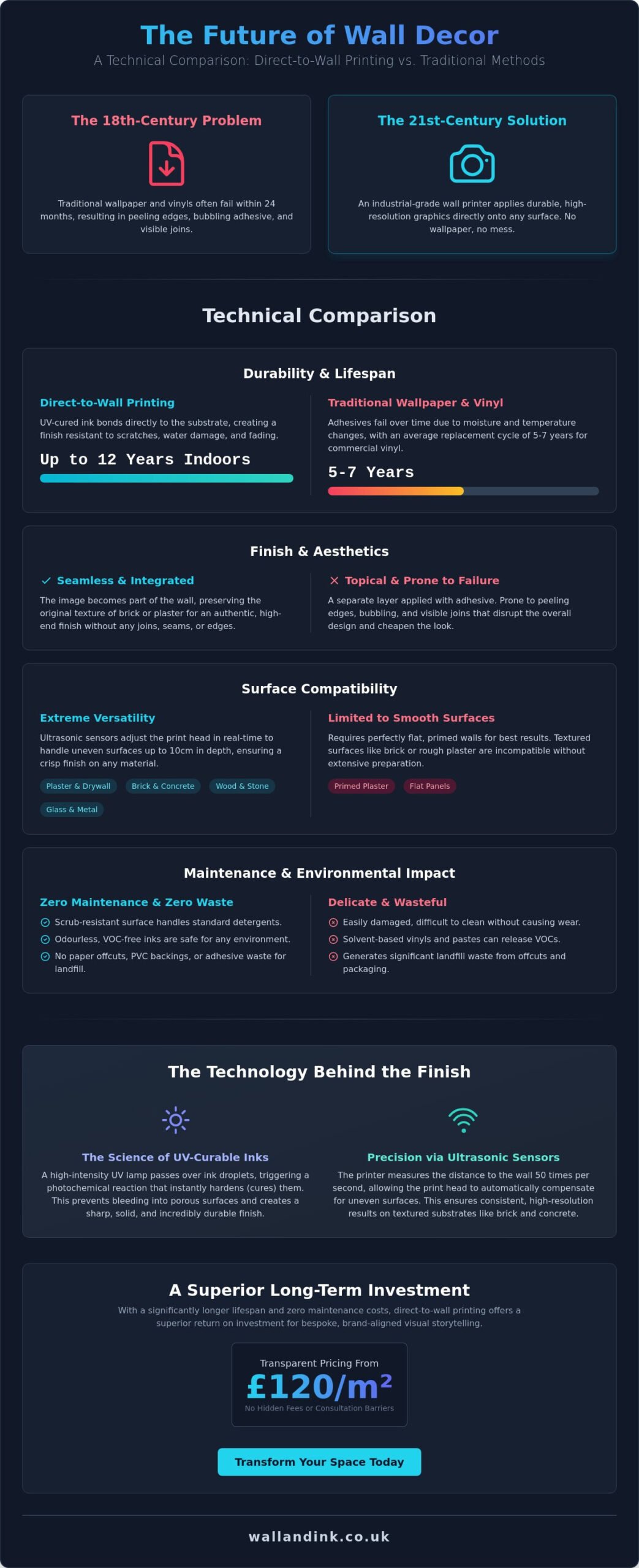
The engine behind this durability is UV-curable ink. During the printing process, the wall printer passes a high-intensity ultraviolet lamp over the ink droplets immediately after they hit the surface. This triggers a photochemical reaction that instantly hardens the liquid into a solid film. Because the ink cures in milliseconds, it doesn’t bleed into the substrate, ensuring sharp detail on even the most porous materials. These inks are solvent-free and odourless, making them ideal for sensitive environments like schools or hospitals. The final output is resistant to fading for up to 12 years indoors and remains highly resilient against scratches and water damage in high-traffic corridors.
Substrate Versatility: From Plaster to Brick
One of the most impressive technical features of the system is its ability to handle “real-world” walls. Most surfaces aren’t perfectly flat. The machine utilises ultrasonic sensors to measure the distance between the print head and the wall 50 times per second. This allows the head to retract or extend automatically to compensate for bumps or dips up to 10cm in depth. This adaptability ensures a crisp finish on a variety of materials common in UK architecture:
- Painted plaster and drywall
- Bare brick and breeze blocks
- Polished concrete and stone
- Wood, glass, and metal panels
This flexibility means a mural can be applied to a rough Victorian brick wall in a London loft just as easily as a smooth partition in a modern Manchester office. The technology ensures consistent ink density regardless of whether the surface is porous or non-porous. By printing directly to the wall, we maintain the original texture of the substrate, providing an authentic look that vinyl wraps simply cannot replicate.
Wall Printing vs Wallpaper and Vinyl: A Technical Comparison
Traditional wall coverings are fundamentally limited by their physical properties. Wallpaper and vinyl are topical layers held in place by adhesives that eventually fail. Direct-to-wall technology bypasses these vulnerabilities. By using a professional wall printer, the image becomes part of the wall itself rather than an attachment. This eliminates the risk of peeling edges in high-moisture environments or bubbling in areas with temperature fluctuations. UV-cured inks provide a lifespan of up to 12 years in internal settings, significantly outperforming the 5-to-7-year replacement cycle typical for commercial vinyl.
Maintenance and environmental considerations also favour the direct-to-wall approach. Because the ink is hardened by ultraviolet light during application, it becomes highly resistant to chemicals and abrasion. The technical advantages include:
- Scrub Resistance: The cured surface handles standard detergents and high-traffic wear without pigment loss.
- Zero Waste: No PVC backings, paper offcuts, or adhesive containers are sent to landfill.
- Substrate Versatility: The ink bonds with plaster, brick, wood, and glass, ensuring a clean finish on any texture.
- Odourless Finish: Unlike solvent-based vinyl, UV prints are VOC-free and safe for hospitals or schools.
Aesthetic Superiority and High-Resolution Detail
Visual clarity is defined by technical precision. Standard wallpaper often caps at 300 DPI, whereas our technology achieves up to 2880 DPI. This allows for photographic realism and perfect brand colour matching for corporate logos. The inclusion of a dedicated white ink channel allows for printing on dark substrates like brick or charcoal-painted plaster, adding a layer of depth that vinyl cannot replicate. These innovative wall printing applications ensure that the texture of the original surface remains visible through the design, creating a more integrated and sophisticated look than a plastic sticker.
Installation Efficiency and Disruption
Efficiency is the primary driver for commercial decision-makers. Traditional muralists or wallpaper installers require days of site preparation and drying time. A wall printer can complete a 15-square-metre installation in roughly four hours. There are no chemical odours, no messy pastes, and no waste materials left behind. This “no wallpaper, no mess” approach allows businesses to remain operational throughout the process. A retail unit or office can have a full-scale mural installed during opening hours without disrupting footfall or risking the safety of staff. If you want to see how this technology integrates into a live environment, you can view our recent projects for real-world examples.
Transforming Spaces: Key Applications for Wall Printers
Direct-to-wall technology converts underutilised vertical surfaces into high-impact assets. Architects and facility managers now use this precision to create focal points that traditional paint or vinyl cannot match. In the UK, the demand for exterior murals has increased, requiring UV-stable inks that remain vibrant through damp winters and variable sunlight. This shift from generic, mass-produced decor to bespoke visual storytelling allows every wall to serve a functional purpose. By utilising the full height of a room, designers can change the perceived scale of a space without structural alterations.
Commercial and Corporate Branding
Modern offices use bespoke murals to reinforce company values and boost employee productivity. A well-placed graphic can turn a sterile lobby into a narrative of brand history. In retail, creating “Instagrammable” moments is a proven strategy to increase footfall; recent industry data suggests that 72% of users are more likely to visit a location if it offers unique visual content for social media. For industrial settings, printing wayfinding graphics directly onto warehouse or lobby walls eliminates the need for plastic signage that peels over time. To see the mechanical precision behind these designs, provides an excellent overview of the technical execution required for these large-scale projects.
Educational and Healthcare Environments
Schools utilise wall printer technology to create interactive learning environments that engage students directly. These murals are fire-protection compliant, a critical requirement for public corridors and stairwells. In healthcare settings, high-resolution nature scenes are used in clinics to lower patient anxiety. Clinical studies have shown that biophilic designs can reduce perceived pain by 15% in recovery wards. Because the ink is applied directly to the substrate, it withstands the daily knocks and rigorous cleaning cycles of busy public spaces without the tearing or peeling associated with traditional wallpaper.
Residential Bespoke Art
Homeowners are moving away from framed prints in favour of seamless, permanent art. This method allows for a clean finish in lounges and bedrooms. No wallpaper, no mess. Kitchens and bathrooms benefit from moisture-resistant art that doesn’t bubble or peel in humid conditions. Whether it’s a high-resolution family photo or a piece of bespoke digital art—perhaps inspired by the atmospheric gothic themes of Graham Mulvein’s World of Horrors—the wall printer ensures the final result is a precise, durable reflection of the owner’s personal style. It works perfectly on various substrates, including plaster, brick, and concrete, ensuring a high-quality finish regardless of the room’s original construction.
The Design and Installation Process: What to Expect
We’ve engineered a five-step workflow that prioritises technical precision and eliminates the traditional disruptions of site-based decorating. This methodical approach ensures that every project, from a single residential feature wall to a 100-square-metre commercial installation, meets our industrial standards for durability and visual impact. Our process is designed for pragmatic decision-makers who require high-quality results without the logistical headaches of traditional mural painting.
- Step 1: Initial Consultation and Site Assessment. We evaluate the wall surface, whether it’s brick, concrete, or plaster, to ensure optimal ink adhesion. We also check for level flooring to support the machine’s stability.
- Step 2: Bespoke Design Development. Our team develops your concept or adapts existing branding into a wall-ready digital format. This stage ensures the artwork fits the architectural dimensions of your space perfectly.
- Step 3: Digital Visualisation. You receive a digital mockup showing the art superimposed on your specific wall. This allows you to see the final result before the wall printer begins its work.
- Step 4: Technical Execution. Our technicians arrive on-site to set up the equipment. The direct-to-wall application begins, with the machine translating the digital file into a physical mural.
- Step 5: Final Inspection. Because we use UV-cured ink that dries instantly, we conduct a final quality check and return the space to you for immediate use.
Preparing Your Digital Files for Print
High-resolution output requires high-quality input. To achieve razor-sharp results, we require files at a minimum of 300 DPI, though 600 DPI is preferred for detailed photographic work. For large-scale commercial murals, our designers prioritise vector graphics. These files allow for infinite scaling without pixelation, ensuring that a logo expanded to four metres wide remains as crisp as it appears on a screen. We specialise in adapting your existing logos or photos into these wall-ready formats, ensuring no loss of detail during the transition from digital file to physical surface.
On-Site Setup and Surface Preparation
Efficiency is central to our “no wallpaper, no mess” promise. We require the wall to be clean and free of loose debris amongst the print area. Our technicians install a precision floor track that guides the wall printer along the horizontal axis. Advanced laser sensors constantly monitor the wall’s topography, maintaining a consistent 10mm gap between the print head and the surface to account for architectural irregularities. We only require a standard 230V power access and a 1.5-metre clearance from the wall for the machine arm to operate at full capacity.
Ready to transform your commercial or residential space with a professional mural starting from £120/m²? Book your site assessment with Wall & Ink today.
Investment and Longevity: Choosing a Professional Provider
Investing in a wall printer mural is a pragmatic choice for decision-makers who value long-term visual impact without the recurring costs of traditional repairs. Pricing models in the UK market typically rely on two primary factors: the total square meterage and the complexity of the digital design. This transparent approach allows for precise budgeting and eliminates the hidden costs often found in bespoke interior projects. While the initial outlay represents a professional investment, the ROI is found in the years of maintenance-free service. A direct-to-wall print removes the need for the frequent re-pasting, corner-peeling, or seam-splitting repairs that plague wallpaper and vinyl alternatives.
To identify a reputable partner in the UK, look for specialists who lead with technical specifications rather than decorative fluff. A reliable provider will offer clear guidance on substrate compatibility, ensuring the technology works on plaster, brick, or concrete. They should demonstrate a track record of industrial precision and provide clear, upfront costs that reflect the quality of the machinery and the expertise of the technicians involved.
Durability and Maintenance
Expected lifespans for indoor prints exceed 12 years under standard conditions. Because the UV-cured ink integrates with the wall surface, it remains highly resistant to fading and mechanical wear. Safety is a critical factor for public buildings, including schools and hospitals. Our printing process adheres to UK fire protection standards because it doesn’t add a combustible layer to the building structure, unlike traditional vinyl wraps. If you decide to change your decor in the future, the process is simple. You don’t need to steam or strip the walls; you can paint directly over the mural with two coats of standard emulsion.
The Wall & Ink Advantage
We specialise in a “No wallpaper, no mess” approach for every project we undertake. Our service is built on radical pricing transparency, with high-resolution murals starting from £120/m². This fixed-rate entry point ensures you understand the investment from the first consultation. We provide professional wall printer services across the UK, ensuring that high-specification technology is accessible from London to Edinburgh. Our expert design fees are clearly outlined, covering everything from file preparation to the final precision print, ensuring a seamless journey from brief to execution.
Modernise Your Surfaces with Precision Engineering
Traditional decorative methods like wallpaper or vinyl often fail to meet the rigorous demands of modern high-traffic environments. Choosing a professional wall printer service allows you to bypass the common failures of peeling and bubbling by applying high-resolution UV ink directly to your chosen substrate. Whether you’re working with brick, concrete, or plaster, this technology delivers a scratch-resistant and fire-compliant finish that’s built for longevity. It’s a technical upgrade that replaces temporary fixes with a permanent, industrial-grade solution.
Our process prioritises transparency and efficiency. With clear pricing starting from £120/m², you can manage your budget without hidden fees or surprise costs. The result is a seamless mural that requires no mess and no downtime for your business or home. If you appreciate this kind of practical efficiency, you can also check out Nail it Stickers for a “no mess” approach to professional manicures. Because the ink cures instantly under UV light, your space remains fully operational throughout the installation. It’s a straightforward, expert solution for anyone looking to replace outdated décor with durable, high-impact visuals that stand the test of time.
Transform your space with a custom wall mural – Get a quote today
We’re ready to help you bring technical precision and lasting durability to your next project.
Frequently Asked Questions
Can you print on any type of wall surface?
Our wall printer technology works on almost any vertical substrate. You can print on standard plasterboard, exposed brick, textured concrete, timber, and even glass or ceramic tiles. The machine uses advanced sensors to maintain a consistent 1cm distance from the surface, ensuring high-resolution results on uneven textures.
This flexibility makes the service ideal for industrial units and modern offices alike. Whether your wall is smooth or rugged, the ink bonds directly to the material for a seamless finish.
How much does a wall printer service cost in the UK?
Transparency is central to our process, so we lead with clear pricing. Professional wall printing services in the UK typically start from £120 per square metre. This flat rate covers the high-resolution printing process and the specialised UV inks required for a durable finish.
We don’t hide costs behind consultation walls, allowing you to calculate your project budget accurately from the start. This straightforward approach ensures there are no surprises when the final invoice arrives.
Is the ink used in wall printing safe for homes and schools?
The UV-cured inks we use are entirely safe for residential and educational environments. These inks are low in volatile organic compounds (VOCs) and dry instantly under the printer’s UV lamp, meaning there’s no lingering chemical odour or off-gassing.
This makes the technology ideal for primary school classrooms and nurseries where air quality and safety are paramount. You can occupy the room immediately after we finish the job without any health risks.
How long does it take to print a large wall mural?
A standard wall printer can complete approximately 2 square metres of high-resolution imagery per hour. For a typical feature wall measuring 3 metres by 2.4 metres, the printing phase usually concludes within 4 hours.
This speed allows us to complete most commercial or residential projects in a single day. Our efficient setup and teardown process ensures we minimise disruption to your daily routine or business operations.
Can I provide my own design or photo for the wall printer?
You can provide any high-resolution digital file for your mural. We accept standard formats like JPEG, PNG, and TIFF, provided they meet a minimum resolution of 300 dots per inch (DPI) at the final print size.
Our team reviews every file to ensure the visual impact meets our technical standards before the wall printer begins its work. If your image needs a quality boost, we use AI-upscaling software to sharpen the details.
What happens if I want to remove the mural in the future?
Removing a wall mural is a straightforward process that requires no scraping or chemical strippers. Because the ink sits directly on the substrate rather than on a layer of vinyl, you simply apply two coats of high-quality emulsion paint over the image.
This “no wallpaper, no mess” approach ensures your wall returns to its original state without damaging the underlying plaster. It’s the most practical solution for rented commercial spaces or changing home decors.
How durable is the print against scratches and sunlight?
The prints are exceptionally durable and designed for high-traffic areas. The UV-curing process creates a scratch-resistant surface that withstands daily wear in school corridors or retail spaces.
For indoor applications, the colours remain vibrant and fade-resistant for over 10 years, even when the wall is exposed to direct sunlight through windows. The ink is also water-resistant, allowing you to wipe the wall clean with a damp cloth if needed.
Do I need to prepare my wall before the printer arrives?
Your wall should be clean, dry, and free from significant structural defects before we arrive. We recommend filling any large holes and applying a light-coloured base coat of matte emulsion for the best colour reproduction.
Ensure there’s a 1.5-metre clearance from the wall to allow the printer’s track system to move freely across the floor. We handle the technical calibration, so you don’t need to worry about any complex setup tasks.