
Traditional interior finishes like wallpaper or vinyl decals fail in 34% of high-traffic commercial environments within the first 18 months. You’ve likely felt the frustration of watching expensive graphics bubble or seeing edges peel away from a structural concrete wall. It’s a recurring headache for UK facility managers who need a high-impact visual but fear the mess of hand-painting, which is why the adoption of the wall printing machine has become the modern standard for durable design.
This direct-to-wall technology delivers industrial precision and high-resolution, permanent results on difficult surfaces like brick, glass, or plaster without the need for adhesives. You’ll gain complete confidence in a durable, seamless finish that’s ready for active office or school life immediately. It’s a professional solution designed for pragmatic decision-makers who value efficiency and the elimination of traditional maintenance hassles.
This guide breaks down the technical mechanics of the process and explains the end-to-end journey from digital brief to the final “no wallpaper, no mess” execution.
Key Takeaways
- Understand how CNC-guided inkjet technology delivers a seamless “direct-to-wall” finish with industrial precision, upholding the “no wallpaper, no mess” promise.
- Learn about the technical calibration process that allows a wall printing machine to map complex textures and boundaries on any vertical surface accurately.
- Compare the long-term benefits of UV ink against traditional décor, offering up to 15 years of indoor durability without the risk of fading or visible joins.
- Explore the versatility of printing across diverse substrates including brick, wood, and metal, with specialised ink flow adjustments for every material type.
- Recognise why professional results require the combination of advanced technology and expert operator calibration to guarantee a flawless, high-resolution outcome.
Understanding Wall Printing Machine Technology: Beyond Traditional Murals
A wall printing machine is a specialised, CNC-guided inkjet system designed to apply graphics directly onto vertical surfaces. Unlike traditional methods that rely on adhesive vinyl or manual labour, this technology translates digital files into physical art with industrial precision. The “direct-to-wall” concept eliminates the need for middle-man substrates, allowing ink to bond directly with materials such as plaster, brick, and concrete. This shift marks a significant move away from consumer-grade decals toward industrial-grade UV printing, providing a level of durability and detail previously unattainable in large-scale decor.
The primary advantage of this system is captured in the mantra: No wallpaper, no mess. By removing the requirement for pastes, steaming, or complex alignment, the wall printing machine streamlines the installation process. It operates as a sophisticated evolution of wide-format printing technology, adapted specifically for the challenges of vertical architecture. This process ensures that the finished product is a seamless part of the wall rather than an addition that might peel or fade over time.
The Core Components of a Professional Wall Printer
The mechanical integrity of the system relies on a high-precision vertical rail system. These tracks ensure the machine maintains a perfectly straight path, even when printing across a 10-metre expanse. The print head sits at the centre of the operation, delivering micro-droplets of UV-curable ink that harden instantly under integrated lamps. To handle the realities of construction, the machine utilizes integrated ultrasonic sensors. These sensors measure the distance between the print head and the wall 50 times per second; this allows the system to adjust for uneven plaster or textured surfaces without compromising the image quality.
Why 2026 is the Turning Point for Wall Printing
As we move through 2026, the technology has reached a level of maturity that makes it the standard for commercial and high-end residential projects. Improvements in hardware now allow for resolutions up to 2880 DPI, delivering near-photographic clarity that was impossible for early prototypes. Speed has also increased significantly. Modern machines can now cover approximately 4 square metres per hour, which is a 60% improvement over models from 2022. Advanced software algorithms have also been refined to handle complex colour gradients. These updates ensure that corporate branding and intricate artwork are reproduced with 99.5% colour accuracy, making the wall printing machine a reliable tool for the most demanding design specifications.
The Precision Process: How a Wall Printing Machine Operates
Every successful installation begins with a high-resolution digital file. The wall printing machine functions as a vertical inkjet system, translating complex pixels into precise mechanical movements across a vertical axis. This method shares its scientific foundation with additive manufacturing technologies, specifically material jetting, where droplets are deposited with microscopic accuracy to build a durable image directly onto the substrate. It’s a process built on industrial reliability, ensuring the final output matches the digital proof with 100% fidelity.
Step 1: Digital Visualisation and Mapping
The quality of the final mural depends on the source file. We require a minimum of 300 DPI resolution to ensure every detail remains sharp when scaled to a 3-metre height. Before the first drop of ink hits the surface, the machine uses laser-guided sensors to map the wall. These sensors detect 0.1mm deviations in surface texture, adjusting the print head distance in real-time to prevent collisions with uneven plaster or brickwork. If the mural exceeds the physical height of the gantry, the software manages ‘stitching.’ This involves the precise alignment of vertical passes, creating a seamless image with no visible joins or overlaps.
Step 2: The UV Curing Mechanism
Unlike traditional printing that relies on solvent evaporation, this process uses instant chemical bonding. The machine’s print head is equipped with high-intensity UV lamps operating at specific wavelengths, typically between 365nm and 395nm. As the ink hits the substrate, the UV light triggers an immediate polymerisation reaction. It dries instantly. This means a school corridor or a busy hospital ward remains fully operational during the installation. The resulting finish is incredibly hardy. UV-cured inks are naturally scratch-resistant and fade-resistant, making them ideal for high-traffic environments like retail units or public stairwells. No wallpaper, no mess, just a permanent visual impact.
Step 3: Quality Control and Finishing
Once the print completes, we perform a final inspection to verify colour accuracy against the original brief. Because the UV process bonds the ink directly to the pores of the substrate, whether it’s brick, plaster, or concrete, no additional protective coatings or laminates are usually required. The ink is also non-toxic and VOC-free. This lack of chemical off-gassing is vital for sensitive environments, allowing for immediate room occupancy without lingering odours. It’s a clean, efficient alternative to traditional vinyl wraps. If you’re ready to transform your workspace with this modern solution, you can explore our sector-specific applications to see the technology in action.
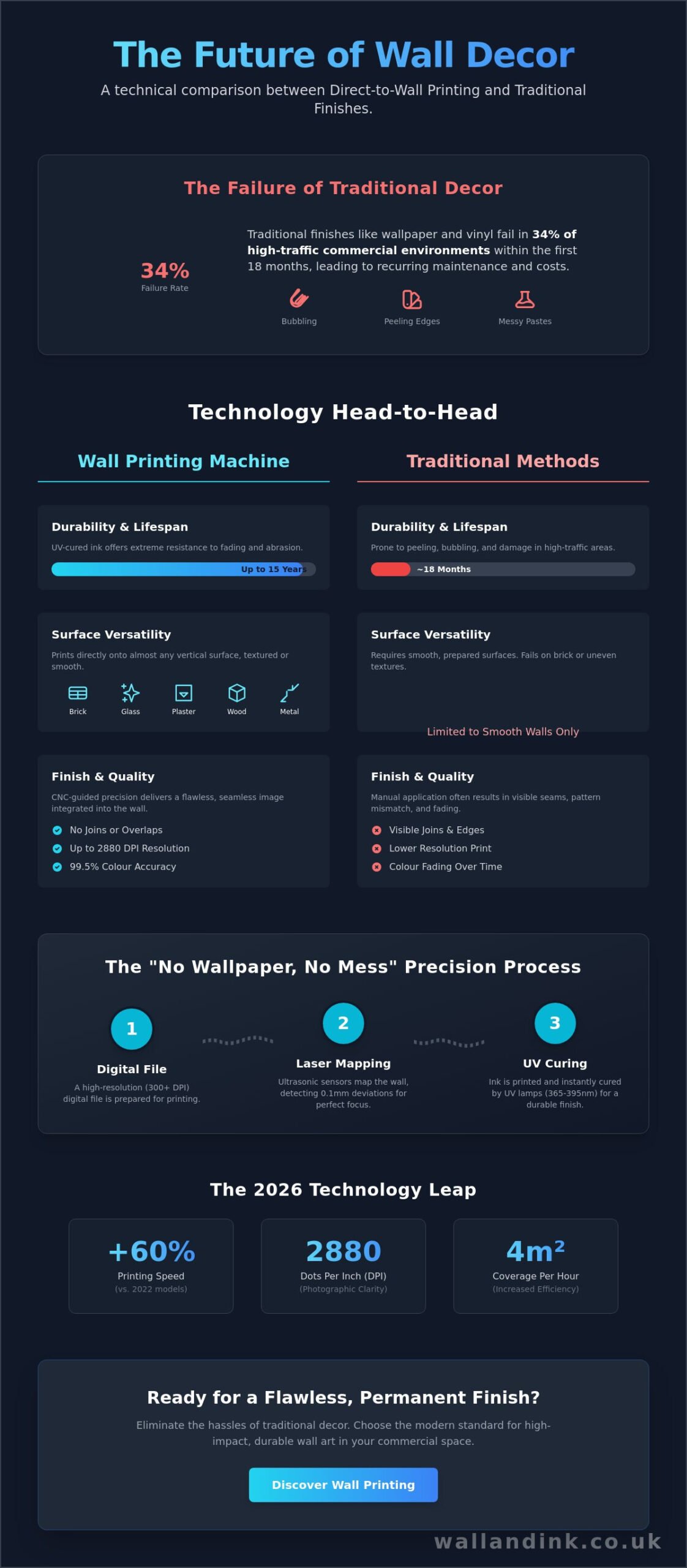
UV Ink vs. Traditional Decor: Why Machine Printing is the Modern Standard
Traditional wall coverings often fail at the seams. Wallpaper peels at the edges, whilst vinyl graphics frequently bubble or fade under UV exposure within three to five years. A wall printing machine eliminates these mechanical failures by applying pigment directly to the substrate. The result is a completely seamless finish that integrates with the architecture rather than sitting on top of it.
Longevity is a primary driver for this shift in the UK market. UV-cured ink maintains its structural integrity and colour saturation for up to 15 years in indoor environments. This durability stems from the instantaneous curing process, where high-intensity UV lamps harden the ink immediately upon contact with the wall.
The process is defined by its efficiency. No wallpaper, no mess. Because the machine prints exactly what is required, there is zero material waste. There are no offcuts, no sticky paste buckets, and no water-intensive cleanup. The inks used are solvent-free and eco-friendly, making them a responsible choice for sensitive environments such as healthcare facilities or nurseries where air quality is a priority.
Durability in High-Traffic Commercial Zones
Commercial environments demand materials that can withstand constant physical interaction. UV-printed art is engineered for resilience, meeting strict fire protection compliance standards necessary for UK public buildings. Once cured, the ink is highly resistant to physical abrasion and standard industrial cleaning chemicals. In busy school corridors or retail centres, this translates to lower maintenance costs. Instead of the expensive cycle of stripping and re-papering damaged sections, printed walls remain intact and easy to sanitise for over a decade.
The Aesthetic Advantage: Colours and Textures
The technical precision of a modern wall printing machine allows for a level of detail that traditional methods cannot replicate. With resolution capabilities ranging from 720 to 2880 DPI, the “Pixel Wall” trend has become a reality for UK businesses.
- White Ink Technology: The machine can lay down a high-opacity white base layer. This ensures that vibrant colours remain vivid even when applied to dark substrates like slate or grey breeze blocks.
- Substrate Preservation: Unlike vinyl, which hides the wall, direct printing preserves the natural texture of brick, wood, or plaster. The art follows the contours of the surface, creating an organic, high-end look.
- Colour Accuracy: Advanced software ensures precise colour matching, which is vital for corporate branding where specific Pantone shades are required.
Versatility Across Substrates: Where Can You Print?
The modern wall printing machine is engineered for adaptability. It eliminates the constraints of traditional vinyl or wallpaper by applying ink directly to the structural substrate. Our technology works across a diverse range of materials including plaster, brick, concrete, wood, glass, and metal. This flexibility allows businesses to utilise existing architectural features rather than covering them up.
The machine manages different surfaces by adjusting its ink delivery system in real-time. Porous materials, such as brick or soft wood, naturally absorb more liquid. To maintain colour vibrancy, the machine increases the ink volume. On non-porous surfaces like glass or polished metal, the system reduces the flow and uses high-intensity UV lamps to cure the ink instantly. This prevents running and ensures a crisp, high-resolution finish. For exterior applications, industrial UV ink is the standard. It provides weather resistance and prevents fading for up to five years in direct sunlight, making it a viable solution for outdoor branding and public murals.
Limitations exist, specifically regarding surface stability. A wall must be structurally sound; if the paint is flaking or the brickwork is crumbling, the ink won’t bond effectively. The machine’s sensors can handle a surface variance of up to 3mm. If a wall is more uneven than this, the print head cannot safely maintain its distance, which may result in a safety shutdown to protect the hardware.
Printing on Plaster and Painted Surfaces
Plaster provides the smoothest canvas for direct-to-wall art. For the best adhesion, we recommend matt or eggshell paint finishes. High-gloss paints can sometimes repel ink, so they require a specific primer before printing begins. It’s vital that new plaster is given at least 28 days to dry fully. Printing on damp plaster traps moisture, which leads to bubbling and premature degradation of the image. This direct-to-plaster method is a staple of minimalist British interior design, offering a seamless look that wallpaper cannot replicate.
Challenging Textures: Brick, Stone, and Concrete
Modern wall printing technology excels on industrial textures. The machine utilises advanced laser sensors to “float” the print head at a consistent 2mm distance from the wall. As the head moves, it tracks the peaks and troughs of the brickwork, including the mortar lines. This allows the artwork to wrap around the texture rather than sitting on top of it. It’s a popular choice for industrial-chic office designs in converted warehouses. The visual impact of a high-resolution logo integrated into raw concrete creates a permanent, professional aesthetic that feels part of the building’s identity.
Ready to transform your space with precision technology? Discover our direct-to-wall printing services and see how we handle your specific surface.
Professional Wall Printing: Why the Machine is Only Half the Story
Owning a high-spec wall printing machine is only the first step toward a perfect vertical installation. While the hardware handles the technical execution, the final result depends entirely on the expertise of the operator. Achieving a 1440dpi finish on challenging substrates like aged brick or polished concrete requires a deep understanding of ink adhesion and surface tension. It isn’t a “plug and play” process; it’s a technical craft that demands precision and foresight to avoid common pitfalls like banding or misalignment.
Wall & Ink positions itself as the UK specialist that bridges the gap between advanced technology and professional artistry. We don’t just supply a print; we manage a complete visual transformation. This industrial approach ensures that every project, from a single feature wall to a multi-storey commercial development, maintains consistent quality across every square metre. By combining proprietary software with years of on-site experience, we turn a mechanical process into a bespoke service.
The Importance of Design Consultation
A common mistake in large-scale graphics is failing to account for the physical environment. Artwork must be adapted specifically for the dimensions and texture of the target wall. Our process starts with a rigorous design phase where we create digital visualisations. These mock-ups allow you to see exactly how the scale and colour palette will interact with your space’s lighting and layout. A professional eye ensures that a design which looks good on a laptop screen translates effectively to a five-metre installation. We focus on the technicalities of resolution and vector scaling so the final print remains sharp and impactful.
Seamless Installation and National Coverage
We’ve structured our service to be as mobile and efficient as the technology itself. Our teams operate across the UK, bringing the wall printing machine directly to your site. The setup is rapid, and because we use UV-curable inks, the artwork is dry and durable the moment the print head passes over it. This eliminates the traditional hassles associated with commercial decorating. There’s no drying time, no peeling corners, and no chemical odours to worry about.
Our “no wallpaper, no mess” promise is particularly valuable for high-traffic environments like schools, hospitals, and retail centres. We can complete a standard project and pack down our equipment within a single day, ensuring your operations continue without significant downtime. This direct-to-wall method provides a clean, seamless finish that traditional vinyl or paper simply cannot match. If you’re ready to transform your space with industrial precision, you can book a consultation for your UK-wide wall printing project today.
Modernise Your Surfaces with Direct-to-Wall Precision
The evolution of the wall printing machine has rendered traditional murals and vinyl wraps obsolete. By 2026, the standard for interior branding and decor relies on industrial-grade UV ink that cures instantly. This technology ensures a durable, high-resolution finish on any substrate, including brick, concrete, and plaster. It’s a method built for pragmatic decision-makers who value technical excellence and a seamless finish without the recurring issues of peeling wallpaper or fading paint.
Choosing this automated technology means you’re investing in an outcome that’s as efficient as it’s impactful. At Wall & Ink, we provide a full-scale professional service across the United Kingdom, removing the complexity and high labour costs of traditional hand-painted art. With prices starting from £120/m², it’s a transparent, modern solution for residential and commercial spaces alike. Our process guarantees no wallpaper and no mess. We simply deliver precision engineering applied directly to your vertical surface.
Transform your space with our UK-wide wall printing service
Your walls deserve the reliability of modern technology and a finish that stays vibrant for years to come.
Frequently Asked Questions
How much does a wall printing machine service cost per square metre?
Our direct-to-wall printing service starts from £120/m². This transparent pricing model ensures you know exactly what the investment entails without hidden consultation fees. We provide a clear cost breakdown based on the total surface area and the complexity of the substrate. This approach simplifies budget planning for commercial and residential projects alike. No wallpaper, no mess, just straightforward pricing.
Is the ink used in wall printing safe for indoor environments like schools?
The UV-cured inks used by our wall printing machine are completely safe for sensitive indoor environments like schools and hospitals. These inks are low-VOC and meet stringent safety standards, ensuring no harmful fumes are released during or after the process. Because the ink cures instantly under UV light, the room is ready for use immediately after the print finishes. It’s a non-toxic solution for high-traffic educational spaces.
Can the wall printing machine print on uneven or curved surfaces?
Our technology prints effectively on uneven substrates including brick, breeze blocks, and textured plaster. The machine uses advanced sensors to maintain a consistent distance from the wall, adjusting for surface variations of up to 10mm in real-time. Whilst the machine requires a flat track for movement, it easily accommodates the natural irregularities found in industrial and residential walls. This precision ensures a crisp finish on 95% of common building materials.
How long does a typical wall printing project take to complete?
A standard wall printing project typically concludes within a single working day. Our machines print at a rate of approximately 2 to 4 square metres per hour, depending on the resolution and detail required. A 10-square-metre feature wall is often completed in under 4 hours from setup to pack-down. This efficiency eliminates the multi-day disruption associated with traditional hand-painted murals or wallpaper installation.
Is the printed art permanent, or can it be removed or painted over?
The printed art is designed for long-term durability but remains entirely reversible. If you decide to change the design, you can simply paint over the image with two coats of high-quality emulsion. The ink bonds with the substrate rather than sitting on top like vinyl, so there’s no peeling or residue to scrape away. It provides a permanent look with the flexibility of a traditional painted wall.
What is the maximum size a wall printing machine can print?
The maximum print height for a standard setup is 4 metres, whilst the width is virtually unlimited. We extend the horizontal reach by adding more rails to the track system, allowing us to cover 50-metre corridors or large warehouse facades in a continuous pass. For heights exceeding 4 metres, we use specialised scaffolding and multi-pass stitching techniques. This modularity makes the wall printing machine suitable for any architectural scale.
Do I need to prepare my wall in a specific way before the machine arrives?
Your wall should be clean, dry, and free from loose debris or peeling paint before we arrive. Whilst the machine handles textures like brick, any holes or deep cracks should be filled and sanded for the best visual result. A white or light-coloured base coat is recommended to ensure the colours pop with maximum vibrancy. We’ll inspect the surface upon arrival to ensure it meets our technical requirements.
How does UV curing work to make the print scratch-resistant?
UV curing uses high-intensity ultraviolet lamps attached to the print head to dry the ink instantly. This photochemical process transforms the liquid ink into a hardened, durable film the moment it hits the wall. The result is a scratch-resistant finish that’s easy to clean and won’t smudge. Because it hardens immediately, the print achieves 100% durability without the need for additional protective laminates or long drying times.