
Traditional wallpaper is becoming an obsolete technology for modern British interiors. You’ve likely experienced the frustration of peeling vinyl or bubbles in a decal that refuses to sit flat on a plaster surface. It’s a common struggle for those seeking bespoke art that fits specific architectural dimensions without the inevitable mess of traditional decorating. This is where the pixel wall concept redefines the standard, moving away from physical substrates toward direct-to-wall digital precision that eliminates the need for adhesives entirely.
We understand that you value industrial efficiency and high-quality results over the significant downtime required for hand-painted murals. You’ll discover how our proprietary printing technology delivers a seamless, durable finish that maintains its integrity even in high-traffic commercial corridors. This guide previews the high-resolution art trends for 2026 and explains how our no-mess process transforms brick, concrete, or plaster into a maintenance-free digital masterpiece with absolute precision.
Key Takeaways
- Understand the technical distinction between digital LED displays and permanent UV-printed surfaces to select the most efficient high-resolution solution for your space.
- Discover why the “no wallpaper, no mess” approach is disrupting the UK decorating industry by printing directly onto substrates like plaster, brick, and concrete.
- Learn how a pixel wall leverages advanced UV-curing technology to create intricate, durable designs that are impossible to achieve with standard vinyl or paper.
- Identify the specific commercial and residential sectors where high-resolution digital art is being utilised to create immersive and professional brand environments.
- Gain insight into the bespoke design and digital visualisation process that ensures total project confidence and precision before the printing begins.
What is a Pixel Wall? Redefining Modern Interior Design
A pixel wall represents a significant shift in how we approach vertical surfaces in British architecture. Unlike traditional methods that rely on physical layers, a pixel wall is a high-resolution digital image printed directly onto a wall using advanced UV technology. This process eliminates the need for paper or vinyl, resulting in a finish that feels integrated into the building itself rather than an addition to it.
It’s vital to distinguish this technology from digital LED displays. Whilst an ultra-high-resolution display uses physical hardware and constant electricity to show an image, a printed pixel wall is a permanent, static installation. It provides the same pin-sharp clarity without the hardware clutter, heat output, or energy consumption. The term “pixel” in this context refers to the microscopic precision of modern UV printing heads, which can replicate digital files with absolute fidelity on almost any surface.
In British homes and offices, we’re seeing a move away from generic, mass-produced patterns. Decision-makers now choose bespoke, data-driven art that reflects specific corporate identities or personal histories. This transition is driven by a desire for industrial precision and the elimination of traditional decorating hassles. With pricing starting from £120/m², it’s a transparent and efficient alternative to high-end wallpapering or manual mural painting.
The Evolution of the Feature Wall
The concept of the feature wall has travelled from the hand-painted murals of the Victorian era to the bold, repeating patterns of 1970s wallpaper. Each era sought to add character to a space, but they often struggled with durability or the mess of application. Today’s digital direct-to-wall revolution solves these legacy issues. High-definition photography and digital illustration have changed what we expect from our interiors. We no longer settle for “close enough” colours or visible seams. Modern design demands a seamless finish that integrates with architectural features like windows, sockets, and corners without disruption.
Digital Precision Meets Physical Surfaces
The transition from a digital file to a physical surface is where the technology proves its value. Any high-resolution file, whether it’s a corporate logo or a favourite landscape photograph, can be converted into a pixel wall. Success depends on the quality of the source file; high-resolution assets are essential for achieving that sought-after “painted-on” look. A pixel wall is the permanent application of digital art directly onto a substrate. Our process works across various materials including plaster, brick, concrete, and wood. It’s a clean, fast, and reliable solution. No wallpaper, no mess.
The Technology Behind the Precision: How UV Printing Works
The rise of the pixel wall as a dominant design trend for 2026 is driven by mechanical precision rather than manual application. At the heart of this shift is UV-curing technology, a process that bypasses the limitations of traditional wallpaper or vinyl. Unlike solvent-based inks that require hours to vent and dry, UV inks are engineered for industrial speed and reliability. This technology allows for a “no wallpaper, no mess” execution that is currently disrupting the UK decorating industry.
The durability of these prints is a result of the chemical bond formed during application. UV-cured inks are notably lightfast, meaning they don’t fade when exposed to direct sunlight through large commercial windows. The integration of visual technology in interior design has moved beyond digital screens, allowing us to treat physical surfaces like high-resolution canvases. We print directly onto a vast array of substrates, including:
- Standard plaster and painted walls
- Textured brickwork and concrete
- Sleek glass partitions
- Natural timber and wood panelling
The UV Curing Process Explained
As the print head moves across the wall, it deposits specialised ink droplets that are immediately followed by a high-intensity ultraviolet light. This light triggers a polymerisation reaction, hardening the ink instantly. This instant-dry capability is vital for high-footfall commercial environments like schools or retail centres, where downtime isn’t an option. Because the ink doesn’t “soak” into the surface but bonds to the top, the result is 100% VOC-free and eco-friendly. It’s a clean, modern solution for sectors that prioritise air quality and immediate room availability.
Resolution and Detail (DPI)
Precision is defined by dots per inch (DPI). Our technology operates at resolutions up to 2880 DPI, ensuring that lines remain sharp even when viewed from a few centimetres away. We use a multi-pass printing method where the machine travels over the same area multiple times. This builds intense colour saturation and visual depth that traditional methods can’t replicate. The result is a seamless finish with no joins, no overlapping seams, and no risk of peeling. If you’re planning a project that requires this level of detail, you can view our direct-to-wall process to see the technology in action.
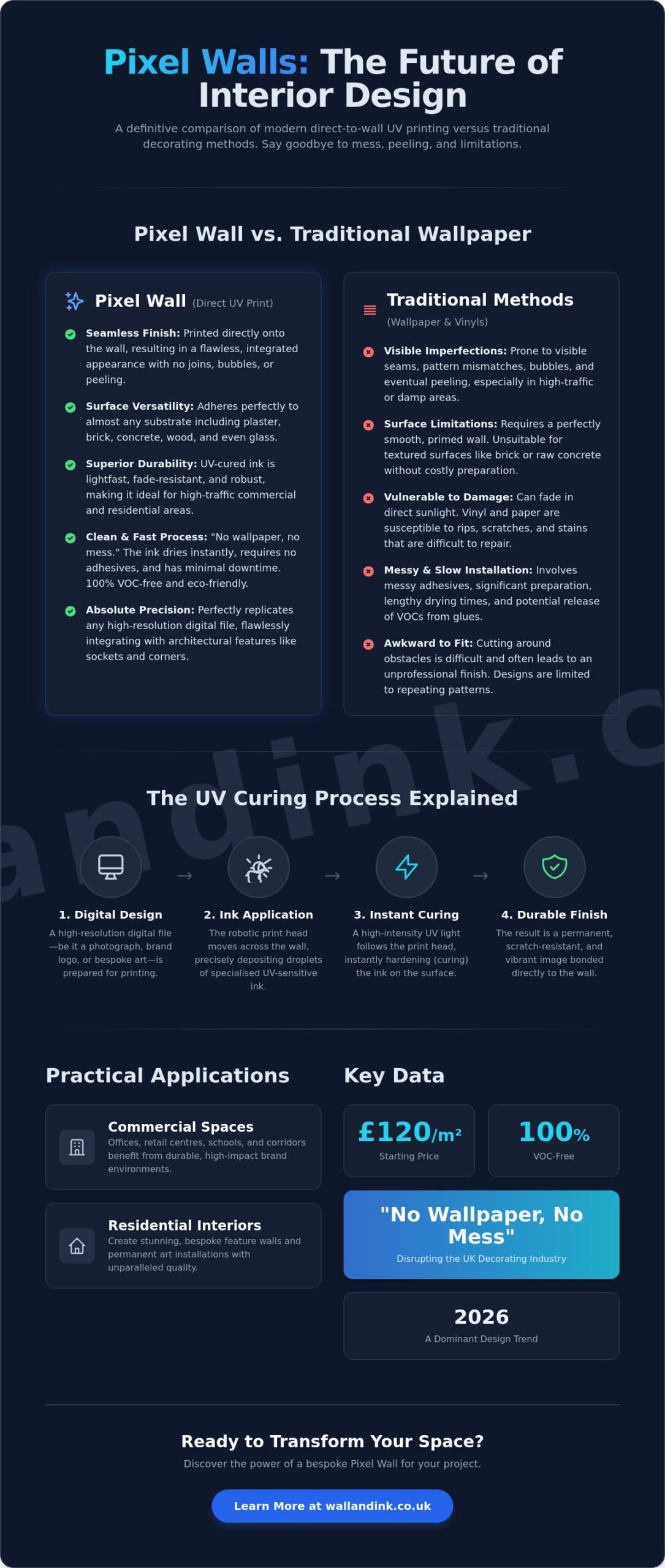
Pixel Walls vs. Traditional Wallpaper: A Comparison
Traditional wall coverings rely on adhesives and physical layers that sit on top of a surface. A pixel wall removes these variables by applying pigment directly to the substrate. This structural difference is the primary reason why UK project managers are shifting away from vinyl and paper. Wallpaper is a temporary addition; direct-to-wall printing is a permanent architectural integration. The “no wallpaper, no mess” approach isn’t just a slogan. It’s a practical response to the failure rate of traditional materials in commercial environments.
Many decision-makers wrongly assume that digital prints are more fragile than heavy-duty vinyl. The reality is the opposite. Direct-to-wall technology bonds the ink to the surface, creating a finish that doesn’t bubble, tear, or lift. Whilst wallpaper begins to degrade the moment the adhesive dries, a digital print maintains its structural integrity for years. It’s a shift from craft-based decorating to industrial-grade precision.
Eliminating the Weak Points
Common issues like peeling edges, air bubbles, and visible seams are inherent to wallpaper. These failures don’t exist with a pixel wall. In high-traffic environments like NHS clinics or UK primary schools, hygiene is a priority. Direct-to-wall prints offer a flat, non-porous surface that doesn’t harbour bacteria in frayed edges or behind lifting paper. We utilise eco-friendly UV printing technology to ensure the finish is scratch-resistant and easy to sanitise. Standard household cleaners won’t degrade the image quality. It’s a durable solution that outperforms traditional 300gsm vinyl in longevity tests.
Bespoke Sizing and Architectural Integration
Wallpaper rolls come in fixed widths. This often leads to 15% to 20% material waste and awkward pattern repeats around architectural features. A pixel wall is mapped to the exact dimensions of your space. The printer handles windows, light switches, and complex corners with millimetre precision. Our digital visualisations allow you to approve the layout before the first drop of ink hits the wall. This eliminates the guesswork and the waste associated with roll-based products.
- Precision: No “pattern repeat” issues around sockets or radiators.
- Zero Waste: You only pay for the ink used on the wall, not the offcuts in the bin.
- Speed: Most UK commercial installs are completed in a single day with no drying time for adhesives.
The initial investment for direct-to-wall printing starts from £120/m². Whilst this might seem higher than budget wallpaper rolls, the cost-benefit analysis favours the digital approach. You aren’t paying for excess material or the inevitable repairs that come with peeling vinyl. It’s a one-time fee for a permanent, high-resolution finish that stays sharp for years. It’s a modern solution for pragmatic leaders who value efficiency and high-quality results.
Practical Applications: Where High-Resolution Art Works Best
The adoption of the pixel wall across the UK reflects a shift toward more durable, high-precision interior solutions. Recent industry data suggests a 22% increase in digital wall applications within corporate offices throughout 2024. This growth is driven by the need for branding that doesn’t peel or fade like traditional vinyl. High-resolution art works best where visual clarity and long-term durability are non-negotiable; specifically in sectors that demand a professional, seamless finish on challenging substrates.
Commercial and Office Environments
Commercial branding has evolved beyond simple logos. Modern office lobbies now use immersive graphics to communicate company values the moment a client walks in. Using direct-to-wall technology ensures that high-impact graphics are applied with industrial precision. This method is particularly effective in busy retail and hospitality venues because it offers “zero downtime” printing. Since the UV-cured ink dries instantly, there’s no need to cordone off areas for days whilst wallpaper adhesive sets.
A recent project for a London-based tech firm demonstrated how a clean, printed finish supports a professional corporate image far better than traditional methods. By printing directly onto the existing concrete and plaster, the business avoided the messy removal of old materials. It’s a pragmatic solution for decision-makers who value efficiency. The benefits include:
- Precision: Every pixel is placed with mechanical accuracy, ensuring brand colours are exact.
- Durability: The output is scratch-resistant and suitable for high-traffic corridors.
- No Mess: No wallpaper, no paste, and no peeling edges.
Residential and Bespoke Art
In the luxury residential market, homeowners are moving away from mass-produced decor in favour of bespoke feature walls. A common trend for 2026 involves turning personal travel photography into a floor-to-ceiling pixel wall. This creates a deeply personal atmosphere in lounges or bedrooms that can’t be replicated with off-the-shelf products.
Digital designs can also be used to create an illusion of depth in smaller rooms. By applying 3D-effect patterns directly to the wall, you can make a narrow hallway feel significantly wider. For those looking to upgrade their home, Direct-to-wall printing offers a modern solution that bypasses the frustrations of traditional decorating. Whether it’s a complex geometric pattern or a landscape photo, the result is a seamless part of the architecture rather than an addition to it.
Explore our direct-to-wall printing services today.
Transforming Your Space with Wall & Ink
Wall & Ink provides a professional, direct-to-wall printing service that eliminates the traditional frustrations of interior decorating. From regional offices in the Midlands to commercial developments in London, our national UK coverage brings advanced technology directly to your doorstep. We’ve replaced the common issues of peeling vinyl and bubbling wallpaper with a permanent, high-resolution solution. Our proprietary process is designed for pragmatic decision-makers who value efficiency and industrial precision. To maintain absolute transparency, we lead with clear pricing starting from £120/m², ensuring you can budget accurately for your pixel wall project without hidden costs or consultation walls.
The journey from an initial design brief to a finished installation follows a methodical four-step path:
- Initial Brief: We discuss your aesthetic goals, wall dimensions, and substrate type.
- Digital Visualisation: Our design team creates a precise mock-up of the artwork within your space.
- Technical Preparation: We optimise your files for large-scale UV printing.
- On-Site Execution: Our technicians arrive and complete the print with zero mess.
The Design and Visualisation Phase
We take your existing brand assets, high-resolution photography, or custom illustrations and optimise them for large-scale application. Our team adapts your logos into wall-ready formats that maintain crisp edges even at massive scales. To ensure total client confidence, we charge a bespoke design and digital visualisation fee. This allows us to create precise digital mock-ups that show exactly how the art will sit within your specific architectural environment, accounting for windows, doors, and furniture. This rigorous pre-production process ensures the final print perfectly matches the digital proof you approved.
On-Site Execution and Aftercare
Installation day is designed to be non-disruptive and remarkably fast. Our wall printing technology is clean, quiet, and incredibly efficient, making it ideal for active office environments or residential spaces. Our “No wallpaper, no mess” mantra is a technical reality, as we require minimal preparation for surfaces such as plaster, brick, concrete, or wood. Because the ink cures instantly under UV light, the surface is durable and touch-dry immediately after the print head passes. This modern solution provides a seamless finish that resists fading and mechanical wear better than traditional alternatives.
We’ve completed projects for schools, retail hubs, and commercial offices across the country, proving that any vertical surface can become a high-impact feature. If you’re ready to upgrade your interior with a durable, high-resolution pixel wall, enquire about your pixel wall project today.
Future-Proof Your Interior with Precision Printing
Modern interior design is moving away from the limitations of paper and glue. This high-resolution technology represents the next generation of surface customisation, utilising advanced UV printing to apply imagery directly onto your existing substrate. This method eliminates the common failures of vinyl and traditional wallpaper, offering a durable, seamless finish that won’t peel or fade over time. Whether you’re upgrading a commercial lobby or a residential space, our industrial-grade printers deliver total precision on surfaces ranging from smooth plaster to textured brick.
We’ve streamlined the entire process to remove the stress of renovation. With transparent pricing starting from £120/m² and a national UK-wide professional installation team, high-end art is now more accessible and efficient. Our “no wallpaper, no mess” guarantee ensures your space remains clean whilst we transform it with industrial-grade accuracy. It’s time to replace outdated methods with a modern, technical solution that lasts.
Start your pixel wall project with a bespoke quote and bring your 2026 design vision to life today.
Frequently Asked Questions
What is the difference between a pixel wall and a wall mural?
A pixel wall is a high-resolution image printed directly onto a vertical surface using advanced UV ink technology. Traditional wall murals typically rely on physical substrates like vinyl or wallpaper that require adhesives. Our direct-to-wall process eliminates the seams and peeling common with standard murals; it’s a modern solution that achieves industrial-grade precision without the mess associated with traditional decorative applications.
Can you print a pixel wall on a rough surface like brick or concrete?
You can print a pixel wall on almost any substrate, including rough brick, textured concrete, and uneven plaster. Our machinery uses intelligent sensors to maintain a consistent distance from the surface, ensuring the ink bonds perfectly regardless of the texture. This flexibility allows for high-resolution art in industrial spaces where traditional wallpaper would fail to adhere or look unprofessional.
How long does it take to print a high-resolution wall?
Printing speed depends on the complexity and size of your design, but our technology typically covers 2 to 4 square metres per hour. A standard feature wall can often be completed within a single working day. Because the UV ink cures instantly under built-in lamps, the area is ready for use immediately after the print head finishes its final pass.
Is the ink used in pixel walls safe for children’s bedrooms or schools?
The UV-curable inks we use are entirely safe for schools, hospitals, and children’s bedrooms. These inks are VOC-free and odourless once cured, meeting strict safety standards for indoor environments. Unlike traditional solvent-based printing methods, our process doesn’t release harmful fumes, making it an ideal choice for high-traffic educational settings where air quality is a primary concern.
Can I provide my own image for a pixel wall project?
You can provide your own high-resolution files for any pixel wall project, provided the image meets our quality thresholds. We recommend files with a minimum resolution of 300 DPI to ensure the final output remains sharp at large scales. Our technical team reviews every file before printing to confirm it will translate effectively to the wall without pixelation or loss of detail.
How much does a professional pixel wall cost per square metre?
Professional pixel wall installations start from £120 per square metre. This transparent pricing includes the setup and execution of the direct-to-wall print. By choosing this modern method, you avoid the hidden costs of wallpaper paste, specialised installers, and the eventual removal fees associated with traditional vinyl graphics or paper-based murals.
What happens if I want to change or remove the pixel wall in the future?
If you want to change your design, you simply paint over the existing print with two coats of standard emulsion. There’s no need for scraping, steaming, or chemical strippers because there’s no physical paper to remove. This makes it a highly efficient option for commercial spaces that require regular rebranding or residential rooms that need a fresh look every few years.
Do I need to prepare my wall in a special way before printing?
Walls should be clean, dry, and free from loose debris before we arrive. For the best colour accuracy and vibrancy, we recommend a light-coloured or white base coat. While our technology handles textures like brick and concrete, the surface must be structurally sound. A quick wipe-down to remove dust is usually the only preparation required for most indoor painted surfaces.