
Traditional wallpaper is a failing technology that relies on unstable adhesives and visible seams to decorate your space. You’ve likely felt the frustration of watching expensive vinyl graphics peel at the edges or seeing your brand colours distorted by off-the-shelf mural limitations. It’s a common pain point for pragmatic decision-makers who need high-quality results without the traditional hassle. With the global direct to wall printing market reaching a value of $1.97 billion in 2024, more UK businesses are moving away from manual applications in favour of industrial precision.
This guide explains how advanced UV technology transforms any vertical surface into a high-resolution masterpiece with no wallpaper and no mess. You’ll discover how this modern solution delivers a seamless finish on everything from brick to plaster, offering industrial-grade durability that lasts 10 years indoors according to industry standards. We’ll detail the exact process of achieving perfect brand colour matching and minimal installation disruption, providing a clear roadmap for your next project starting from £120/m².
Key Takeaways
- Understand how UV-curing technology eliminates drying times and installation mess, turning a multi-day project into a matter of hours.
- Learn why direct to wall printing outperforms traditional vinyl and wallpaper through superior resistance to UV fading and industrial-grade scuff protection.
- Discover how digital visualisation and mock-ups remove the risk from your project by showing a precise preview on your specific wall surface.
- Explore tailored applications for high-traffic environments, including scuff-resistant school murals and bespoke branding for commercial boardrooms.
- Get practical details on project planning, from essential surface preparation to transparent pricing structures starting at £120/m².
What is Direct-to-Wall Printing? The Future of Interior Surfaces
At its core, direct to wall printing is a computer-controlled inkjet process that applies pigment directly onto vertical substrates. Unlike traditional methods that require an intermediary material, this technology uses advanced digital printing technology to spray UV-curable ink that hardens instantly. This instant-dry capability is achieved through integrated UV lamps that follow the print head; the ink is cured the moment it touches the surface. This creates a durable, scratch-resistant finish without the need for drying time or protective laminates. UV wall printing provides a seamless alternative to traditional vinyl, ensuring that the final image becomes part of the wall rather than a layer on top of it.
The “No wallpaper, no mess” mantra isn’t just a slogan; it’s a technical reality. By eliminating the need for adhesives, pastes, and backing papers, the process removes the most common points of failure in wall decoration. There’s no risk of chemical odours or messy clean-ups. The high-resolution capabilities of these printers reach up to 2880 dpi, which is roughly double the resolution of standard commercial wallpaper printing. This allows for photographic quality that captures every detail of a brand’s assets or a homeowner’s favourite image.
The Mechanics of Vertical UV Printers
The machinery behind this process is a marvel of industrial engineering. Vertical UV printers use ultrasonic sensors to track surface irregularities in real time, automatically adjusting the nozzle distance to maintain precision on substrates ranging from rough brick to smooth plaster. This ensures a consistent output even on challenging surfaces like concrete, stone, or painted masonry. By utilising a CMYK+W ink set, the printer can lay down a white base layer first. This technical justification is vital for achieving vibrant, accurate colours on dark backgrounds. The robotic movement of the printer is calibrated to eliminate visible banding; this ensures the final mural is entirely seamless across any width or height.
Why “Direct” Beats “Applied” Every Time
Traditional wallpaper and vinyl decals are prone to mechanical failure. Adhesives eventually dry out, leading to peeling edges, bubbling, and visible joins that disrupt the visual flow of a design. In high-traffic UK commercial environments, vinyl graphics often suffer from scuffing and corner lifting within the first 24 months of installation. Direct application removes these vulnerabilities entirely. There are no seams to catch and no adhesives to fail. The result is a clean finish that mimics the aesthetic of hand-painted art but with the speed and precision of a digital file. It provides an integrated finish that respects the architectural integrity of the building whilst providing industrial-grade durability.
Comparing Wall Printing to Traditional Murals and Vinyl
Traditional decorative methods often impose a heavy timeline on commercial projects. Whilst a hand-painted mural might require a specialist artist to occupy a site for several days, direct to wall printing completes the same task in a matter of hours. This speed doesn’t compromise quality. Recent advances in direct-to-wall printing have produced machines capable of rendering complex graphics with industrial-grade durability. According to industry data, UV-curable inks provide a lifespan of approximately 10 years for indoor applications and 5 years for outdoor environments. This longevity is supported by high resistance to UV fading and common cleaning chemicals, making it a pragmatic choice for high-traffic zones.
Environmental impact is another differentiator. Vinyl applications generate significant plastic waste through offcuts and backing sheets. In contrast, wall printing produces zero VOCs and minimal waste, as the ink is applied with mechanical precision only where needed. This process works across diverse substrates including industrial brickwork, wood, glass, and smooth plaster. Traditional adhesives often fail to bond effectively on these varied surfaces, but UV ink creates a permanent, integrated finish. If you’re looking for a more professional and durable finish, you can view our range of commercial wall murals.
Wall Printing vs. Traditional Wallpaper
Wallpaper faces significant challenges in moisture-rich environments like kitchens or bathrooms. Steam often compromises the adhesive, leading to peeling and mould growth behind the paper. Wall printing’s UV-cured ink is water-resistant and bonds directly to the substrate, eliminating these risks. When it’s time for a change, you don’t need to strip layers of paper and glue; you simply paint over the surface. Over a 5-year period, this reduces maintenance costs and refurbishment downtime significantly. It’s a clean, efficient alternative that adheres to the “No wallpaper, no mess” standard.
UV Ink vs. Vinyl Graphics
Vinyl graphics are notorious for “lifting” at the edges, especially on porous surfaces like concrete or plaster. Because vinyl relies on a surface-level bond, temperature fluctuations can cause the material to shrink or expand. Direct to wall printing avoids this by penetrating the surface texture, creating a permanent bond that won’t peel. UV inks also offer a broader colour gamut and superior lightfastness. This ensures that brand colours remain accurate and vibrant for years without the dulling effect common in standard vinyl applications.
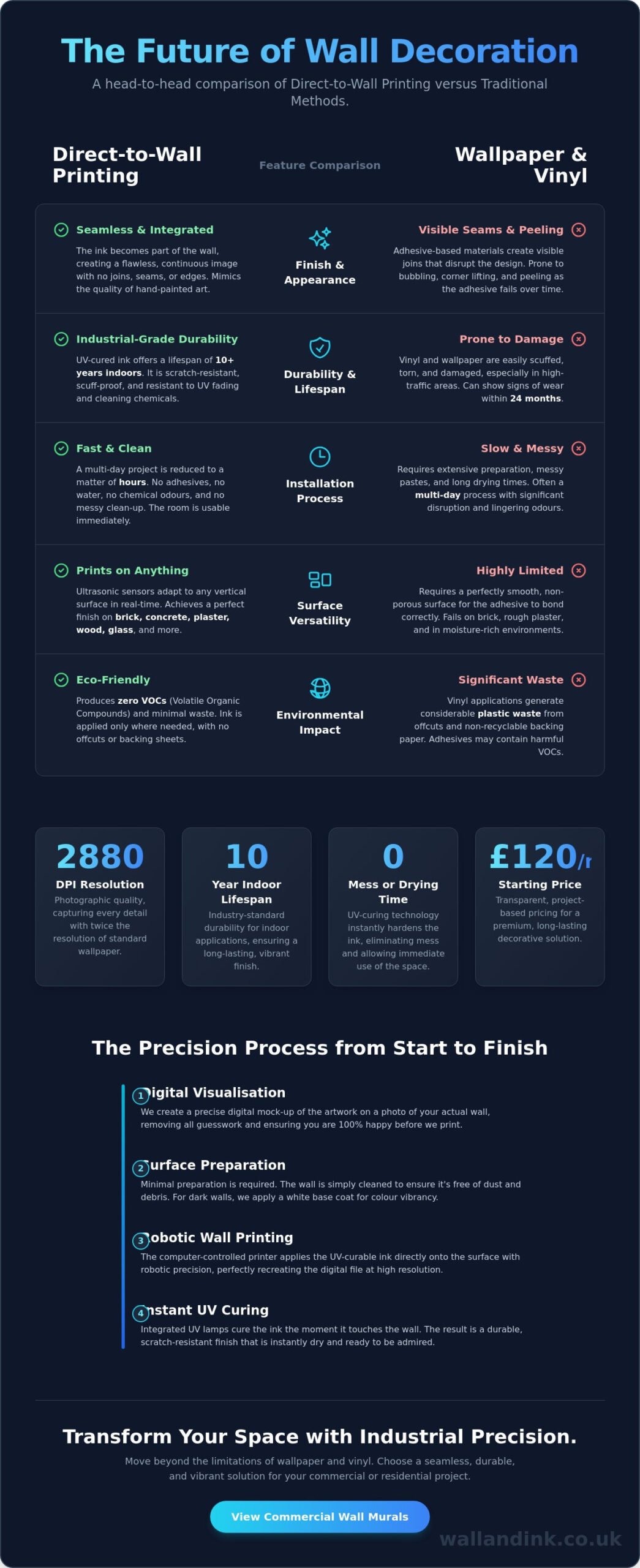
The Precision Process: From Digital Visualisation to Execution
Achieving a high-resolution finish on a ten-metre feature wall requires more than just a digital file; it demands a rigorous calibration process. Unlike off-the-shelf murals that often result in pixelated or poorly fitted graphics, direct to wall printing relies on a methodical digital-to-physical workflow. This bespoke approach ensures that every pixel aligns with the architectural reality of your space. Precision isn’t accidental. It’s the result of industrial-grade software and technician expertise working in tandem to deliver a result that meets professional standards.
Scaling images for architectural use involves proprietary algorithms that maintain sharpness at any size. A specialist technician calibrates the printer’s vertical rail and ultrasonic sensors to account for the specific substrate, whether it’s the rough texture of industrial brick or the uniform surface of painted plaster. This calibration prevents distortion and ensures the ink drops land with micron-level accuracy. This technical justification is why the process achieves such a clean finish, even on irregular surfaces that would cause traditional vinyl to fail.
Bespoke Design and Artwork Preparation
Adapting brand assets or high-resolution photography for vertical surfaces isn’t a simple resize. We organise files to ensure perfect colour matching using Pantone or RAL references, which is critical for maintaining corporate identity across different environments. The “Pixel Wall” concept allows us to create lifelike depth by layering inks. By using a white ink base on darker walls, we ensure that the final colours remain vibrant and true to the original brief. This level of technical preparation distinguishes professional direct to wall printing from basic inkjet alternatives.
Digital Mock-ups and Visualisation
One major failing of traditional mural services is the lack of a precise preview. We address this gap by using site photographs to create realistic digital mock-ups. This removes the guesswork from the process. It allows for the following adjustments before any ink touches the wall:
- Scale and Placement: Aligning graphics to avoid being obscured by furniture or equipment.
- Architectural Integration: Ensuring the design flows naturally around windows, doors, and light switches.
- Lighting Analysis: Predicting how natural and artificial light will interact with the UV-cured finish.
By seeing a 1:1 representation of the mural in the actual environment, you gain total transparency. This step ensures that the final installation integrates perfectly with the room’s behaviour and aesthetic, providing a reliable outcome for pragmatic decision-makers.
Sector Applications: Where Direct Wall Printing Excels
Direct to wall printing serves as a high-performance alternative to traditional media across diverse sectors. In the UK commercial market, which reached a value of approximately £8.6 billion in 2025-26, the demand for efficient, high-impact branding has never been higher. This technology isn’t limited to simple aesthetics; it’s an industrial solution for environments that demand durability and precision. From high-traffic school corridors to sophisticated restaurant interiors, the ability to print on almost any vertical surface—including brick, glass, and wood—provides a level of versatility that wallpaper cannot match.
Industrial Precision for Commercial Branding
Businesses choose this method for its reliability and minimal operational impact. Traditional decorating processes often require rooms to be vacated for 48 hours or more to allow for adhesive setting and fume dissipation. Our process adheres to the “No wallpaper, no mess” standard, ensuring that boardrooms and retail spaces remain functional throughout the installation. The UV-curable inks are compliant with COSHH regulations, making them safe for immediate use in public-facing hospitality settings where air quality and hygiene are paramount. The result is a permanent, professional-grade finish that withstands the rigours of a busy workplace.
- Live Office Environments: Branding executed during business hours with zero fumes and instant curing.
- Hospitality: Immersive restaurant environments and printed menus on durable, wipe-clean surfaces.
- Retail: High-resolution shop fronts and feature walls that maintain colour fidelity under intense store lighting.
Inspiring Educational and Residential Environments
Schools require surfaces that are as durable as they are educational. In high-traffic corridors, traditional wallpaper or vinyl decals often succumb to scuffs and peeling within the first 12 months. By printing directly onto the substrate, we create interactive learning walls that are integrated into the building itself. This durability extends to residential settings. Homeowners use this technology to personalise bedrooms or create unique kitchen splashbacks on glass or tile. The weather-resistant properties of UV ink even allow for exterior applications, bringing high-resolution art to building facades that lasts up to 5 years in outdoor conditions.
Whether it’s a motivational office mural or a durable school display, the mechanical superiority of the process ensures a clean finish every time. If you’re ready to transform your vertical surfaces with industrial precision, get a quote for your wall printing project today.
Project Planning: Costs, Prep, and Professional Installation
Successful direct to wall printing begins with radical transparency regarding costs and logistical requirements. Pragmatic decision-makers value clarity, which is why our pricing model starts from £120 per square metre. Projects involving darker or textured walls that require an additional white ink base layer typically average £130 per square metre to ensure maximum colour vibrancy. These figures provide a baseline for budgeting, though factors such as site location, surface complexity, and total area coverage will influence the final project fee. It’s a straightforward investment structure designed to eliminate the hidden costs often found in traditional decorating quotes.
Surface Preparation for Plaster, Brick, and Concrete
Achieving industrial precision requires the substrate to be in optimal condition before the machine arrives on site. For fresh plaster, the surface must be fully dry and sealed with a high-quality primer to prevent the ink from being absorbed unevenly. Rough substrates like brick or concrete must be cleared of loose debris and oils to ensure the UV ink bonds permanently. Our “Clean Finish” promise relies on a dust-free environment during the printing window; airborne particles can compromise the high-resolution output of the machine’s nozzles. This preparation ensures the direct to wall printing process delivers the mechanical reliability our clients expect.
On the day of installation, the process is methodical and clean. The printer moves along a vertical rail system, applying the design with mechanical accuracy whilst integrated UV lamps cure the ink instantly. You don’t need to worry about drying times or chemical odours. Most commercial boardrooms or residential features are completed within hours, allowing the space to be used immediately. Post-print care is straightforward; the cured surface is water-resistant and can be cleaned with a damp cloth and mild detergent without risking colour degradation.
Understanding the Investment and ROI
Choosing UV wall printing is a long-term strategy for space management and brand maintenance. Traditional wallpaper often requires replacement every 24 to 36 months in high-traffic UK environments due to peeling edges and scuffing. In contrast, our prints offer a 10-year indoor lifespan, significantly reducing the total cost of ownership over time. By choosing a permanent, integrated finish, you eliminate the recurring costs of stripping, prepping, and reapplying temporary materials. It’s a modern solution for those who prioritise durability and visual impact over temporary fixes. To begin your transformation, enquire about your project and receive a bespoke quote tailored to your specific requirements.
Transform Your Vertical Surfaces with Industrial Precision
Adopting direct to wall printing represents a move away from the mechanical failures of the past. You’ve seen how UV technology eliminates the peeling edges and visible seams associated with traditional vinyl and wallpaper. By choosing a solution that bonds directly to substrates like brick, plaster, or concrete, you’re investing in a finish with a 10-year indoor lifespan. This process isn’t just about aesthetics; it’s a pragmatic choice for those who value efficiency and high-resolution results without the traditional mess.
Our commitment to transparency means you benefit from clear pricing starting from £120/m² and a reliable, UK-wide professional installation service. We handle the technical calibration and digital visualisation to ensure your brand or home artwork integrates perfectly with your space’s architectural features. It’s time to eliminate the hassle of adhesives and embrace a modern, seamless finish that stands the test of time. Book a Design Consultation for Your Next Wall Project and discover how our “No wallpaper, no mess” guarantee can redefine your environment today.
Frequently Asked Questions
Is direct-to-wall printing permanent or can it be removed?
Direct-to-wall printing is a permanent finish that bonds with the substrate, but it’s easily removed by painting over the surface. Unlike wallpaper, there’s no need for chemical strippers or physical scraping. If you decide to change your branding or decor, you simply apply two coats of standard emulsion to return the wall to its original state. This makes it a flexible solution for commercial spaces that undergo periodic refurbishments.
Can you print on textured surfaces like brick or wood?
Our technology prints on almost any vertical surface, including rough brick, natural wood, glass, and metal. The printer uses ultrasonic sensors to track surface irregularities in real time, maintaining a consistent nozzle distance to ensure high-resolution results on uneven textures. This mechanical precision allows for a clean finish on industrial substrates that would typically cause vinyl graphics or traditional decals to fail or peel.
How much does direct-to-wall printing cost per square metre?
Transparent pricing starts from £120 per square metre for standard prints on light-coloured, smooth walls. For darker surfaces or textured substrates requiring a white ink base layer for colour vibrancy, the cost is approximately £130 per square metre. These rates include a free visualisation of your design, providing a clear investment framework for pragmatic decision-makers who value budget certainty and high-quality results.
Is the UV ink safe for use in schools and hospitals?
Yes, the UV-curable inks used in direct to wall printing are entirely safe for sensitive environments like schools and healthcare facilities. The inks are cured instantly by integrated UV lamps, meaning there are zero fumes and no drying time required. Our process complies with COSHH 2002 regulations and produces a durable, wipe-clean surface that withstands the rigorous hygiene standards of medical and educational buildings.
What is the maximum height and width for a wall print?
There is no limit to the width of a wall print, whilst the standard height reaches up to 4 metres in a single pass. For taller surfaces, the machine can be repositioned to continue the graphic seamlessly. This flexibility allows us to cover entire building facades or expansive warehouse walls with industrial precision, ensuring the final mural fits the architectural scale of your project perfectly.
How long does the installation process take for a standard office wall?
A standard office feature wall of approximately 15 square metres typically takes 3 to 5 hours to complete. Because the ink cures instantly upon contact, the room is ready for immediate use once the machine is packed away. This minimal disruption is a primary advantage for live commercial environments, as it eliminates the 48-hour drying window required by traditional mural artists or wallpaper installers.
What resolution is required for my own images to be printed?
We recommend digital files with a resolution of at least 300 DPI at a 1:1 scale for the highest photographic quality. However, for large-format architectural murals viewed from a distance, 150 DPI is often sufficient to maintain a clean finish. Our technicians review all artwork during the design consultation to ensure the source file supports the intended scale without any visible pixelation or distortion.
Can the wall printer handle exterior surfaces in the UK climate?
Direct to wall printing is highly effective for exterior applications and is engineered to withstand the varied UK climate. The UV-curable ink is resistant to water and sunlight, providing an outdoor durability of approximately 5 years. This makes it a reliable choice for branding building facades, retail shop fronts, and public art installations that require industrial-grade resistance against the elements without fading.