
Why wait weeks for fresh plaster to dry and endure the dusty mess of a mist coat when you could have a finished feature wall in a single afternoon? Most homeowners and site managers dread the traditional decorating cycle. You’re likely worried about paint peeling off porous surfaces or wallpaper failing to stick to new plaster. It’s a valid concern because standard paint materials cost between £2 and £6 per square foot, yet they often require repainting every three to five years. Printing on bare plaster walls offers a sophisticated, industrial-grade alternative that bypasses these frustrations entirely.
At Wall & Ink, we provide a modern solution that delivers high-resolution graphics starting from £120 per square metre. You’ll discover how our direct-to-wall UV printing eliminates the need for messy mist coats whilst providing a professional finish that is rated for 10 years of indoor durability. This guide explores the technical precision of our process, the cost-effectiveness of skipping traditional primers, and how we achieve a seamless visual impact with zero decorating mess. We’ll show you how to transform a porous, bare substrate into a durable piece of art without the wait.
Key Takeaways
- Bypass the time-consuming mist-coating process and avoid the risk of paint peeling or bubbling on fresh, porous plaster.
- Discover why printing on bare plaster walls using UV-cured ink provides a superior bond compared to traditional emulsion or wallpaper adhesives.
- Achieve a high-resolution, durable finish in a single session without the physical mess or long drying times associated with conventional decorating.
- Understand the long-term value of UV-cured graphics, which offer up to 10 years of indoor performance without the need for frequent touch-ups.
- Implement a simple preparation checklist to ensure your plaster surface is smooth and ready for a high-precision, direct-to-wall installation.
The Challenge of Decorating Bare Plaster Walls
Fresh plaster is notoriously difficult to manage. It’s a high-porosity substrate that acts like a sponge, aggressively drawing moisture out of any substance applied to its surface. This physical characteristic makes understanding plaster walls essential before you pick up a roller or a brush. Traditionally, decorators are forced into a gruelling four-step cycle that begins with a mandatory waiting period. You can’t touch new plaster until it’s fully dry, which often takes several weeks depending on the ambient temperature and ventilation. Once dry, you face the “mist coat,” a messy process of thinning down emulsion with 30% water to create a seal. If you skip this or get the ratio wrong, you risk the “peel-off” failure, where the top layer of paint loses its bond and flakes away in large, unsightly sheets.
Printing on bare plaster walls disrupts this outdated, manual labour-intensive workflow. Traditional methods require a dry-prime-coat-coat sequence that can stretch over a month when you factor in the initial drying time. Direct-to-wall UV printing bypasses the moisture-management issues that plague standard emulsion. Instead of relying on the plaster to absorb a liquid bond over several hours, our technology cures the ink instantly using ultraviolet light. This creates a durable, high-resolution finish that stays exactly where it’s placed, regardless of the substrate’s thirst for moisture.
Why Traditional Paint Often Fails on New Plaster
Standard emulsion paint is designed to sit on a sealed surface. When applied to raw gypsum, the plaster “sucks” the water out of the paint so rapidly that the pigment can’t form a proper chemical bond. This creates a layer of fine dust between the wall and the paint film, leading to immediate adhesion failure. Thinning paint for a mist coat is a clumsy solution that often results in drips on the floor and uneven coverage on the wall. Wallpaper isn’t a safer alternative; the porous plaster absorbs the adhesive too quickly, which leads to shrinking seams, bubbling, or the paper simply falling off the wall within months of installation.
The “No Wallpaper, No Mess” Philosophy
We approach every project with a “No wallpaper, no mess” mindset. Traditional decorating is an inherently dirty trade involving sanding, dust sheets, and chemical odours. In contrast, our direct-to-wall process offers industrial precision with a clean-site guarantee. There’s no dust from sanding down primer and no risk of spills from thinned-down paint buckets. We use advanced machinery to apply graphics with a level of detail that manual rollers simply cannot match. By choosing Wall & Ink, you’re opting for a modernised decorating workflow that values efficiency and high-quality results over the unpredictability of manual brushes. It’s a professional, straightforward solution for pragmatic decision-makers who want to move from a bare construction site to a finished masterpiece without the traditional hassle.
What is Direct-to-Wall Printing on Plaster?
Direct-to-wall UV printing is a high-resolution digital process that applies ink directly onto a vertical surface. Unlike standard emulsion that relies on evaporation and absorption, this method uses ultraviolet lamps to cure the ink instantly. This technological shift is fundamental for anyone considering printing on bare plaster walls, as it eliminates the chemical unpredictability of manual decorating. The process is supported by industry standards from the Digital Printing Association, ensuring that the application meets rigorous commercial requirements for adhesion and colour accuracy.
The ink used in this process is engineered for durability. Whilst household paint is susceptible to scuffs and fading, UV-cured inks are designed to withstand high-traffic environments. These inks are also eco-friendly and produce low Volatile Organic Compounds (VOCs), making them safe for sensitive environments like schools or hospitals. This industrial precision ensures that the visual impact remains consistent for up to 10 years indoors; this is a significant improvement over the 3 to 5-year lifecycle of traditional paint. By choosing this modern solution, you’re investing in a finish that’s both technologically advanced and environmentally responsible.
The Science of UV Curing on Porous Surfaces
UV curing is a photochemical process where high-intensity ultraviolet light triggers a chemical reaction that hardens liquid ink into a solid film instantly. Because the ink solidifies in milliseconds, it doesn’t have time to be “lost” or sucked into the porous gypsum. This creates a robust bond on the surface layer rather than relying on deep absorption. The result is a scratch-resistant finish that’s tough enough to forgo a protective topcoat, reducing both material costs and installation time.
Precision and Resolution: Beyond Flat Colour
Traditional rollers and brushes are limited by their physical texture, often leaving “orange peel” patterns or brush marks. A wall printer operates with a resolution ranging from 720 to 2880 dpi, allowing for photorealistic images and complex gradients that are impossible to achieve by hand. This level of detail is particularly effective for printing on bare plaster walls where the machine’s sensors can adjust for the natural, minor imperfections of a hand-plastered finish. The technology maintains a consistent distance from the substrate, ensuring every pixel is placed with mechanical accuracy. If you’re looking for a professional finish that combines art with engineering, our direct-to-wall printing service provides the most efficient path forward.
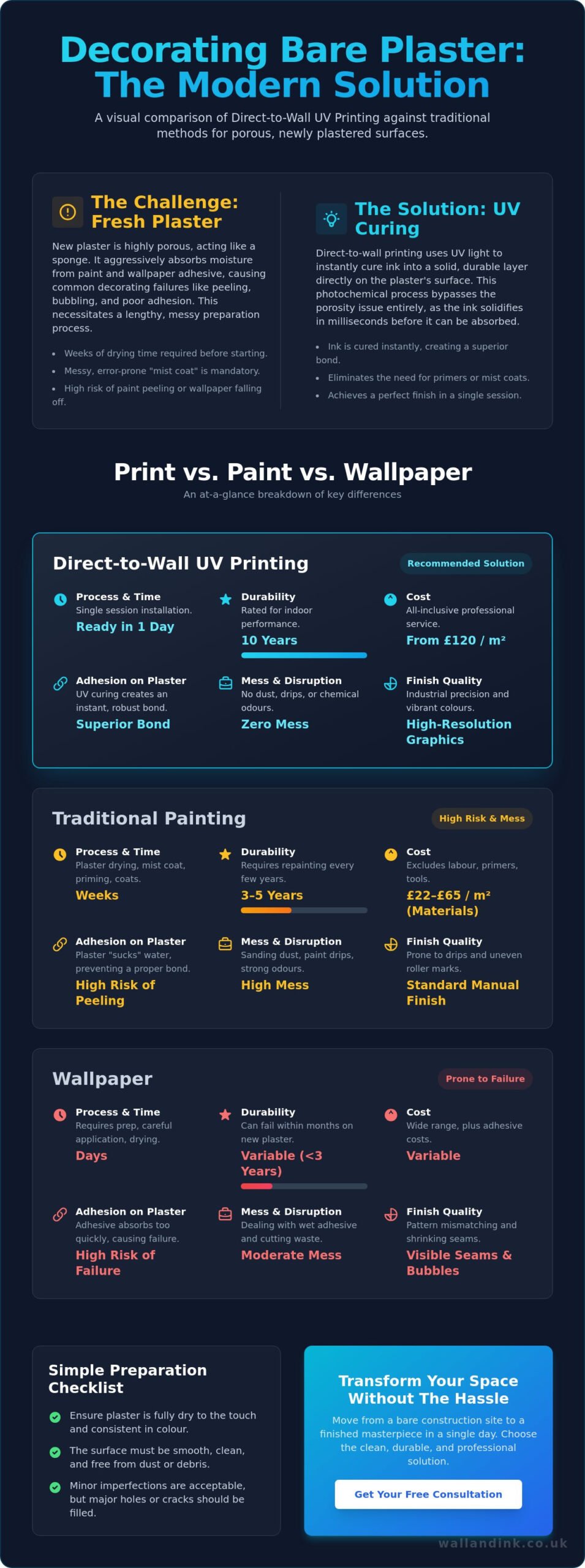
Comparing the Options: Print vs Paint vs Wallpaper
Choosing the right finish for a new build or renovation requires looking beyond the initial material cost. Whilst traditional latex paint averages $2 to $6 per square foot for materials, the total cost of ownership quickly escalates when you factor in professional labour for mist-coating and multiple topcoats. Wallpaper presents an even higher hurdle; with material costs between $3 and $8 per square foot and installation fees reaching up to $10 per square foot, it’s a significant investment that remains vulnerable to peeling on porous surfaces. Printing on bare plaster walls offers a fixed-cost alternative that eliminates these secondary labour expenses entirely.
The design flexibility of UV printing far exceeds off-the-shelf options. Instead of settling for a generic flat colour or a repeating wallpaper pattern, you gain access to photorealistic murals and bespoke branding. This industrial precision ensures that every feature wall is unique to your space. Unlike paint, which typically requires a refresh every 3 to 5 years due to scuffing, our UV-cured prints are rated for 10 years of interior durability. This longevity makes it the pragmatic choice for high-traffic environments where maintenance budgets are a priority.
Speed of Installation: Time is Money
Traditional decorating is a multi-week commitment. You must wait for the plaster to fully dry before applying a mist coat, followed by at least two topcoats with drying time between each. In a commercial environment, this downtime translates directly to lost revenue. Direct-to-wall printing is a single-day process for most residential feature walls. Because our technology works on bare substrates, we can start as soon as the wall is clean and dry. This efficiency allows businesses to resume operations almost immediately, providing a professional finish without the protracted schedule of a decorating crew.
Durability and Maintenance
Maintenance is where the superiority of UV ink becomes clear. Standard wallpaper is notoriously sensitive to sunlight, often showing visible fading within a few years. Our UV-cured inks are chemically designed to resist light degradation, maintaining their vibrancy even in bright, south-facing rooms. These prints can be wiped clean with a damp cloth without risk of smudging or fading the pigment. If your requirements change in the future, the thin profile of the UV ink means you can simply paint over the print without the heavy sanding or stripping required to remove traditional wallpaper. It’s a clean, adaptable solution that respects both your time and your property.
Preparing Your Bare Plaster for a Professional Print
Preparation is the foundation of industrial precision. Whilst our technology is designed to handle the natural variations of building materials, achieving a high-resolution finish requires a substrate that is structurally sound and properly curated. For successful printing on bare plaster walls, the surface must be “print-ready,” which means it is clean, dry, and free from any chemical sealants that could interfere with the UV ink bond. A professional plasterer should aim for a “polished” finish, as any deep gouges or significant trowel marks will be visible under high-resolution detail. Our machines use advanced sensors to maintain a consistent distance from the wall, but they cannot fill holes or smooth out poor craftsmanship.
To ensure your project stays on schedule, follow this definitive preparation checklist:
- Confirm the wall is structurally dry with a uniform pale colour.
- Remove all “nibs,” splashes, or grit using a fine 120-grit sandpaper.
- Wipe the surface with a dry microfibre cloth to eliminate dust.
- Ensure the room is free from ongoing “wet trades” like tiling or floor screeding.
- Do not apply PVA, mist coats, or any standard primers.
The “Dry Enough” Test for Plasterwork
You can determine if a wall is ready by observing its visual cues. Fresh plaster undergoes a distinct colour change as it cures, moving from a dark, wet pink or brown to a uniform pale matt finish. If the wall appears patchy or has dark “sweat marks,” the moisture content is still too high for the ink to bond effectively. Whilst natural drying is often the safest route for surface integrity, you can use dehumidifiers to accelerate the process. However, you must avoid excessive heat, which can cause the plaster to “blown” or crack, compromising the substrate before we arrive.
Fixing Imperfections Before the Printer Arrives
Minor surface inconsistencies are common in hand-applied plaster. You should lightly sand any small bumps or “snot” left by the trowel to create a level plane. It is vital that you avoid using PVA or traditional sealants. These products create a plastic-like film that prevents the UV ink from making direct contact with the gypsum, which can lead to adhesion failure. If your wall has minor permanent stains, our design team can often use digital visualisation to hide these inconsistencies within the mural’s artwork. This ensures a seamless visual impact without the need for chemical primers. If you are unsure about your wall’s readiness, you can contact our technical team for a site assessment.
Transforming Your Space with Wall & Ink
Wall & Ink operates as a premier UK specialist in direct-to-wall technology, providing a professional alternative to the limitations of traditional decorating. We don’t just apply colour; we integrate high-resolution art directly into the fabric of your building. Printing on bare plaster walls allows us to turn a raw construction site into a finished space with industrial precision. Our “No wallpaper, no mess” mantra is a core commitment to our clients, ensuring that every installation is completed without the dust, chemical odours, or waste associated with conventional methods. We provide a streamlined service journey that moves from your initial concept to a durable, high-impact finish in a fraction of the time required by traditional trades.
Embracing this modern solution means moving beyond the restricted palette of flat paint. Whether you are managing a high-stakes commercial rebranding or a residential renovation, our process is designed for pragmatic decision-makers who value both aesthetics and efficiency. By choosing a direct-to-wall mural, you bypass the generic and adopt a bespoke finish that is physically bonded to the substrate. This ensures a seamless visual impact that won’t bubble, peel, or fade, providing a level of reliability that manual applications cannot replicate.
Bespoke Design for Residential and Commercial Walls
Our design process is built on technical accuracy. We adapt client logos, high-resolution photographs, or custom-commissioned art to fit any wall dimensions with mathematical precision. Before the installation begins, we provide detailed digital mock-ups. These visualisations are essential for ensuring the design interacts correctly with your architectural space, accounting for fixtures like radiators, windows, and light switches. This rigour applies to every project, from interior office branding to exterior plasterwork. Our ability to print on diverse surfaces ensures that your visual identity remains consistent across different areas of a property, maintaining a professional standard that reflects the quality of your own brand or home.
Transparent Pricing and Professional Execution
We operate with a level of honesty that distinguishes us from competitors who obscure costs. Our pricing is transparent, starting from £120/m², allowing you to plan your project with financial certainty. Based in Derby, our specialist team provides a reliable, UK-wide service, bringing the same level of industrial precision to a London boardroom as we do to a Midlands bedroom. We manage the entire execution from brief to final print, ensuring a clean-site installation every time. If you’re ready to disrupt the traditional decorating cycle and invest in a modernised workflow, book your bespoke design consultation with Wall & Ink today.
Elevate Your Architecture with Direct-to-Wall Precision
Traditional decorating methods are no longer the only way to finish a new build or renovation. By choosing printing on bare plaster walls, you eliminate the weeks of waiting and the unpredictable mess of mist coats. Direct-to-wall technology provides a durable, 10-year finish that bonds instantly to porous substrates. This process offers a level of high-resolution detail that manual rollers cannot achieve, ensuring your feature wall is a precise architectural statement rather than just a flat colour.
Our UK-wide professional service is designed for pragmatic decision-makers who value efficiency and total cost transparency. With clear pricing starting from £120/m², we provide a reliable, technical path to high-impact design without the typical decorating hassle. The Derby-based team ensures every project meets our standards of industrial precision, from the initial digital mock-up to the final UV-cured print. It’s time to replace the dust and peeling paper of the past with a modern, “No wallpaper, no mess” installation. Transform your bare plaster walls with a bespoke mural today and see how industrial-grade technology can redefine your interior space.
Frequently Asked Questions
Can you print on fresh plaster that is still pink?
No, the plaster must be structurally dry before the installation begins. Fresh plaster that is still pink or dark in colour contains too much moisture, which prevents the UV ink from forming a stable bond with the gypsum. You’ll know the wall is ready when it has turned a uniform pale pink or grey and has a matt appearance across the entire surface. This ensures the 10-year durability rating of our professional finish.
Do I need to apply a mist coat before you print on my wall?
You don’t need to apply a mist coat or any other primer. Our industrial-grade UV inks are designed for direct application to bare substrates, including raw plaster. By skipping the traditional thinned-down paint coat, you avoid the mess and drying times associated with manual decorating. Printing on bare plaster walls is a “one-step” solution that replaces the need for the dry-prime-coat-coat cycle used in traditional trade work.
How long does direct-to-wall printing take on a standard plaster wall?
A standard residential feature wall measuring approximately 10 to 12 square metres typically takes between 3 and 5 hours to complete. This includes the machine setup, precision calibration, and the actual print process. Because the ink is cured instantly by ultraviolet light, the wall is touch-dry and finished the moment the machine reaches the end of its track. This single-day execution is significantly faster than the multi-week timeline required for traditional paint or wallpaper.
Is the ink used in wall printing safe for children’s bedrooms?
Yes, our UV-cured inks are eco-friendly and produce low Volatile Organic Compounds (VOCs). The photochemical curing process happens instantly, meaning there are no lingering chemical odours or harmful gasses released into the room after the project is finished. This makes the technology a preferred choice for sensitive environments such as nurseries, schools, and healthcare facilities where air quality is a primary concern.
What happens if I want to change the design or paint over the print later?
You can simply paint over the mural with a standard emulsion if you decide to change your decor. Because the UV ink layer is microscopically thin, it doesn’t leave a raised texture or edge like a vinyl decal would. There’s no wallpaper to strip or heavy adhesive residue to sand away. You just apply a high-quality primer or base coat directly over the print, and the wall is ready for a new colour or a different direct-to-wall design.
Does the wall printer work on uneven or slightly curved plaster surfaces?
Our machinery uses advanced ultrasonic sensors to manage minor surface imperfections in real-time. These sensors adjust the distance between the print head and the wall to account for the natural “waves” found in hand-plastered finishes. Whilst the technology is designed for flat vertical surfaces, it can handle slight inconsistencies without losing image clarity. For significantly curved walls or deep textures, we recommend a site assessment to ensure the high-resolution output meets our precision standards.
Is printing on bare plaster more expensive than traditional wallpapering?
Whilst our pricing starts from £120/m², it often represents a lower total cost of ownership than high-end wallpaper. Traditional wallpapering requires you to pay for the material, the specialist adhesive, and the professional labour for both priming and hanging. When you factor in the 10-year durability of UV ink and the lack of maintenance required, the direct-to-wall method is a pragmatic investment for those who value long-term results and a “No wallpaper, no mess” installation.
How durable is a UV print on a high-traffic corridor wall?
UV-cured prints are highly scratch-resistant and designed to withstand the rigours of high-traffic commercial environments. The ink forms a robust physical bond with the plaster, making it much tougher than standard household paint which can scuff or flake. You can wipe the surface clean with a damp cloth and mild detergent without fading the pigment or damaging the artwork. This durability ensures that your investment remains a high-impact feature for up to a decade in an indoor setting.