
Why invest in a large-scale exterior brand asset if it’s destined to peel, bubble, or fade within eighteen months? Most property owners accept that outdoor graphics come with a high maintenance burden, often settling for vinyl wraps that fail under the stress of British weather. You’re likely looking for a way to achieve high-resolution exterior building mural printing that actually lasts, avoiding the mess of traditional paint and the fragility of adhesive stickers. Traditional methods simply don’t match the durability of UV-curable ink. This guide demonstrates how advanced UV printing technology transforms exterior facades into durable, weather-resistant assets without the limitations of legacy methods.
We’ll show you how to achieve a maintenance-free finish that maintains its colour vibrancy for up to five years, even on challenging textures like brick or concrete. You’ll learn about the industrial precision of direct-to-wall application and the essential planning regulations for UK commercial sites. By the end, you’ll understand why this clean, fast installation process is the modern standard for architectural branding.
Key Takeaways
- Evaluate the technical advantages of exterior building mural printing over traditional vinyl to ensure your brand assets remain intact and vibrant.
- Learn how UV-curable inks create a permanent bond with porous substrates like brick and render to eliminate the risk of peeling or bubbling.
- Discover the science behind weather-resistant graphics that withstand sunlight, frost, and high winds without requiring frequent maintenance.
- Understand the professional workflow from initial digital visualisation to the final, clean installation on any exterior surface.
- Compare the five-year lifespan of direct-to-wall prints against the rapid degradation of legacy outdoor media in the British climate.
Transforming Facades with Exterior Building Mural Printing
Blank exterior walls represent a significant missed opportunity for property owners and commercial developers. In the past, these surfaces were either left as raw brickwork or covered with temporary vinyl wraps that quickly degraded. Modern exterior building mural printing changes this dynamic entirely. It treats the facade as a permanent canvas, integrating high-resolution graphics directly into the building’s substrate. This isn’t a sticker or a temporary overlay; it’s a professional architectural enhancement. By 2026, the trend across the UK has shifted toward using these surfaces for high-impact brand storytelling and urban regeneration, moving away from the clutter of traditional signage toward a cleaner, more integrated aesthetic.
Architects and facility managers now view exterior walls as high-value assets. A well-executed mural does more than just decorate; it establishes a sense of place and increases the perceived value of the property. Because the process uses industrial-grade UV inks, the result is a durable finish that resists the typical wear and tear of urban environments. It’s a pragmatic solution for those who want the visual impact of a hand-painted mural without the long lead times or the risk of human error during the application process.
The Evolution of Building Facade Graphics
The history of mural art stretches back to ancient civilisations, but the methods have evolved significantly to meet modern commercial demands. Traditional hand-painting often lacks the precision required for contemporary corporate branding. It’s a slow process that’s prone to inconsistency. Industrial UV printing solves these issues by using digital files to guide the print head with millimetre accuracy. This ensures that a brand’s visual identity is replicated perfectly on a grand scale. Digital visualisation plays a crucial role here, allowing clients to see exactly how the artwork interacts with the building’s features before any ink is applied to the wall.
Direct-to-Wall vs. Traditional Signage
Standard signage often requires heavy mounting brackets, metal frames, and intrusive drilling into the building’s envelope. These additions can compromise the structural integrity of the facade and create long-term maintenance headaches. Direct-to-wall printing eliminates these requirements. The ink bonds with the existing texture of the brick, stone, or render, maintaining the building’s original character. This ‘frameless’ approach creates a more sophisticated finish that feels part of the architecture rather than an afterthought bolted onto it. You don’t have to worry about frames collecting dirt or brackets rusting; the art is the wall itself.
The Technical Edge: UV Ink Technology and Substrate Versatility
UV-curable ink technology provides the mechanical foundation for high-performance exterior building mural printing. Unlike traditional pigments that rely on evaporation, UV inks undergo a photochemical reaction when exposed to ultraviolet light. This process creates an immediate, resilient bond with the substrate, making it ideal for the porous and often uneven surfaces found on building exteriors. We achieve resolutions ranging from 720dpi to 2880dpi, ensuring that even on a massive scale, the imagery remains sharp and professional. Maintaining colour accuracy on darker materials like charcoal brick or grey concrete requires a specialised approach; our machines apply a high-opacity white base layer first, ensuring the final colours remain vibrant and true to the original brand guidelines.
The chemical stability of these inks is vital for long-term exposure. Because the ink is cured instantly, it doesn’t soak deeply into the material in a way that causes “feathering” or loss of detail. Instead, it sits as a durable, micro-thin layer that flexes with the building’s natural thermal expansion. This technical precision allows for the reproduction of complex gradients and fine text that would be impossible to achieve with traditional stencils or hand-painting. If you’re planning a large-scale project, you can view our technical specifications to see how we manage complex substrates across various environments.
Printing on Brick, Render, and Concrete
The primary challenge of masonry is its inherent irregularity. Traditional vinyl wraps often fail here because they cannot bridge the gap of deep mortar lines or textured render without eventually lifting. Our printing technology utilises advanced sensors to adjust the print head’s distance from the wall in real-time. This allows the ink to follow the natural contours of the surface, resulting in a “fused” aesthetic where the artwork appears as part of the material itself. Before the machine arrives, the surface must be clean and free of loose debris. Following a professional process for public murals ensures that the substrate is properly prepared to receive the ink, guaranteeing maximum adhesion and a high-quality finish.
Industrial Precision: The Wall Printing Machine
Reliability in exterior environments comes from mechanical stability. The printer operates on a system of vertical and horizontal rails, using high-precision laser sensors to maintain a perfectly level output across the entire facade. This setup allows us to cover large square footage in a matter of hours, significantly reducing the disruption caused by traditional scaffolding or hand-painting crews. UV curing is an instant drying process that prevents runs or bleeds by solidifying the ink the microsecond it touches the wall. This technical superiority means your project is completed quickly with zero mess and no risk of weather-related smudging during the application phase.
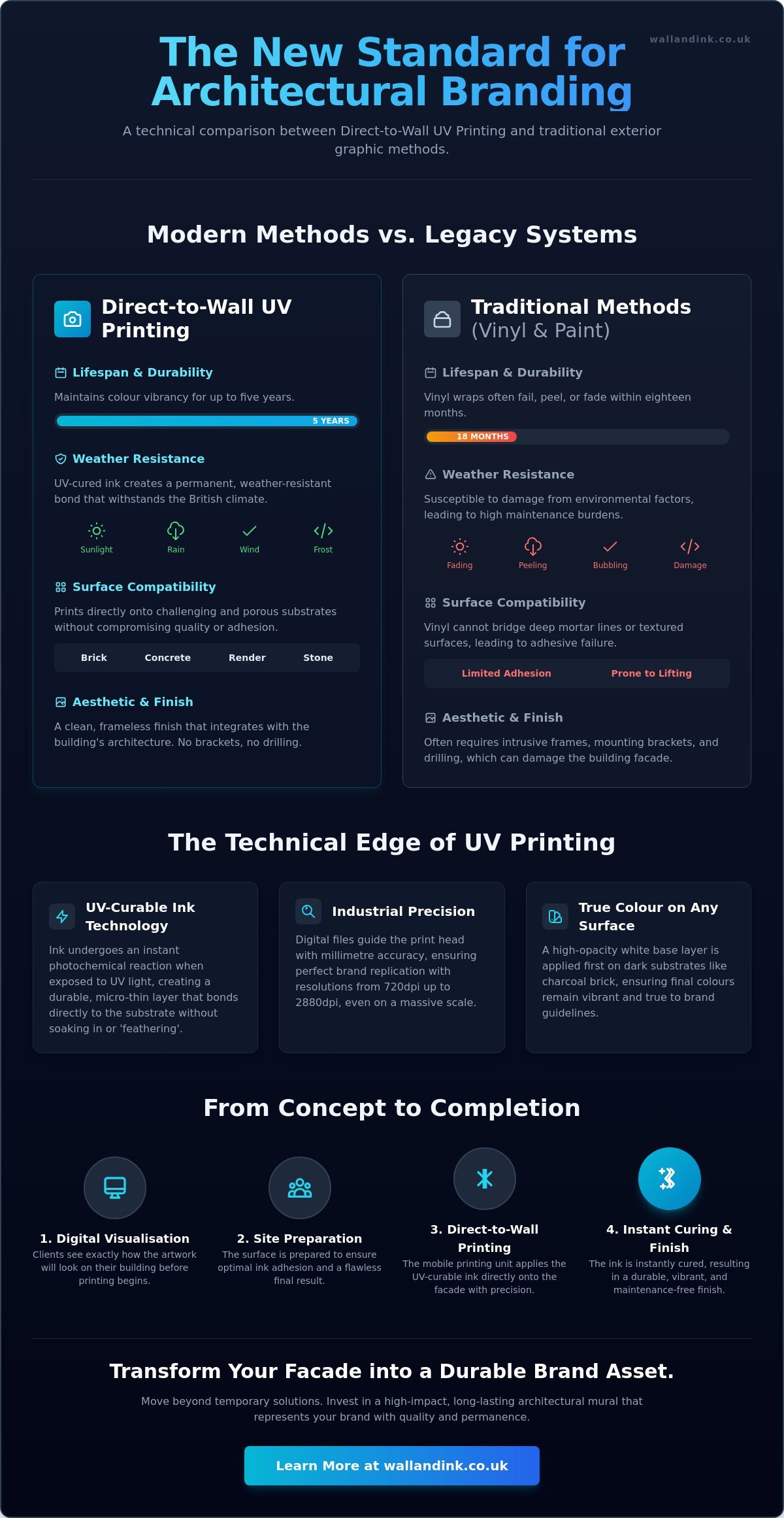
Direct-to-Wall Printing vs. Traditional Exterior Vinyl Wraps
Choosing between a vinyl wrap and direct-to-wall application is often a choice between a temporary covering and a permanent architectural integration. While vinyl has been the legacy choice for decades, it remains a surface-level film that sits on top of the building. In contrast, exterior building mural printing utilises UV-curable inks that bond with the substrate itself. Technical data indicates that UV prints on exterior walls typically maintain their integrity for up to five years, depending on weather exposure. Vinyl, however, frequently begins to fail within three years when applied to textured outdoor surfaces. The difference isn’t just in longevity; it’s in how the media reacts to the environment.
Maintenance requirements highlight another significant divide. Vinyl surfaces are prone to scratching and can be difficult to clean without lifting the edges of the film. A printed mural is as durable as the wall it sits on. It doesn’t require specialised cleaning agents or the delicate touch needed for adhesive graphics. From a cost-benefit perspective, the initial investment in exterior building mural printing eliminates the cycle of removal and replacement common with vinyl. You aren’t just paying for a graphic; you’re investing in a five-year asset that doesn’t bubble, peel, or trap dirt along adhesive lines.
The Problem with Adhesive-Based Solutions
Temperature fluctuations in the UK pose a constant threat to adhesive films. As the building heats and cools, the masonry expands and contracts at a different rate than the plastic vinyl. This mismatch leads to tension, causing the material to pull away from mortar lines and corners. Vinyl fails on texture. It’s a simple physical reality. Removing these wraps often reveals “ghosting” or stubborn adhesive residue that requires chemical stripping. For listed or heritage buildings, this risk of surface damage is unacceptable. Direct printing offers a non-invasive alternative that respects the masonry without the need for aggressive chemicals or intrusive mounting hardware.
Breathability and Structural Integrity
Trapping moisture is a primary concern for any exterior facade. Vinyl acts as a non-porous barrier, which can lead to moisture build-up behind the film, eventually causing exterior render to crack or blown brickwork. UV inks are inherently different. The application process ensures the wall remains breathable, allowing moisture to escape naturally through the porous ink layer. This preserves the structural integrity of the building whilst providing high-resolution graphics. Choosing this method also aligns with modern environmental goals. By eliminating large sheets of plastic, you significantly reduce the project’s plastic waste and the long-term environmental impact of the installation.
Weatherproofing and Longevity: Built for the British Climate
Durability in an outdoor environment requires more than just high-quality pigments; it demands a chemical bond that can withstand the specific rigours of the British climate. Exterior building mural printing succeeds where other media fail because the UV-cured ink becomes a resilient polymer upon application. This material doesn’t just sit on the surface like a sticker. It integrates with the masonry. While traditional vinyl laminates often yellow or crack after prolonged exposure to the elements, UV-cured prints maintain their physical integrity against driving rain, heavy frost, and high winds. The ink is inherently scratch-resistant, making it a practical choice for high-traffic public areas where accidental contact or abrasion is a constant factor.
Data from 2026 indicates that the typical lifespan of a UV ink print on an exterior wall is up to five years. This duration depends heavily on weather exposure and the specific substrate type. In milder environments, these prints often last well beyond the five-year mark. However, in harsh environments with constant direct sunlight and extreme temperatures, the lifespan might reduce to approximately two years. This remains significantly more reliable than legacy alternatives that often require replacement or repair within the first eighteen months of installation. For a detailed assessment of your building’s specific environment, you can consult our exterior durability specialists.
UV Stability and Colour Retention
Fading is the primary enemy of outdoor graphics. Standard pigments break down when exposed to ultraviolet radiation, leading to a washed-out appearance within seasons. UV-curable inks are engineered to resist this degradation through a stable chemical bond that prevents pigment breakdown under direct sunlight. This technical superiority means that South-facing walls, which typically suffer the most from sun damage, are no longer a restriction for large-scale murals. When comparing fading rates, UV ink consistently outperforms both hand-painted pigments and digital vinyl prints. Hand-paint often loses vibrancy as the binders erode, whilst vinyl relies on a secondary laminate layer that eventually fails. UV ink provides a single-stage, high-stability solution.
Cleaning and Vandalism Resistance
Maintaining a professional appearance over several years requires a surface that is easy to clean. You can safely clean a printed mural using a low-pressure jet wash, typically kept below 1500 PSI, to remove urban grime and salt deposits. This level of maintenance would likely peel the edges of a vinyl wrap or scrub the pigment off a hand-painted surface. For projects in areas prone to tagging, we offer optional anti-graffiti coatings. These specialised top layers provide an additional shield, allowing for the removal of spray paint without damaging the underlying UV print. To keep your mural looking vibrant for its full lifespan, we recommend a simple annual wash with mild detergent and low-pressure water to prevent the build-up of environmental pollutants.
From Concept to Completion: The Wall & Ink Professional Process
Executing a large-scale exterior building mural printing project requires a methodical approach that prioritises technical accuracy and architectural harmony. The process begins with a bespoke design consultation where we align your visual objectives with the physical realities of the site. We don’t just print images; we engineer them to suit the specific substrate and environmental conditions of your property. This initial phase involves a comprehensive site survey to assess surface health, verify power access, and determine the necessary reach for our vertical printing equipment. Our pricing structure is built on radical transparency, utilising clear metrics that allow for accurate budgeting without hidden costs or unexpected fees.
Precision is the hallmark of our workflow. By conducting a thorough assessment of the masonry or render before the machine arrives, we ensure maximum ink adhesion and longevity. This technical preparation is what distinguishes a professional installation from a temporary graphic. We manage every variable, from local weather windows to site access logistics, ensuring the project remains on schedule. This structured journey moves from initial curiosity to a logical, high-quality conclusion, providing a reliable partnership for pragmatic decision-makers.
Designing for Architectural Impact
Large-scale graphics viewed from a distance require a specific design logic. Our team specialises in adapting corporate branding and complex artwork for textured facades, ensuring that legibility and impact remain high across various viewing angles. We utilise digital visualisation to place the proposed mural in situ, allowing you to see the final result against the actual building architecture. These digital mock-ups are essential for securing stakeholder approval and ensuring the artwork complements the local character. This stage eliminates the guesswork associated with traditional hand-painting, providing a precise preview of the high-resolution finish.
National Installation and Logistics
We coordinate on-site printing across the United Kingdom, managing all logistics to ensure a seamless execution. Our “No Mess, No Fuss” guarantee is a direct result of our specialised technical process. There are no paint spills, no harmful fumes, and no excessive waste materials left behind. The printer operates with industrial precision, completing the application in a fraction of the time required by legacy methods. Upon completion, we conduct a final handover to ensure the work meets our rigorous quality standards. This professional delivery ensures your building receives a durable, high-impact asset that is ready for immediate public display. Enquire about your exterior building mural project today to begin the consultation process.
Future-Proofing Your Building Facade with Direct-to-Wall Technology
Direct-to-wall application represents the modern standard for durable architectural branding. We’ve explored how advanced UV-cured ink technology eliminates the common failures of vinyl, such as peeling and moisture trapping, by creating a permanent bond with the masonry. This industrial process ensures your exterior building mural printing project remains vibrant and intact against the British weather for years. By choosing a professional method that respects the building’s structural integrity and breathability, you avoid the recurring costs of replacement and repair.
Our UK-wide professional installation team delivers high-resolution results with total transparency in our square-footage pricing. We provide the technical precision required for high-stakes commercial environments, ensuring a clean and efficient handover. You can now transform underutilised exterior walls into high-value brand assets without the disruption or mess of traditional painting. It’s a pragmatic solution for long-term impact.
Request a bespoke quote for your exterior wall printing project and discover how our specialised technology can modernise your space. We look forward to helping you achieve a maintenance-free, high-resolution finish that lasts.
Frequently Asked Questions
How long does an exterior building mural last in the UK weather?
UV ink prints on exterior walls typically maintain their integrity for up to five years in the British climate. This lifespan depends on the surface type and the degree of exposure to direct sunlight and rain. Whilst harsh environments might see a shorter duration, murals in sheltered or milder conditions often remain vibrant well beyond this five-year mark.
Can you print on rough brick or uneven rendering?
Yes, the technology is engineered specifically to handle rough brick, concrete, and uneven rendering. Integrated laser sensors adjust the print head in real-time to follow the wall’s natural contours. This ensures the ink settles perfectly into mortar lines and textures, creating a fused aesthetic that hand-painting or vinyl cannot replicate.
Is exterior wall printing more expensive than traditional signage?
Exterior building mural printing often provides superior long-term value compared to traditional signage or vinyl wraps. It eliminates the need for heavy mounting brackets, metal frames, and the structural maintenance they require. By choosing a solution that doesn’t peel or bubble, you reduce the total cost of ownership and the frequency of replacement.
Do I need to prime the wall before the mural is printed?
You don’t usually need to apply a separate primer provided the surface is clean, dry, and stable. The masonry simply needs to be free of loose debris or flaking paint before the machine arrives. If the wall is dark or heavily textured, our process includes a specialised white ink base layer to ensure the final colours remain sharp and vibrant.
What happens if the building mural is vandalised or spray-painted?
We recommend an optional anti-graffiti coating for murals in high-traffic or public areas. This protective layer allows you to remove spray paint with specialised cleaners without damaging the underlying UV print. For general urban grime, a low-pressure jet wash kept below 1500 PSI is sufficient to restore the mural’s original appearance.
How large can an exterior building mural be?
There are effectively no limits to the scale of exterior building mural printing projects. Our modular rail system allows the equipment to cover vast facades by printing in precise, seamless sections. Because we use high-resolution digital files, the imagery remains sharp and professional whether the mural covers a small entrance or an entire multi-storey gable end.
Is the ink used in wall printing environmentally friendly?
Yes, the UV-curable inks used in our process are a more sustainable choice than traditional solvent-based pigments. They are typically low-VOC and solvent-free, solidifying instantly under UV light. This method also aligns with environmental goals by eliminating the significant plastic waste generated by large-format vinyl sheets and adhesive backings.
Can the mural be removed if we rebrand or move premises?
You can easily remove the mural by painting over it with standard masonry paint. Unlike vinyl wraps, there is no adhesive residue to strip and no risk of damaging the underlying render or brickwork. This makes it a flexible and non-permanent solution for businesses that might need to update their branding or restore the facade in the future.