
A sterile office is no longer just an aesthetic failure; it is a direct contributor to “quiet quitting” and high staff turnover. You likely recognise that an uninspiring “grey office” environment drains productivity, especially whilst 28% of working adults in Great Britain navigate hybrid models that demand a more purposeful physical workspace. It is time to view office decor to improve employee morale as a high-precision management tool rather than a mere decorative afterthought. Instead of messy, disruptive renovations that halt operations, strategic visual interventions can anchor your company culture and make staff proud of their environment.
You deserve a workplace that reinforces your values through durable, high-impact designs that require zero maintenance. In this guide, we explore how innovative direct-to-wall printing and commercial wall murals transform sterile surfaces into engaging assets that align with LEED v5 and WELL v2 standards. We will examine the shift toward biophilic and “resimmercial” design, providing a clear roadmap for creating a high-performance office that actively supports retention and mental well-being.
Key Takeaways
- Identify the psychological connection between workspace aesthetics and cognitive fatigue to effectively combat “quiet quitting” and disengagement.
- Master the use of colour psychology and strategic office decor to improve employee morale through high-impact visual anchors that reinforce company values.
- Evaluate the technical superiority of direct-to-wall printing over traditional wallpaper or vinyl to ensure long-term durability in climate-controlled environments.
- Utilise “Vertical Zoning” techniques to organise open-plan layouts, creating a functional balance between collaborative hubs and quiet focus zones.
- Streamline your office transformation with a bespoke mural strategy that prioritises industrial-grade precision and eliminates the disruption of traditional renovations.
The Psychological Link Between Office Decor and Employee Morale
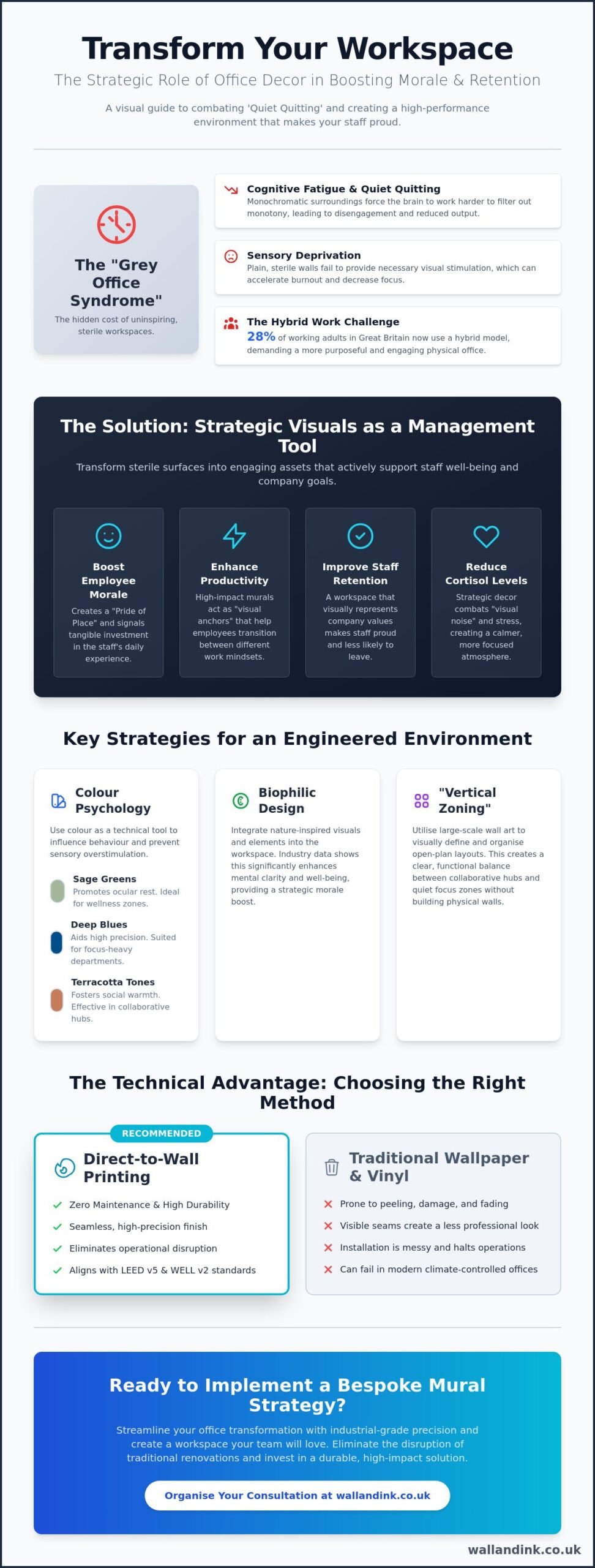
The physical environment dictates human behaviour. In the modern UK workplace, the “Environment-Behaviour” relationship is a measurable metric of operational efficiency. A workspace is not merely a container for desks; it is a psychological trigger that either facilitates focus or induces lethargy. When companies ignore the impact of office decor to improve employee morale, they often fall victim to “Grey Office Syndrome”. This condition, characterised by sterile, monochromatic surroundings, contributes directly to cognitive fatigue. It forces the brain to work harder to filter out the monotony, leading to lower engagement levels and reduced output.
Employee morale is deeply influenced by “Environmental Belonging”. This concept suggests that when an employer invests in high-precision, bespoke wall art or murals, it signals a tangible investment in the staff’s daily experience. By 2026, the traditional “cubicle culture” has been largely replaced by “experiential workspaces”. These environments prioritise the employee experience, turning the office into a destination that staff actually want to visit rather than a location they are forced to inhabit.
Beyond Aesthetics: Why Workspace Environment Affects Retention
A well-designed office environment does more than impress visitors; it actively reduces cortisol levels. High-stress professional settings often suffer from “visual noise” or, conversely, total visual silence, both of which spike stress. By implementing strategic office decor to improve employee morale, businesses create a “Pride of Place”. Employees feel a stronger connection to a brand that visually represents its values through high-quality murals. This sense of pride is a key driver for staff retention. When workers are proud to show off their workspace to peers, they are less likely to seek opportunities elsewhere. Additionally, purposeful wall graphics act as social catalysts, facilitating spontaneous collaboration amongst team members by creating shared points of interest in communal zones.
Combatting Sensory Deprivation in Professional Settings
Sterile environments are often a hidden drain on productivity. Research suggests that plain white walls can actually decrease focus by failing to provide the brain with necessary visual stimulation. This sensory deprivation leads to quicker burnout. To counter this, businesses use visual “anchors”, such as specific, high-impact murals, to help employees mentally transition between different work mindsets. Biophilic design is a strategic morale booster that integrates natural elements into the workspace, with industry data showing that nature-inspired visuals significantly enhance mental clarity for the 28% of UK adults now working in hybrid models.
Strategic Visuals: Using Colour and Imagery to Influence Workplace Behaviour
Strategic imagery serves as a silent directive for staff behaviour. It’s about moving beyond simply “filling a wall” to engineering a mood that supports specific business objectives. Distracting art often fails because it lacks a clear relationship with the work being performed; it creates visual clutter that competes for attention. In contrast, inspiring murals are designed to complement the room’s function. By using office decor to improve employee morale, companies can guide employees through different mental states, from high-focus precision to relaxed social interaction. The goal is to integrate branding so it feels like an organic part of the architecture rather than a temporary marketing brochure.
The Science of Colour: Selecting Palettes for Productivity and Calm
Colour psychology is a technical tool when applied at scale. Large-scale wall applications require a balance between vibrant accents and neutral bases to prevent sensory overstimulation. Consider these specific applications for your workspace:
- Sage Greens: Ideal for wellness zones and breakout areas, these tones promote ocular rest and reduce perceived stress levels.
- Deep Blues: Best suited for departments requiring high precision and analytical focus, such as finance or data centres.
- Terracotta and Warm Earth Tones: These shades foster social warmth and are highly effective in kitchens or collaborative hubs.
In the UK, where natural light is often limited, understanding Light Reflectance Values (LRV) is essential. Choosing wall art with the correct LRV ensures that the space remains bright without causing glare. Pragmatic leaders often choose bespoke commercial wall murals to ensure their branding is integrated with technical precision rather than superficial application.
Narrative Murals: Building a Sense of Belonging Through Brand Storytelling
Generic stock photos often feel hollow and disconnected from a team’s actual experience. Bespoke illustrations, however, allow a firm to visualise its unique history and future goals. This is “Internal Branding” at its most effective. It moves the employee’s perspective from being a name on a payroll to being an essential part of a larger mission. For long-standing UK firms, a timeline mural can be a powerful tool to improve morale. It honours the past whilst pointing clearly toward future growth. By using narrative imagery, you provide a constant visual reminder of collective achievement, which anchors the team during challenging periods. This approach ensures that the office decor to improve employee morale is rooted in the company’s authentic identity.
Comparing Decor Methods: Why Traditional Wallpaper and Vinyl Often Fail
Traditional renovation methods often carry a heavy burden of hidden costs that pragmatic managers frequently overlook. Whilst wallpaper and vinyl decals might seem like standard choices, they are essentially temporary solutions in a high-stakes professional environment. These materials are prone to physical failure. This failure can actively damage the very morale you are trying to build. If your office decor to improve employee morale starts to bubble, peel, or show visible seams, it signals a lack of attention to detail that employees will notice. A workspace that looks neglected after only a year of use fails to inspire confidence or a sense of stability amongst the team.
The hygiene factor has also become a critical consideration for modern facility managers. Traditional wallpaper is porous and features seams that naturally collect dust, grime, and bacteria. These joins are visual disruptions that break the immersion of a mural. In contrast, modern surfaces must be easy to sanitise without the risk of the art lifting or fading. Legacy methods simply don’t offer the durability required for a post-pandemic workplace where cleaning protocols are more rigorous and frequent.
The Pitfalls of Peeling: Durability Issues in High-Traffic Commercial Spaces
Corridors and communal kitchens are high-traffic zones where walls are constantly subjected to physical contact and environmental stress. Standard vinyl decals and traditional wallpaper are ill-equipped for these conditions. In many UK offices, the combination of central heating and air conditioning creates a cycle of expansion and contraction that destroys adhesive bonds. This leads to the “shabby office” look. Once a corner begins to lift, the entire graphic is compromised. Long-term maintenance becomes a headache as you struggle to patch up sections that no longer match the original print. You need a solution that remains pristine despite the daily rigours of a busy professional setting.
Elimination of Disruption: The Case for Direct-to-Wall UV Printing
Direct-to-wall UV printing represents a fundamental shift in how commercial spaces are updated. This technology bypasses the inconveniences of legacy alternatives. There is no glue. There is no mess. There is no lingering chemical odour that forces staff to work from home. By printing directly onto the wall substrate, the ink becomes part of the surface itself. This creates a finish that is both permanent and scratch-resistant. The speed of execution is a primary benefit for busy firms. A large-scale mural can be completed in a fraction of the time required for traditional installation, often whilst the team is away for a break or a meeting. This ensures that your office decor to improve employee morale is implemented with zero impact on your daily operations.
Zoning for Success: Tailoring Wall Art to Different Office Environments
Vertical Zoning is a strategic method for defining space usage without the need for physical barriers or intrusive partitions. Whilst some designers suggest using rugs to outline areas, these are often trip hazards and lack the immediate cognitive impact of a wall-based cue. Walls provide the primary visual landmark in any large building. By using office decor to improve employee morale, you can create distinct atmospheres for different tasks. This approach helps employees navigate the open-plan office, providing clear signals for where high-energy collaboration is encouraged and where silence is mandatory. Strategic murals also assist with wayfinding, using specific imagery to act as intuitive markers in complex corporate layouts.
The rise of hybrid work has made the “video call backdrop” a critical component of office design. With over 28% of UK adults working in hybrid models, the office must serve as a professional studio for virtual meetings. Designing specific walls to act as high-quality backdrops ensures that remote interactions feel cohesive and professional. It’s an effective way to maintain brand standards whilst making staff feel confident during digital presentations. These visual anchors help bridge the gap between physical and remote teams, reinforcing a unified culture regardless of location.
Energising Breakout Areas and Social Spaces
Breakout areas require a different psychological approach than the main work floor. These spaces serve as the “Office Hub”, a centre of gravity where the team can decompress and socialise. Bold, abstract patterns are highly effective here as they stimulate conversation and creative thinking. Many UK firms choose to ground their office in its local context by incorporating murals of regional landmarks or community themes. This connection to the local area fosters a sense of belonging and identity amongst the staff. For these high-traffic social zones, direct-to-wall printing provides the durability needed to withstand the daily wear of a busy kitchen or canteen.
Focus-Driven Designs for Quiet Zones and Meeting Rooms
Quiet zones and meeting rooms demand visual restraint to facilitate deep work and high-stakes decision-making. Minimalist, textured murals provide a sophisticated alternative to plain walls without becoming a distraction. These designs use “Acoustic-Friendly” imagery, where soft textures and organic shapes visually suggest a quieter environment, helping to lower the perceived volume of a room. In meeting rooms, the goal is to impress external clients whilst keeping staff calm and focused during pitches. By selecting subtle, high-precision graphics, you create a space that feels authoritative and professional, ensuring that your office decor to improve employee morale supports every aspect of the business day.
Implementing a Bespoke Mural Strategy with Wall & Ink
Execution is the final, critical stage in any plan involving office decor to improve employee morale. Whilst the psychological and strategic foundations are essential, the technical quality of the application determines the long-term success of the project. Bespoke design is superior to generic, “off-the-shelf” prints because it allows for a precise alignment with your corporate identity. Generic art often feels like a superficial addition; bespoke murals feel like an integral part of the building’s architecture. Our industrial-grade process ensures that every graphic is a permanent asset rather than a temporary fix. This method is highly versatile, allowing for direct application onto various substrates, including plaster, brick, and wood, without the need for additional primers or adhesives.
The transition from a conceptual strategy to a physical mural requires technical expertise. By using office decor to improve employee morale, you are making a statement about your company’s standards. Our process utilizes UV-cured inks that are instantly dry and completely odour-free. This ensures that your workspace remains functional throughout the installation. Pragmatic decision-makers value this efficiency, as it eliminates the traditional hassles associated with paint fumes or messy glue applications. The result is a high-precision finish that maintains its integrity in even the most demanding commercial environments.
From Digital Visualisation to Precision Execution
Architectural scale is a primary consideration during our design consultations. A mural that looks effective on a computer screen must be carefully adapted to fit the physical dimensions of your office. We provide high-resolution digital mock-ups before the first drop of ink hits the wall, allowing you to visualise the impact on your team’s environment. This transparency ensures that the final result meets your exact specifications. Our commitment to a “Zero-Disruption” installation means we work around your schedule, providing a seamless transformation for busy UK businesses that cannot afford operational downtime.
The Benefits of UV Ink Technology for Modern Workplaces
Modern offices often feature large glass fronts and sun-drenched atriums, which can cause traditional prints to fade over time. Our UV-cured inks offer exceptional lightfastness, ensuring that your investment remains vibrant for years. These inks are also eco-friendly, boasting low VOC credentials that protect indoor air quality and align with current health standards. Our UV printers can reproduce any digital image with 100% colour accuracy. This level of mechanical superiority ensures that your brand colours are represented with absolute precision, reinforcing a sense of professionalism and stability throughout the workspace.
Engineering a Future-Proof Workplace Culture
Transforming your workspace from a sterile environment into a high-performance hub is a strategic necessity. You now understand that office decor to improve employee morale is not about superficial aesthetics but about psychological anchoring and functional zoning. By moving away from the disruption of traditional wallpaper and the fragility of vinyl, you choose a solution that matches the permanence of your company’s mission. Strategic visuals and narrative murals serve as silent management tools that reinforce belonging whilst supporting the diverse needs of a hybrid workforce.
Wall & Ink provides the technical precision required for this transition. Our direct-to-wall printing offers UV-cured durability for high-traffic zones, ensuring your investment remains pristine. We include bespoke design visualisation to guarantee architectural alignment before the zero-mess, odour-free installation begins. It is time to eliminate the “grey office” and replace it with a space that inspires pride and retention. Transform your office morale with a bespoke Wall & Ink mural today and create a workplace where your team can truly thrive.
Frequently Asked Questions
Does office decor really affect employee productivity and morale?
Workspace aesthetics have a measurable impact on performance, with data indicating that well-designed environments can increase productivity by up to 17%. By strategically using office decor to improve employee morale, you actively combat “Grey Office Syndrome” and reduce cognitive fatigue. A purposeful environment signals that an employer values the staff’s daily experience, which is a critical factor for retention in the modern hybrid work market.
What is the most durable type of wall decor for a busy office?
Direct-to-wall printing using UV-cured ink is the most durable solution for high-traffic commercial environments. Unlike vinyl decals or traditional wallpaper, which often peel or bubble due to temperature fluctuations in UK offices, UV ink becomes a permanent part of the wall substrate. It is scratch-resistant and remains pristine in corridors and kitchens where physical contact is frequent and unavoidable.
How can I decorate my office walls without disrupting the working day?
You can transform your workspace with zero operational downtime by choosing direct-to-wall UV printing technology. This method requires no adhesives, solvents, or primers, meaning there are no lingering chemical odours or messy cleanup. The process is efficient enough to complete large-scale graphics whilst your team is away for a lunch break or attending an off-site meeting.
Is wall printing better than traditional wallpaper for commercial spaces?
Wall printing is technically superior to wallpaper for professional applications because it eliminates visible seams and the risk of adhesive failure. In climate-controlled rooms, wallpaper often bubbles or lifts at the edges over time. Direct-to-wall printing is also a non-porous solution that is easier to sanitise, making it a more hygienic choice for post-pandemic professional settings.
Can I include my company logo and brand colours in a custom wall mural?
Industrial UV printing technology allows for the integration of logos and brand assets with 100% colour accuracy. This is a primary component of office decor to improve employee morale, as it facilitates “Internal Branding” and reinforces a shared mission amongst the team. We can reproduce any high-resolution digital file directly onto plaster, brick, or wood surfaces with absolute precision.
How long does it take to install a large-scale wall mural in an office?
Installation is significantly faster than legacy methods, often taking only a few hours for a standard-sized mural. Whilst hand-painted murals take days and wallpaper requires drying time, direct-to-wall printing is dry the moment it is applied. This efficiency ensures your project is completed with industrial precision and avoids the disruption of traditional renovations.
What kind of designs are best for improving mental health in the workplace?
Biophilic designs and “resimmercial” aesthetics are the most effective for supporting mental health and well-being. Incorporating sage greens, natural textures, and imagery of local UK landscapes helps align your office with WELL v2 and LEED v5 standards. These elements are proven to reduce cortisol levels and provide essential visual rest for employees during high-pressure tasks.
Is direct-to-wall printing easy to clean and maintain?
Direct-to-wall printing is exceptionally easy to maintain and can be cleaned with standard, non-abrasive detergents. Because the ink is cured directly onto the wall surface, there are no edges to lift or delicate layers to tear. This creates a long-lasting, low-maintenance finish that prevents the “shabby office” look often associated with peeling vinyl or bubbling wallpaper.