
The era of relying on vinyl wraps or hand-painted murals for high-traffic business facades is officially over. Most pragmatic decision-makers know the frustration of seeing a significant investment in commercial exterior wall art UK succumb to the British weather. You’ve likely dealt with vinyl peeling in the rain or hand-painted colours fading after just one summer of UV exposure. It’s a cycle of maintenance and replacement that compromises your professional image, particularly as the UK wall art market is projected to reach a revenue of US$ 6,741.2 million by 2033.
This guide demonstrates why direct-to-wall UV printing is now the superior choice for durable branding. You’ll discover how this industrial-grade technology provides a maintenance-free, high-resolution finish that bonds directly to your building’s substrate. We’ll examine the technical advantages of UV-cured inks, the elimination of traditional hassles like scaffolding, and how to achieve a brand presence that remains sharp for years without fading or bubbling.
Key Takeaways
- Identify the technical reasons why direct-to-wall UV printing achieves a permanent chemical bond with external substrates, outperforming traditional stickers and paint.
- Compare the long-term lifespans of various branding solutions to understand why commercial exterior wall art UK is now considered a durable architectural feature.
- Learn how digital visualisation and precise scaling ensure that large-format graphics maintain high-resolution impact across vast street-level distances.
- Discover the logistics of a nationwide on-site service that eliminates the need for scaffolding and minimises disruption to your daily business operations.
Defining Commercial Exterior Wall Art for UK Businesses
The concept of branding a business facade has moved beyond the static, plastic lettering of the past. Modern commercial exterior wall art UK now functions as an integrated architectural element rather than a temporary after-thought. Whilst traditional methods relied on mounting physical boards or applying adhesive vinyl, direct-to-wall UV printing applies pigment directly to the substrate. This process creates a permanent bond with brick, concrete, or render, ensuring the artwork becomes part of the building’s fabric rather than a layer sitting on top of it.
Pragmatic property owners are moving away from stuck-on graphics in favour of these integrated solutions. It’s a shift driven by the need for durability and a desire to increase commercial property value through placemaking. Understanding Mural techniques and history shows that large-scale public art has always been a powerful tool for communication. In 2026, the trend is about using the wall as a canvas to create a sense of destination. This isn’t just decoration; it’s a strategic investment in the physical identity of a business premises.
The Shift from Signage to Storytelling
Businesses no longer just display their names; they use exterior walls to communicate brand values. A plain, grey gable end is a wasted asset that could be telling your brand’s story. Retail and hospitality venues are specifically targeting ‘instagrammable’ facades to drive organic social media engagement. However, generic garden art fails to meet professional standards. Commercial environments require high-resolution, industrial-grade finishes that maintain their integrity under scrutiny. If the art looks cheap, the brand looks cheap. Direct-to-wall printing ensures that even complex, photorealistic imagery remains sharp and professional.
Key Commercial Sectors Benefiting from Exterior Murals
Several sectors have identified the high-impact potential of direct-to-wall printing. The applications are diverse, but the goal is consistent: professional-grade visual impact.
- Retail and shopping centres: These environments use large-scale murals to drive footfall. By creating a visual landmark, they turn a standard shopping trip into a memorable experience.
- Corporate offices: National organisations use exterior art to reinforce identity across multiple sites. It’s an efficient way to ensure brand consistency on a massive scale without the logistical nightmare of traditional painting.
- Hospitality and leisure: Pubs and hotels use unique exterior atmospheres to stand out in crowded local markets. A high-resolution mural creates an immediate point of difference that attracts customers from the street.
For commercial property owners, the goal is often a holistic upgrade to the building’s exterior. This can include pairing high-impact wall graphics with professionally installed ground surfaces; Scott Patterned Concrete provides detailed guides on how to ensure these decorative concrete elements remain durable and well-maintained in the UK climate.
By treating the building as a primary branding tool, businesses eliminate the need for repetitive signage replacements. It’s a modern solution that prioritises long-term reliability and visual precision over the temporary fixes of the past.
The Science of Durability: How UV Printing Survives the British Climate
The British climate is notoriously aggressive toward exterior graphics. Rain, frost, and high humidity levels constantly test the integrity of surface-level applications. For a professional commercial exterior wall art UK installation, durability isn’t just a preference; it’s a technical requirement. Direct-to-wall UV printing addresses these challenges through industrial-grade chemistry rather than traditional painting methods. It’s a chemical bond, not a sticker.
Ink Technology and Surface Bonding
The core of this durability lies in a photochemical reaction called curing. Unlike traditional paint that dries through evaporation, UV-curable inks harden instantly when exposed to high-intensity ultraviolet light. This process creates a resilient polymer that is chemically bonded to the surface. According to UK guidance on UV-curable inks, the safe and precise handling of these materials ensures a finish that is significantly more robust than standard air-dried pigments.
Because the ink cures in milliseconds, there is no opportunity for dust or moisture to interfere with the finish. This eliminates the need for a separate protective topcoat. In traditional murals, these topcoats often yellow or crack over time; UV printing removes this point of failure entirely. The result is a clean, precise application that maintains its colour saturation even under the persistent UV exposure of south-facing walls. This technology allows for a lifespan of up to five years with proper protection, far outperforming the rapid fading seen in hand-painted alternatives.
Substrates and Architectural Challenges
A common misconception in the industry is that high-resolution art requires a perfectly smooth surface. Some competitors suggest that metal panels are the only way to achieve long-term outdoor results. Direct-to-wall technology proves otherwise. The printer heads are designed to manage the irregularities of brick, concrete, and render. It’s a solution that respects the texture of the building whilst providing the sharp imagery usually reserved for indoor displays.
One critical advantage of this method for commercial exterior wall art UK is breathability. Vinyl wraps and certain thick masonry paints create an airtight seal over the building. This can trap moisture within the bricks, leading to damp or structural spalling during freeze-thaw cycles. UV printing is porous at a microscopic level. It allows the masonry to ‘breathe’ naturally, ensuring the artwork doesn’t compromise the building’s structural health. If you are looking for a long-term branding feature that respects your architecture, you can explore our exterior wall printing services to see how we handle diverse architectural substrates.
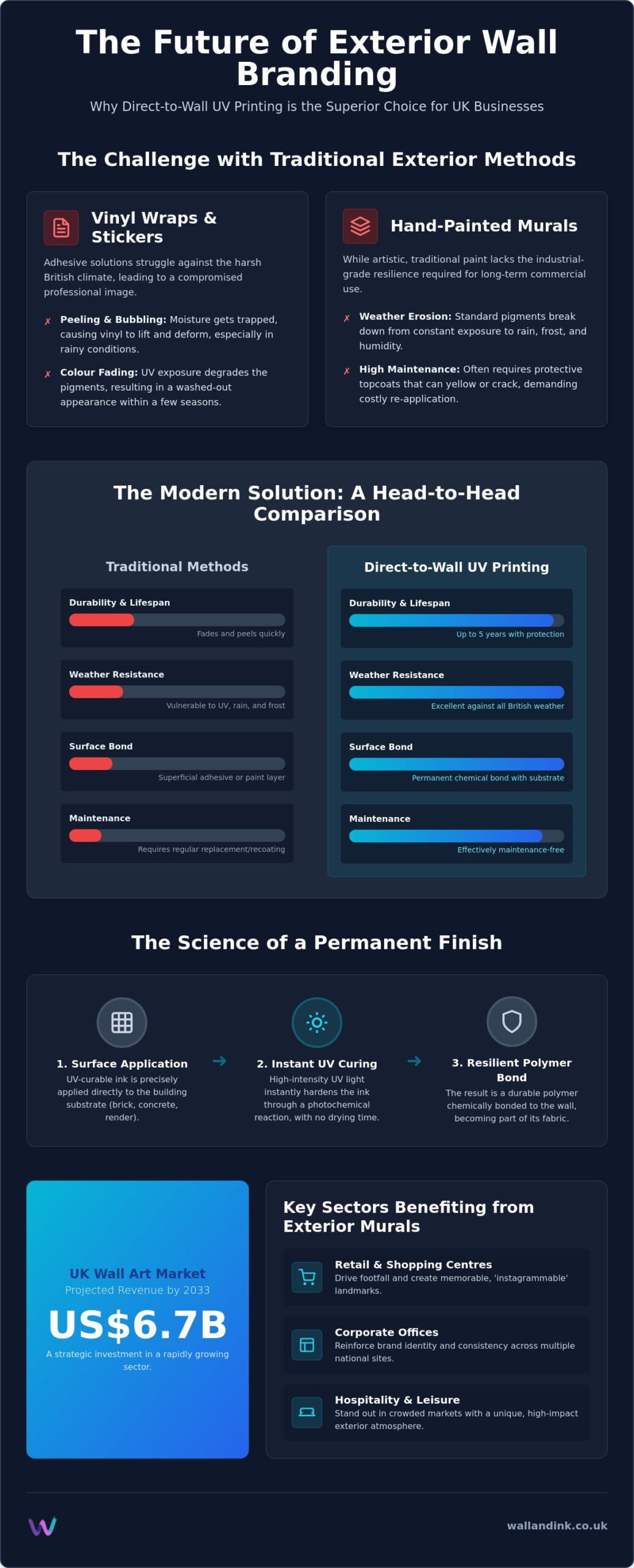
Comparing Exterior Solutions: Direct-to-Wall Printing vs Vinyl Wraps
Choosing the right medium for commercial exterior wall art UK is a decision that dictates both the long-term aesthetic and the total cost of ownership. Whilst vinyl wraps have been a common choice for temporary signage, they often fail to meet the standards required for permanent architectural branding. The primary difference lies in the application method: vinyl is an adhesive-backed plastic sheet, whereas direct-to-wall printing is an industrial pigment application that becomes part of the building’s surface. This distinction has significant implications for durability, visual quality, and compliance with UK government guidance on outdoor advertisements.
The Problem with Vinyl in Commercial Settings
The ‘peel and stick’ method of vinyl application is fundamentally unsuitable for porous exterior walls like brick or render. Over time, the British weather causes the adhesive to degrade; this leads to bubbling, peeling, and the accumulation of dirt behind the film. Beyond these physical failures, vinyl presents a significant hurdle for corporate ESG (Environmental, Social, and Governance) goals. Most wraps are PVC-based, contributing to plastic waste when they inevitably need replacement. Direct-to-wall printing is a plastic-free alternative that applies ink directly to the masonry, avoiding the ‘sticker’ look that can cheapen the appearance of high-end commercial properties.
Cost-Efficiency Over the Product Lifecycle
Pragmatic business owners look beyond the initial invoice to the total lifecycle of the installation. Traditional vinyl or hand-painted murals often require recurring maintenance or full replacement every 12 to 24 months due to UV degradation or weather damage. In contrast, UV-cured prints are designed for longevity, with some providers offering warranties of up to two years and an expected lifespan of five years with proper protection. This durability ensures that the high-resolution brand imagery remains sharp without the need for constant touch-ups.
- Installation Speed: Our specialized printing equipment operates without the need for complex scaffolding in many scenarios, significantly reducing site disruption.
- Maintenance: Unlike vinyl, which can tear, or paint, which can flake, UV prints are highly resistant to physical abrasion and can be cleaned easily with standard low-pressure methods.
- Resolution: Direct printing maintains 100% colour depth even on rough architectural textures where vinyl would struggle to adhere.
Direct-to-wall UV printing delivers a superior return on investment by providing a permanent architectural branding feature that eliminates the recurring replacement and labour costs associated with temporary vinyl alternatives. By opting for a solution that handles rain, frost, and humidity at a chemical level, businesses ensure their exterior presence remains a professional asset rather than a maintenance liability.
Strategic Design: Maximising Brand Impact on External Surfaces
Successful execution of commercial exterior wall art UK requires a transition from graphic design to architectural integration. A design that looks effective on a desktop monitor rarely translates perfectly to a thirty-meter gable end without careful recalibration. The process must account for viewing distances, atmospheric conditions, and the unique physical geometry of the building. It’s about ensuring the brand message remains legible from across a busy high street whilst maintaining its professional finish upon closer inspection.
The Digital Visualisation Workflow
Pragmatic decision-makers require certainty before committing to large-scale exterior changes. Our workflow prioritises digital visualisation to ensure stakeholders can approve a realistic mock-up of the final installation. This stage involves superimposing the artwork onto high-resolution photographs of the site. It’s a critical step for adapting corporate logos to massive formats; often, fine details need simplifying to maintain impact at scale. We focus on the relationship between resolution and distance, ensuring that the transition from digital dots to physical meters is seamless and technically precise.
Integrating architectural features like windows, drainage pipes, and vents is a hallmark of professional design. Rather than ignoring these obstructions, we incorporate them into the composition. This prevents the ‘stuck-on’ appearance of traditional signage and reinforces the mural as a permanent architectural feature. If you are ready to see how your brand translates to a large-format surface, you can contact our design team to begin the visualisation process.
Lighting and Environment
The perception of exterior art changes significantly throughout the day. A design must be effective in the flat light of an overcast British afternoon and under the harsh shadows of direct sunlight. We analyse the sun-path and local environment during the design phase to anticipate how shadows from eaves or neighbouring structures might bisect the imagery. This ensures the focal point of the mural remains visible and impactful regardless of the time of day.
Implementing Your Vision: The Wall & Ink National Service
Scaling a brand identity across multiple locations requires a partner with national reach and technical consistency. Our service for commercial exterior wall art UK is designed for businesses that demand industrial precision without the logistical headaches of traditional site work. We manage the entire lifecycle of the project, from the initial digital consultation through to the final on-site printing. This end-to-end approach ensures that the high-resolution imagery approved in your design phase is exactly what appears on your building’s facade.
Facility managers find our process straightforward because it eliminates the most common industry pain points. We provide clear technical specifications regarding wall preparation and site access well in advance of our arrival. Our team is equipped to handle various substrates, including brick and render, ensuring a uniform finish regardless of the building’s age or condition. By treating each project as a technical installation rather than a decorative exercise, we deliver results that meet the highest professional standards.
Our Professional Installation Standards
Safety and site management are central to our operational protocol. When delivering commercial exterior wall art UK, we adhere to strict Health and Safety guidelines, particularly when working at height. Our equipment is compact and efficient, often allowing us to work in public spaces with minimal disruption to footfall or daily business operations. We don’t require the extensive site hoarding or long-term scaffolding often associated with hand-painted murals.
Our ‘no-mess’ promise is a direct result of our UV technology. Unlike traditional painting, which involves wet pigments, drips, and chemical odours, our UV-curable inks are dry the millisecond they touch the wall. There is no risk of overspray or environmental contamination. Once the print is complete, our team leaves the site clean and ready for immediate use. Every installation is backed by a durability guarantee, providing long-term reassurance that your investment will withstand the British elements.
Getting Started with Your National Project
We operate with radical transparency regarding our pricing and processes. To begin, we require basic site information and your digital assets. We provide quotes based on square-footage metrics, allowing for accurate budgeting across single sites or national portfolios. This clarity ensures that pragmatic decision-makers can calculate their return on investment without hidden consultation fees or unexpected site costs.
Preparing for an installation is simple. Our bespoke design team will review your high-resolution files to ensure they are optimised for large-format architectural printing. We then coordinate with your facility managers to schedule the on-site execution at a time that minimises business downtime. If you are ready to transform your building’s facade into a durable brand asset, Contact Wall & Ink for a bespoke commercial quote today.
Future-Proofing Your Business Exterior with Industrial Precision
Adopting advanced UV printing technology ensures that your branding becomes a permanent architectural feature rather than a temporary addition. This guide has detailed how direct-to-wall application eliminates the traditional failures of vinyl and hand-painted art, providing a finish that is both durable and high-impact. By choosing commercial exterior wall art UK specialists, you secure high-resolution results that maintain their integrity against rain, frost, and UV exposure. Our national service coverage and bespoke digital visualisation ensure that every project is executed with methodical accuracy and zero site disruption.
Investing in your building’s facade is a strategic move that enhances property value and drives brand recognition. It’s an efficient way to communicate professional standards whilst removing the recurring costs of maintenance and replacement. If you’re ready to upgrade your premises with a solution designed for the long term, we’re here to help you execute that vision with technical excellence.
Transform your building with a professional Wall & Ink mural
Your exterior is the first point of contact for every customer; make sure it reflects the innovation and reliability of your business.
Frequently Asked Questions
Can you print on old or uneven brick walls?
Yes, our direct-to-wall technology is specifically designed to handle architectural irregularities. The printer sensors maintain a consistent distance from the substrate, allowing for high-resolution imagery on brick, stone, and textured render. This precision eliminates the need for the perfectly smooth surfaces required by vinyl wraps or mounted boards.
How long does commercial exterior wall art actually last in the UK?
UV-cured murals typically have a potential lifespan of up to five years when provided with proper environmental protection. This durability is significantly higher than traditional hand-painted murals which often fade within two seasons of UV exposure. Some industry providers offer a two-year warranty on outdoor UV prints to ensure long-term brand consistency.
Is the UV printing process waterproof immediately after application?
Yes, the ink is waterproof and fully cured the millisecond it is applied to the wall. Because we use high-intensity ultraviolet light to trigger a photochemical reaction, the pigment bonds instantly with the surface. This means a sudden British rain shower during installation won’t smudge or damage the finished commercial exterior wall art UK.
How much does commercial exterior wall art cost per square metre?
Pricing for industrial-grade wall printing is calculated using square-footage metrics and depends on factors such as substrate type, site access, and design complexity. We provide transparent, bespoke quotes once we’ve assessed your specific project requirements. This approach ensures you only pay for the exact coverage area without hidden consultation fees or unexpected costs.
Do I need planning permission for a commercial exterior mural in the UK?
Planning requirements depend on the content and location of the artwork. If a mural includes business logos or commercial references, it is often classified as an advertisement under the Town and Country Planning Regulations 2007 and requires an Advertisement application. Stricter rules apply to listed buildings or conservation areas where specific consent is mandatory.
What happens if the wall gets damaged or graffitied?
UV-cured prints are highly resistant to physical abrasion and can be cleaned using low-pressure methods. Whilst no surface is entirely immune to vandalism, the durable nature of the polymer bond makes the artwork more resilient than traditional paint. Minor structural repairs to the masonry can often be touched up to maintain the visual integrity of the mural.
Can the print be removed if the business rebrands or moves?
Direct-to-wall printing is a permanent architectural feature rather than a temporary sticker. If a rebrand is required, the surface can be prepared and painted over using standard masonry paint, providing a fresh canvas for new graphics. This differs from vinyl, which must be peeled off and often leaves adhesive residue or damage behind.
Is the ink environmentally friendly for corporate ESG reporting?
Yes, direct-to-wall UV printing is a plastic-free branding solution that helps businesses meet their environmental and sustainability targets. Unlike PVC-based vinyl wraps that contribute to landfill waste, UV-curable inks are applied directly to the building. The process is also cleaner than traditional solvent-based painting, producing fewer volatile organic compounds during the application.