
Why settle for the temporary nature of adhesive vinyl or the inevitable mess of hand-painted murals when industrial precision can solve both? Most project managers and homeowners have experienced the frustration of peeling edges or bubbling wallpaper that undermines a professional environment. You likely want a permanent solution that is as durable as the building itself, whilst avoiding the logistical nightmare and clutter of traditional installation methods.
This technical guide explains the direct to wall printing process, showing how advanced UV technology transforms digital designs into high-definition art on almost any vertical surface. We promise to show you how this method achieves surgical accuracy on substrates ranging from textured brick to smooth glass without the typical disruption of a construction site. We’ll preview the mechanical steps involved, the science of instant curing, and why this industrial approach provides a mess-free, long-lasting alternative to legacy wall treatments.
Key Takeaways
- Understand how industrial UV light technology ensures instant ink curing for a smudge-free, high-definition finish on vertical surfaces.
- Learn the methodical technical steps involved in the direct to wall printing process, from bespoke digital design to mechanical execution.
- Discover the unique versatility of this method, which allows for precise application on challenging substrates including brick, glass, and bare plaster.
- Explore the superior durability of UV-cured murals that offer higher scratch and fade resistance than traditional hand-painted alternatives.
- Identify why digital wall printing provides a cleaner, more reliable installation compared to the inevitable mess of wallpaper or peeling vinyl.
Understanding the UV Direct-to-Wall Printing Technology
Direct-to-wall printing is a specialised application of digital printing technology that eliminates the need for intermediate substrates like paper or vinyl. At its core, the direct to wall printing process relies on a computer-controlled inkjet system mounted on a vertical track. Unlike traditional methods that involve adhesive layers, this technology applies pigment directly to the wall surface. The result is a breathable, permanent finish that won’t bubble, peel, or degrade over time. It represents a significant shift from temporary vinyl decals toward durable, industrial-grade wall art that integrates with the building’s architecture.
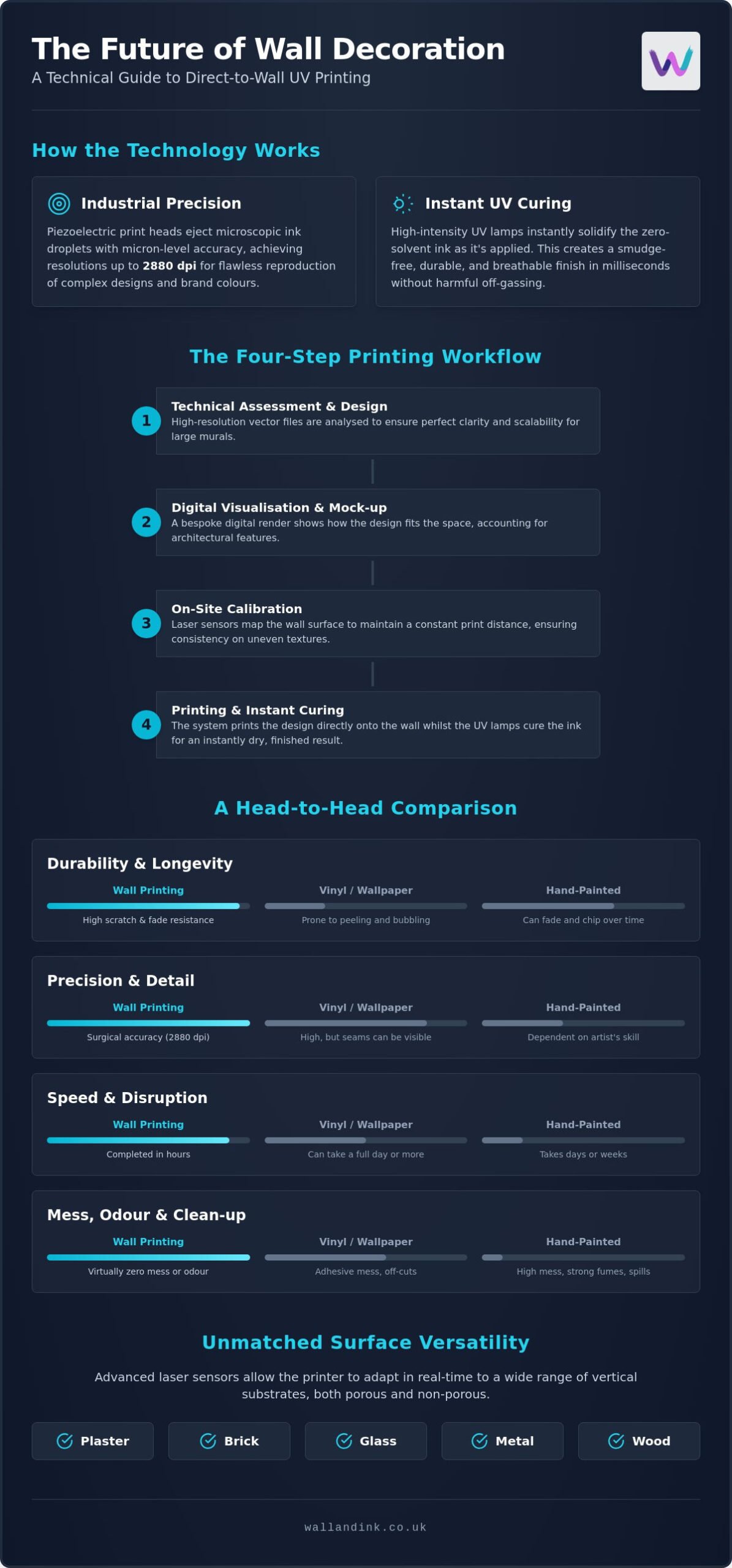
The mechanical heart of the system is the piezoelectric print head. These components are the gold standard for high-resolution murals because they use electric charges to eject microscopic ink droplets with extreme consistency. This allows for a print resolution of up to 2880 dpi, ensuring that even the most complex digital designs are rendered with total clarity. By bypassing the limitations of manual application, this technology provides a reliable solution for decision-makers who require high-quality results without the typical mess of traditional decorating.
The Science of UV-Cured Inks
The defining feature of this technology is the use of Ultraviolet (UV) light to cure the ink. As the print head moves across the surface, high-intensity UV lamps follow immediately behind it. This triggers a chemical reaction known as polymerisation, which transforms liquid ink into a solid film in milliseconds. Because the curing is instant, the ink doesn’t have time to spread or smudge, even on non-porous materials like glass or polished metal. These inks are typically zero-solvent formulations. This is a critical advantage for high-traffic environments like schools and hospitals, as it ensures superior indoor air quality without the off-gassing associated with traditional paints or solvent-based inks.
Industrial Precision vs. Manual Painting
Manual murals often suffer from human error, inconsistent line weights, or subtle deviations in brand colours. Digital wall printing removes these variables through mechanical superiority. The system achieves micron-level accuracy, ensuring that the final output matches the digital file with surgical precision. This level of control allows for the perfect reproduction of complex logo geometries and corporate brand colours that are often impossible to replicate by hand. Whilst a manual painter might take days to complete a complex design, a professional wall printer delivers high-definition results in hours, maintaining a level of detail that remains sharp even upon close inspection.
Just as architectural murals require specific industrial tools for accuracy, other precision-led industries rely on specialised suppliers; for instance, artists in the tattoo industry can discover Tatt Lab for professional-grade equipment and medical-grade supplies.
The Step-by-Step Wall Printing Workflow
Success in the direct to wall printing process begins long before the machine arrives on site. It starts with a rigorous technical assessment of your digital assets. To achieve high-definition results, we require high-resolution files, ideally in vector format. This allows for infinite scaling without any loss of detail or clarity. This preparation ensures that a logo appearing on a small screen maintains its geometric integrity when expanded to a five-metre mural. By verifying the quality of the source file early, we guarantee a final result that meets industrial standards for precision.
Digital Visualisation and Mock-ups
We provide bespoke digital renders that show exactly how the mural will sit within your environment. This visualisation phase accounts for architectural features like light switches, radiators, or door frames that might interfere with the design. By adjusting the scale and positioning digitally, we eliminate the guesswork associated with traditional decorating. You’ll receive a precise mock-up for approval, ensuring the final installation aligns perfectly with your spatial requirements. If you’re ready to see how a design fits your space, you can view our commercial wall murals for inspiration.
Machine Setup and Surface Sensing
Once on site, the focus shifts to mechanical calibration. The printer operates on a modular rail system that must be perfectly levelled to ensure stable horizontal and vertical movement. Modern units utilise advanced laser sensors to detect wall irregularities in real-time. These sensors adjust the print head’s position to maintain a constant distance from the substrate, even on uneven brick or textured plaster. This prevents smudging and ensures consistent ink density across the entire surface. We then establish a “zero point,” which serves as the absolute coordinate for the entire design to ensure the machine knows its exact location in space.
The actual printing phase is a display of industrial-grade UV-curable inkjet technology in action. The vertical gantry moves with millimetre precision, guided by the software to deposit ink exactly where the digital map dictates. This methodical approach guarantees that the print starts and finishes exactly where intended, delivering a level of accuracy that manual methods simply cannot replicate. It’s a clean, quiet, and efficient operation that allows for immediate use of the room once the machine is packed away. The process is surgically clean, leaving no residue, dust, or paint fumes behind.
Surface Versatility: From Bare Plaster to Industrial Brick
Whilst traditional wall treatments require perfectly smooth, primed surfaces, the direct to wall printing process is engineered for the physical reality of modern architecture. This technology bypasses the limitations of adhesive vinyl, which often fails on porous or uneven substrates. Our industrial printers achieve high-definition results on a diverse range of materials, including concrete, timber, and even corrugated metal. This versatility makes the service ideal for environments where traditional decorating is impractical or prone to failure.
Bare plaster represents one of the most efficient applications for this technology. In UK new builds, waiting for plaster to fully cure and then applying multiple mist coats is a time-consuming necessity for traditional painters. Our process allows for the application of complex murals directly onto dry, bare plaster. This eliminates the need for base painting whilst providing a permanent, breathable finish that integrates with the wall. Beyond standard drywall, we frequently execute projects on non-traditional substrates such as glass partitions, ceramic tiles, and stainless steel, where the instant UV curing ensures total ink adhesion without the risk of running or smudging.
Preparing the Surface for Printing
The mechanical reliability of the print head depends on a strictly clean environment. We follow a “clean and dry” rule because microscopic dust particles are the primary enemy of precision inkjet components. Before the process begins, the substrate must be free from loose debris and oils. When printing on dark or transparent surfaces like glass, we utilise a multi-layer white underprint. This creates an opaque base that ensures brand colours remain vibrant and accurate regardless of the background shade. For fresh plaster, a technical moisture check is essential. Printing on damp walls can compromise the polymerisation of the ink, so we verify that the substrate is sufficiently dry before calibration starts; if you encounter persistent moisture issues, you can visit SEALTIGHT UK for specialist damp-proofing services.
Printing on Challenging Textures
Handling textured surfaces like brickwork or stone requires a high degree of mechanical control. The ink doesn’t just sit on top of the bricks; it effectively “wraps” around the texture, following the contours of the mortar joints to create a rustic, integrated look. We rely on the advanced laser sensors mentioned earlier to maintain a precise distance from these uneven surfaces. This prevents the print head from making physical contact with the wall whilst ensuring the ink droplets land with surgical accuracy. There is also a technical distinction between matte and gloss finishes. Whilst matte surfaces provide excellent natural grip, non-porous gloss finishes often require a specific chemical primer to ensure the UV ink bonds permanently to the surface.
Durability and Maintenance of UV-Cured Murals
Traditional wall graphics often fail because they rely on surface-level adhesion. In contrast, the direct to wall printing process creates a permanent polymer bond with the substrate. This chemical integration results in exceptional scratch resistance that far exceeds standard emulsion paint or delicate vinyl wraps. In high-traffic commercial environments like school corridors or retail centres, these murals withstand daily contact without scuffing or peeling. Because the ink is cured instantly by high-intensity UV light, it forms a hard, durable shield that’s inherently resistant to mechanical damage.
Fade resistance is another technical advantage of this industrial method. Traditional pigments often degrade when exposed to direct sunlight, leading to washed-out colours within months. UV-curable inks are engineered to remain vibrant for 4 to 8 years indoors, with some professional environments reporting clarity for up to 20 years. This longevity ensures your investment retains its visual impact without the need for frequent touch-ups or replacements. These inks are also VOC-free. This lack of volatile organic compounds makes the process safe for healthcare and educational settings where air quality is a priority.
Cleaning and Aftercare
Maintaining the visual quality of a UV mural is straightforward. Because the ink is fully polymerised, it doesn’t require additional lamination or varnishing to protect the design. You can clean the art using a soft, damp cloth and mild detergent to remove surface dust or fingerprints. It’s vital to avoid harsh abrasive chemicals or solvent-based cleaners, as these can eventually degrade the polymer bond. This low-maintenance profile is a primary reason why industrial wall printing is preferred over traditional murals that require protective topcoats.
Removing or Changing the Design
The process is also designed for long-term flexibility. Unlike vinyl decals that leave behind stubborn adhesive residue or can damage the underlying plaster during removal, UV prints are easily updated. When a rebrand or aesthetic change is required, you simply paint over the mural with a standard primer and emulsion. This makes the surface a clean slate for a new design without the labour-intensive scraping or wall repairs associated with wallpaper. Refreshing a professional environment with a new print is a fast, efficient task that minimises downtime. If you’re ready to upgrade your space, you can contact our team for direct-to-wall printing to discuss your requirements.
Why Choose Professional Wall Printing Over Traditional Alternatives?
Traditional decorating methods are often defined by their eventual failures. Wallpaper inevitably peels at the seams, whilst vinyl decals bubble and lift as the adhesive degrades over time. The direct to wall printing process eliminates these vulnerabilities by removing the physical layer between the design and the substrate. Because the ink is deposited directly onto the surface, there are no edges to catch or seams to align. It represents a permanent architectural upgrade rather than a temporary surface covering. This industrial approach ensures that the art remains an integral part of the wall for years, avoiding the common maintenance cycles associated with legacy alternatives.
Speed and precision also distinguish this technology from manual methods. A complex hand-painted mural can take a specialist artist days or even weeks to complete, often with variations in quality. In contrast, our digital system delivers high-definition results in a fraction of the time, maintaining total consistency across the entire installation. This efficiency is particularly valuable for commercial projects where minimising downtime is a priority. You don’t have to wait for paint to dry or for wallpaper paste to set; the UV curing is instant, allowing the space to be returned to full use immediately after the machine is packed away.
A Mess-Free Installation Experience
One of the most significant advantages of this process is the surgical cleanliness of the installation. Traditional wallpapering and painting involve water, paste, drop cloths, and often strong chemical smells. Our method requires no liquid adhesives and produces no dust or fumes. This allows us to work in occupied offices, active retail spaces, or busy schools without causing major disruption to daily operations. The environmental benefit is also clear; because the ink is applied with digital precision, there is virtually no waste material to dispose of compared to the offcuts and packaging associated with vinyl or wallpaper.
The Wall & Ink Bespoke Approach
We provide a national UK service that prioritises industrial reliability and technical excellence. Our approach is built on transparency and precision, ensuring that the high-definition art you approve during the digital visualisation phase is exactly what appears on your wall. We manage the entire journey, from initial consultation to the final UV-cured result, providing a consistent standard of quality across every project. If you’re looking for a durable, high-impact solution for your space, you can enquire about your bespoke wall printing project to start the process. This modern method ensures your walls reflect the professional standards of your organisation without the traditional hassles of decorating.
Modernise Your Environment with Industrial Precision
The direct to wall printing process represents a significant advancement in architectural decoration, replacing the mess and temporary nature of traditional methods with surgical accuracy. By utilising professional UV ink technology for instant, durable curing, we ensure that your digital designs become a permanent part of the substrate. This method eliminates the bubbling of wallpaper and the peeling of vinyl, providing a reliable solution for high-traffic schools, retail centres, and professional offices.
Every project includes comprehensive design visualisation to ensure the final result matches your spatial requirements perfectly. Our national UK coverage provides a mess-free, professional installation that respects your operational schedule without the disruption of traditional construction. This industrial approach guarantees that your walls reflect the modern standards of your organisation whilst remaining easy to maintain for years to come.
Transform your space with a custom wall mural from Wall & Ink. We’re ready to help you achieve a high-definition finish that stands the test of time.
Frequently Asked Questions
How long does the direct-to-wall printing process take?
Most projects are completed in a single day. A standard commercial wall printer typically operates at speeds of 2 to 6 square metres per hour depending on the required resolution. This efficiency allows us to finish complex murals in hours rather than days, with the room ready for immediate use once the machine is packed away.
Can you print on uneven or textured walls like brick?
Yes, the technology is designed specifically for textured substrates including industrial brick, stone, and timber. Our machines use advanced laser sensors to maintain a constant distance from the wall, allowing the ink to wrap around contours without smudging. This mechanical precision ensures high-definition results even on non-flat surfaces that would be impossible for vinyl application.
Is the ink used in wall printing safe for schools and hospitals?
The UV-curable inks we use are VOC-free and contain no harmful solvents. Because the ink is cured instantly by ultraviolet light, there is no off-gassing or lingering chemical smell during or after the direct to wall printing process. This makes the service an ideal choice for high-traffic environments where air quality and patient or student health are critical considerations.
Can the wall mural be removed or painted over later?
You can easily update your space by painting over the mural with standard primer and emulsion. Unlike vinyl decals that leave behind stubborn adhesive residue or wallpaper that requires labour-intensive scraping, these prints integrate with the wall surface. A simple coat of paint returns the substrate to a blank slate for future rebranding or aesthetic changes.
Does the wall need special preparation before the printer arrives?
Walls must be clean, dry, and free from loose debris or oils. Whilst special primers aren’t always necessary for standard plaster, we perform a technical assessment of every substrate. For non-porous surfaces like glass or metal, we may apply a specific bonding agent to ensure the UV ink adheres permanently and maintains its scratch-resistant properties.
How durable is the print in a high-traffic area?
UV-cured prints are exceptionally durable and resistant to both scratches and fading. In commercial settings like corridors or reception areas, these murals typically last 4 to 8 years without signs of wear. The instant polymerisation process creates a hard shield that withstands daily contact far better than traditional paint or delicate adhesive wraps.
Can you print on glass or metal surfaces?
Yes, our industrial printers can apply graphics directly to glass partitions, stainless steel, and ceramic tiles. We typically use a multi-layer white underprint to ensure colours remain vibrant and opaque on transparent or dark materials. This versatility allows for consistent branding across diverse architectural elements within a single professional facility.
Is wall printing more expensive than wallpaper?
Whilst the initial cost may be higher than generic wallpaper, wall printing is often more cost-effective over a five-year cycle. It eliminates the recurring costs of removal, wall repairs, and replacement associated with peeling vinyl or bubbling paper. You’re investing in a durable, bespoke solution that reduces long-term maintenance expenses and protects the building’s fabric.