
The most sophisticated photo wall murals in 2026 aren’t printed on paper; they are engineered directly into the substrate of your building. For years, the industry relied on vinyl and wallpaper, but these traditional methods often fail when faced with the realities of high-traffic commercial environments or humid residential spaces. You’ve likely dealt with the frustration of visible seams ruining a landscape’s continuity or edges that begin to peel just months after installation.
We understand that you need a solution that prioritises precision and durability without sacrificing aesthetic impact. This guide demonstrates how innovative direct-to-wall UV printing is revolutionising photo wall murals across the UK, offering a seamless and permanent alternative to outdated paper applications. We’ll examine the technical advantages of instant-cure inks, the process of digital visualisation, and how this specialist method achieves high-definition results on challenging surfaces like brick, wood, and concrete.
Key Takeaways
- Understand why direct-to-wall UV printing has superseded traditional wallpaper as the industrial standard for high-durability architectural art.
- Discover how advanced wall printing hardware uses precision sensors and instant-cure UV inks to produce flawless results on almost any internal or external surface.
- Learn how to achieve perfectly seamless photo wall murals that eliminate the peeling and misalignment issues common with manual paper hanging.
- Explore the professional design process required to adapt bespoke branding or high-resolution imagery into large-scale, durable installations.
- Gain clarity on the commissioning journey, from digital visualisation to the transparent price-per-square-metre model used for national UK delivery.
The Evolution of Photo Wall Murals: Moving Beyond Wallpaper
The definition of photo wall murals has undergone a fundamental shift. In the past, a mural was synonymous with “large-scale wallpaper,” a product delivered in numbered rolls and pasted to a surface by hand. Today, we define the modern mural as a bespoke digital art installation. This transition represents a move away from mass-produced paper rolls toward direct-to-substrate UV printing. For pragmatic decision-makers in the UK, the appeal lies in the elimination of traditional hassles. A seamless image creates a powerful psychological impact that panelled graphics simply cannot match. When the eye isn’t interrupted by vertical lines every 50cm, the brain perceives the image as part of the architecture rather than a temporary addition. It creates an immersive environment that feels intentional and high-end.
Why Traditional Wallpaper Murals Often Fail
Traditional paper photo wall murals carry inherent structural weaknesses. Seams are the primary point of failure; as temperature and humidity levels fluctuate in a room, paper expands and contracts. This movement causes gaps to appear or edges to overlap, ruining the image continuity. In high-traffic corridors, kitchens, or bathrooms, moisture often compromises the adhesive, leading to unsightly peeling. There is also the “DIY stress” factor. Aligning complex patterns across multiple panels requires a level of manual precision that is difficult to achieve consistently. Even professional installers struggle with the “stretch” of wet paper. This often results in a finished product that looks amateur rather than professional, with misaligned horizons or broken geometric lines.
The Rise of Direct-to-Wall Printing in the UK
Modern digital printing technology has disrupted the UK interior design market by removing the need for a middleman material like vinyl or paper. By printing directly onto “raw” substrates such as plaster, brick, wood, or even glass, we ensure the artwork becomes a permanent feature of the space. This method has become the preferred choice for commercial and educational environments where durability is non-negotiable. Schools require surfaces that resist scuffs and can be wiped clean, whilst retail spaces need graphics that won’t peel under heavy footfall or air conditioning draughts. Direct-to-wall printing delivers this mechanical superiority. It provides a clean, mess-free installation process that bypasses the need for toxic pastes or lengthy drying times. The result is an industrial-grade finish that respects the texture of the original wall whilst providing high-definition visual clarity. This technical precision allows for a level of detail and longevity that was previously impossible with legacy methods.
The Technical Edge: How Direct-to-Wall UV Printing Works
Direct-to-wall printing is a mechanical process that eliminates the human error inherent in manual application. The printer travels on a precision rail system, using ultrasonic sensors to map the wall’s topography in real-time. This ensures the print head maintains a consistent distance from the surface, even if the substrate is slightly uneven or bowed. It’s a system built for industrial precision, allowing us to execute large-scale designs with a level of accuracy that manual labour cannot replicate.
The science of UV-cured inks is central to the success of modern photo wall murals. Unlike traditional inks that dry through evaporation, UV inks undergo a photochemical reaction when exposed to high-intensity ultraviolet light. They cure instantly. This prevents the ink from “bleeding” into the substrate, which results in sharper lines and deeper colour saturation. Because the ink is dry the moment it hits the wall, there is no risk of smudging or atmospheric contamination during the installation phase.
We achieve pixel-perfect clarity at a scale that traditional printing can’t match. High-resolution imagery is rendered with industrial precision, ensuring that even large-format graphics remain crisp when viewed from a close distance. If you’re planning a project, you can view our technical specifications to see how we manage different wall types and resolutions.
This method is also a victory for sustainability. There is no backing paper to discard and no chemical-heavy paste to manage. We use low-VOC (Volatile Organic Compound) inks, making the process safe for sensitive environments like nurseries or medical facilities. It’s a clean, zero-waste alternative to the traditional decorating industry.
Printing on Any Surface: Versatility Beyond Paper
The machine’s adaptability is its greatest asset. It handles textured surfaces like brick, stone, or breeze block by adjusting its output to fill the recesses of the material. For non-porous substrates like glass or metal, specific primers ensure total adhesion. Research from the UCLA@SPARC Digital/Mural Lab highlights how digital technology is expanding the boundaries of traditional muralism, allowing for complex art on surfaces that were previously considered unprintable. This versatility makes it the only viable solution for exterior murals that must withstand the elements without peeling.
Durability and Longevity of UV Murals
These murals are designed for the rigours of public life. The cured ink is scratch-resistant and fully washable, which is why it’s the preferred choice for high-traffic corridors in schools and hospitals. UV stability is another critical factor. Whilst traditional wallpaper fades and yellows when exposed to direct sunlight, UV-cured inks are chemically resistant to solar degradation. UV-cured ink becomes part of the wall surface. This integration ensures the artwork lasts for years without the need for protective lamination or constant maintenance.
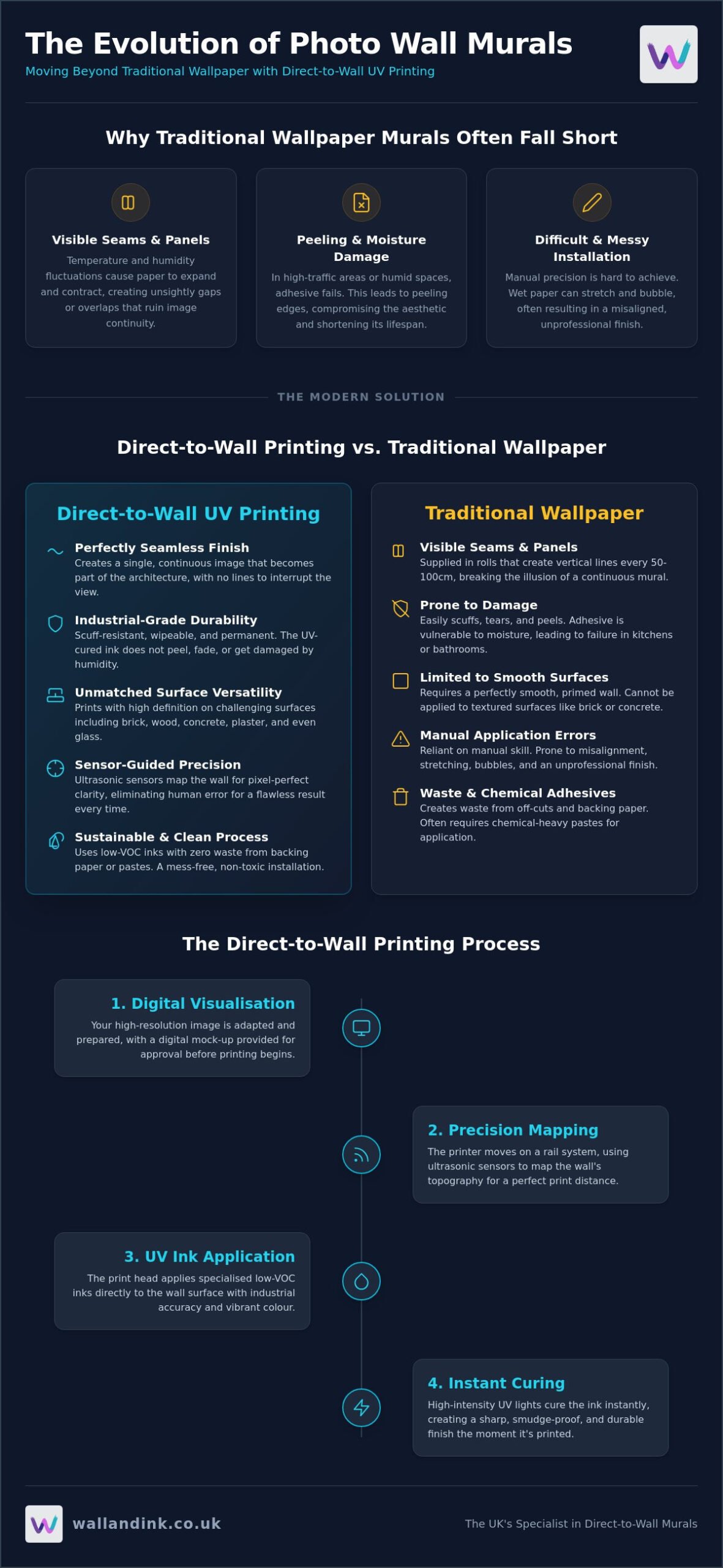
Direct-to-Wall vs. Traditional Wallpaper: A Comparison
When evaluating options for large-scale graphics, the choice between traditional paper and direct-to-wall printing is a choice between legacy limitations and modern engineering. Manual paper hanging is a labour-intensive process that is inherently prone to human error. Even the most skilled decorator cannot prevent the natural expansion of wet paper or the slight misalignments that occur across multiple panels. In contrast, our robotic printing system operates with sub-millimetre precision, completing complex photo wall murals in a fraction of the time required for traditional installation. This efficiency isn’t just about speed; it’s about the total elimination of the mess, toxic pastes, and physical waste associated with paper.
Long-term cost-effectiveness is where the technical gap becomes most apparent. Traditional wallpaper has a finite lifecycle, often requiring replacement every few years as edges lift, corners scuff, or colours begin to fade. Direct UV printing offers a significantly longer service life. Because the ink is integrated into the substrate, it cannot peel or delaminate. Maintenance is similarly straightforward. Whilst textured papers trap dust, oils, and bacteria within their fibres, a printed wall remains a flat, non-porous surface that can be sanitised with standard cleaning agents. This makes it the superior choice for environments where hygiene is a priority, such as healthcare centres or commercial kitchens.
The Seamless Advantage
Seams are the primary failure point in traditional mural design and remain the number one complaint amongst facility managers. Every vertical join creates a visual ‘break’ that disrupts the immersion of the piece. This is particularly problematic for panoramic photography or sophisticated wall mural ideas from designers that rely on clean, expansive horizons. Direct printing maintains the total integrity of the original digital file. By removing the need for panels, we ensure that the finished photo wall murals are delivered as a single, continuous image that respects the architectural lines of the room without the distraction of visible joins.
Environmental Impact and Waste Reduction
Sustainability in the UK construction and design sectors is a critical requirement for 2026. Traditional wallpapering generates significant environmental waste through off-cuts and excess rolls that inevitably end up in landfill. Many vinyl-based options also contain plasticisers and PVC that are difficult to recycle. Direct-to-wall printing is the greener alternative because it uses exactly the amount of ink required for the specific dimensions of the design. There are no discarded trimmings, no chemical-heavy adhesives, and no plastic backing materials. It is a zero-waste solution that aligns perfectly with the environmental targets of modern sustainable builds and corporate social responsibility mandates.
Designing Your Perfect Photo Mural: A Professional Approach
Executing successful photo wall murals requires a technical approach to design that moves beyond simple image selection. When an image is scaled to cover an entire architectural surface, the source file’s resolution becomes the primary determinant of quality. A file that looks acceptable on a computer screen will often pixelate when expanded to four metres in height. We work exclusively with high-resolution digital assets to ensure that every detail remains sharp, from the fine texture of a landscape to the precise edges of a corporate logo.
Bespoke design allows for the seamless integration of branding elements directly into the wall’s architecture. For our commercial clients, this means more than just placing a logo; it involves adjusting colour profiles to match specific brand guidelines and ensuring that graphics complement the existing interior palette. This level of customisation ensures the mural feels like an integral part of the building’s identity rather than a superficial addition. To begin your own project, you can consult with our design specialists regarding file requirements and layout options.
Selecting the Right Imagery for Your Space
Room function dictates the most effective imagery. Landscapes are frequently utilised in healthcare and office environments to provide a sense of depth and reduce the psychological feeling of confinement. Conversely, abstract patterns or geometric “pixel walls” are ideal for retail spaces where the goal is to create a dynamic, high-energy focal point. Scale is equally critical. A common error is choosing an image that is too “busy” for a small room, which can overwhelm the space. We analyse the viewing distance and ambient lighting of your site to recommend themes that enhance the room’s purpose without dominating it.
The Visualisation Process: De-Risking Your Project
Our process relies on digital visualisation to eliminate uncertainty before the printing machine arrives on-site. We create digital mock-ups that show the artwork in situ, allowing us to account for architectural obstacles such as doors, windows, radiators, and light switches. This phase is essential for adjusting the composition; we can shift key visual elements so they aren’t obscured by furniture or interrupted by a doorway. Digital visualisation is the bridge between concept and reality. By providing this transparency, we ensure that the final execution meets the exact technical and aesthetic requirements of the brief.
Commissioning Your Mural with Wall & Ink: The National UK Service
Wall & Ink provides a comprehensive end-to-end service that manages the entire lifecycle of your photo wall murals. Unlike competitors who merely ship rolls of paper to your door, we handle every technical detail from bespoke design and digital visualisation to on-site execution. This holistic approach ensures that the final result is exactly as planned, removing the burden of sourcing third-party installers or decorators who may lack experience with large-scale graphics. Our team manages the logistics of the machinery and the precision of the output, ensuring a professional finish that respects the architecture of your space.
Our operational model is built on transparency and efficiency. We employ a clear price-per-square-metre model, allowing project managers and homeowners to calculate costs with precision before any work begins. This eliminates the hidden fees and complex quotes often associated with traditional bespoke art commissions. With national UK coverage, we deploy our specialised UV printing hardware to any location, providing a consistent level of quality for both residential settings and high-stakes commercial environments. Whether you are based in a central London office or a rural school, our service remains accessible and straightforward.
The “No Mess” promise is a core component of our technical process. Traditional decorating involves wet pastes, trimmings, and significant preparation time that can disrupt daily operations. Machine printing is a clean alternative; there is no chemical waste, no backing paper to discard, and the area is ready for use immediately after the print head completes its pass. It is a modern solution designed for pragmatic decision-makers who value cleanliness and minimal downtime.
Commercial and Educational Specialists
We specialise in transforming high-traffic environments like offices, retail units, and schools into durable, high-impact spaces. Our photo wall murals meet strict health and safety standards, utilising low-VOC inks that are essential for public and medical environments. In educational settings, our durable graphics are scuff-resistant and easy to clean, turning plain corridors into immersive learning environments that improve student engagement. Case studies across the UK demonstrate that professional mural installations significantly enhance brand presence in retail and clinical contexts—such as dental practices offering Invisalign Liverpool—by creating unique, story-driven environments that traditional paint or wallpaper cannot achieve.
Getting Started: Your Bespoke Quote
To begin your project, start by measuring the height and width of your intended wall to receive an accurate initial estimate. During the consultation phase, you will discuss your vision with our design experts who will guide you through image selection and technical feasibility. Once the brief is defined, we move to the visualisation stage to de-risk the installation, ensuring every element is perfectly positioned around your room’s features. Book your bespoke wall mural consultation with Wall & Ink to start the process today.
Modernising Your Interior with Direct-to-Wall Precision
The transition from traditional wallpaper to direct-to-wall printing represents a significant advancement in architectural design. By utilising advanced UV technology, we eliminate the persistent issues of visible seams and peeling edges that have historically compromised photo wall murals. This method ensures that high-definition imagery is integrated directly into the substrate, providing industrial-grade durability that withstands the demands of both commercial and residential environments. Whether you’re printing on raw brick or polished plaster, the result is a permanent, maintenance-free installation that respects the integrity of the building.
Choosing a professional, end-to-end service de-risks your project through precise digital visualisation and expert execution. Our national UK coverage ensures that this level of technical superiority is available for any sector, from healthcare centres to retail units. It’s time to move beyond the limitations of manual paper hanging and embrace a cleaner, more efficient alternative that delivers flawless results every time. Transform your space with a bespoke Wall & Ink mural and experience the new standard of modern wall printing.
Frequently Asked Questions
Can you print photo murals on textured walls like brick or breeze block?
Yes, our technology is specifically designed to handle irregular substrates. The printing hardware utilises ultrasonic sensors to map the wall’s topography in real-time, adjusting the print head distance to account for recesses and textures. This allows for high-definition results on exposed brick, stone, or breeze block where traditional wallpaper would fail to adhere or look distorted.
How long does a direct-to-wall photo mural actually last?
These installations are engineered for industrial-grade longevity. In interior settings, photo wall murals typically remain in excellent condition for many years because the UV-cured ink becomes a permanent part of the substrate. Unlike vinyl or paper, the image cannot peel or delaminate. Exterior prints also offer significant durability, resisting environmental wear far more effectively than traditional alternatives.
Is direct-to-wall printing more expensive than high-quality wallpaper?
The initial investment is comparable to premium bespoke wallpaper, but the total cost of ownership is often lower. You eliminate the separate costs of material procurement and professional hanging fees. Because the surface is scratch-resistant and requires no maintenance, the replacement cycle is much longer. This makes it a pragmatic, cost-effective choice for high-traffic commercial environments.
What happens if I want to remove the mural or change the design?
Changing the design is a clean and straightforward process. Removal involves simply painting over the image with two coats of standard emulsion. There is no need for the steaming, scraping, or chemical strippers required for wallpaper removal. This ensures the underlying plaster remains undamaged, allowing you to return the wall to its original state or prepare it for a new installation quickly.
Do I need to prepare my wall in a special way before you arrive?
The wall should be clean, dry, and structurally sound. We recommend a white or light-coloured background to ensure maximum colour accuracy and vibrancy. Any significant cracks or holes should be filled and sanded prior to our arrival. This preparation ensures a smooth mechanical pass for the printer, resulting in a flawless finish that respects the architectural lines of your space.
Can you print murals in damp or humid environments like bathrooms?
Yes, UV-cured inks are moisture-resistant and won’t peel in humid conditions. This makes direct-to-wall photo wall murals an ideal solution for bathrooms, spas, and indoor pool areas where steam would typically cause wallpaper adhesive to fail. The non-porous finish is easy to sanitise and prevents the moisture-related issues common with traditional paper-based products.
How high is the resolution of the final printed image?
We achieve pixel-perfect clarity that remains sharp even at a massive scale. The technology renders high-resolution digital files with industrial precision, ensuring that landscapes and branding elements don’t lose definition. This level of detail is essential for professional environments where the mural is viewed from a close distance, such as retail displays or office meeting rooms.
Is the ink used in the printing process safe for schools and nurseries?
Our process uses low-VOC, eco-friendly inks that are entirely safe for sensitive public environments. Because the inks cure instantly under UV light, there are no lingering chemical odours or off-gassing after the installation is complete. This makes the technology a preferred choice for schools, nurseries, and healthcare facilities that must maintain strict indoor air quality and safety standards.