
Most beer garden decor in the UK is effectively disposable, designed to fail within three seasons of exposure to the elements. Whether you’re searching for bespoke beer garden wall art UK weather won’t destroy or a simple branding update, the results of traditional methods are often disappointing. You’ve likely seen vinyl graphics bubbling under the sun, hand-painted murals flaking off damp brickwork, or cheap tin signs looking tacky after a single winter. It’s frustrating to invest in your outdoor atmosphere only to watch the aesthetic degrade while maintenance costs climb.
This guide introduces a superior alternative: direct-to-wall UV printing. You’ll discover how this industrial-grade technology creates permanent, weather-proof murals that outperform traditional signage and vinyl wraps. We’ll explore the technical precision of UV-cured inks, the benefits of printing directly onto rough substrates like brick or stone, and how to create a high-resolution feature wall that drives both footfall and social media engagement. By moving away from legacy methods, you can achieve a professional, zero-maintenance finish that remains as sharp as the day it was printed.
Key Takeaways
- Understand why integrated graphics printed directly onto external substrates eliminate the common failures associated with traditional outdoor wallpaper and vinyl wraps.
- Discover the industrial precision of vertical UV printing technology and how its instant curing process ensures a permanent, weather-resistant bond on any surface.
- Evaluate the long-term performance of direct-to-wall applications compared to temporary alternatives when selecting beer garden wall art UK for your venue.
- Learn how to leverage various textures, including rough brick and render, to create high-resolution murals that maintain clarity across massive multi-storey facades.
- Explore the design journey from initial concept to 1:1 digital visualisation, ensuring your mural aligns perfectly with your brand identity before the printing process begins.
Beyond the Tin Sign: What Makes Premium Beer Garden Wall Art?
Traditional outdoor decor is often an afterthought, consisting of mass-produced metal plates or temporary vinyl banners. However, premium beer garden wall art UK venues now utilise integrated wall art to create permanent architectural features. Integrated wall art refers to graphics printed directly onto the structural substrate, such as brick, stone, or render, rather than being applied as a separate hanging panel or adhesive layer. This method ensures the artwork becomes part of the building’s fabric, eliminating the risk of theft, wind damage, or mechanical failure of mounting brackets.
The UK climate presents unique challenges for exterior decor. Persistent rain, frost cycles, and fluctuating humidity levels quickly degrade inferior materials. Whilst modern mural techniques have evolved from traditional fresco and hand-painting, the demand for industrial durability has led to the rise of digital direct-to-wall applications. For a mural to survive more than a single season in a British beer garden, it must possess three critical properties: UV stability to prevent solar fading, breathability to allow moisture to escape the masonry, and superior mechanical adhesion to the specific wall texture.
Transforming a functional patio into a destination venue relies heavily on the “Instagram Effect”. Large-scale, high-resolution murals provide a professional backdrop that encourages customer-led social media promotion. When the artwork is integrated directly into the wall, it creates a seamless, high-end feel that increases perceived value and footfall, far outperforming the “tacky” aesthetic of cheap tin signs or peeling stickers.
The Limitations of Traditional Outdoor Signage
Metal signs, whilst initially cost-effective, are prone to oxidation and rust when exposed to coastal air or heavy rain. Even treated aluminium eventually fades under direct UV exposure, leading to a washed-out appearance that reflects poorly on the brand. Adhesives are even more problematic. Outdoor wallpaper and vinyl wraps frequently bubble or peel because they trap moisture behind the plastic layer, especially on damp UK brickwork. Hand-painted murals offer a classic look, but they carry high maintenance costs; they require regular varnishing and are susceptible to flaking as the underlying masonry breathes and shifts.
Why Direct-to-Wall Printing is the 2026 Standard
Direct-to-wall printing has emerged as the industrial standard because it offers a “no-peel” alternative to legacy methods. Because the printer’s nozzles travel across the wall’s topography, the ink settles into the mortar lines and crevices of rough brick, creating a finish that looks like it was meticulously painted by hand but with the precision of a 2880dpi digital file. This process requires zero drilling, preserving the structural integrity of the wall and avoiding the need for unsightly mounting hardware. UV-cured ink delivers a seamless, “painted-on” aesthetic that respects the natural topography of the wall while providing the precision of a high-resolution digital file.
The Technology Behind Durable Exterior Wall Murals
The transition from traditional signage to modern beer garden wall art UK involves shifting from manual application to robotic precision. We utilise a vertical UV printer, an industrial robot designed to traverse uneven architectural surfaces with millimetre accuracy. Unlike wide-format printers that require flat panels, this system prints directly onto the existing wall. It achieves a resolution of up to 2880dpi; this is high enough to replicate photographic detail on the coarsest stock brick or heavily textured render without losing clarity.
Central to this durability is the UV curing process. As the print head passes over the substrate, high-intensity UV lamps follow immediately behind. This light triggers a chemical reaction that hardens the liquid ink into a solid, durable layer in milliseconds. There is no “drying time” in the traditional sense. This instant solidification prevents the ink from bleeding into the masonry pores excessively whilst ensuring it doesn’t run during typical British drizzle or high humidity.
How UV Ink Bonds to Brick, Stone, and Render
The ink forms a mechanical bond by anchoring into the microscopic pores of the wall. Whilst the durability of acrylic paints depends on evaporation and film formation, UV-cured inks create a robust layer that remains breathable. This breathability is vital for exterior walls in the UK. It allows water vapour to pass through the substrate without pushing the artwork off the surface, which is exactly why our murals don’t bubble or blister like vinyl. The resulting surface is exceptionally scratch-resistant, making it ideal for high-traffic hospitality environments where furniture or customers might brush against the facade.
Maintaining Colour Vibrancy in the British Sun
Sunlight is the primary cause of degradation for outdoor graphics. We use UV-stable pigments specifically engineered to resist the photo-degradation that turns standard posters grey over time. These inks maintain deep blacks and vivid, neon-like saturations even on south-facing facades. Current 2026 longevity data for exterior exposure confirms that these UV-cured prints are rated to stay “day-one” fresh for over a decade. This eliminates the need for the frequent repainting or replacement cycles associated with hand-painted murals or temporary tin signs.
This technology is also a cleaner alternative to traditional methods. There is zero vinyl waste and significantly lower VOC emissions compared to solvent-based paints. Pub owners looking to modernise their outdoor spaces can explore direct-to-wall printing as a sustainable, long-term investment. By choosing robotic application, you’re opting for industrial precision that manual painting simply cannot match.
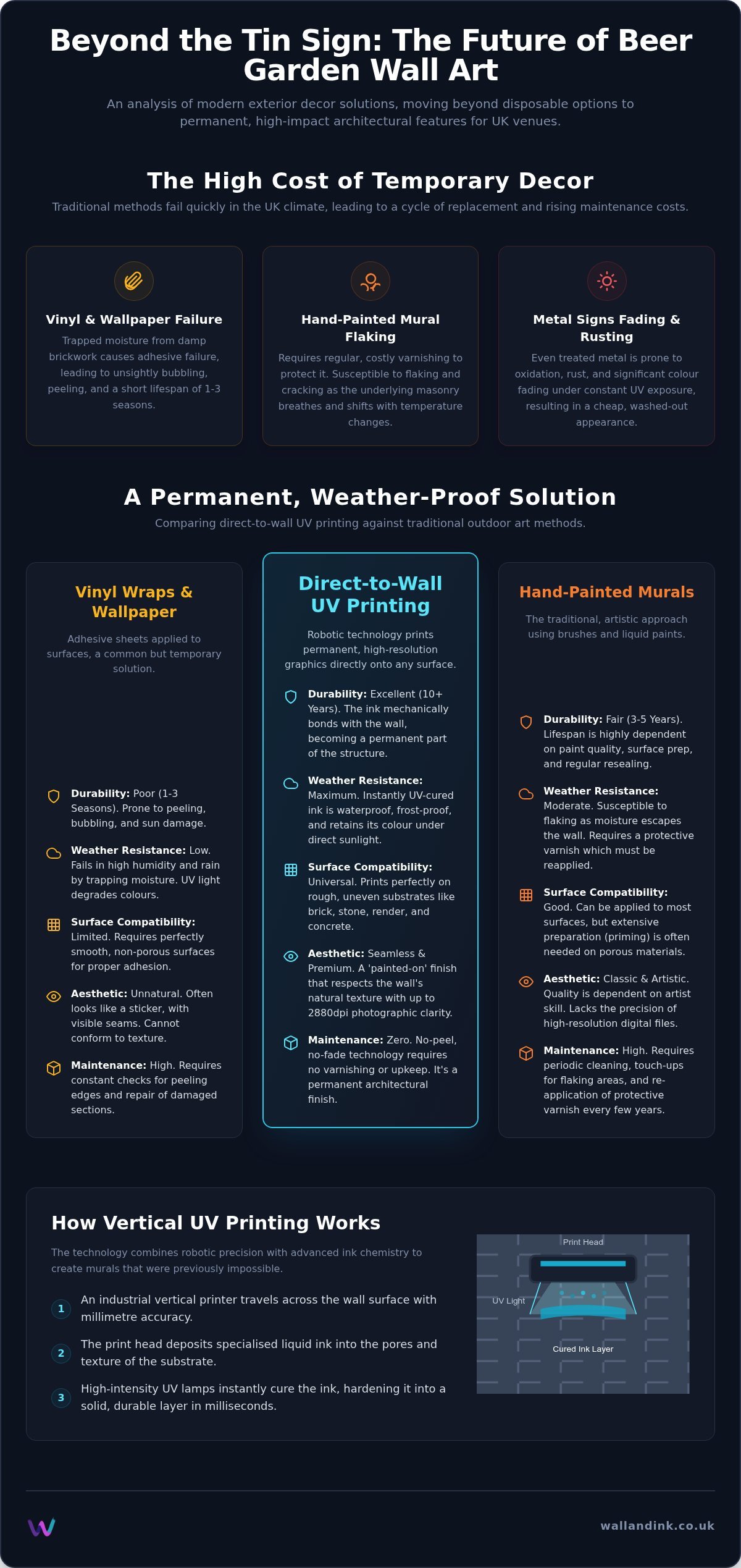
Comparing Options: UV Printing vs. Vinyl vs. Hand-Painting
Choosing the right medium for beer garden wall art UK installations requires a balance between initial capital expenditure and long-term durability. Traditional methods often appear cost-effective at the point of purchase, yet they frequently fail within the first 24 to 36 months of exterior exposure. By contrasting industrial UV printing against legacy alternatives, venue owners can identify the most resilient solution for their specific environment.
- Direct-to-Wall UV Printing: Offers a 10+ year lifespan with zero seams. The robotic application works on any texture, from rough stone to smooth render, creating a bespoke design that bonds chemically with the surface.
- Vinyl Wraps: Typically last 2-3 years before UV degradation causes shrinkage and peeling. These are strictly limited to smooth surfaces; any moisture trapped behind the plastic leads to immediate bubbling.
- Hand-Painting: Whilst aesthetically pleasing, it suffers from inconsistent quality and high labour costs. In the UK, hand-painted murals often cost between £130 and £150 per square metre and are prone to flaking as masonry dampness pushes the paint film off the wall.
- Outdoor Wallpaper: Carries a high risk of moisture damage in the British climate. Visible seams and difficult cleaning requirements make it a poor choice for high-traffic hospitality spaces.
Long-Term Cost Analysis for Hospitality
The return on investment for wall art is dictated by the replacement cycle. Vinyl and wallpaper require complete removal and re-installation every few years, doubling the long-term cost and causing recurring operational downtime. UV printing eliminates these hidden expenses. Maintenance is restricted to a simple wipe-down with a damp cloth; the cured ink layer is non-porous and resists dirt accumulation. Unlike vinyl, which requires extensive wall preparation and chemical primers to ensure adhesion, robotic printing adapts to the existing wall condition, reducing the need for costly remedial masonry work before the art is applied.
Aesthetic Impact: The “Stuck-On” vs. “Built-In” Look
Aesthetic integration is where direct printing outperforms panels and wraps. Architects and designers prefer integrated art for heritage and industrial buildings because it preserves the natural character of the brick or stone. A vinyl wrap hides the texture, creating a flat, plastic appearance that often feels disconnected from the venue’s architecture. Robotic UV printing follows the wall’s topography, ensuring the design feels “built-in” rather than “stuck-on”. This flexibility allows for precise branding, where digital files are matched exactly to existing pub logos and colour palettes, ensuring a professional finish that enhances the venue’s premium identity.
Substrate Guide: Can You Print on Your Beer Garden Wall?
Vertical UV printing technology is compatible with almost every common architectural surface found in British hospitality venues. Unlike traditional signage that requires flat, uniform panels, our process adapts to the inherent texture of the wall. This allows for the creation of beer garden wall art UK pubs can use to turn structural limitations into aesthetic features. Whether your venue is a historic brick building or a modern rendered terrace, the mechanical precision of the print head ensures consistent ink delivery across uneven elevations.
- Brick and Stone: We utilise the natural mortar lines to add three-dimensional depth to the mural. The ink settles into the crevices, ensuring the design looks integrated rather than overlaid.
- Render and Plaster: Both smooth and textured surfaces are suitable, provided the substrate is stable. The high-resolution output maintains sharp edges even on irregular render.
- Wood and Fencing: Timber boundaries can be transformed into vibrant feature walls. The UV-cured ink bonds to the wood fibres, resisting the natural expansion and contraction of the material.
- Metal and Glass: For commercial exteriors, UV technology provides a durable solution for non-porous surfaces, offering high-opacity finishes that standard paints cannot achieve.
Preparing Your Exterior Wall for Printing
Optimal adhesion starts with a clean substrate. Before the installation team arrives, the wall must be free from moss, algae, and loose debris. A simple pressure wash is usually sufficient, but the wall must be completely dry before printing begins. We adhere to the “Dryness Rule” regarding new construction; fresh render or plaster must be fully cured for at least 28 days to prevent moisture from being trapped beneath the ink. In cases where the substrate is particularly dark or porous, a white base coat may be necessary to ensure maximum colour vibrancy and saturation.
Managing the UK Weather During Installation
The unpredictable British climate is managed through specific operational protocols. We operate within temperature windows that ensure the mechanical components of the printer function with industrial precision. Whilst we require a dry window for the initial application, the artwork is rain-proof the exact second the UV light passes over the ink. This instant curing means there’s no risk of wash-off if a sudden shower occurs post-installation. To ensure a professional finish, the Wall & Ink team uses protective screening to shield the work site from wind and precipitation during the process. If you’re ready to upgrade your venue, you can book an exterior wall printing consultation to assess your substrate’s suitability.
Bespoke Design: Creating a Destination Beer Garden
Bespoke design is the primary driver for increasing hospitality revenue in competitive UK markets. With the UK pub and bar market valued at £24.1 billion as of late 2025, venues are investing heavily to distinguish their outdoor offerings. Generic, mass-produced signs fail to create the unique identity required to become a “destination” venue. Instead, professional beer garden wall art UK pubs install should be treated as a strategic branding tool. Our design journey moves from your initial concept through to a 1:1 digital visualisation, ensuring the scale, colour palette, and placement are optimised for your specific architecture before the printing robot is deployed.
The flexibility of direct-to-wall printing allows for extreme scaling. We can apply intricate graphics to small patio alcoves or execute massive, multi-storey murals that dominate a street-facing facade. Beyond aesthetics, integrated art serves a functional purpose in wayfinding. Strategic murals can guide customers from the main bar area through to the garden, increasing the usage of outdoor capacity during peak trading periods. This professional approach ensures that every square metre of your wall space contributes to the customer experience and brand recognition.
Commercial Trends: What’s Working in 2026
Current hospitality trends for 2026 show a clear preference for three specific aesthetic directions:
- Botanical and “Jungle” Themes: These designs are particularly effective for urban beer gardens, providing a lush, organic contrast to concrete environments and creating highly “Instagrammable” backdrops.
- Industrial Typography: Traditional pubs are utilising heritage-style branding and oversized industrial lettering to reinforce their local history whilst maintaining a modern, clean finish.
- Abstract Geometrics: Modern hospitality hubs often opt for bold, geometric patterns that use high-contrast colours to define different zones within a large outdoor space.
Residential Inspiration: The Ultimate Garden Room
The demand for high-quality exterior art extends to residential garden rooms and private terraces. In smaller UK gardens, bespoke murals can be designed to create a “trompe l’oeil” effect, providing the illusion of depth and space where masonry boundaries feel restrictive. By matching your wall art to your garden’s specific planting scheme and furniture colour palette, you create a cohesive outdoor living area that functions as a true extension of the home. This industrial-grade application ensures your private sanctuary remains vibrant without the maintenance required by traditional garden decor. To begin your project, contact Wall & Ink for a bespoke digital visualisation and see how our national service can transform your exterior space.
Secure a Permanent Aesthetic Advantage for Your Venue
Investing in integrated wall art is a pragmatic decision for venue owners who value efficiency and high-quality results. Traditional outdoor decor is often a liability, requiring constant attention and replacement as the British weather takes its toll. Our direct-to-wall UV technology disrupts this cycle by creating a permanent chemical bond between the ink and the substrate. Whether you’re working with historic masonry or modern render, this process delivers a zero-maintenance solution for beer garden wall art UK that remains sharp for over a decade.
Wall & Ink offers a national installation service backed by industrial-grade precision and bespoke digital visualisations. We eliminate the guesswork and the traditional hassles of outdoor branding, providing a professional finish that stands up to high-traffic hospitality environments. Request a Bespoke Quote and Digital Mock-up for Your Wall Art to begin your transformation. Your venue deserves a feature wall that is as resilient as it is visually striking.
Frequently Asked Questions
How long do exterior wall murals last in the UK weather?
Exterior murals produced with UV-cured ink are rated for a lifespan of over 10 years in the British climate. The technology ensures that the artwork remains resistant to heavy rain, frost cycles, and high humidity without the peeling or flaking associated with hand-painted alternatives. This industrial-grade durability makes it a permanent branding solution for any beer garden wall art UK installation.
Can you print a mural directly onto a rough brick or rendered wall?
Yes, the vertical printing robot is specifically designed to traverse uneven architectural surfaces like London stock brick or pebbledash render. Sensor-controlled print heads maintain a consistent distance from the substrate, allowing the ink to settle into mortar lines and textures without losing photographic clarity. You don’t need a smooth surface to achieve a high-resolution, professional finish.
Is the ink used in direct-to-wall printing environmentally friendly?
The process is significantly more sustainable than traditional methods because it produces zero vinyl waste and uses low-VOC inks. Because the ink is cured instantly by UV light, there are no harmful solvents evaporating into the atmosphere during a traditional drying process. This makes it an ideal choice for businesses looking to improve their environmental credentials whilst upgrading their outdoor spaces.
Will the beer garden art fade if it’s in direct sunlight all day?
No, the pigments used in our direct-to-wall process are engineered for maximum UV stability to prevent solar degradation. Unlike standard digital prints or vinyl, which often turn grey or yellow after one summer, these industrial inks maintain their vibrancy for over a decade. This is particularly beneficial for south-facing facades that receive constant sun exposure throughout the year.
Do I need to prime my exterior wall before the printing process begins?
Priming isn’t always a requirement, but the wall must be clean, dry, and structurally sound. We typically recommend a white base coat if you’re printing onto a very dark or highly porous surface to ensure the colours remain vivid and accurate. During your initial consultation, we assess the substrate to determine if any specific preparation is needed to guarantee optimal ink adhesion.
What happens if the mural gets scratched or someone vandals it?
The cured ink layer is exceptionally robust and naturally scratch-resistant, making it suitable for high-traffic hospitality environments. For venues concerned about graffiti, we can apply a clear anti-graffiti coating that allows spray paint to be removed without damaging the underlying mural. Regular maintenance only requires a simple wipe-down with water to remove surface dirt or dust.
How much does a custom exterior wall mural cost per square metre?
Pricing for a bespoke mural is determined by several variables, including the total surface area, the complexity of the design, and the specific substrate involved. We operate with a transparent pricing structure that considers the logistics of the site and any necessary preparation. To provide an accurate figure for your beer garden wall art UK project, we provide a detailed quote following a review of your wall’s dimensions and condition.
Can you print on wooden garden fences or sheds?
Yes, UV-cured ink bonds effectively to timber surfaces, including garden fencing and external sheds. The printing process allows the ink to anchor into the wood fibres, which helps the artwork resist the natural expansion and contraction of the timber. This is a popular solution for transforming plain boundaries into vibrant, branded feature walls without the need for hanging heavy panels.