
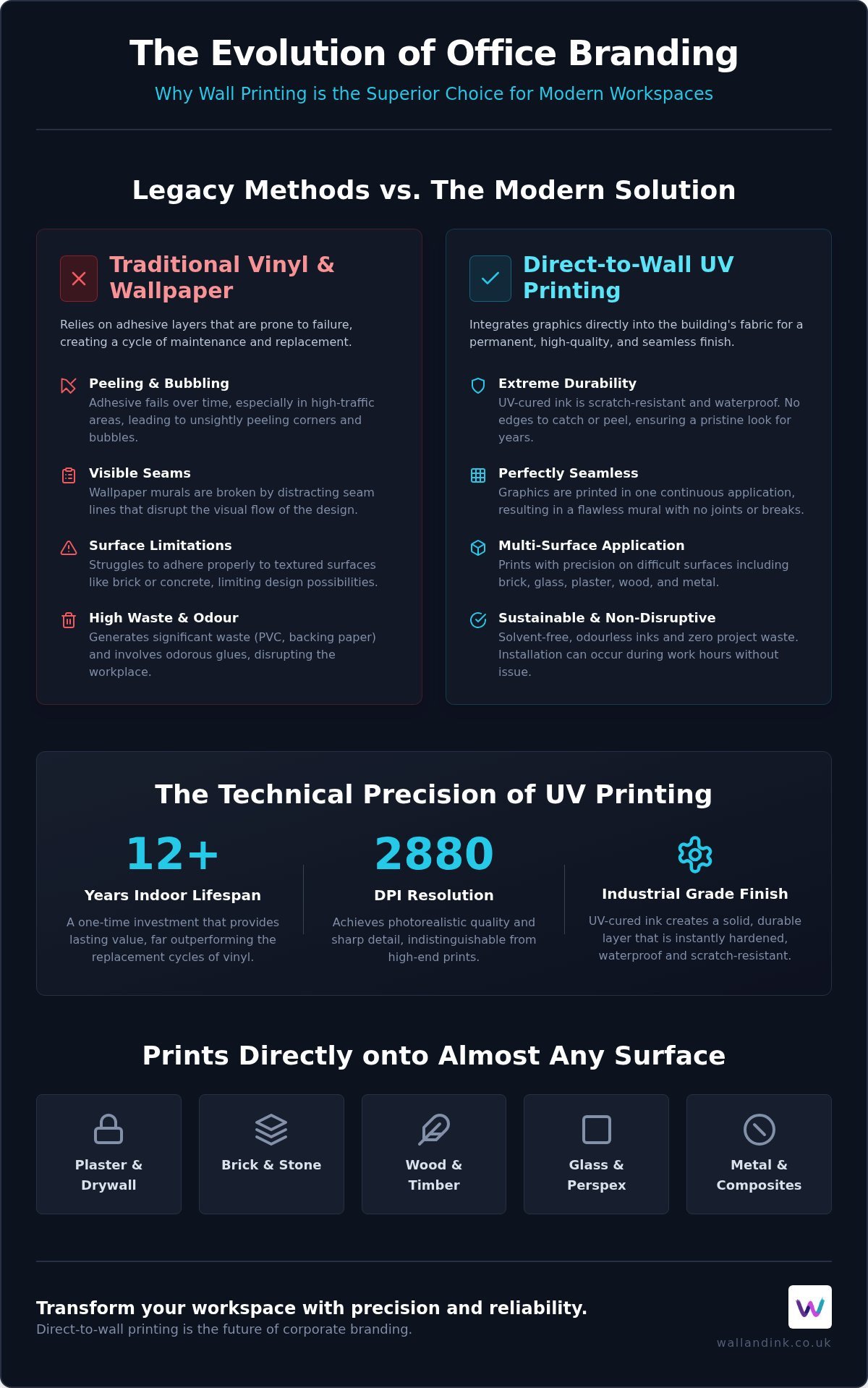
Traditional vinyl graphics and heavy wallpapers are no longer the gold standard for corporate environments; they are becoming liabilities. You’ve likely noticed the peeling corners of a vinyl decal in a high-traffic corridor or the unsightly seams that break the flow of an expensive wallpaper mural. These legacy methods often fail to withstand the rigours of a modern workplace, leading to a degraded brand image over time. Transitioning to wall printing for office branding offers a more permanent, industrial-grade solution that bypasses these aesthetic and structural failures entirely.
In this guide, you’ll discover how direct-to-wall UV printing provides a durable, high-resolution, and bespoke branding solution that eliminates the typical failure points of traditional graphics. We’ll explain the technical process behind achieving a professional finish that lasts for over a decade without the need for odorous glues or disruptive scaffolding. From printing on difficult surfaces like brick and glass to the mess-free installation workflow, we’ll show you how to upgrade your workspace with precision and reliability.
Key Takeaways
- Identify the structural failure points of legacy branding methods, such as adhesive peeling and seam separation in high-traffic corridors.
- Explore the technical advantages of UV-curable ink, which provides a scratch-resistant and waterproof finish with a 12-year indoor lifespan.
- Evaluate the long-term ROI of wall printing for office branding by comparing its durability against the frequent replacement cycles of traditional vinyl.
- Learn how bespoke designs are adapted for complex architectural surfaces like brick and glass with zero operational disruption.
- Discover how to transform vertical spaces into high-impact brand assets that enhance company culture and improve wayfinding.
The Evolution of Office Branding: Why Businesses are Moving Away from Vinyl
Office environments have moved beyond the era of simple signage and framed posters. Modern workspaces now demand immersive, high-impact visuals that reflect corporate identity through the very fabric of the building. For decades, large-format vinyl decals and commercial wallpapers were the standard. However, these methods rely on a “middle man” substrate, a layer of plastic or paper between the brand and the wall. This layer is increasingly seen as a structural liability rather than a design asset. Businesses are now adopting wall printing for office branding because it integrates graphics directly into the architectural substrate, creating a permanent finish that feels like a part of the building rather than an after-thought.
Current design trends favour bespoke, biophilic, and textured elements that traditional adhesives simply cannot accommodate. Whilst a vinyl sticker might sit awkwardly on a brick feature wall or a glass partition, Digital UV printing technology allows for precise application on almost any vertical surface. This shift is driven by a need for reliability. In busy UK offices where temperature and humidity fluctuate, the mechanical bond of ink to a surface is far superior to the chemical bond of an adhesive that can dry out or degrade.
The Problem with Large-Format Adhesives
Adhesive-based graphics have inherent failure points. In high-traffic areas like lift lobbies and narrow corridors, physical contact is inevitable. A single caught corner on a vinyl graphic can lead to rapid edge-peeling, instantly degrading the brand’s perceived quality. This creates a cycle of constant maintenance and replacement. Traditional wallpaper suffers from similar issues, specifically seam separation and bubbling. These flaws are particularly noticeable in client-facing reception areas where a premium aesthetic is non-negotiable. Direct wall printing eliminates these risks. Because there is no edge to catch and no seam to split, the graphic remains intact for its entire lifespan, offering a significantly better return on investment than regular re-vinyl cycles.
Sustainability and the Modern Workplace
Corporate social responsibility is now a primary factor in office fit-out decisions. Traditional branding often involves PVC-based vinyls, which are difficult to recycle and often end up in landfill. By contrast, direct-to-wall UV printing is a more sustainable choice. It reduces project waste by eliminating backing paper, transfer tapes, and vinyl off-cuts. The inks used are solvent-free and odourless, which is a critical requirement for occupied offices, healthcare settings, and educational facilities. You don’t have to worry about the “new plastic” smell that lingers after a traditional installation. This allows for branding projects to be completed during normal working hours without affecting the air quality or comfort of your employees.
The Technical Precision of Direct-to-Wall UV Printing Technology
Direct-to-wall printing is a high-precision mechanical process that eliminates the variables associated with manual graphic application. Unlike traditional methods that rely on pre-printed sheets, this technology utilises industrial printheads to jet UV-curable ink directly onto the vertical substrate. As the ink is deposited, high-intensity UV lamps follow the printhead, instantly hardening the liquid into a solid, durable layer. This “jet and cure” cycle ensures that the ink does not bleed or smudge, even when applying complex gradients or fine text. It’s this level of mechanical control that makes wall printing for office branding the preferred choice for architects who require millimetre-perfect execution of corporate assets.
The resolution achieved by these industrial systems is a significant leap forward for interior graphics. High-end printheads can reach resolutions of up to 2880 dpi, producing detail that is indistinguishable from high-quality photographic prints. This precision is vital because the Psychological Underpinnings of Brands show that employees and clients subconsciously equate the quality of an office environment with the quality of the business itself. When a logo is printed directly onto a wall with perfect colour accuracy and no visible seams, it projects an image of stability and permanence. You can explore our gallery of commercial wall murals to see how this technical clarity translates into professional environments.
Printing on Challenging Commercial Substrates
One of the most impressive technical features of a wall printer is its ability to maintain focus on uneven surfaces. Advanced laser sensors constantly map the distance between the printhead and the wall, adjusting the output in real-time to account for the texture of exposed brick, breeze blocks, or industrial concrete. On dark or non-white walls, the system can lay down a dedicated white ink base layer in a single pass. This ensures that brand colours remain vibrant and accurate regardless of the background shade. This capability extends to non-porous surfaces like glass partitions and metal facades, where the UV curing process creates a chemical bond that traditional adhesives simply cannot match.
Industrial Durability and Maintenance Standards
Durability is engineered into the ink itself. Once cured, the UV ink is both scratch-resistant and waterproof, making it ideal for high-traffic zones like office lift lobbies or staff canteens. You don’t need specialised equipment to maintain the finish; standard eco-friendly cleaning agents are sufficient to keep the mural looking pristine without risking colour fade or abrasion. The industrial-grade bond ensures that the graphics won’t peel or crack under the pressure of daily office life. Indoor prints have a confirmed lifespan of over 12 years, providing a decade of branding consistency without the need for touch-ups or replacements.
The Business Case for Direct Wall Printing: ROI and Long-Term Value
Pragmatic decision-makers often focus on the upfront cost of an office fit-out, but the real value lies in the life-cycle expenditure. Traditional wall graphics like vinyl decals are notorious for high maintenance costs. They require frequent replacement due to edge-peeling or colour degradation, often within a three-year cycle. By choosing wall printing for office branding, you are investing in a solution with a confirmed indoor lifespan of over 12 years. This longevity fundamentally changes the ROI calculation for corporate facilities managers. Instead of budgeting for three or four replacement cycles over a decade, a single application provides a permanent, high-quality finish that withstands the rigours of a busy workplace.
Brand integrity across a national portfolio requires digital precision. Our systems allow for exact Pantone colour matching, ensuring that your corporate identity remains identical across multiple sites. This level of consistency is paired with a unique ease of removal. Unlike vinyl, which can damage the plasterboard during removal, UV-cured ink is integrated into the surface. When a corporate rebrand is required, the graphic can be simply painted over with standard emulsion. This future-proofs your space, allowing for rapid aesthetic changes without the need for specialist removal teams or surface repairs.
Calculating the Life-Cycle Cost of Office Graphics
The cost-per-year of a UV-cured print is significantly lower than that of legacy adhesives. When a vinyl graphic fails, the hidden costs include specialist labour for removal and the inevitable repair of the underlying substrate. Direct-to-wall printing eliminates these peripheral expenses. Beyond the balance sheet, bespoke murals serve as a high-impact branding asset that increases employee engagement and creates a memorable impression for visitors, adding intangible value to the workspace environment.
Minimising Operational Disruption During Installation
Project delays are expensive. Traditional wallpapering or large-format vinyl installation often requires scaffolding and significant site preparation. These methods also involve odorous glues that can force temporary office closures. Our process is designed for live environments. A standard commercial wall can be transformed in a single day with zero dust and no odours. This “no mess” approach ensures your business remains fully operational whilst wall printing for office branding is executed, providing a seamless transition from a blank wall to a branded asset.
From Concept to Completion: The Bespoke Design and Visualisation Process
Successful execution of wall printing for office branding begins long before the printer arrives on site. It starts with a comprehensive situational analysis of the architectural environment. We don’t treat a wall as a flat canvas; we treat it as a structural element with unique light conditions, textures, and geometric constraints. During the initial consultation, we evaluate how your corporate assets will interact with the specific vertical substrate. This methodical approach ensures that the final print doesn’t just sit on the wall but feels integrated into the building’s design. By identifying architectural features like bulkheads, light switches, or recessed panels early, we can adjust the artwork to flow naturally around these obstacles.
Resolution management is the technical backbone of large-format clarity. A common failure in traditional branding is the use of low-resolution files that appear pixelated when scaled to a three-metre height. Our design team manages this through rigorous pre-press protocols, ensuring every digital file is optimised for industrial-grade output. We utilise high-resolution imagery and custom vector art to maintain infinite scalability. This technical precision ensures that fine text remains legible and gradients remain smooth, providing the professional finish that modern corporate environments demand.
Digital Mock-ups: Eliminating Uncertainty in Office Design
We eliminate the risk of “buyer’s remorse” through a structured digital visualisation phase. By using high-resolution photographs of your actual workspace, we create realistic digital mock-ups that show the artwork in situ. This feedback loop allows stakeholders to evaluate the scale, colour balance, and positioning of the graphics within the context of existing office furniture and lighting. It’s a pragmatic way to adjust for maximum visual impact before a single drop of ink is jetted. This transparency ensures that the final result matches the approved concept with 100% accuracy.
Developing Bespoke Artwork for Brand Consistency
Maintaining brand integrity requires close collaboration with your internal marketing or design teams. We adhere to strict brand guidelines, ensuring that Pantone colours are matched with digital precision. Our bespoke design process involves more than just scaling a logo; it’s about adapting brand stories for a vertical environment. This includes:
- Integrating architectural features like windows, doors, and vents into the mural composition.
- Sourcing and optimising high-resolution assets for crisp, large-scale reproduction.
- Developing custom wayfinding elements that align with the core mural aesthetic.
This level of detail ensures that your office branding is both functional and aesthetically superior. To start your design journey, you can request a bespoke design consultation for your workspace.
Strategic Implementation: Transforming Commercial and Public Environments
The successful deployment of vertical graphics depends on an understanding of the specific demands of the environment. Strategic implementation moves beyond simple decoration; it transforms a building’s architecture into a functional brand asset. In corporate offices, wall printing for office branding is utilised to embed company culture directly into the workspace. Core value murals in breakout areas or bespoke wayfinding graphics on glass partitions provide a sense of permanence that temporary signage cannot replicate. This methodical integration ensures that the brand identity is not just seen but is felt as an integral part of the office’s physical structure.
In the retail and hospitality sectors, the objective shifts towards engagement and footfall. High-resolution feature walls create “Instagrammable” moments that drive social sharing and organic brand reach. Because the UV-curable ink is jetted with millimetre precision, even complex, high-contrast designs remain crisp under intense retail lighting. For industrial environments, the technology allows for branding on a massive scale. Large warehouse facades or internal distribution centres can be branded on substrates like brick or corrugated metal, turning utilitarian structures into high-impact landmarks. The weather-resistant properties of UV ink ensure these exterior applications withstand the UK’s varied climate without fading or cracking.
Sector-Specific Applications: From Retail to Healthcare
Different sectors require different technical priorities. In educational settings, we create interactive learning environments using curriculum-based murals that are durable enough to survive high-traffic school corridors. For healthcare facilities, the odourless and solvent-free nature of our inks is a primary benefit, allowing for the installation of calming, hygienic graphics in occupied wards. Retail centres benefit from the speed of the process; seasonal graphics can be applied quickly and, unlike vinyl, they leave the wall surface pristine when the time comes to refresh the design for a new campaign.
Partnering with Wall & Ink for National Rollouts
Executing a consistent brand identity across multiple sites requires a partner with a national footprint and industrial reliability. We provide a streamlined project management workflow that ensures a London headquarters looks identical to a regional office in Edinburgh. Our approach is built on radical transparency, providing clear pricing structures and a methodical step-by-step process from the initial digital mock-up to the final execution. We eliminate the traditional hassles of office refurbishment, providing a “no mess, no stress” service that respects your operational timelines. If you are ready to upgrade your corporate environment with industrial-grade precision, Book a consultation for your national business branding project and discover the future of vertical surface graphics.
Future-Proofing Your Corporate Environment
The evidence confirms that legacy adhesives like vinyl and wallpaper are no longer sufficient for high-traffic professional spaces. By adopting wall printing for office branding, you bypass the common failure points of peeling edges and visible seams. This industrial-grade method utilises UV ink technology to ensure a 12-year indoor lifespan, providing a level of durability that traditional substrates simply cannot match. It’s a methodical transition from temporary stickers to permanent architectural assets that enhance your building’s value.
Our comprehensive national UK-wide service ensures that your corporate identity is executed with millimetre precision across your entire portfolio. We include bespoke digital visualisation in every project, so you can evaluate the impact of your design in situ before the first drop of ink is jetted. This transparency eliminates design uncertainty and guarantees a professional finish that reflects the quality of your business. Transform your workspace with a bespoke wall mural from Wall & Ink and experience a branding solution engineered for the modern workplace.
Frequently Asked Questions
Can direct-to-wall printing be used on any commercial surface?
Direct-to-wall printing is compatible with almost any vertical commercial substrate. The machinery utilises advanced sensors to maintain a consistent distance from textured surfaces like exposed brick, industrial concrete, or breeze blocks. It’s equally effective on non-porous materials such as glass partitions and metal facades. This versatility makes it a superior choice for wall printing for office branding in modern architectural spaces.
How long does a commercial wall print last in a high-traffic office?
A commercial wall print is engineered to last for over 12 years in an indoor environment. The UV-cured ink creates a permanent mechanical bond with the substrate, making it highly resistant to the abrasions and scuffs typical of high-traffic corridors or lift lobbies. Unlike vinyl, there are no edges to peel or seams to separate over time, ensuring the graphic remains pristine for its entire lifespan.
Is the ink used in wall printing safe for use in hospitals or schools?
The UV-curable inks are entirely safe for use in sensitive environments like hospitals and schools. The inks are solvent-free and odourless, meaning they don’t emit volatile organic compounds (VOCs) during or after the application. This allows for branding projects to be completed in occupied spaces without compromising air quality or occupant health, making it an ideal choice for healthcare and education sectors.
What happens if our business rebrands and we need to remove the wall print?
If your business undergoes a rebrand, the wall print can be simply painted over with standard emulsion. Because the ink is integrated into the wall surface rather than sitting on a plastic layer, there is no need for specialist removal teams. You won’t face the risk of damaging the underlying plasterboard, which is a common and costly issue when stripping traditional vinyl graphics or heavy wallpaper.
How do I clean a wall that has been printed on using UV technology?
You can clean a UV-printed wall using standard, eco-friendly cleaning agents and a soft cloth. The cured ink is waterproof and scratch-resistant, so it won’t smudge or fade during routine maintenance. This durability ensures that your office branding remains pristine even in communal areas like staff canteens or reception zones where frequent cleaning is a priority for hygiene and professional appearance.
How much does direct-to-wall printing cost for a UK business?
Pricing for UK businesses is typically structured on a square metre basis, reflecting the size and complexity of the project. Every project is unique, so costs vary depending on the substrate type and the level of design work required. We operate with radical transparency to ensure you receive a clear, fixed-price quote after an initial consultation, allowing for accurate budgeting without hidden fees.
Do I need to provide my own high-resolution artwork for the mural?
We offer an end-to-end service that includes bespoke design and digital mock-ups. Whilst you can provide your own high-resolution assets, our team can also create custom vector art for infinite scalability. We ensure all files are optimised for large-format clarity to prevent pixelation, ensuring your wall printing for office branding meets the highest professional standards of detail and colour accuracy.
Is the printing process disruptive to our daily office operations or staff?
The process is designed to be non-disruptive to your daily office operations. We don’t require scaffolding, and the machinery operates without creating dust or mess. Most standard commercial walls can be completed in a single day. Since the inks are odourless and solvent-free, your staff can continue working in the same room whilst the installation is underway without any health or comfort concerns.