
Why invest in a bespoke mural only to watch the edges peel or the colours fade within eighteen months? Traditional wall finishes often come with hidden maintenance burdens that pragmatic decision-makers want to avoid. If you are looking for a more durable and precise alternative, understanding the wall printing cost uk is the first step toward a more reliable interior solution. Most professionals agree that the unpredictability of manual decorating or the bubbling of vinyl decals creates unnecessary friction in both commercial and residential projects.
We’ve developed this guide to provide a transparent framework for evaluating direct-to-wall printing against legacy methods. You’ll discover exactly how square-metre pricing is calculated for various substrates and why industrial-grade UV ink technology represents a superior long-term investment. We also explore how digital visualisation prevents expensive errors before the first drop of ink hits the surface. By the end of this article, you’ll have the technical clarity needed to choose a wall finish that delivers both aesthetic impact and industrial durability.
Key Takeaways
- Learn how the standard per square metre model works and which variables influence the final wall printing cost uk for your specific project.
- Understand how substrate selection, ranging from smooth plaster to textured brick, affects the application process and technical requirements.
- Compare the long-term value of UV ink technology against traditional wallpaper to eliminate common issues like peeling or bubbling.
- Follow a logical two-step framework to measure your space and identify wall materials for an accurate budget projection.
- Discover how industrial UV curing allows for immediate room occupancy. This removes the lengthy drying times associated with hand-painted murals.
What is Direct-to-Wall Printing and How is it Priced?
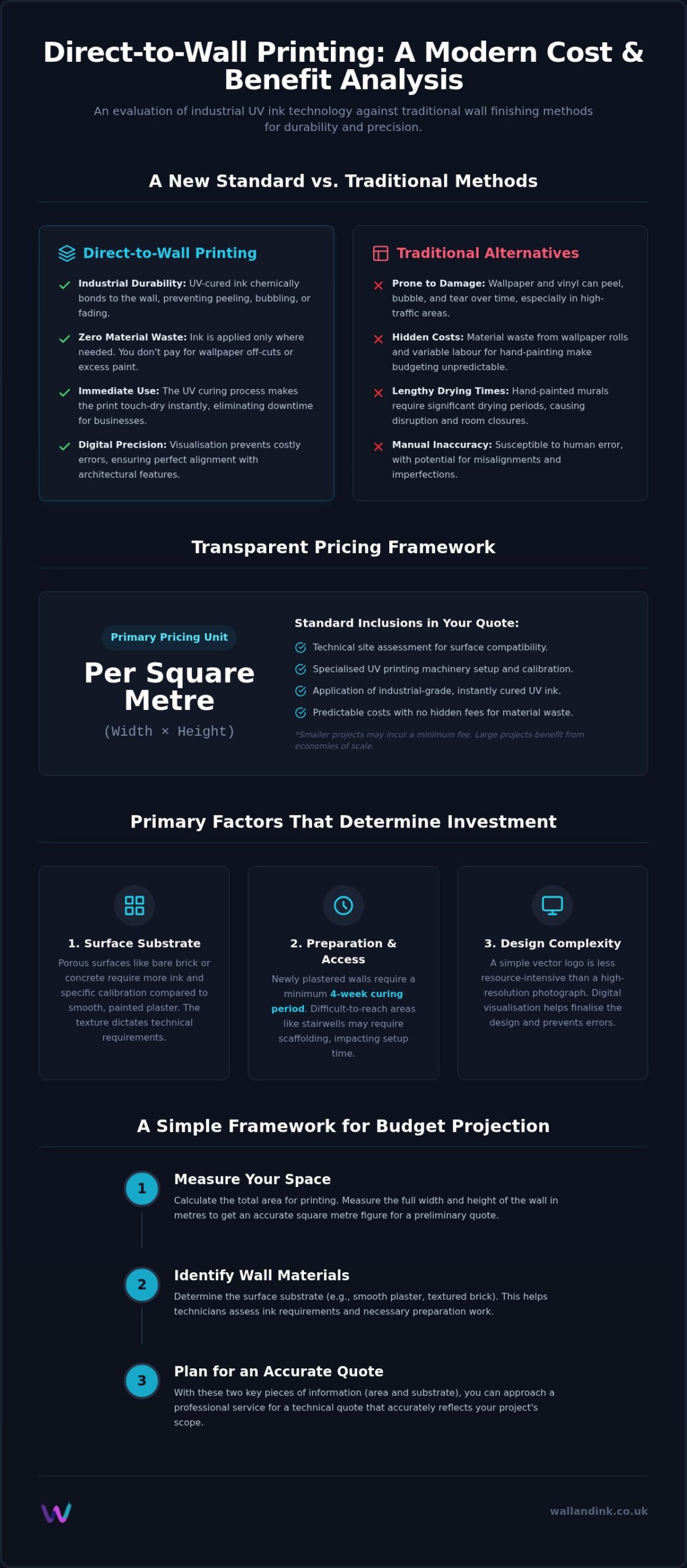
Direct-to-wall printing is a technical process where high-resolution UV ink is applied directly to a vertical surface using a specialised inkjet system. It’s an industrial alternative to traditional Mural techniques that rely on hand-painting or physical substrates like wallpaper. By removing the need for paper, vinyl, or heavy adhesives, the process creates a durable finish that won’t peel or bubble. When you evaluate the wall printing cost uk, you’re looking at a pricing model built on transparency and mechanical precision rather than the variable labour of manual decoration.
Most professional providers include the setup of the specialised UV printing machinery within the initial quote. This covers the logistics of bringing industrial equipment to your site and ensuring it’s calibrated for the specific environment. Unlike traditional decorating, there’s no material waste. You don’t pay for off-cuts or excess rolls that end up in a skip. You pay for the exact area of the wall that receives the ink. This elimination of hidden costs makes the investment predictable from the start.
The Basic Pricing Unit: Square Metres vs Project Fees
To get an accurate preliminary quote, you must measure the total width and height of your print area in metres. The industry operates primarily on a per-square-metre basis, which allows for a direct comparison with other high-end finishes. Smaller residential projects, such as a single feature wall, typically incur a minimum project fee. This fee ensures the technical requirements of the site visit and machine calibration are covered. In contrast, large commercial environments benefit from economies of scale. When the printer can run continuously across expansive surfaces, the operational efficiency increases, often resulting in a more competitive rate for the total area covered.
Standard Inclusions in a Professional Wall Printing Quote
A professional service goes beyond simply pressing a button. A standard quote includes a technical site assessment to check surface compatibility and wall condition. Technicians must calibrate the machinery for the specific wall colour and texture to ensure colour accuracy. The quote also covers the application of UV-cured ink, which provides an industrial-grade finish that’s touch-dry the second the print head passes. This immediate curing removes the downtime associated with traditional painting, making it a pragmatic choice for high-traffic professional spaces that can’t afford extended closures. You receive a finished product that is durable, precise, and ready for immediate use.
Primary Factors That Determine Your Wall Printing Investment
Accurate budgeting for a project depends on the physical reality of the site. While the square metre unit provides a base, technical variables such as substrate porosity and image resolution dictate the final investment. Specialists don’t just look at the size of the wall; they evaluate the mechanical requirements of the surface. Evaluating the wall printing cost uk involves understanding these industrial nuances before the machinery arrives.
Surface Substrate and Preparation Requirements
Porosity is a primary driver of technical cost. Printing on bare brick or concrete requires more ink and specific calibration compared to smooth, painted plaster. The printer must adjust for the textures of a rough surface to maintain image integrity. If you’re working with newly plastered walls, they must be fully cured. This typically requires a minimum of four weeks of drying time before the UV ink application can begin. Difficult-to-reach areas, such as stairwells or high-ceilinged commercial lobbies, also impact the setup time. These environments require specialised rails or scaffolding, which extends the technical preparation phase.
Design Complexity and Digital Visualisation
The shift toward digital technology in contemporary murals has introduced new efficiencies, but design hours remain a factor. A simple vector logo requires less processing than a high-fidelity photographic mural. High-resolution files are essential. An image that looks sharp on a monitor may pixelate when scaled to a four-metre wall. Digital visualisation allows us to overlay the design onto a photograph of your actual space. This prevents costly errors by showing exactly how the artwork interacts with architectural features like light switches or door frames. If you need original artwork created from scratch, this bespoke development adds a creative fee to the initial project scope.
Access and logistics are the final pieces of the investment puzzle. Working in restricted commercial environments or outside of standard hours can influence the operational budget. For instance, retail spaces often require overnight installation to avoid disrupting foot traffic. These logistical requirements are factored into the final quote to ensure the project runs without technical friction. If you’re unsure how your specific wall material might affect the project, you can request a technical consultation to clarify the requirements.
Wall Printing vs Traditional Alternatives: A Cost-Benefit Analysis
Pragmatic decision-makers evaluate an investment based on its total lifecycle cost rather than just the initial quote. When assessing the wall printing cost uk, it’s essential to compare the long-term performance of UV-cured ink against traditional wallpaper or vinyl decals. While high-end wallpaper might seem comparable in price per roll, the secondary costs of specialist installation and inevitable maintenance often inflate the total expenditure. Digital wall printing eliminates these variables by providing a finish that is structurally integrated with the wall surface. It’s a permanent solution that bypasses the common failure points of legacy decorating methods.
UV Printing vs Wallpaper: The Real Cost of Maintenance
Wallpaper is prone to physical failure. In high-traffic commercial corridors or school environments, edges peel, surfaces scuff, and adhesives fail over time. Direct-to-wall printing removes these risks entirely. The UV-cured ink is scrub-resistant and durable, making it a more hygienic choice for healthcare settings where rigorous cleaning protocols are mandatory. You don’t have to worry about moisture getting trapped behind a substrate or edges lifting in humid conditions. Beyond durability, the process is environmentally efficient. By printing directly onto the substrate, you eliminate the material waste of paper off-cuts and the chemical VOCs found in traditional adhesives. It’s a cleaner, more sustainable method for modern interiors that value both aesthetics and air quality.
Bespoke Printing vs Hand-Painted Murals
The most significant differentiator between printing and manual mural techniques is the compression of time. A complex, hand-painted mural can take weeks of site access, requiring scaffolding and causing prolonged disruption to your operations. In contrast, an industrial wall printer completes the same area in a matter of hours. This speed doesn’t compromise quality; it enhances it. The technology achieves photographic detail and precise brand colour matching that is impossible to replicate with a brush. For businesses with multiple UK locations, this ensures total consistency in brand identity across every site. You get a one-time investment that remains vibrant for over 10 years, whereas traditional paint may require touch-ups or complete re-application much sooner. The efficiency of the machine allows for a predictable schedule, ensuring your space is back in use without the lingering smell of wet paint or the presence of onsite artists for weeks on end.
How to Calculate Your Wall Printing Budget and Project Scope
Calculating the wall printing cost uk requires a methodical approach to the physical space. You must move beyond simple area estimations to account for the technical realities of the substrate and the environment. A precise budget is built on five critical steps that ensure operational clarity before the machinery arrives on site. This process eliminates the guesswork often associated with traditional murals or wallpaper installations.
- Step 1: Measure the total width and height of the print area in metres to establish the base square footage.
- Step 2: Identify the wall material. Bare brick, glass, and painted plaster each have different ink absorption rates and preparation needs.
- Step 3: Audit your design assets. Determine if you have high-resolution, print-ready files or if you require bespoke design development.
- Step 4: Check the base colour of the wall. Dark or vibrantly coloured surfaces require a white ink base layer to maintain colour accuracy.
- Step 5: Request a formal digital visualisation to confirm the final project scale and architectural alignment.
Measuring for Success: Avoiding Common Errors
Precision in measurement is the foundation of a successful print. You must account for sockets, light switches, and architectural features like skirting boards or cornicing. Providing a clear, straight-on photograph of the wall allows technicians to identify these obstacles during the quoting phase. Levelness is also critical. Technicians must check the vertical alignment of the wall to calibrate the printer’s rails correctly. Unlike wallpaper, where you can trim excess material, digital printing requires defined margins. Failing to account for these architectural interruptions can lead to alignment issues that are expensive to rectify post-application.
Budgeting for Commercial Environments
In professional settings, the operational window is as important as the print itself. You should plan for out-of-hours installation if the project is located in a high-traffic retail or office space. This prevents business disruption but may influence the logistical portion of your budget. Large organisations often achieve better unit pricing by scaling wall graphics across multiple offices or floors in a single mobilisation. For outdoor projects, you must factor in the requirement for exterior-grade UV inks. These specialised pigments are engineered to withstand UV exposure and weather conditions on facades or concrete boundaries. To begin your project with an accurate estimate, you can submit your wall dimensions here for a technical review.
Professional Wall Printing: Why Precise Technology Saves Money
Industrial precision is the primary driver of long-term savings. When you consider the wall printing cost uk, you must factor in the elimination of costly re-works. Traditional murals rely on manual steady-handedness, which is subject to human error and variable quality. Our automated systems use laser-guided sensors to maintain a consistent distance from the substrate, ensuring every drop of ink lands with mathematical accuracy. This mechanical superiority prevents the expensive mistakes that often plague traditional site decoration. You receive a perfect execution on the first application, which protects your budget from the volatility of manual labour.
UV curing technology provides another layer of financial efficiency. The ink is hardened instantly by ultraviolet light as the print head moves across the wall. This means there is zero drying time. For a retail environment or a busy school corridor, this allows for immediate occupancy. You don’t lose days of operational revenue waiting for paint to dry or fumes to dissipate. It’s a pragmatic solution for high-stakes environments where time is a measurable asset. The resulting finish is scratch-resistant and durable, which significantly reduces the need for future repairs or repainting in public spaces. This durability ensures your initial investment remains an asset for years rather than a maintenance burden.
The Wall & Ink Approach to Transparent Pricing
We believe in radical transparency. Every project begins with a detailed, all-inclusive quote that covers technical setup, ink consumption, and mobilisation. There are no hidden fees or surprise material costs. Our digital visualisation service allows you to see the final artwork overlaid on your actual wall before the first drop of ink is applied. This ensures you are entirely satisfied with the design and scale, removing the risk of post-installation regret. From our central hub in Derby, we provide a national UK service that delivers high-quality murals to any location with the same level of technical rigour. We position ourselves as specialists in execution, ensuring that the technology delivers exactly what the visualisation promised.
Final Steps: Moving from Quote to Installation
Moving from a preliminary estimate to a finished installation is a logical, streamlined process. Once you approve the digital visualisation and technical quote, we schedule a date that minimises disruption to your routine. The typical timeline from design approval to on-site execution is efficient, often taking only a few business days depending on project complexity. You can book a technical consultation to discuss your specific substrate requirements and logistical needs. Our specialists will guide you through the technical specifications to ensure your investment delivers maximum value. Providing this level of expertise ensures your project is handled with the industrial precision it deserves.
Get a bespoke wall printing quote for your UK project
Modernise Your Space with Industrial Precision
Choosing direct-to-wall printing is a pragmatic decision for those who value mechanical durability and visual precision. By moving away from traditional wallpaper or manual painting, you eliminate the risks of peeling edges and lengthy project delays. Understanding the wall printing cost uk allows you to budget with confidence; you’ll know that the square-metre pricing includes technical calibration and bespoke design visualisation. This methodical approach ensures the final result aligns perfectly with your architectural space without the hidden burdens of legacy decorating methods.
Our national UK service provides access to specialised UV-cured ink technology that’s both scratch-resistant and immediate in its application. We include bespoke design consultations to ensure every project meets our standards for industrial excellence. Whether you’re transforming a commercial lobby or a residential feature wall, our process remains transparent and efficient from initial consultation to final execution. The result is a durable, high-resolution finish that stands up to the demands of modern environments. We look forward to helping you modernise your environment with precision-engineered artwork.
Request your bespoke wall printing quote today
Frequently Asked Questions
Is wall printing more expensive than traditional wallpaper?
Initial investment for direct-to-wall printing is often higher than off-the-shelf wallpaper, but it eliminates the secondary costs of specialist adhesives and future maintenance. Wallpaper is prone to peeling and bubbling in high-traffic areas, whilst UV-cured ink is scratch-resistant and integrated into the substrate. Over a ten-year lifecycle, the total wall printing cost uk is typically more efficient as it removes the need for frequent repairs or complete re-applications.
How much does a custom wall mural cost per square metre in the UK?
Standard pricing for wall printing is calculated on a per-square-metre basis, reflecting the exact area of the wall that receives the ink. This model ensures you don’t pay for material waste or off-cuts associated with traditional rolls. The final rate depends on factors such as the wall’s texture, the need for a white base layer, and the total scale of the project. Larger commercial installations often benefit from more competitive unit pricing.
Does the cost of wall printing include the design of the artwork?
Professional quotes include bespoke design consultations and digital visualisation to ensure the artwork fits the architectural space. This prevents costly alignment errors by showing exactly how the mural interacts with features like sockets or door frames. Whilst technical calibration of your existing high-resolution files is standard, the creation of entirely original artwork from scratch may involve a separate creative development fee. This ensures the design meets industrial print standards.
Are there extra charges for printing on difficult surfaces like brick or glass?
Textured or non-porous surfaces require specialised technical setups and specific ink treatments, which can influence the project budget. Printing on bare brick or concrete involves higher ink consumption and precise calibration to maintain image integrity across the rough substrate. Glass or metal surfaces might require specific primers or slower print speeds to ensure the UV ink bonds correctly. These technical requirements are clarified during the initial site assessment to ensure a durable finish.
How long does a printed wall mural last before it needs replacing?
Interior wall prints are engineered for longevity and can last up to 10 years without significant fading or degradation. For exterior applications, the UV-cured ink is designed to withstand weather conditions for up to 5 years. This durability makes it a superior investment for professional environments compared to vinyl decals, which often fail much sooner. The industrial-grade pigments are scratch-resistant, ensuring the aesthetic impact remains consistent in high-traffic public spaces.
Do you offer discounts for large-scale commercial wall printing projects?
Economies of scale are a standard part of the pricing structure for expansive commercial projects. When the printing machinery can run continuously across large surfaces or multiple rooms in a single mobilisation, the operational efficiency increases. This reduction in technical setup time per square metre allows for a more competitive rate on large-scale office or retail graphics. We provide transparent quotes that reflect the total project volume and logistical requirements.
Is there a minimum call-out fee for wall printing in the UK?
A minimum project fee applies to cover the logistical costs of mobilisation and the technical calibration of the machinery. This ensures that even small residential feature walls receive the same level of industrial precision and professional setup as large-scale commercial murals. This fee covers the technician’s time, travel, and the initial machine alignment required to guarantee high-resolution results. It’s a standard practice that maintains the quality of the service.
What happens if my wall needs repair before printing can start?
Walls must be clean, dry, and structurally sound before the printing process can commence. Any repairs, such as filling holes or smoothing uneven plaster, should be completed and fully cured in advance. Newly plastered walls typically require four weeks of drying time to ensure the UV ink bonds correctly to the substrate. If the surface is not properly prepared, it can lead to technical friction and delays, as the machinery requires a level surface for accurate calibration.