
Traditional wall décor is fundamentally limited by the materials used; wallpaper eventually peels and manual murals are often restricted by the artist’s time and the surface’s texture. You likely want a solution that offers the longevity of a structural feature without the logistical headache of traditional decorating. Understanding how does a wall printer work reveals a shift from manual labour to industrial precision, allowing you to transform any vertical substrate into a high-resolution gallery. This technology replaces messy adhesives and long drying times with digital accuracy and instant durability.
You might feel uncertain about whether a machine can handle the irregularities of brick, plaster, or wood. We promise to show you how advanced sensors and UV technology ensure a perfect finish every time. This guide explores the mechanical rail systems that guide the printhead, the chemistry behind UV-curable inks that dry the instant they hit the wall, and the specific ways this equipment adapts to uneven surfaces. You will discover the technical process that makes direct-to-wall printing a reliable, modern alternative for both commercial and residential spaces across the UK.
Key Takeaways
- Understand how does a wall printer work by utilising vertical inkjet technology that applies ink directly to substrates, removing the need for traditional wallpaper or vinyl.
- Discover the industrial precision of the vertical rail system that ensures perfect alignment across both horizontal and vertical axes for any scale of mural.
- Learn why UV curing technology provides immediate durability by instantly hardening ink into a solid film, making the artwork resistant to fading and wear.
- Explore the digital workflow that allows you to visualise bespoke designs in your specific space before the printing process begins.
- Identify the practical benefits of a seamless finish that eliminates the common issues of visible joins, pattern mismatches, and peeling associated with legacy methods.
Understanding Direct-to-Wall Printing Technology
Direct-to-wall printing represents a significant leap from traditional surface decoration. To understand how does a wall printer work, you must look at it as a fusion of robotics and advanced chemistry. Rather than applying a secondary layer like vinyl or paper, this technology uses advanced inkjet printing technology to propel droplets directly onto the vertical surface. This vertical inkjet process is governed by computer-controlled printheads that move with industrial precision. By removing the need for intermediary substrates, the method ensures that the artwork becomes a part of the wall itself. This integration bridges the gap between digital design and physical interior architecture, creating a finish that is as durable as the structure it adorns.
When people ask how does a wall printer work, they are often surprised by the lack of mess. There are no adhesives involved. This eliminates the common failures of legacy methods, such as peeling edges or trapped air bubbles that often plague wallpaper installations. Because the ink is applied directly to the wall, the finished product is seamless and permanent, requiring no drying time or post-application cleanup.
The Shift from Traditional Murals to UV Printing
Manual mural painting is a skilled craft, but it lacks the scalability and repeatability required for modern commercial environments. Mechanical precision has replaced the paintbrush in sectors where brand consistency is non-negotiable. Digital files allow for the exact replication of corporate logos and complex brand assets, ensuring that a mural in London looks identical to one in Manchester. Whilst a hand-painted mural might fade or vary in quality depending on the artist’s technique, UV-stable inks are engineered to resist colour degradation. This shift provides a reliable, predictable outcome for pragmatic decision-makers who value both aesthetics and longevity.
UV Ink vs Traditional Ink: The Science of Instant Drying
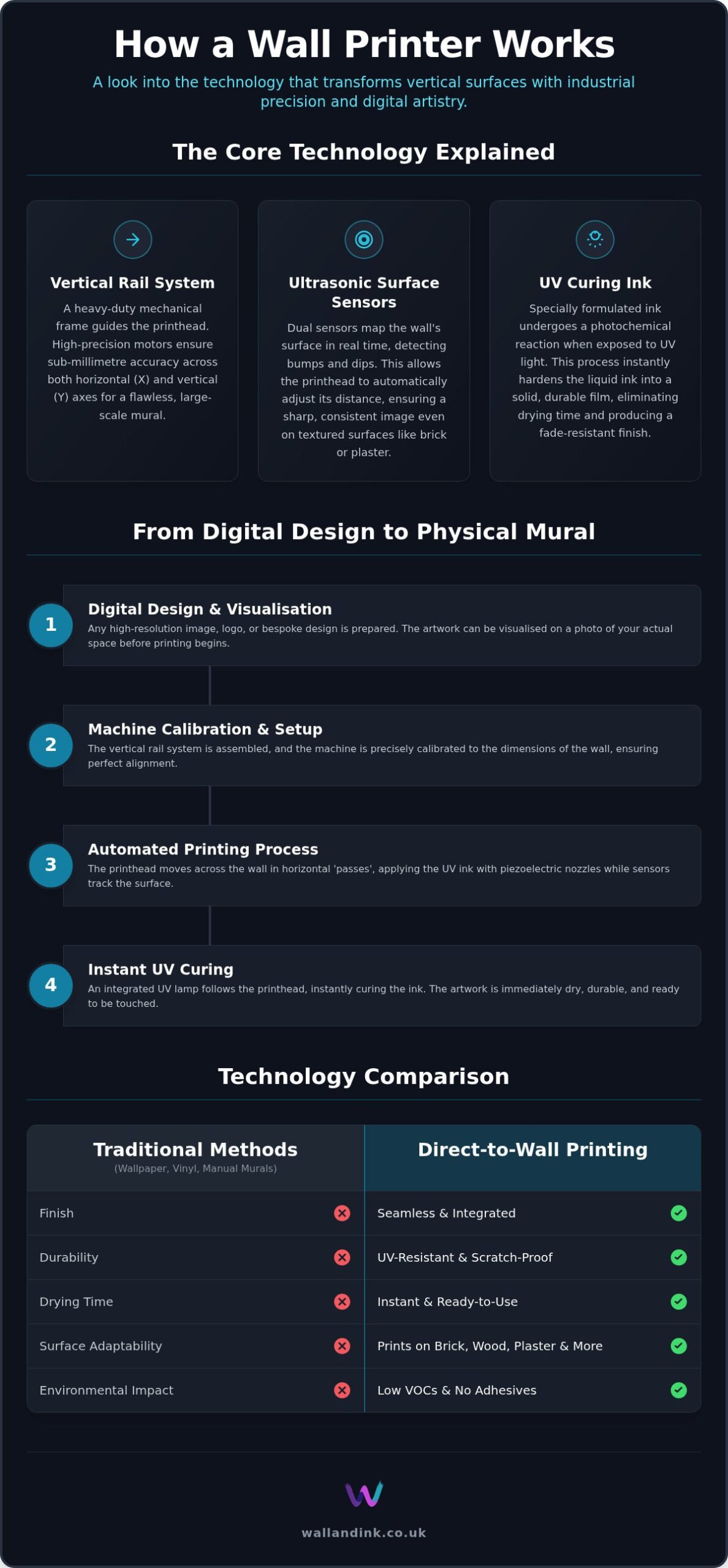
The core of this process is UV (Ultraviolet) ink. Unlike solvent-based inks that dry through evaporation, UV ink undergoes a photochemical reaction. When exposed to high-intensity UV light, the liquid ink cures into a solid film instantly. This instant curing is a primary advantage; it allows the space to be used immediately after the machine finishes its pass. There is no lingering chemical smell. UV inks are also more environmentally friendly than traditional solvent alternatives because they emit significantly lower levels of volatile organic compounds (VOCs). This makes the technology safe for high-traffic areas, including schools and healthcare facilities, where air quality is a priority.
The Mechanics of the Vertical Printing Process
The physical architecture of the machine is what separates it from standard office equipment. It relies on a heavy-duty vertical rail system to provide a stable foundation for the printhead assembly. High-precision stepper motors manage movement across the X (horizontal) and Y (vertical) axes with sub-millimetre accuracy. This level of control is essential for producing high-resolution murals that appear seamless from any distance. To understand how does a wall printer work, you must view it as a robotic system that translates digital data into precise mechanical actions. Unlike traditional renovation, the process is remarkably clean. It doesn’t produce dust or release harmful chemical fumes, making it perfectly suitable for occupied offices, schools, or clinical environments. A ‘pass’ refers to the specific horizontal sweep where the printhead applies a segment of the image before the machine shifts vertically to begin the next section.
Ultrasonic Sensors and Surface Tracking
Walls are rarely perfectly flat. To prevent the printhead from colliding with the substrate, the machine uses dual ultrasonic sensors to ‘see’ the surface in real time. These sensors measure the distance between the wall and the nozzles thousands of times per second. This real-time adjustment is a core part of how does a wall printer work on non-standard surfaces, allowing the machine to maintain a constant gap by adjusting for bumps or dips. This tracking capability is why the technology excels on textured surfaces like brick, stone, or coarse plaster. If you’re planning commercial wall murals on a rugged substrate, these sensors ensure the image remains crisp despite the uneven terrain.
Piezoelectric Printheads: The Heart of the Machine
The actual application of ink is handled by piezoelectric printheads. These components use electrical pulses to vibrate a microscopic crystal, which then triggers the release of ink droplets. This method allows for variable drop sizes, which is critical for creating smooth gradients and realistic shadows. Most professional machines utilise a CMYK+W configuration. Including white ink is vital for printing on dark or coloured walls, as it provides a neutral base that ensures the primary colours remain vibrant. This advanced UV-curable inkjet technology ensures that every droplet bonds perfectly to the surface. It creates a professional finish that far exceeds the quality of hand-painted alternatives or vinyl decals.
UV Curing: Why Direct Prints are Instantly Durable
The durability of a digital mural depends entirely on the transition from liquid to solid state. In professional systems, high-intensity UV lamps are mounted directly onto the printhead assembly. This configuration ensures that every droplet of ink receives immediate exposure to ultraviolet light the moment it contacts the surface. This isn’t a standard drying process; it’s a photochemical reaction known as curing. The light triggers a molecular cross-linking that transforms the ink into a resilient, solid film. When people ask how does a wall printer work to produce such lasting results, the answer lies in this industrial-grade bond. The resulting finish is remarkably scratch-resistant and far tougher than traditional decorative paint.
This cured surface is also completely water-resistant. In high-traffic environments like hospitals or retail centres, hygiene is paramount. Because the ink has hardened into a non-porous layer, the murals can be cleaned using standard non-abrasive detergents without any risk of smearing or colour loss. This level of physical integrity ensures the artwork remains a permanent fixture rather than a delicate temporary addition. Unlike wallpaper, there are no edges to catch or surfaces to tear, making it a robust choice for busy public spaces.
Surface Versatility: From Plaster to Glass
Traditional paints and legacy printing methods often require a porous surface to provide a ‘key’ for the material to grip. UV technology bypasses this requirement. Because the ink cures instantly upon contact, it can adhere to non-porous substrates that would cause standard paint to run or bead. This includes glass partitions, metal cladding, and polished wood. On bare plaster, the ink maintains its vibrancy because it doesn’t soak into the substrate. This versatility allows for consistent branding across multiple material types within a single commercial environment, ensuring a unified aesthetic regardless of the wall’s composition.
Longevity and UV Stability in the UK Climate
Interiors in the UK often experience significant variations in natural light, which can lead to the bleaching of traditional pigments. UV-cured prints are engineered for high UV stability, meaning they resist the fading effects of sunlight even in bright, south-facing rooms. Understanding how does a wall printer work in relation to light exposure explains why these murals remain vibrant for years without intervention. This longevity far exceeds that of traditional vinyl decals. Vinyl relies on a secondary adhesive layer that eventually dries out and fails, leading to unsightly edge-peeling and bubbling. By contrast, a direct-to-wall print has no adhesive to degrade. It remains maintenance-free for the lifespan of the wall, providing a modern solution that eliminates the recurring costs of replacement and repair.
From Digital Design to Physical Mural: The Workflow
The transition from a digital concept to a permanent architectural feature is a methodical, multi-stage process. It begins with the preparation of a high-resolution digital file. This is crucial because any imperfections in the source image are magnified when scaled to the size of a full wall. Understanding how does a wall printer work at the software level reveals that the machine requires precise data to ensure crisp lines and accurate colour reproduction. Before any ink is applied, digital visualisation allows you to see exactly how the mural will look within your specific environment. This step eliminates uncertainty and ensures the final result aligns with your brand’s visual standards.
Once the design is finalised, the physical execution moves on-site. The setup is remarkably efficient. The technician calibrates the machine to account for the specific floor level and the angle of the wall. This calibration ensures that the vertical rail remains perfectly plumb, which is essential for sub-millimetre accuracy. Because the printing speed is consistent, most projects are completed within a single day. This rapid execution minimises disruption to your daily operations, making it a superior choice for high-stakes professional environments.
The Importance of High-Resolution Imagery
Scaling artwork for a full-sized wall requires a deep understanding of DPI (Dots Per Inch). Whilst a standard image might look acceptable on a computer screen, professional wall printers can achieve resolutions up to 2880 DPI for exceptional detail. This high density is necessary for adapting brand logos and complex photography without losing clarity. Bespoke design consultations ensure that your brand assets are correctly prepared for large-format vertical printing. If you’re ready to transform your workspace with industrial precision, you can book our direct-to-wall printing service to begin the visualisation process.
Site Preparation and Workspace Safety
The operational footprint of the printer is minimal. It requires very little clearance, allowing it to work in tight corridors or busy retail environments without obstructing foot traffic. This makes the process ideal for ‘live’ environments like schools or active offices where a lengthy, messy renovation isn’t feasible. The only requirement is that the wall surface must be clean and free of loose debris to ensure optimal ink adhesion. Because there are no toxic fumes or dust, there’s no need for specialised ventilation or PPE for bystanders during operation. This level of cleanliness and safety is a hallmark of the modern specialist approach to interior design. Understanding how does a wall printer work in these settings confirms its role as a disruptor of traditional, more invasive decorating methods.
The Advantages of Professional Wall Printing Services
Professional wall printing services offer a definitive solution to the logistical failures of traditional decorating. Wallpaper installation involves messy adhesives, complex pattern matching, and the inevitable risk of peeling joins over time. By contrast, understanding how does a wall printer work reveals a process that is entirely digital and seamless. There are no overlaps or visible joins because the machine applies the image in a continuous, robotic sweep. This creates a finish that is both aesthetically perfect and functionally superior. We operate with radical transparency, providing pricing structures that allow pragmatic decision-makers to plan their budgets with absolute certainty. The result is an industrial-grade feature that doesn’t just decorate a space but enhances its architectural value.
Unlike manual painting, which is subject to human error and variation, the mechanical precision of our systems ensures that every mural meets the same high standard. This reliability is essential for businesses that value efficiency and high-quality results. The process is clean, fast, and permanent, eliminating the recurring maintenance costs associated with legacy alternatives like vinyl decals or traditional paint.
Precision Engineering for Bespoke Interiors
The machine achieves levels of detail that are physically impossible for human painters to replicate. High-resolution printheads produce intricate textures and gradients that remain sharp even when viewed from a few centimetres away. This engineering allows us to print right up to the edges of skirting boards, door frames, and ceilings, ensuring a fully integrated look. For national brands, this technology guarantees that a logo in a London office is identical to the one in an Edinburgh branch. This consistency is a core reason why businesses move away from traditional methods toward our specialised application. Understanding how does a wall printer work in these high-stakes environments confirms its role as a modern, reliable solution for bespoke interiors.
Why Wall & Ink is the Modern Choice
Wall & Ink represents the shift toward industrial precision in the interior design sector. We use the latest UV technology to ensure that every project is durable, water-resistant, and instantly ready for use. Our end-to-end service includes a bespoke digital visualisation process, allowing you to confirm the design in your actual space before we arrive on-site. We provide national installation across the UK, serving commercial, educational, and residential sectors with the same level of technical expertise. If you’re ready to bypass the hassles of wallpaper and vinyl, you can book a consultation for your national wall printing project to see how we can transform your environment. Our approach is designed for those who value efficiency, transparency, and results that last.
Modernising Your Vertical Surfaces with Industrial Precision
Understanding how does a wall printer work reveals a shift from traditional decorating to a precision-engineered architectural solution. By replacing fragile wallpaper and manual murals with robotic accuracy, you ensure a result that is both aesthetically superior and functionally resilient. This technology utilises UV-stable, scratch-resistant inks that bond directly to your wall, creating a permanent feature that resists fading and wear. The process is defined by its efficiency; our no-mess, dust-free installation allows you to upgrade your environment without the downtime or cleanup associated with legacy methods.
Whether you are managing a corporate office, a retail centre, or an educational facility, the transition from digital design to physical mural is seamless. Our national service across the UK brings this specialised technology to your doorstep, providing a reliable alternative to traditional surface treatments. You can now achieve high-resolution, bespoke art on almost any substrate with absolute confidence in the final outcome. Transform your space with a custom wall mural from Wall & Ink and experience the benefits of modern vertical printing for your next project.
Frequently Asked Questions
How long does a wall print actually last?
Indoor prints typically last for over 12 years without fading or degradation. This longevity is due to the UV-stable pigments that resist the bleaching effects of natural light. For exterior applications, the lifespan is usually between three and five years, depending on the severity of environmental exposure and the condition of the substrate.
Can you print on textured walls like brick or breeze blocks?
Printing on textured surfaces like brick or breeze blocks is a standard capability of this technology. To understand how does a wall printer work on uneven terrain, you must look at the ultrasonic sensors that track the wall’s profile in real time. These sensors maintain a constant distance between the printhead and the surface, ensuring the image remains sharp and undistorted even on rugged materials.
Is the ink safe for use in schools or hospitals?
The UV inks used are entirely safe for sensitive environments, including schools and healthcare facilities. Because the ink is cured instantly by ultraviolet light, it doesn’t release harmful fumes or volatile organic compounds (VOCs) into the air. This allow for immediate occupancy of the room without the lengthy ventilation periods required for traditional paint or adhesives.
How do I remove a wall print if I want to change the design?
Removing a wall print is as simple as painting over the surface with two coats of standard emulsion. Unlike wallpaper or vinyl decals, there is no adhesive residue to scrape away and no risk of damaging the underlying plaster. The cured ink forms an extremely thin film that doesn’t create visible ridges or textures under a new layer of paint.
Does the wall need special preparation before the printer arrives?
Most walls require no specialised preparation other than being clean, dry, and structurally sound. Any loose paint or dust should be removed to ensure optimal ink adhesion. If the wall is a dark colour and you require a vibrant design, the machine’s white-ink capability handles the base layer automatically during the printing process to ensure colour accuracy.
What is the maximum size a wall printer can handle?
The maximum height for a single pass is typically determined by the vertical rail system, which often reaches up to four metres. However, the width is effectively unlimited as the machine moves along its horizontal track. For extremely tall walls, the image is printed in multiple horizontal sections that are digitally aligned to create a seamless finish.
Can the machine print on glass or metal surfaces?
The machine can print directly onto glass, metal, and polished wood. The UV-curable ink creates a strong mechanical bond with non-porous surfaces that traditional paints cannot grip. This capability is ideal for branding glass partitions or adding industrial graphics to metal cladding in commercial settings. When considering how does a wall printer work on these materials, the instant curing process is what prevents the ink from running.
How much does professional wall printing cost per square metre?
Professional wall printing costs are calculated based on the total square footage of the mural and the complexity of the design. Factors such as the substrate type and the geographic location of the project also influence the final quote. We provide transparent, bespoke pricing for every project to ensure that you only pay for the specific area covered by the artwork.