
The traditional roll of wallpaper might be the most fragile component in your interior design strategy. You probably recognise the visual impact of a well-placed mural, yet you’re likely tired of the bubbling seams and peeling edges that define legacy paper applications in high-traffic or humid environments. When evaluating wall printing vs wallpaper, the physical limitations of paper-based media are difficult to ignore. Direct-to-substrate UV printing isn’t just a decorative choice; it’s a technical evolution that removes the inherent failures of traditional adhesive methods through industrial precision.
In this guide, you’ll discover how industrial-grade UV printing surpasses wallpaper through mechanical superiority, enhanced durability, and a completely seamless finish. We’ll examine the 2026 shift towards high-resolution digital art and eco-friendly, odourless inks that facilitate immediate room occupancy without chemical residues. We provide a pragmatic comparison of installation efficiency, surface versatility, and long-term performance. This overview will clarify why direct-to-wall technology has become the reliable standard for professionals who value high-quality results without the traditional maintenance hassles.
Key Takeaways
- Identify the inherent structural failures of traditional wallpaper, including peeling edges and bubbling seams, that lead to environmental degradation in high-traffic areas.
- Examine the technical superiority of CNC-guided UV printing and how piezoelectric printhead technology delivers microscopic accuracy directly onto the wall surface.
- Compare the efficiency of wall printing vs wallpaper to understand how hours of printing can replace days of manual application whilst improving hygiene in professional settings.
- Expand your design possibilities by learning to print on specialist substrates such as brick, stone, and glass partitions where traditional media fails to adhere.
- See how a managed professional service uses bespoke digital visualisations to ensure every industrial mural fits your environment with absolute precision.
The Limitations of Traditional Wallpaper in Modern Interior Design
Wallpaper has long been the default choice for interior murals, but it remains a surface-level solution. Whilst the history of wallpaper demonstrates its role as a decorative staple, the medium relies on external adhesives to bond a separate layer to a substrate. This physical separation is the primary cause of environmental degradation. In modern UK interiors, where climate control and building materials vary, these paper or vinyl layers frequently fail. They don’t integrate with the wall; they merely sit on top of it.
When evaluating wall printing vs wallpaper, the mechanical weakness of paper becomes clear. Wallpaper is prone to peeling edges, bubbling, and seam separation. These aren’t just aesthetic flaws. They represent a structural failure of the adhesive bond. Traditional glues and PVC-based vinyls also raise environmental concerns. Many standard wallpapers release Volatile Organic Compounds (VOCs), which compromise indoor air quality. Modern builds often feature non-standard architectural features like curved walls or integrated recesses. Fitting a flat roll of paper to these complex geometries is technically difficult and often leads to visible gaps.
The Maintenance Burden of Paper and Vinyl
Longevity is often compromised by humidity and temperature fluctuations. In high-traffic commercial environments, wallpaper struggles to maintain its integrity against daily wear. Cleaning traditional paper is equally problematic. Most papers cannot withstand abrasive cleaning agents without damaging the print or the underlying fibres. Even so-called scuff-resistant vinyls often fail to meet the rigorous standards of hospitals or schools, where hygiene and durability are non-negotiable requirements. Once a section is torn, the entire drop usually requires replacement.
Aesthetic Constraints: The Problem with Seams
Seams are the most significant visual disruption in any large-scale mural. Pattern matching across multiple vertical drops requires extreme precision, yet paper stretch often makes a perfect alignment impossible. Wallpaper struggles with photographic realism at scale because the human eye naturally detects the repetitive vertical breaks. You also face the frustration of batch variance. If a roll is damaged during installation, finding an exact colour match from a different print run is notoriously difficult. This inconsistency is a major drawback in the wall printing vs wallpaper debate for professional spaces where brand consistency is vital.
The Technical Superiority of UV Direct-to-Wall Printing
The transition from manual decoration to industrial application is defined by the hardware. A vertical wall printer operates as a CNC-guided precision tool, moving with mathematical accuracy along a rigid rail system. Unlike the human hand, which relies on tactile feedback and visual estimation, the printer uses piezoelectric printhead technology to deliver microscopic ink droplets with absolute consistency. This level of control ensures that every pixel of a digital file is replicated faithfully on the substrate, regardless of the complexity of the image.
A significant advantage in the wall printing vs wallpaper comparison is the CMYK+W colour gamut. Traditional wallpaper is limited by the base colour of the paper or the opacity of the printed ink. Our process utilises a dedicated white ink channel, which acts as a high-opacity primer. This allows for the application of vibrant colours on dark or saturated walls without the original surface colour bleeding through. This ink is instantly solidified by integrated UV-LED lamps. This UV printing technology ensures the mural is dry to the touch the millisecond it is applied, preventing the running or deformation common in liquid-based applications.
The Science of Substrate Bonding
Wallpaper fails because it is a separate layer held by a temporary chemical bond. In contrast, UV-curable ink forms a mechanical bond directly with the wall surface. Because there are no distinct layers or heavy adhesives involved, the artwork cannot peel, bubble, or flake away from the substrate. The result is a scratch-resistant finish with high UV stability. This ensures that colours remain vibrant even in UK homes or offices with significant natural light exposure, where traditional papers would quickly fade or discolour.
High-Resolution Precision at Scale
Precision is maintained through a combination of high-resolution output and advanced sensors. Our systems achieve between 720 and 2880 DPI, providing photographic clarity that mass-produced wallpaper rolls cannot match at scale. To manage the physical reality of uneven UK masonry, laser-guided sensors maintain a constant 1mm gap between the printhead and the wall. High-precision vertical rails ensure the machine remains perfectly level, eliminating the drift that often ruins pattern matching in traditional decorating. If you are planning a large-scale project, you can explore our direct-to-wall printing services to see how this technical precision translates to your specific space.
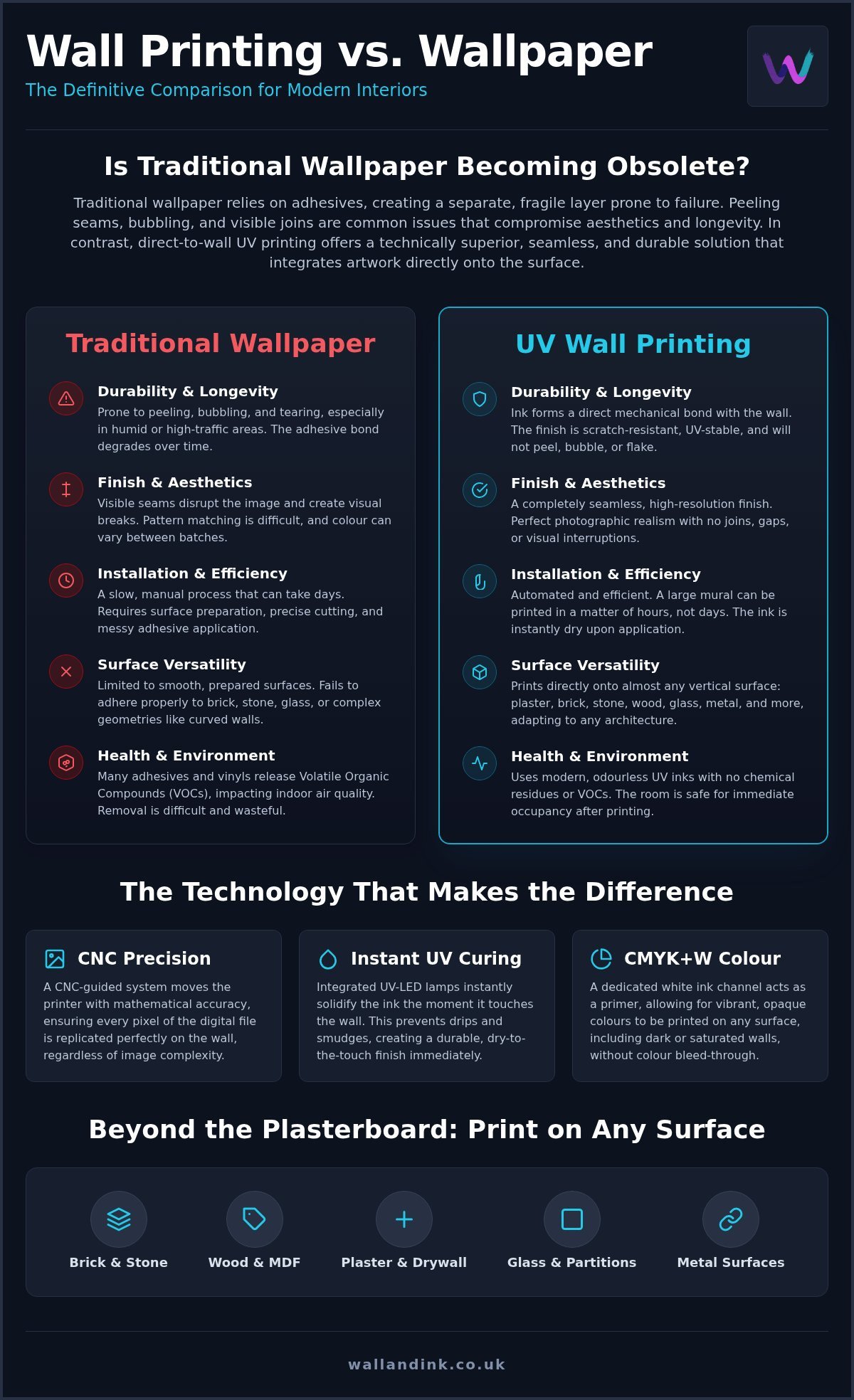
Wall Printing vs Wallpaper: A Direct Performance Comparison
Efficiency in commercial and residential projects is often measured by the reduction of site downtime. When comparing wall printing vs wallpaper, the disparity in installation timescales is significant. Traditional wallpapering is a multi-stage manual process involving surface priming, adhesive application, soaking times, and meticulous hanging. This can take several days for a large-scale mural. Our vertical printing process is an industrial operation that completes the same task in hours. The machine executes the design with continuous precision, eliminating the human error associated with manual alignment and drying times.
Durability in high-traffic UK environments, such as office corridors or school hallways, is where the technical gap becomes most apparent. Traditional vinyl murals or papers are susceptible to physical impact at the seams. Once a seam is compromised, the entire installation begins to fail. Because direct-to-wall printing is a single, integrated layer bonded to the substrate, there are no edges to catch or peel. This shift towards on-demand, digital solutions is reshaping the printed interior market, moving away from mass-produced rolls towards bespoke, high-performance applications that offer superior longevity.
Hygiene and Environmental Impact
In healthcare and educational settings, hygiene is a critical metric. Printed walls offer a distinct advantage as they lack the porous surfaces and adhesive pockets where bacteria can thrive. The UV-curable inks we use are entirely odourless and VOC-free. This allows spaces to be occupied immediately after the printhead finishes its pass. Maintaining the integrity of the art is straightforward. The hardened ink film is resistant to standard detergents, allowing for regular sanitisation whilst maintaining the original colour density and detail.
Versatility in Architectural Design
Modern architectural features often present obstacles for paper-based media. Sockets, switches, and ventilation grilles require complex manual cuts that often leave messy edges or gaps. Digital printing handles these elements with absolute precision. The sensors on our vertical rails allow the printhead to navigate around fixtures whilst maintaining a perfect geometric alignment. This capability extends to heights that exceed standard wallpaper roll lengths and the ability to wrap artwork around corners or into deep alcoves. It is a seamless application that removes the constraints of traditional decorating rolls.
Surface Versatility: Where Can a Vertical Wall Printer Be Used?
Wallpaper requires a perfectly skimmed, flat surface to ensure a successful bond. Any deviation in the substrate, such as the mortar lines in brickwork or the uneven texture of stone, leads to immediate adhesive failure. In the technical evaluation of wall printing vs wallpaper, the printer’s ability to navigate rough architectural textures is a decisive advantage. Whilst wallpaper would tear or bubble over masonry, the vertical printer uses laser sensors to maintain a constant 1mm gap from the wall. This allows the ink to settle into the recesses of the texture, creating a mural that looks like it’s part of the structure rather than a layer stuck on top.
External wall printing provides a durable solution for building facades and retail shopfronts that traditional media cannot match. The UV-curable inks are weather-resistant and don’t require the protection of a separate laminate. This is a significant shift from traditional vinyl decals that often shrink or peel when exposed to the UK’s varied climate. Our national installation team uses these industrial-grade machines to transform challenging surfaces into high-resolution visual assets. If you’re looking to upgrade a specific substrate, you can view our full range of surface printing capabilities to see how we handle diverse materials.
Preparing Standard Construction Materials
Optimal ink adhesion depends on the preparation of the base material. For new plaster, it’s essential to ensure the surface is fully cured. We typically recommend a moisture level below 1% before application. Painted surfaces also play a role in the final aesthetic. A matt emulsion provides the best mechanical key for UV ink. Silk or gloss finishes are non-porous and may require a specific primer to ensure the ink doesn’t bead during the application process. On timber and wood panels, we can apply semi-transparent digital layers that enhance the natural grain whilst adding bespoke branding or artwork.
Industrial and Commercial Substrates
Modern office environments frequently utilise glass and metal, surfaces that are notoriously difficult for traditional decorating methods. Wall printing vs wallpaper isn’t even a contest on these substrates; paper simply won’t adhere. We use specialised primers for glass partitions to create privacy frosting or high-definition logos that are scratch-resistant. In industrial units or commercial kitchens, printing directly onto metal cladding or tiles provides a durable branding solution that survives rigorous cleaning schedules. For brickwork, our process achieves an ‘industrial-chic’ aesthetic that maintains the tactile feel of the masonry without the plastic sheen of a vinyl decal.
Navigating Your Project with Wall & Ink’s Professional Service
The wall printing vs wallpaper decision often comes down to the logistical reality of the installation day. Traditional decorating involves significant site disruption, including the mess of cutting tables and the pervasive smell of chemical adhesives. Our service removes these industrial frictions. We deploy specialised vertical printers that operate with minimal noise and zero dust. Because our UV inks cure instantly under LED light, there is no prolonged drying period. This allows for immediate room occupancy, a benefit that is particularly valuable for retail environments and hospitality sectors where downtime translates directly to lost revenue.
Wall & Ink manages the technical complexity of the vertical rail system and sensor calibration so you can focus entirely on the creative outcome. We position ourselves as a reliable partner for pragmatic decision-makers who value efficiency and high-quality results. Our national UK service brings this industrial precision directly to your site, ensuring a consistent standard of quality whether you are based in a city centre office or a remote commercial unit. We eliminate the traditional hassles of pattern matching and adhesive failure, replacing them with a streamlined mechanical process.
Bespoke Design and Digital Visualisation
We provide bespoke digital visualisations for every project to ensure the final output meets your exact specifications. This step is critical for high-stakes commercial environments where brand accuracy is non-negotiable. Our design team adapts your branding or favourite imagery for large-scale vertical application, creating digital mock-ups that show exactly how the mural interacts with your architectural features. We conduct technical site assessments to verify rail clearance and ensure the piezoelectric printheads have an unobstructed path. This rigorous preparation guarantees that the final mural fits the physical space with absolute accuracy, avoiding the misalignment issues common with paper rolls.
The Wall & Ink Commitment to Quality
Our expert operators are trained in UV ink management and the precise operation of CNC-guided machinery. We operate with radical transparency regarding our costs, providing clear pricing structures based on square footage and design complexity. This straightforward approach allows you to plan your budget with confidence, knowing exactly what the investment entails. From the initial consultation to the final cured print, we provide a seamless end-to-end journey that prioritises cleanliness and technical excellence. If you are ready to transform your interior with a durable, high-resolution mural that outperforms traditional media, enquire about our national wall printing services today to start your project.
Advancing Beyond the Limitations of Decorative Paper
The shift towards direct-to-substrate application marks a fundamental change in how we approach interior murals. Traditional methods are increasingly viewed as temporary fixes, whereas industrial printing provides a permanent, integrated solution. By choosing UV technology, you eliminate the risks of peeling edges and environmental degradation whilst gaining the ability to print on diverse materials like brick, glass, and metal. This technical flexibility ensures your design isn’t limited by the physical properties of paper.
When evaluating wall printing vs wallpaper, it’s clear that the future of interior design relies on mechanical precision and digital accuracy. Our process utilises UV-curable inks for instant, scratch-resistant durability, ensuring your investment remains vibrant for years. Every project includes bespoke digital mock-ups to guarantee a perfect fit within your specific architectural constraints. We provide a national UK service with professional on-site installation, delivering a clean and efficient experience for both high-stakes commercial environments and private residences.
If you’re ready to eliminate the maintenance burdens of legacy media, request a bespoke quote for your wall printing project. We look forward to helping you achieve a seamless, industrial-grade finish for your space.
Frequently Asked Questions
Is vertical wall printing permanent or can I remove it later?
Direct-to-wall printing is a permanent installation in terms of durability, but it is easily reversible. To remove or change the mural, you simply apply two coats of standard emulsion over the print. This process is far cleaner than the traditional method of steaming and scraping required for wallpaper removal, allowing you to update your interior design without damaging the underlying plaster.
Can you print on textured surfaces like brick or rough plaster?
Yes, our technology handles textured substrates with ease. The vertical printer uses laser-guided sensors to maintain a consistent distance from the surface, allowing the ink to settle into the recesses of brickwork, stone, or rough plaster. It maintains image integrity where wallpaper would otherwise fail to adhere, making it ideal for industrial-chic aesthetics or heritage buildings with uneven masonry.
How long does it take to print a standard feature wall mural?
A standard feature wall typically takes between two and four hours to complete. This timescale includes machine setup, rail alignment, and the printing process itself. Because the UV ink cures instantly under the integrated LED lamps, the space is ready for immediate use. This is a significant advantage over wallpaper, which requires 24 to 48 hours for adhesives to dry fully.
Are the UV inks used safe for indoor environments like schools?
UV inks are entirely safe for schools, hospitals, and residential nurseries. The inks we use are VOC-free and produce no chemical odours during or after the application process. Once the UV-LED light passes over the ink, it becomes a stable, inert film that is scratch-resistant and easy to sanitise. This ensures a healthy indoor air quality for students and patients alike.
What is the maximum height a vertical wall printer can reach?
Our standard vertical rail extensions allow the printer to reach a maximum height of 4 metres. For expansive commercial spaces, the horizontal width is effectively unlimited, as the rail system can be extended to cover the entire length of a corridor or hall. This makes it a superior choice for large-scale murals that would otherwise require dozens of individual wallpaper rolls and complex pattern matching.
Do I need to prepare my wall before the printing team arrives?
The wall should be clean, dry, and free from loose debris or peeling old paint. A base coat of matt emulsion provides the best mechanical key for the UV ink to bond with the substrate. We recommend completing any nearby construction work beforehand to ensure the environment is dust-free. This preparation ensures the piezoelectric printheads can deliver ink droplets with absolute industrial precision.
How does the cost of wall printing compare to high-end wallpaper?
Wall printing is often more cost-effective than high-end custom wallpaper when you factor in professional installation and long-term durability. Whilst mass-produced rolls might have a lower initial material cost, the industrial precision of a printed mural eliminates the need for frequent repairs. When evaluating wall printing vs wallpaper, the absence of peeling seams and bubbling makes printing a more sustainable financial investment.
Can the printer accurately reproduce company logos and brand colours?
The system reproduces brand colours and complex logos with absolute accuracy. Using a CMYK+W colour gamut and resolutions up to 2880 DPI, we can match specific digital assets faithfully. The inclusion of a dedicated white ink channel ensures that logos remain vibrant and opaque even when applied to dark or coloured backgrounds. This level of technical control is impossible to achieve with traditional wallpaper rolls.