
The most impactful wall to wall murals aren’t applied to a surface; they are integrated directly into it. If you’ve ever managed a commercial or residential space, you’ve likely experienced the frustration of wallpaper panels showing visible joins or vinyl graphics peeling at the edges. These traditional methods often struggle with durability, particularly in high-traffic areas where physical contact and environmental factors quickly degrade the adhesive. It’s a common compromise that many decision-makers accept, yet it often leads to costly repairs or premature replacements.
Direct-to-wall printing offers a superior, seamless alternative that eliminates these common failure points. In this guide, you’ll discover why industrial-grade UV printing provides a resilient finish that traditional wallpaper simply cannot match. We’ll outline the technical precision behind this modern method, explain its application across various substrates, and show how bespoke digital visualisation ensures your artwork is perfectly tailored to your room’s specific dimensions. By moving away from adhesives and physical layers, you can achieve a durable, high-resolution result that remains pristine for years.
Key Takeaways
- Learn why digital direct-application is replacing traditional paper-based methods to deliver seamless, edge-to-edge visual transformations.
- Understand the technical role of vertical printing robots and UV ink technology in achieving smudge-proof, high-resolution results on any substrate.
- Compare the industrial-grade durability and wipe-clean maintenance of wall to wall murals against the inherent weaknesses of traditional wallpaper.
- See how bespoke digital visualisation and professional consultations ensure your artwork is precisely calibrated to your room’s unique dimensions.
- Discover the benefits of a full-service national partner capable of delivering advanced wall printing directly to your commercial or residential site.
Beyond Wallpaper: Redefining Wall to Wall Murals in 2026
Modern wall to wall murals represent a complete edge-to-edge visual transformation of a space. In 2026, the industry has moved beyond the limitations of physical overlays like paper or vinyl. Whilst the history of murals is rooted in hand-painted artistry, today’s professional standard relies on digital direct-application. This shift reflects a growing demand for durability and precision in both commercial and residential design. Pragmatic decision-makers now prioritise solutions that integrate with the architecture rather than simply sitting on top of it. It’s a move toward industrial reliability where the finish is as tough as the surface it’s printed on.
The Problem with Traditional Wallpaper Murals
Traditional wallpaper methods are inherently flawed due to their reliance on segmented panels. Even with expert installation, seams and joins eventually become visible as the building settles or temperatures fluctuate. These physical breaks distract from the overall visual impact of wall to wall murals, breaking the immersion of the design. In high-traffic areas or humid environments, edge-peeling is a constant risk. The risk isn’t just aesthetic; it’s a maintenance burden. Traditional adhesives can also involve chemical outgassing, and the inevitable material waste from trimming panels creates an unnecessary environmental footprint. You’re left with a product that’s prone to damage and requires frequent attention to remain presentable.
Why Seamless is the New Standard
A continuous, uninterrupted image offers an aesthetic superiority that panelled alternatives can’t match. By removing the vertical lines of wallpaper strips, the artwork flows naturally across the entire surface. This seamless approach enhances the perceived size of a room, creating an expansive feel that opens up tighter spaces. It’s a cleaner, more professional look that signals quality and attention to detail. Direct-to-wall printing is a material-free solution that applies UV-cured ink directly to the substrate, eliminating the need for paper, vinyl, or adhesives. This process ensures the mural becomes a permanent part of the wall, offering industrial-grade durability that withstands the rigours of daily use without fading or peeling. It’s the logical choice for those who value efficiency and high-quality results.
The Technology Behind Direct-to-Wall UV Printing
Direct-to-wall printing is a technical evolution that replaces manual application with robotic precision. Unlike traditional mural painting which relies on the steady hand of an artist, this method utilises vertical printing robots and advanced UV ink chemistry. The core advantage lies in the instant curing process. As the print head travels across the surface, integrated UV lamps trigger a photochemical reaction that hardens the ink immediately. This results in a smudge-proof finish that’s ready for high-traffic environments the moment the machine stops.
The resolution of the output is directly linked to the quality of the digital source file. By using high-resolution assets, the printer can reproduce intricate details that would be impossible to achieve with standard wallpaper printing. This level of clarity is essential for wall to wall murals where the viewer might stand just inches away from the artwork. Every pixel is rendered with industrial accuracy, ensuring the final image is crisp, vibrant, and perfectly scaled to the room’s architecture.
Precision Engineering for Interior Art
The mechanical accuracy of our vertical robots ensures edge-to-edge coverage with millimetre precision. These machines are engineered to maintain a consistent distance from the substrate, even on surfaces that aren’t perfectly level. This precision eliminates the overlap and alignment issues found in traditional methods. Because the UV light locks the pigment in place instantly, the colours remain vibrant for years without the risk of fading. The entire process is remarkably clean. There’s no paste, no messy adhesives, and no lingering chemical odours; it’s a pragmatic choice for active professional environments.
Versatility Across Different Substrates
One of the most significant benefits of this technology is its ability to adhere to almost any surface. Whilst traditional wallpaper requires a smooth, primed surface, direct-to-wall printing works on bare plaster, painted walls, and even non-porous materials like glass or polished wood. When applying wall to wall murals to challenging surfaces like exposed brick or concrete, the robotic sensors adjust in real-time. The ink settles into the crevices of the substrate to create a sense of depth and authenticity. This versatility extends to the outdoors, where exterior wall printing provides a durable solution for facade art that survives harsh weather conditions.
If you’re planning a project that requires this level of technical reliability, exploring the direct-to-wall printing services offered by specialists can ensure a result that meets industrial standards.
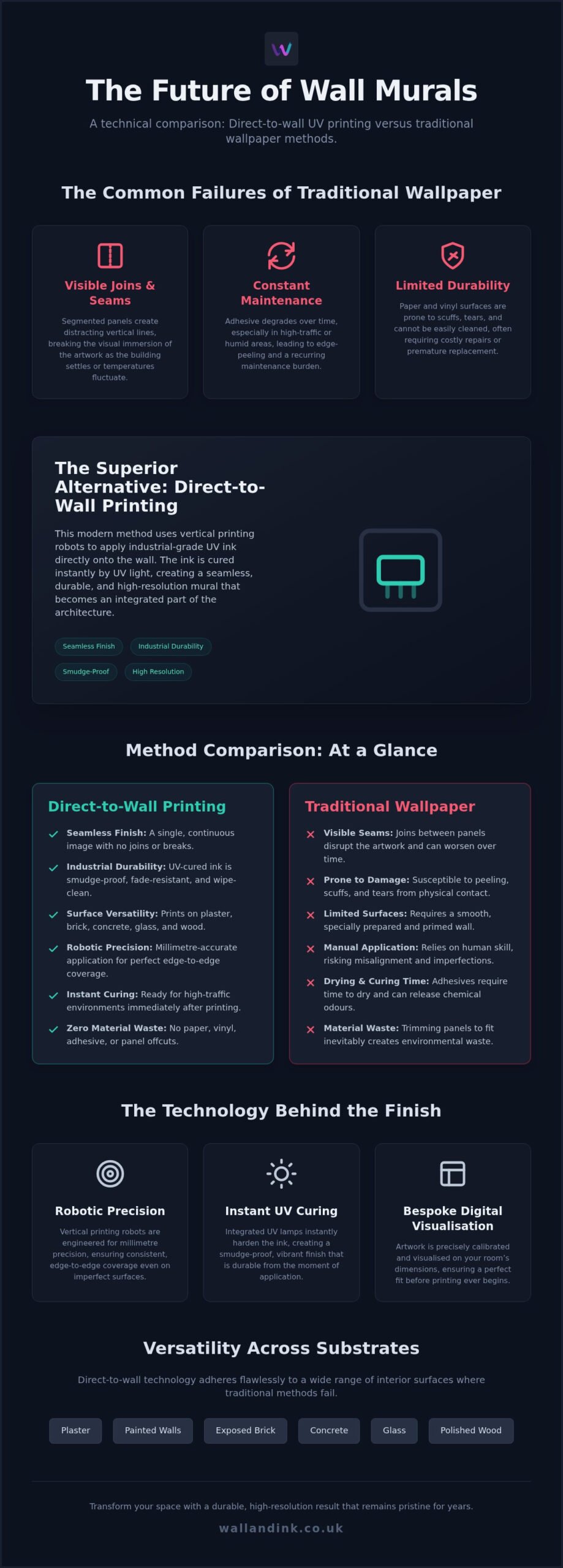
Direct-to-Wall Printing vs Traditional Murals
Choosing between traditional wallpaper and robotic application is a choice between a temporary layer and a permanent architectural finish. Standard wall to wall murals created with paper or vinyl rolls rely on adhesives that eventually degrade. Over time, these materials are prone to shrinking, bubbling, or peeling at the edges. In contrast, UV-cured ink becomes part of the substrate itself. This fundamental difference in digital printing technology ensures a lifespan that far exceeds that of physical overlays. For pragmatic decision-makers, the long-term cost-efficiency is clear: you eliminate the cycle of repair and replacement that traditional methods demand.
The “no-seam” advantage is perhaps the most significant differentiator for complex patterns. When installing traditional wallpaper, even a millimetre of misalignment at the join can ruin the perspective of a large-scale design. Direct-to-wall printing removes this risk entirely. The robot moves across the surface in a continuous motion, rendering the image as a single, flawless piece of art. This lack of physical joins is essential for maintaining the visual integrity of high-impact wall to wall murals in professional environments.
Durability and Maintenance
UV-cured inks provide an industrial-grade level of scratch resistance that paper simply cannot match. In busy commercial settings, walls are often subjected to scuffs from furniture or heavy foot traffic. Whilst wallpaper tears and vinyl scuffs, a printed wall remains intact. Maintenance is equally straightforward. Because the ink is hardened instantly by UV light, the surface is non-porous and wipe-clean. You can remove dust or marks with a damp cloth without the risk of the artwork smudging, fading, or absorbing moisture. It’s a reliable, low-maintenance solution for schools, hospitals, and retail spaces.
Installation Efficiency
Traditional wallpapering is often a multi-day project involving surface priming, adhesive application, and meticulous panel alignment. It’s a messy process that frequently requires a room to be vacated. Direct-to-wall printing is a “print and go” service. The setup is rapid, and the lack of odours or wet adhesives means the space can remain operational. This efficiency minimises disruption to homes and offices, allowing for a complete visual overhaul in a fraction of the time. Once the robot finishes its pass, the mural is dry and the project is complete. There’s no waiting for glue to set and no waste material to clear away.
Designing Your Bespoke Mural: From Concept to Visualisation
Precision engineering requires precise planning. Every successful wall to wall murals project begins with a professional design consultation. This stage moves beyond simply selecting a stock image from a gallery; it involves a technical assessment of the physical environment. Designers evaluate the lighting, the intended behaviour of the space, and the existing colour palette to ensure the final output is a deliberate architectural feature. Pragmatic planning eliminates the guesswork that often plagues traditional wallpapering, providing a reliable roadmap from the initial concept to the final print.
The Digital Visualisation Process
Our technical workflow relies on creating detailed mock-ups that account for every architectural element, including doors, windows, and even light switches or sockets. This process ensures that the focal point of your art isn’t obscured by furniture or structural fixtures. By seeing a digital preview of the mural in your specific space, you can adjust colour palettes to match your existing interior décor perfectly. It’s about achieving a bespoke fit that standard wallpaper rolls cannot provide, ensuring the artwork integrates seamlessly with the room’s dimensions.
Bespoke Art Creation
True bespoke art creation allows for the integration of diverse visual assets, from corporate branding to high-resolution photography. For commercial environments, this means scaling logos and text without any loss of quality. We utilise vector technology to ensure that even the largest wall to wall murals maintain sharp edges and clear definitions. This technical approach avoids the pixelation and distortion often seen in lower-quality digital prints. Whether you’re adapting a professional photograph or creating a unique graphic, the artwork is optimised specifically for the dimensions and texture of the wall substrate.
Achieving professional results requires more than just high-end machinery; it requires a design process that respects the physical reality of the site. If you’re ready to begin your project, you can start your bespoke design consultation with our specialist team. By combining digital visualisation with industrial printing precision, we ensure that every mural is a perfect technical and aesthetic match for its environment.
Transform Your Space with Wall & Ink’s National Service
Wall & Ink provides a comprehensive end-to-end service that eliminates the risks associated with DIY installation or third-party contractors. Whilst some competitors simply ship wallpaper rolls and leave the technical challenges to the client, we manage the entire process on-site. From the initial visualisation to the final robotic print, our team ensures every project meets industrial standards for precision and cleanliness. This national UK service brings advanced UV printing technology directly to your doorstep, providing a reliable partner for large-scale visual projects. Professional execution is the only way to guarantee the perfect finish required for high-impact wall to wall murals.
Commercial and Educational Applications
In educational settings, the ability to create immersive learning environments is a significant advantage. Schools utilise direct-to-wall printing to depict historical timelines, complex scientific diagrams, or geographical maps across entire corridors and classrooms. These murals are durable enough to withstand the daily rigours of a school environment whilst remaining easy to clean. For office spaces, high-impact branding reinforces corporate identity and culture without the clutter of physical signage or the peeling edges of vinyl decals. Retail and hospitality sectors also benefit from this technology; it allows for bespoke graphics that can handle high footfall and frequent sanitisation. The result is a professional environment that communicates quality and attention to detail to every visitor.
Residential Feature Walls
Direct-to-wall printing offers homeowners a level of customisation that traditional decor cannot reach. You can personalise your living spaces with high-resolution bespoke art that is scaled exactly to your wall’s dimensions. This method is particularly effective for creating immersive themes in children’s bedrooms and nurseries, where the lack of chemical odours and wet adhesives is a practical benefit. Because the ink is integrated into the wall surface, the artwork is resilient and remains pristine without the bubbling or tearing common with wallpaper. It’s a clean, efficient way to introduce sophisticated art into a private setting without the mess of traditional decorating.
If you are ready to move beyond the limitations of paper and vinyl, you can book your bespoke wall mural consultation with Wall & Ink today. Our specialists provide the technical expertise and the industrial machinery needed to deliver wall to wall murals that are as durable as they are visually striking. We handle the technical complexities so you can focus on the final aesthetic result, ensuring a seamless transition from your initial concept to a finished, high-resolution wall.
Secure the Future of Your Wall Surfaces
Transitioning to direct-to-wall printing represents a strategic investment in the longevity and visual integrity of your space. By eliminating the inherent weaknesses of traditional wallpaper, such as peeling edges and visible joins, you ensure a finish that remains pristine even in high-traffic areas. The combination of robotic precision and UV-cured inks provides a level of industrial durability that legacy methods simply cannot match. It’s a pragmatic solution for those who value efficiency and high-resolution results over temporary fixes.
Our professional on-site installation and bespoke design visualisation service guarantee that every project is technically perfect from the first pass. We manage the complexities of scaling and substrate compatibility, ensuring your wall to wall murals are perfectly integrated into the architecture. This material-free approach is the modern standard for permanent, high-impact art in both commercial and residential settings.
Request a bespoke quote for your wall to wall mural to discover how our specialised process can redefine your environment. It’s time to replace fragile paper layers with a resilient, high-resolution architectural feature that stands the test of time.
Frequently Asked Questions
What is the difference between a wall mural and wallpaper?
Wallpaper consists of repetitive patterns printed on physical rolls of paper or vinyl that require manual application with adhesives. A mural is a single, large-scale image designed for a specific surface. Direct-to-wall murals are printed directly onto the substrate, which eliminates the seams, joins, and adhesive failures inherent in traditional wallpaper. This results in a more durable, integrated finish that becomes part of the architecture itself.
Can you print a wall to wall mural on a textured surface like brick?
Yes, our vertical printing robots are engineered to print on various textured surfaces including exposed brick, concrete, wood, and stone. The machine utilises advanced sensors to adjust the print head’s distance from the wall in real-time, maintaining a consistent focus across uneven substrates. This allows the UV ink to settle into the texture of the material, creating a sense of depth that traditional paper or vinyl cannot achieve.
How long does a direct-to-wall printed mural last?
A direct-to-wall printed mural typically lasts between 5 and 10 years in an indoor environment without fading or degrading. Because the UV-cured ink is bonded directly to the substrate, it’s highly resistant to scratches, scuffs, and environmental wear. Unlike wallpaper or vinyl, it doesn’t bubble, peel at the edges, or tear in high-traffic areas, making it a reliable choice for long-term wall to wall murals.
Is the ink used in wall printing safe for homes and schools?
The UV-cured inks used in our process are safe for sensitive environments including homes, nurseries, and schools. Once the ink is hardened by the UV lamps, it’s instantly dry, odourless, and non-toxic. The process doesn’t involve the volatile organic compounds (VOCs) often found in solvent-based printing or the chemical adhesives required for wallpaper installation, ensuring a clean and healthy indoor air quality.
Do I need to prepare my wall before the printing process begins?
Walls must be clean, dry, and free from significant physical defects such as deep cracks or holes. Whilst our technology handles surface texture effectively, a stable and relatively flat substrate ensures the best ink adhesion. We generally recommend a light-coloured, matte-finish base for the most accurate colour reproduction. Our technical team provides specific guidance on surface preparation during the initial consultation to ensure a professional result.
Can I use my own high-resolution photograph for a custom mural?
Yes, you can use your own high-resolution digital files to create bespoke wall to wall murals. The final print quality is directly dependent on the resolution of the source image, so we recommend professional-grade files. Our design visualisation service includes a technical check to ensure your photograph can be scaled to the required dimensions without pixelation or loss of detail, ensuring a crisp and impactful finish.
What happens if I want to change the mural in the future?
If you decide to update your space, you simply paint over the existing mural using a standard primer and topcoat. Because there’s no physical layer of paper or vinyl to strip away, the removal process is significantly cleaner and faster than traditional methods. There’s no damage to the plaster and no adhesive residue to scrape off. Once the wall is repainted, it’s immediately ready for a new design.