
A pop-up shop shouldn’t feel like a temporary compromise; it must project the authority of a flagship store from the very first hour of trade. You’ve likely faced the logistical deadlock of a short-term lease where traditional renovations are prohibited and landlords forbid any permanent alterations. The common reliance on vinyl wraps or wallpaper often leads to damaged surfaces and peeling edges, resulting in a generic interior that fails to justify premium pricing or attract significant footfall.
We recognise that speed and precision are the primary drivers of retail success. This article explores high-impact pop-up shop interior ideas that transform bare units into immersive brand experiences through direct-to-wall UV printing. You’ll learn how to create durable, high-resolution feature walls on brick, plaster, or wood without the mess of traditional applications. We’ll outline a strategic approach to interior design that ensures your temporary space is both Instagrammable and professional, providing a clear roadmap from initial digital visualisation to a finished, high-traffic environment that eliminates the usual hassles of shopfitting.
Key Takeaways
- Learn how to elevate temporary retail environments to flagship standards by prioritising professional design over generic, fast-decor alternatives.
- Discover high-impact pop-up shop interior ideas including typography-led brand manifestos and geometric graphics designed to guide customer movement.
- Compare the technical benefits of direct-to-wall UV printing against vinyl decals to achieve a high-resolution, painted-on finish on brick, wood, or plaster.
- Master strategic layout techniques, such as the ‘Decompression Zone’, to ensure your brand story is communicated effectively from the shop entrance.
- Understand the efficiency of a no-mess installation process that utilises bespoke digital visualisations to guarantee precision for UK retail turnarounds.
Maximising Impact in Temporary Spaces: The Pop-Up Challenge
Pop-up retail has transitioned from an experimental trend into a critical strategy for UK brands. This shift demands a move away from makeshift aesthetics toward fully immersive environments. The psychological role of interior design in these short-term spaces is immense; it must bridge the gap between a brand’s digital presence and physical reality in a matter of days. Traditional fast decor, such as temporary wallpaper or stand-alone banners, often fails the premium brand test. These solutions lack the tactile quality and industrial precision required to justify high price points or build long-term trust.
Effective pop-up shop interior ideas must now navigate the tension between bold identity and strict landlord restrictions. Most commercial landlords in the UK forbid permanent renovations, yet a generic white-box interior won’t drive footfall. The challenge lies in creating a space that looks permanent and bespoke whilst remaining entirely non-invasive. Modern retail demands a finish that suggests the brand has been there for years, even if the lease is only for weeks. Achieving this requires a move toward technical solutions that integrate with the existing architecture rather than sitting awkwardly on top of it.
The ‘First Five Seconds’ Rule in Retail
Visual cues at the entrance dictate customer dwell time almost instantly. In a high-traffic high street or shopping centre, your interior must project authority the moment it’s glimpsed from the pavement. Large-scale graphics are the most efficient way to achieve this. By using the entire vertical surface of a unit, you create a sense of scale that smaller fixtures cannot match. Colour psychology is equally vital. Saturated, precisely applied colours build trust and signal quality, whereas poorly matched or peeling vinyl can subconsciously suggest a budget operation. Using high-resolution typography on a feature wall allows you to communicate brand values without cluttering the floor space, keeping the customer’s path clear and focused.
Overcoming the Limitations of Short-Term Leases
Short-term leases often result in a reliance on vinyl decals or traditional wallpaper. These methods are frequently problematic. Vinyl often bubbles on uneven surfaces like brick or timber, and both options risk leaving unsightly residue or damaging the landlord’s walls upon removal. Direct-to-wall UV printing offers a superior alternative. This process applies ink directly to the substrate, accommodating various surface types including plasterboard, wood, and brick. It provides the painted-on look of a hand-painted mural but with the speed of a digital process. This allows for a 24-hour turnaround in shop fitting, ensuring you don’t lose valuable trading days to complex installations. The result is a professional, high-impact environment that respects the lease terms whilst maximising brand presence. It’s a pragmatic solution for brands that refuse to compromise on visual quality despite time constraints.
Innovative Wall Graphic Ideas for High-Conversion Interiors
High-conversion pop-up shop interior ideas rely on graphics that serve a dual purpose: aesthetic appeal and functional guidance. Unlike traditional murals that may feel disconnected from the brand, typography-led walls allow you to print manifestos or mission statements with industrial precision. This approach transforms a plain surface into a narrative tool that communicates brand authority instantly. A comprehensive guide to getting started in temporary retail emphasises that differentiation is key to success; direct-to-wall printing provides this by embedding your brand identity into the very fabric of the unit.
Abstract geometric patterns are another effective method for influencing customer behaviour. By using sharp lines and contrasting colours, you can subconsciously guide shoppers through the floor plan. This technical approach to decor ensures that customers don’t just stand at the entrance but move toward high-value inventory. For brands with high-quality visual assets, hyper-realistic product photography can be printed directly onto architectural features like exposed brick or timber. This creates a sophisticated, integrated look that vinyl stickers cannot replicate. You can even include digital triggers, such as QR codes, printed with pixel-perfect accuracy to bridge the gap between physical browsing and online conversion.
Creating Social-First Focal Points
Developing ‘selfie-ready’ walls is a standard requirement for modern retail, but execution often fails due to poor lighting. Standard gloss vinyl reflects shop lights, ruining photographs with glare. We utilise a matte UV ink finish that ensures graphics are camera-ready under any lighting conditions. Strategic placement is also vital. Positioning your most impactful art at the rear of the shop encourages customers to traverse the entire space, increasing the likelihood of unplanned purchases. Integrating brand hashtags naturally into the design ensures that every shared photo serves as a direct referral back to your location.
Zonal Branding and Wayfinding
Large-scale graphics allow you to define product categories without the need for expensive or bulky physical partitions. This zonal branding keeps the space open whilst providing clear visual cues for the shopper. Wayfinding is the strategic use of signage and design to guide customers through a space to increase basket size. Direct-to-wall printing produces professional, integrated signage that won’t peel or curl over time. For brands planning a multi-city tour, our commercial wall murals provide a consistent, high-resolution finish across every location, ensuring brand equity remains high regardless of the site’s original condition.
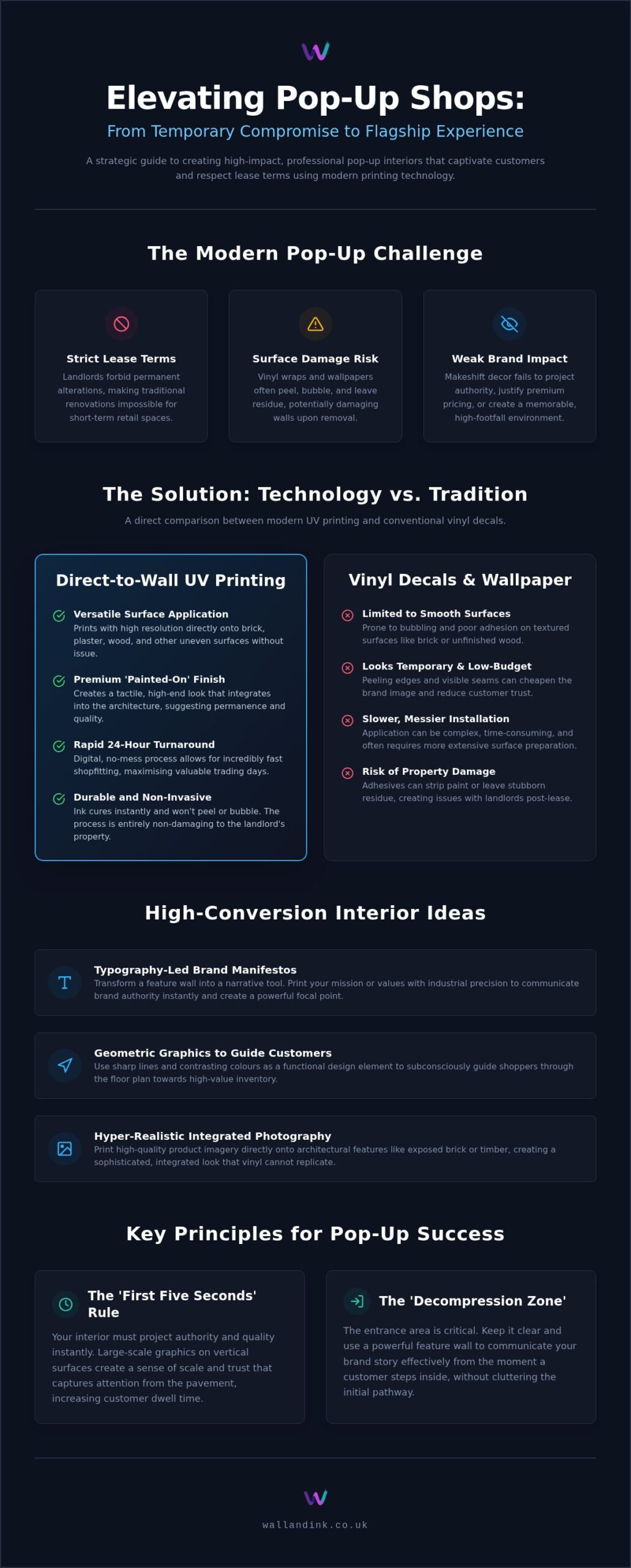
Direct-to-Wall Printing vs Vinyl Decals: Which Suits Your Shop?
Selecting the right application method is a technical decision that dictates the professional finish of your retail space. Whilst vinyl decals are often the default choice for pop-up shop interior ideas, they frequently result in a ‘sticker’ aesthetic that can undermine premium branding. In contrast, direct-to-wall printing offers a sophisticated ‘painted-on’ finish that integrates seamlessly with the architecture. This method ensures that your graphics look like a bespoke part of the building rather than a temporary addition.
Surface versatility is a significant differentiator. Traditional vinyl requires perfectly flat, non-porous surfaces to adhere correctly; it often bubbles on brick and peels on uneven plaster. Our direct-to-wall UV printing accommodates almost any substrate, including timber, concrete, and textured masonry. This capability allows you to utilise the existing character of an urban warehouse or a historic high street unit without the need for expensive surface preparation or temporary partition walls.
Retail environments are high-traffic zones where durability is paramount. Customer contact and accidental scratches quickly degrade vinyl graphics, leading to a tatty appearance within weeks. UV inks are cured instantly during the printing process, creating a durable layer that resists mechanical wear and maintains its integrity for the duration of your lease. From a sustainability perspective, direct printing is the superior choice. It eliminates the need for plastic-based films and PVC-heavy materials, reducing the environmental footprint of your temporary installation by applying ink directly to the existing wall.
The Technical Superiority of UV Ink
UV printing technology uses high-intensity light to cure ink immediately upon contact with the wall. This creates a smudge-proof, high-resolution finish that is ready for retail trade the moment the machine finishes its pass. The precision of the process ensures that brand logos and fine typography remain sharp even under close scrutiny from customers. Installation is a clean, no-mess process that avoids the fumes associated with traditional paints or the alignment issues of large-scale vinyl. Our automated printers deliver consistent quality across large-scale murals, ensuring your brand image is identical across every site in a multi-location brand deployment.
Cost-Benefit Analysis for Short-Term Use
Pragmatic decision-makers view interior decor as an investment in footfall. A professional brand image justifies premium pricing, whilst a cheap-looking shopfront can drive potential customers away. Maintaining a fresh appearance is simple; UV-printed walls don’t peel or curl at the edges like traditional alternatives. Protecting your security deposit is also a primary concern for retailers. Direct-to-wall printing is easily painted over at the end of the lease, ensuring a straightforward ‘make-good’ process that avoids the stubborn adhesive residue and surface damage common with vinyl removal.
Strategic Layout and Brand Storytelling for Pop-Up Success
Strategic layout is the foundation of effective pop-up shop interior ideas. It ensures that the transition from the street to the point of sale is logical and persuasive. A cohesive brand story must be told from the moment a customer crosses the threshold, requiring a methodical approach to how graphics and products are positioned. By treating the walls as a narrative canvas, you can guide the customer through a curated experience that builds trust and justifies premium pricing.
The first two metres of any retail unit function as a ‘Decompression Zone’. This area must remain visually calm to allow shoppers to adjust to the change in environment and lighting. Overwhelming this space with dense information or cluttered displays often leads to sensory overload, causing customers to leave prematurely. Instead, utilise minimalist graphics that set the tone without demanding immediate action. This allows the customer to orient themselves before they engage with your core product range further inside the shop.
Shopper behaviour consistently shows that customers naturally turn right upon entering a store. This makes the right-hand wall your ‘Power Wall’, the highest-value real estate in the unit. High-impact feature walls should be utilised here to showcase flagship products or your brand manifesto. Balancing these bold graphics with strategic negative space is vital to prevent visual fatigue. It creates a rhythmic sense of progression where the customer’s eye is drawn to specific, high-resolution focal points rather than being lost in a sea of competing stimuli. Ready to plan your next retail installation? Explore our retail and hospitality graphics to see how we transform temporary units with industrial precision.
The Power of Bespoke Digital Visualisations
Precision starts before the printer arrives. We use bespoke digital visualisations to overlay designs onto your specific unit’s dimensions, ensuring that scale and colour are optimised for the site’s unique architectural features. This process is essential for pop-up shop interior ideas that require brand consistency across diverse locations. It allows you to verify the visual impact and adjust the positioning of key elements before a single drop of ink is applied. This technical foresight eliminates the risk of design errors and ensures a perfect fit for every mural.
Lighting Your Wall Art for Maximum Effect
Technical lighting choices significantly influence the perceived quality of your interior. Track lighting is an excellent tool for enhancing the texture of direct-to-wall prints, particularly on industrial surfaces like brick or timber. It’s important to avoid hot spots by angling lights to spread illumination evenly across high-resolution graphics. When executed correctly, shadows and depth make 2D wall art feel 3D, creating a tactile experience that engages customers. This attention to detail reinforces the professional image of the brand and elevates the overall retail environment.
Executing Your Vision with Wall & Ink’s Bespoke Printing
Wall & Ink bridges the gap between high-concept pop-up shop interior ideas and physical execution. Our process begins with a high-resolution digital file, which is processed through specialised software to ensure colour accuracy and sharp detail. Unlike traditional methods that rely on manual application or adhesive films, our direct-to-wall printers apply UV-curable ink directly to the substrate with mechanical precision. This ensures that the final mural is an exact replica of your brand’s digital assets, maintaining visual integrity across any surface from the first pass of the print head.
Our industrial UV printers are the secret weapon for retailers who require flagship-quality results on a pop-up timeline. These machines are engineered for reliability and speed, capable of handling complex graphics on brick, timber, or plaster without the need for priming or extensive surface preparation. We provide comprehensive national coverage, acting as a reliable partner for brands launching multi-city tours across the UK. Whether you’re opening in London, Manchester, or Edinburgh, our team ensures a consistent professional image that justifies premium retail positioning and eliminates the inconsistencies of local contractors.
A Mess-Free Installation for Busy Retailers
Speed is essential in short-term retail, and our technology is designed for rapid turnarounds. The UV printing process is entirely mess-free; there is no dust from sanding and no toxic fumes from traditional paints. This ‘no-dust, no-fumes’ advantage allows us to work in environments where stock and fixtures are already present. The precision of our machines means we can print within millimetres of existing shelving or door frames, eliminating the need for a total site clearance. We recommend booking your installation slot during the 24 to 48-hour ‘pre-launch’ window to ensure your space is trade-ready for the opening hour without the risk of wet paint or peeling vinyl.
Ready to Transform Your Pop-Up?
Preparation for a professional wall printing session is straightforward. We require only a clear, clean wall and access to a standard power supply to begin the transformation. Our design team is available to consult on bespoke mural concepts, ensuring your pop-up shop interior ideas are technically feasible and visually impactful before we arrive on site. We operate with radical transparency, utilising a price-per-square-metre model that allows you to budget with absolute certainty. There are no hidden costs or complex consultation fees; you pay for the exact area of your mural. Start your pop-up transformation with a bespoke quote from Wall & Ink and secure a retail environment that drives both footfall and social sharing through industrial-grade precision.
Elevate Your Retail Presence with Technical Precision
Transforming a temporary unit into a high-conversion retail environment requires a shift from makeshift decor to professional, industrial-grade applications. We’ve explored how direct-to-wall UV printing addresses the specific limitations of short-term leases, providing a durable and high-resolution finish that vinyl stickers cannot match. By implementing strategic pop-up shop interior ideas such as typography-led manifestos and optimised zonal layouts, you ensure your brand story is communicated with authority from the moment you open for trade.
Wall & Ink offers a national UK service with professional on-site installation, ensuring your vision is executed with technical precision regardless of the unit’s original condition. Our process includes bespoke design consultations to guarantee accuracy and UV-durable prints that won’t peel or fade during your tenure. This pragmatic approach eliminates the mess of traditional renovations whilst delivering the high-end aesthetic of a flagship store. Enquire about bespoke wall printing for your next pop-up shop to secure a high-impact interior that justifies premium pricing and drives consistent footfall. Your next retail space is ready for a professional transformation.
Frequently Asked Questions
Can direct-to-wall printing be used on temporary retail walls?
Yes, direct-to-wall printing is specifically engineered for temporary environments where landlords forbid permanent changes. It doesn’t use adhesives that peel or leave residue, making it a superior choice for pop-up shop interior ideas. The process is entirely non-invasive and allows you to return the unit to its original state with a simple coat of paint. This ensures your security deposit remains protected whilst you maintain a premium brand image.
How long does it take to print a large-scale mural in a shop?
Installation speed is a primary benefit for UK retailers operating on tight schedules. A standard feature wall mural can usually be completed within a few hours, allowing for a total shop turnaround in under a day. Because the UV ink cures instantly, there’s no drying time required. You can begin stocking shelves and welcoming customers immediately after the machine finishes its pass, maximising your trading window.
Is the ink used in wall printing safe for public retail spaces?
The UV-curable inks we utilise are entirely safe for public retail environments, including those serving food and beverages. Once the ink is cured by the printer’s high-intensity light, it becomes odourless, non-toxic, and highly durable. It doesn’t emit volatile organic compounds (VOCs) like traditional solvent-based paints. This makes it an ideal solution for enclosed shopping centres or boutique units where air quality and customer comfort are paramount.
Will the wall printer work on rough surfaces like exposed brick or breeze blocks?
Our industrial printers are designed to handle irregular substrates including exposed brick, breeze blocks, and textured plaster. The print head features sensors that automatically adjust its distance from the wall to accommodate surface contours. This technical capability ensures a sharp, high-resolution finish that vinyl decals simply cannot achieve on rough surfaces. It allows you to embrace the industrial aesthetic of a space without compromising on graphic quality.
How do I remove the mural once my pop-up shop lease ends?
Removing the mural at the end of your lease is a straightforward ‘make-good’ process. Unlike vinyl which requires heat guns and scraping, or wallpaper which leaves adhesive residue, you simply apply a standard primer and emulsion over the print. This returns the wall to its original white-box condition in a matter of hours. It’s the most efficient way to exit a temporary lease without incurring damage charges from the landlord.
Can you print brand-specific Pantone colours accurately?
We achieve high colour accuracy by processing your brand’s digital files through specialised RIP software. Whilst absolute Pantone matching can vary slightly depending on the wall’s base colour and texture, our UV inks provide a vibrant and consistent output that satisfies strict brand guidelines. We use bespoke digital visualisations to demonstrate how your specific colours will interact with the unit’s lighting before the physical printing process begins.
Do I need to prime the wall before the printing process begins?
In most cases, no priming is necessary if the wall is clean, dry, and free from loose debris. Our UV ink is designed to adhere directly to common retail substrates like plasterboard, wood, and concrete. If the wall has a very dark or highly absorbent finish, we may recommend a base coat to ensure your pop-up shop interior ideas project with maximum vibrancy. Our team assesses the surface during the initial consultation to ensure optimal results.
What is the maximum size of a wall mural for a retail interior?
There is virtually no limit to the horizontal length of a mural as the printer moves along a modular track system. For height, our standard machines typically cover up to 4 metres in a single pass, which accommodates most UK retail units. For larger industrial spaces or double-height ceilings, we can utilise multi-pass techniques to stack graphics vertically. This flexibility allows you to create massive, floor-to-ceiling brand experiences that dominate the retail environment.