
Your next store refurbishment shouldn’t involve a single roll of vinyl or a bucket of wallpaper paste. While traditional methods have been the industry standard for decades, they’re fundamentally ill-suited for the rigours of a modern high-street environment. You’ve likely dealt with the frustration of vinyl retail graphics peeling at the edges or wallpaper bubbling under harsh store lighting. These legacy solutions often require significant downtime, forcing you to choose between a fresh look and active trading hours.
We understand that a commercial space demands more than just a temporary overlay; it requires industrial-grade durability and visual precision. In this guide, you’ll discover how direct-to-wall UV printing technology is replacing plastic films to create permanent, scuff-resistant branding that integrates directly with your wall surface. We’ll explore the technical advantages of instant-cure inks, the elimination of traditional installation mess, and why the future of commercial design lies in substrate-integrated art rather than adhesive stickers.
Key Takeaways
- Learn how immersive retail graphics transition from simple signage into strategic tools that increase customer dwell time and influence purchasing behaviour.
- Understand the technical superiority of direct-to-wall UV printing, which cures instantly to provide a scuff-resistant finish on brick, wood, or plaster.
- Discover why modern UV-cured inks offer a more sustainable and durable alternative to traditional vinyl decals, eliminating common issues like peeling and bubbling.
- Identify how to strategically place hero murals to maximise storefront visibility and guide customer traffic without creating visual clutter.
- Gain clarity on the implementation process, from digital visualisation to transparent square-footage pricing, ensuring minimal disruption to your trading hours.
Beyond Signage: The Strategic Role of Modern Retail Graphics
Modern retail design has moved past the era of sticking posters in windows or hanging plastic banners. Today, retail graphics serve as a fundamental component of the architectural substrate, transforming a physical shop into a fully immersive brand environment. This shift marks a transition from temporary, plastic-heavy promotional materials to permanent branding that integrates seamlessly with the building’s interior. By 2026, the industry has fully embraced “phygital” spaces, where the physical environment is engineered to look as striking on a smartphone screen as it does to the naked eye.
Effective environmental graphics do more than just direct traffic. They influence subconscious consumer behaviour with industrial precision. High-quality visuals increase “dwell time” by making the retail environment feel more curated and premium. When customers feel comfortable and engaged by their surroundings, they’re more likely to browse for longer, directly impacting transaction values. This isn’t about decoration; it’s about engineering a space that reinforces brand authority at every touchpoint.
The Psychology of Visual Merchandising
Successful retailers apply visual merchandising principles to guide the customer journey with technical accuracy. Colour and scale are used to define specific zones within a retail unit, naturally leading visitors from the entrance to high-value product displays. Large-scale murals create a sense of awe, whilst strategic palettes evoke emotional responses that align with the brand’s market positioning. Creating “Instagrammable” moments is now a commercial necessity, driving organic social media reach through high-resolution backgrounds that resist the glare of studio lighting and look flawless in every frame.
Retail Graphics as a Tool for Storytelling
A logo on a wall is no longer enough to build lasting loyalty. Retailers now use bespoke wall murals to communicate heritage and core values. This approach moves beyond simple identification to create atmospheric environments that reflect a brand’s unique identity. Environmental graphics are the intersection of interior design and marketing. By utilising direct-to-wall printing, these stories are told with a level of detail and permanence that vinyl simply cannot match. It allows for the creation of sophisticated, high-resolution imagery that positions a brand as a leader in its sector, turning flat walls into narrative assets that speak to the quality of the products on the shelves.
The Technical Edge: Why Direct-to-Wall UV Printing is the Future
Direct-to-wall printing represents a mechanical leap over traditional adhesive-based methods. Whilst vinyl sits on top of a surface, UV-cured ink bonds with the substrate itself. The process involves a vertical printer head that applies ink precisely before a UV lamp instantly hardens the liquid into a solid, durable layer. This technology achieves resolutions up to 2880 dpi, which is essential for retail graphics where customers often stand within arm’s reach of the branding. High resolution ensures that fine details and gradients remain crisp, avoiding the pixelation often seen in large-scale vinyl prints.
The mechanics of instant curing eliminate the drying times associated with traditional paint or the settling periods required for wallpaper adhesives. There’s no chemical off-gassing and no risk of the image smudging during installation. This precision allows for a level of detail that was previously impossible in a commercial fit-out, turning every wall into a high-definition canvas that’s ready for public interaction the moment the print head finishes its pass.
Versatility Across Retail Substrates
Many UK retail units are located in heritage buildings with uneven plaster or exposed textures. Traditional decals often fail on these surfaces because the adhesive cannot bridge the gaps in the substrate. Direct-to-wall printing solves this by spraying ink directly into the recesses of brickwork, timber, or stone. It maintains the material’s natural texture whilst adding high-definition branding. This capability extends to non-porous surfaces like glass partitions or metal cladding, where the UV-curing process ensures the ink adheres without the risk of peeling or sliding. It’s an ideal solution for modern industrial aesthetics that require branding on raw materials.
Durability in High-Traffic Environments
Retail environments are inherently punishing. Walls are subject to constant scuffs from bags, shopping trolleys, and cleaning equipment. Traditional wallpaper or vinyl often shows damage within months, requiring expensive patch-ups or full replacements. UV-cured prints are engineered for industrial durability, resisting scratches and common cleaning chemicals. This resilience is backed by research on in-store advertising, which highlights how the physical condition of branding directly influences customer trust and perceived value.
The ink is also UV-stable. It won’t fade or yellow when exposed to direct sunlight in storefront windows, a common failure point for PVC-based alternatives. When you factor in the lack of maintenance and the elimination of replacement costs, the long-term ROI of a permanent print far exceeds that of temporary stickers. If you’re planning a store refurbishment, choosing direct-to-wall printing ensures your investment remains pristine for years. It’s a pragmatic choice for decision-makers who value reliability over quick-fix solutions.
UV Printing vs. Traditional Vinyl: A Comparative Analysis for Retailers
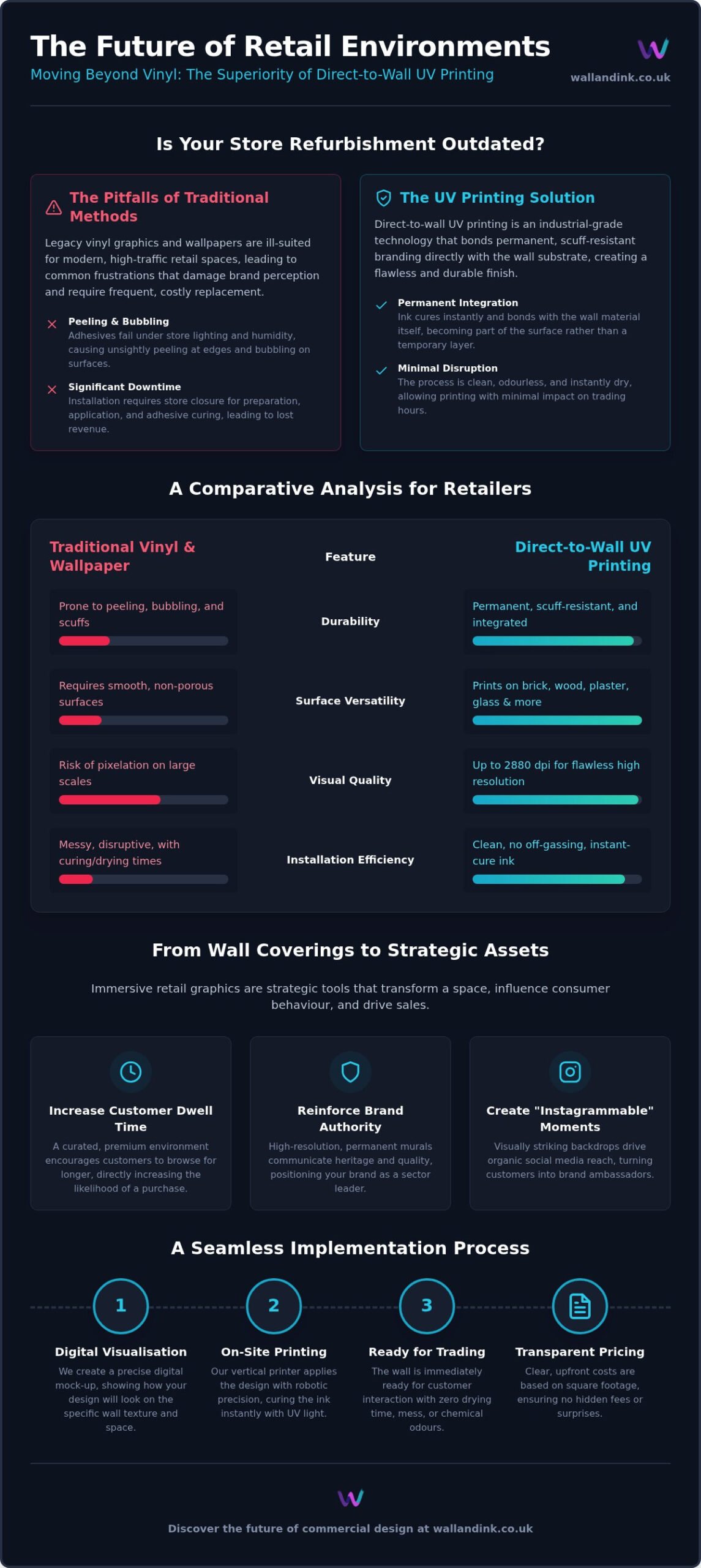
Choosing the right medium for retail graphics isn’t just an aesthetic preference; it’s a strategic decision that affects long-term maintenance costs and brand perception. Traditional vinyl decals have been the industry standard for decades, yet they’re essentially large plastic stickers with inherent mechanical weaknesses. Direct-to-wall UV printing offers a superior alternative by bonding ink directly to the architectural substrate. This creates a finish that looks like high-end painted art rather than a temporary overlay. Whilst vinyl is prone to shrinking, peeling, and bubbling at the edges, UV-cured ink remains stable and flush with the wall surface.
Installation downtime is a critical factor for any trading environment. Vinyl application requires extensive surface preparation and often involves multiple panels that must be perfectly aligned to avoid visible seams. In contrast, our direct-to-wall process is a continuous digital application that eliminates the risk of human error during alignment. The lack of drying time means your space is ready for customers immediately after the print head completes its pass. This aligns with modern in-store marketing trends that prioritise agility and high-impact visual storytelling without the logistical headaches of legacy methods.
Sustainability and the Circular Economy
Environmental responsibility is no longer optional for UK retailers. Most traditional vinyl is PVC-based, a material that’s notoriously difficult to recycle and often ends up in landfill after a single campaign. By choosing direct-to-wall printing, you eliminate the need for plastic backers, release liners, and chemical adhesives. Our UV-cured inks produce low VOC (Volatile Organic Compound) emissions, which ensures better indoor air quality for your staff and customers. This reduction in plastic waste helps your business meet corporate ESG targets whilst providing a cleaner, more sustainable fit-out.
Visual Quality and Precision
The “sticker” look of vinyl often detracts from a premium brand environment. Decals can catch the light at different angles, revealing bubbles or imperfections in the wall behind them. Direct-to-wall printing provides a seamless application that follows the natural contours of the surface. We provide bespoke digital visualisations before any ink is applied, ensuring the final result matches your brand guidelines with mathematical accuracy. There are no edges to lift and no corners to fray; the graphics become a permanent part of the room’s architecture, reinforcing a sense of quality and reliability.
Maximising Footfall: Strategic Placement and Design for Retail Murals
Strategic placement of retail graphics determines how effectively a commercial space converts passersby into active customers. To maximise the impact of your investment, follow a methodical five-step approach to design and installation:
- Identify Hero Walls: Locate sightlines visible from the storefront entrance. These high-impact areas should house your most compelling brand imagery to pull footfall into the shop.
- Avoid Visual Clutter: Balance brand messaging with aesthetic appeal. A wall that’s too “busy” confuses the customer; focus on one clear narrative or visual theme per zone.
- Scale for Dimensions: Ensure the artwork is proportioned correctly for the physical room. Graphics that are too small feel like afterthoughts, whilst oversized images can overwhelm a compact retail unit.
- Integrate Lighting: Use directional spotlights to enhance the texture of the print. The matte finish of UV-cured ink prevents the glare issues common with gloss vinyl.
- Future-proof the Design: Choose imagery that reflects your core brand identity rather than fleeting seasonal trends. This ensures your walls remain relevant as your product lines evolve.
Designing for the Customer Journey
Effective graphics act as silent navigators. By using distinct visual styles for different sections of the store, you can define specific zones such as premium collections, sale areas, or service desks. Wayfinding through art is often more effective than traditional signage; a large-scale mural naturally draws customers toward fitting rooms or points of sale without the need for cluttered hanging boards. This creates a cohesive experience that begins at the exterior facade and continues through every interior wall, reinforcing brand familiarity at every step.
The Role of Digital Visualisation
We eliminate the guesswork from the design process through comprehensive digital mock-ups. These visualisations show exactly how your artwork will sit in situ, accounting for architectural features like columns, alcoves, or electrical fittings. Adjusting scale and colour at this stage ensures the final application is perfect. Bespoke design is superior to off-the-shelf stock imagery because it’s engineered specifically for your brand’s unique architectural substrate and commercial objectives.
If you’re ready to transform your storefront sightlines, contact us for a bespoke retail mural consultation to see how we can engineer your space for maximum footfall.
Implementing Your Vision: The Wall & Ink Bespoke Process
Every successful project starts with a professional consultation to align the technical execution with your specific brand objectives. We don’t believe in opaque quotes or hidden costs. Our pricing model is based on transparent square-footage rates and design complexity, allowing pragmatic decision-makers to budget with precision. This clarity is a core marker of our service, distinguishing us from competitors who hide final costs behind lengthy negotiation periods. We provide a clear roadmap from the initial concept to the final cured print.
Before the printing begins, we conduct a technical site survey. This step is vital to assess the physical reality of the surface, whether it’s textured brick, timber, or smooth plaster. Our specialists ensure the substrate is prepared for the UV printer, guaranteeing the industrial-grade bond required for high-traffic environments. The actual execution is a clean, methodical process. Because our UV-cured inks harden instantly, there’s no need for store closures or long drying times. You can maintain your trading hours whilst we transform your space with minimal disruption to your daily operations.
From Concept to Completion
Our design team works directly with your existing brand assets to adapt them for large-scale retail graphics. This collaborative phase ensures that every digital file is optimised for the high resolution our hardware provides. The result is a permanent architectural feature that requires zero maintenance beyond standard cleaning. The longevity of these murals is a primary competitive advantage; they won’t peel, shrink, or bubble like the legacy alternatives discussed in previous sections. We provide post-installation support to ensure your branding remains a high-impact asset for years to come.
National Service for UK Retailers
Managing a brand rollout across multiple locations requires a partner with national UK coverage and industrial reliability. We specialise in project-managing large-scale installations for national retail chains, ensuring absolute brand consistency from the first storefront to the last. Whether you’re refurbishing a single flagship unit or updating twenty regional branches, our process remains identical. This unified approach protects your brand identity while simplifying the procurement process for regional managers and head office stakeholders alike.
Organise your bespoke design consultation with Wall & Ink today to begin your transition to modern, durable wall branding.
Future-Proofing Your Commercial Environment
The transition toward direct-to-wall technology marks the end of the era of peeling vinyl and bubbling wallpaper. By integrating branding directly into the architectural substrate, you ensure your retail graphics remain a high-definition asset that withstands the rigours of a busy high-street environment. We’ve established that the future of commercial design lies in durability, precision, and the elimination of the plastic waste inherent in traditional decals. UV-cured ink provides immediate scuff resistance, ensuring your space looks pristine from the moment the installation is complete.
We provide digital visualisations with every quote to ensure absolute accuracy before the printing process begins. Our national UK coverage allows us to maintain strict brand consistency across multiple locations, making us a reliable partner for national retail chains and independent boutiques alike. If you’re ready to move beyond temporary stickers and invest in industrial-grade wall art, we’re here to help you execute that vision with technical excellence.
Request a bespoke quote for your retail graphics project to secure a high-impact, permanent solution for your store. We look forward to transforming your walls into durable brand assets.
Frequently Asked Questions
How long do direct-to-wall retail graphics last?
Indoors, these graphics last indefinitely until you decide to repaint the wall. The UV-cured ink is mechanically bonded to the substrate, meaning it won’t peel, shrink, or bubble over time like traditional vinyl. It’s engineered for high-traffic environments, offering superior resistance to the daily scuffs and scratches common in busy shops. Unlike adhesive-based solutions, there is no glue to degrade or dry out.
Can you print on existing wallpaper or do the walls need to be bare?
We can print directly onto existing wallpaper as long as it’s securely bonded to the wall surface. If the underlying paper is peeling or bubbling, the print will eventually fail along with the substrate. For the best results, we recommend printing on bare plaster, brick, wood, or glass. Our technical site survey will determine if your current wall covering is a suitable foundation for retail graphics.
Is UV wall printing suitable for exterior retail facades?
Yes, our technology is specifically designed for exterior applications on various outdoor substrates. The UV-stable inks are water-resistant and engineered to withstand the British weather without significant fading for several years. This makes it an ideal solution for storefront branding, exterior murals, or car park signage where traditional paint might flake and vinyl would likely peel under environmental stress.
How much does retail wall printing cost per square metre?
Our pricing is calculated based on the total square footage of the project and the complexity of the design. We maintain a transparent pricing model that avoids the hidden fees often associated with traditional fit-outs. Because every retail unit has unique architectural features and substrate requirements, we provide bespoke quotes following an initial consultation and digital visualisation of your specific space.
What is the maximum size for a retail wall mural?
There is technically no limit to the width of a mural as our printing hardware operates on a modular rail system. We can print continuous, seamless imagery across the entire length of a flagship store or a large warehouse wall. The vertical height is typically limited by the height of the machine, but we can manage exceptionally large-scale projects through strategic planning and multiple print passes.
How long does the printing process take for a standard shop wall?
A standard feature wall in a retail unit can usually be completed within a single working day. The exact duration depends on the total area and the level of detail in the artwork. Because the UV ink cures instantly, there is no drying time required. Your staff can restock shelves and customers can enter the area immediately after the printer has finished its pass.
Are the inks used in retail graphics safe and odourless?
The inks we utilise are low-VOC and produce virtually no odour once they’ve been cured by the UV lamp. This is a significant advantage over traditional solvent-based paints or adhesives that require ventilation and off-gassing time. It’s perfectly safe to use in food-service environments, pharmacies, or clothing stores without any risk of lingering chemical smells affecting your products or customer experience.
Can the graphics be removed or changed if we rebrand?
Graphics are easily updated by simply painting over the existing print with a standard primer and topcoat. There’s no need for heat guns, chemical strippers, or the laborious scraping associated with vinyl removal. This provides a clean and efficient way to refresh your store’s appearance or implement a complete rebrand without damaging the underlying wall or creating the mess of a full refurbishment.