
Your company logo shouldn’t look like a temporary sticker, yet many businesses still rely on vinyl decals that inevitably bubble, peel, or lift at the edges. It’s frustrating to invest in a premium workspace only to see the branding fail because of poor adhesion or textured surfaces. You’ve likely also considered traditional signage, only to be deterred by the mess and permanent wall damage caused by heavy drilling into masonry or plaster.
This guide demonstrates how logo wall printing for offices has become the industrial-grade disruptor to these legacy methods. By utilising advanced UV-cured ink technology, the process applies high-resolution graphics directly onto any substrate, from smooth partitions to rugged brickwork. This approach ensures your branding is seamlessly integrated into the architecture itself, providing a durable and maintenance-free finish that remains crisp for years.
We’ll examine the technical superiority of the direct-to-wall method, its performance across various professional environments, and why this clean, precise application is the standard for 2026 office branding. From initial digital mock-ups to the final instant-cure finish, you’ll learn how to achieve high-impact visuals without the traditional hassles of installation.
Key Takeaways
- Understand how high-impact environmental branding fosters a professional culture and leaves a lasting impression in the 2026 hybrid work era.
- Discover why direct-to-wall UV ink technology provides a permanent, smudge-proof finish that outperforms the peeling and bubbling associated with vinyl decals.
- Learn how logo wall printing for offices enables crisp, high-resolution graphics on challenging substrates like brick, wood, and textured plaster.
- Identify the essential design requirements, including vector artwork and digital visualisations, to ensure your logo integrates perfectly with its architectural space.
- Recognise the benefits of a mess-free installation process that eliminates the dust, drilling, and permanent wall damage caused by traditional heavy signage.
The Evolution of Office Branding: Why Logos Matter in 2026
In 2026, the physical office serves a dual purpose. It must function as a high-performance workspace whilst acting as a physical embodiment of corporate culture. With 72% of employees experiencing moderate to high stress levels according to a 2025 Aflac report, the environment must be restorative and purposeful. This shift has moved branding away from temporary decorations towards permanent architectural features. Modern logo wall printing for offices ensures that brand identity is integrated into the very fabric of the building, rather than sitting on top of it as a secondary layer.
Adopting biophilic design principles is now standard practice for forward-thinking firms. Integrating your logo into walls that feature natural textures or earthy tones, such as muted greens and clay, helps align corporate identity with modern wellness trends. This approach moves beyond simple decor. It creates a workspace that feels grounded and intentional, which is vital for retaining talent in a competitive market.
First Impressions and Corporate Identity
The reception area remains the primary touchpoint for clients and stakeholders. It’s the first opportunity to signal professional standards. When a logo is printed directly onto the wall, it achieves a level of precision that traditional methods cannot match. This high-resolution clarity suggests an attention to detail that extends to your core business services. For employees, a well-branded space creates a sense of belonging. In a hybrid model, the physical office must earn the commute by providing a sensory experience that home offices lack. Using brand-consistent colour palettes helps ground the workspace, providing a stable visual anchor amongst flexible desk arrangements.
The Limitations of Traditional Office Signage
Legacy branding methods often introduce physical clutter or maintenance burdens. Bulky 3D signage can feel intrusive in narrow corridors or smaller meeting rooms, often requiring invasive drilling that damages the substrate. Traditional wallpaper often fails in high-traffic zones because edges fray or seams become visible over time. Many facilities managers also struggle with the aesthetic of vinyl decals, which are prone to peeling or bubbling when exposed to temperature fluctuations. These temporary solutions often look disjointed and require regular replacement. Direct-to-wall printing eliminates these issues by removing the need for adhesives or mechanical fixings. It provides a clean, flush finish that maintains its integrity regardless of foot traffic or surface texture.
What is Direct-to-Wall Logo Printing?
Direct-to-wall printing is a technical process where specialised UV-cured ink is applied directly to a vertical surface using an automated printer. Unlike traditional methods that rely on adhesive films, this system moves along the wall on a track or wheels, depositing ink with mechanical precision. It represents a significant shift in office wall design trends, moving away from temporary vinyl and towards permanent, architectural-grade graphics. This method is considered industrial-grade because it creates a permanent bond with the substrate, whereas retail stickers only sit on the surface.
The core of this technology is the UV curing process. As the print head moves, high-intensity UV lamps follow immediately behind, triggering a photochemical reaction that hardens the ink instantly. This results in a smudge-proof, scratch-resistant finish that is ready for contact the moment the machine finishes. There is no drying time and no lingering solvent odours. You get a perfect, 1:1 reproduction of your corporate identity with digital CMYK precision.
The Technology Behind the Print
The vertical wall printer uses sophisticated sensors to maintain a consistent distance from the wall, even if the surface is slightly uneven. This ensures that logo wall printing for offices remains sharp across plaster, brick, or wood. Interior UV-cured ink prints typically maintain their colour and integrity for at least five years in standard office conditions. Most traditional printers struggle with dark backgrounds, but our industrial systems include a dedicated white ink channel. This allows for vibrant, opaque logos on charcoal, navy, or even black walls without the substrate showing through.
Resolution and Detail: Beyond the Sticker
The precision of this method is measured in dots per inch, with capabilities ranging from 720dpi for large-scale murals to a staggering 2880dpi for intricate logos. At these resolutions, the print quality is photographic. Vinyl cutters are limited to solid colours or simple layered overlaps. In contrast, UV printing handles complex gradients, shadows, and transparency with ease. The process is also infinitely scalable. Whether you need a subtle 20cm logo on a glass partition or a multi-storey graphic in a central atrium, the machine maintains absolute brand accuracy.
If you are looking to upgrade your workspace, you can explore our range of direct-to-wall printing services to see how this technology adapts to your specific branding needs.
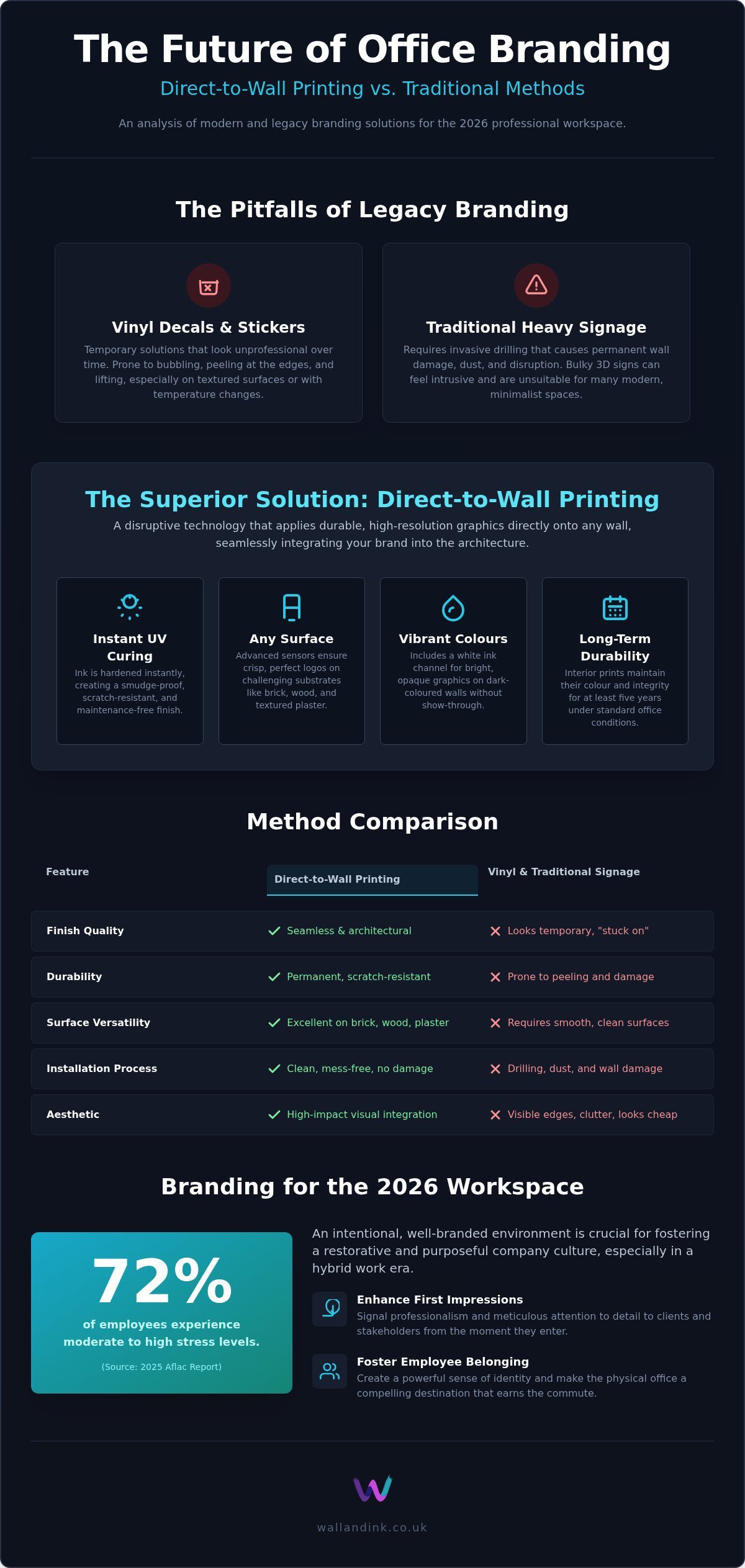
Direct-to-Wall Printing vs Vinyl Decals: The Professional Comparison
Professional workspace management requires solutions that withstand the rigours of daily use without losing visual integrity. Whilst vinyl decals have been the standard for years, they’re fundamentally limited by their adhesive nature. Over time, temperature changes and humidity cause edges to lift or bubble, particularly in busy environments. Logo wall printing for offices bypasses these failures by creating a molecular bond with the wall surface. This method also eliminates the significant plastic waste associated with vinyl backing, aligning with the sustainability focus found in 2026 office design trends.
Surface versatility is another area where direct printing excels. Vinyl requires a perfectly smooth finish to adhere properly, often failing on anything but flat paint. Direct-to-wall technology is far more adaptable, allowing for crisp, high-definition logos on textured plaster, reclaimed wood, or industrial brickwork. The ink settles into the natural texture rather than stretching over it. This prevents the “tenting” effect often seen with stickers on uneven walls, ensuring the graphic remains stable and secure for years.
Durability in High-Traffic Office Areas
In high-traffic zones like breakout areas or lift lobbies, branding is frequently subjected to scuffs from bags, equipment, or furniture. Traditional 3D signs can be knocked loose, potentially causing wall damage or safety hazards. Direct UV printing is exceptionally scratch-resistant and sits flush with the substrate. This makes it a safer and more durable choice for schools and public-facing offices. By choosing a permanent ink solution, you avoid the recurring costs and logistical hassle of periodic vinyl replacements. The surface remains wipeable and easy to maintain with standard cleaning products.
Aesthetics and Integration
The most striking difference lies in the visual integration. A printed logo doesn’t have the tell-tale plastic “sheen” or visible edges associated with decals. It provides a “painted-on” look that feels like a deliberate part of the architecture rather than an afterthought. This seamless integration allows the natural character of the wall to interact with the graphic. Whether it’s the grain of timber or the grit of stone, the texture enhances the logo for a premium, bespoke feel. It creates a sophisticated atmosphere that signals quality to every visitor who enters the space.
Planning Your Office Logo Wall: Design and Preparation
Successful logo wall printing for offices begins long before the machine arrives on site. The quality of the final output is directly linked to the technical precision of the source files. We require vector artwork in AI, EPS, or PDF formats to ensure infinite scaling. Unlike raster images such as JPEGs or PNGs, vector files maintain razor-sharp edges at any size, from a small door sign to a three-storey atrium mural. This technical requirement prevents pixelation and ensures your corporate identity remains crisp and professional.
Colour accuracy is equally critical for brand consistency. Our printing systems utilise advanced CMYK digital controls to align perfectly with your brand guidelines. We don’t guess colours; we calibrate them. This industrial precision ensures that the specific blue in your logo matches your existing stationery and digital assets exactly. Before the print head moves, the wall surface must be clean, dry, and structurally stable. Any loose paint or dust will compromise the bond between the UV ink and the substrate.
The Digital Visualisation Process
We provide comprehensive digital visualisations to eliminate guesswork. By placing a digital mock-up of your logo into a photograph of your actual workspace, you can evaluate the size and placement in situ. This process allows us to account for architectural features such as light switches, vents, or sockets that might otherwise disrupt the design. We also analyse how ambient light and shadows interact with the wall. Adjusting the placement during this digital stage ensures the final graphic is perfectly balanced within the architectural environment.
Preparing Different Surface Types
Direct-to-wall technology is uniquely capable of handling challenging substrates that would defeat traditional methods. Bare plaster and painted walls are straightforward, provided they are fully cured. For industrial textures like brick or concrete, the ink settles into the crevices for a rugged, integrated look. It’s vital to ensure the wall is dry enough for optimal adhesion. Moisture trapped within a new wall can prevent the ink from bonding correctly. We recommend waiting at least four weeks for new plaster to dry before we begin the printing process. If you’re ready to transform your workspace, book your site survey with Wall & Ink to ensure your walls are properly prepared.
Bespoke Wall Printing Services for UK Businesses
Wall & Ink provides a comprehensive service journey that prioritises industrial precision and logistical reliability. Our operations extend across the entire UK, catering specifically to the commercial and educational sectors. We understand that office managers and business owners require a streamlined process that minimises downtime. That’s why we lead with a “No-Drill, No-Dust” promise. Unlike traditional signage installation, our method involves no mechanical fixings or invasive wall preparation. It’s a clean, quiet process that allows your office to remain fully operational whilst the work is being completed.
Transparency is a core value of our business model. We provide project-based pricing that utilises clear square-footage metrics, ensuring you have a predictable cost structure from the outset. Our end-to-end service manages every detail, from the initial design consultation and digital mock-ups to the final technical execution on-site. This holistic approach ensures that the high-resolution standards we promise are delivered without compromise, regardless of the project’s scale.
Our National Service Approach
Managing large-scale rollouts across multiple UK sites requires significant coordination and technical expertise. We work directly with interior designers and refurbishment contractors to integrate logo wall printing for offices into broader fit-out schedules. Our teams are equipped to handle complex logistics, ensuring brand consistency whether we’re printing in a single reception area or across several regional hubs. On-site efficiency is a priority. Because the UV ink cures instantly, there is no need to cordon off areas for drying, which significantly reduces workplace disruption.
Why Choose Wall & Ink for Your Office Rebrand
Our commitment to technical excellence distinguishes us as a specialist partner rather than a general design agency. We maintain a dedicated design team to handle bespoke adaptations, ensuring your logo scales perfectly to your specific wall dimensions. Once a design receives final approval, our on-site execution is rapid, often completing the printing process within a single working day to ensure your project stays on schedule. This speed doesn’t come at the expense of quality. Every print is delivered with mechanical superiority, providing a durable, high-impact finish that outlasts temporary alternatives. We focus on delivering a professional result that reflects the standards of your own business, backed by a process that respects your time and your property.
Secure Your Brand’s Future with Architectural Printing
Adopting a modern approach to environmental branding ensures your workspace reflects the quality of your business operations. As explored throughout this guide, logo wall printing for offices has moved beyond the limitations of temporary stickers. By choosing direct-to-wall UV technology, you’re investing in a permanent, industrial-grade finish that integrates seamlessly with your building’s architecture. This method eliminates the common failures of vinyl, such as peeling or bubbling, and works across diverse substrates including brick, wood, and plaster.
Wall & Ink provides a clean, efficient service journey designed for pragmatic decision-makers. Our no-drill, no-dust installation process ensures your workspace remains operational whilst we apply your branding with mechanical precision. With national UK coverage and the durability of UV-cured ink, you can achieve high-resolution results that last for years without maintenance. It’s time to replace temporary decor with a bespoke, architectural solution that signals authority and attention to detail.
Book your bespoke design consultation with Wall & Ink today to see how our technical expertise can elevate your corporate identity.
Frequently Asked Questions
How long does logo wall printing take to complete?
Most logo prints are completed within a single working day. The setup and execution of a standard corporate graphic typically takes between two to four hours depending on the size and complexity. Because the UV ink cures instantly under the machine’s integrated lamps, the area is ready for use the moment we finish. This efficiency ensures your business operations experience minimal downtime compared to multi-day signage installations.
Can the printed logo be removed if we move offices or rebrand?
Printed logos are permanent but can be easily covered if you rebrand or vacate your premises. Unlike vinyl, which often leaves adhesive residue or pulls off paint, a UV-printed graphic is simply painted over with two coats of standard emulsion. This makes it a superior choice for leased office spaces. You don’t have to worry about the wall damage often caused by removing heavy 3D signs or industrial-strength stickers.
Will the printing process create dust or mess in our office?
Our printing process is entirely mess-free and creates no dust or debris. Because we don’t use drills, screws, or mechanical fixings, there’s no structural impact on your walls. The vertical printer operates quietly and cleanly, making it ideal for active professional environments. You won’t need to hire cleaners or cover furniture before we arrive. It’s a precise, industrial method that respects the cleanliness and organisation of your workspace.
Is direct-to-wall printing suitable for textured surfaces like brick?
Yes, direct-to-wall printing is perfectly suited for textured substrates including brick, stone, and reclaimed wood. The machine’s sensors maintain a consistent distance from the wall, allowing the ink to settle into the natural crevices of the surface. This creates an integrated, painted-on look that vinyl decals cannot achieve. Logo wall printing for offices on textured surfaces provides a premium, bespoke aesthetic that highlights the architectural character of your building.
How do I need to prepare the wall before the printing team arrives?
The wall must be clean, dry, and free from loose paint or grease before our team arrives. If the wall has been recently plastered, it needs at least four weeks to fully cure and dry out. We recommend a light wipe-down with a damp cloth to remove any surface dust. Ensuring the substrate is stable and neutral provides the best possible foundation for the UV ink to bond and cure effectively.
What file format do I need to provide for my company logo?
We require vector-based files such as AI, EPS, or high-resolution PDF formats. These formats allow for infinite scaling without any loss of clarity or sharpness, which is essential for professional branding. If you only have raster images like JPEGs or PNGs, our design team can often assist in converting these into the necessary vector paths. Providing the correct technical files ensures your logo appears crisp and professional at any size.
How much does logo wall printing cost compared to vinyl stickers?
Whilst the initial setup for logo wall printing for offices may be higher than basic stickers, it’s more cost-effective over its lifecycle. You eliminate the recurring costs of replacing peeling vinyl or repairing walls damaged by adhesives. Our pricing is transparent and based on square-footage metrics, providing a predictable investment for a permanent branding solution. It’s a high-value alternative that offers industrial durability and a superior aesthetic finish for professional environments.
Is the UV ink used in office printing safe for indoor environments?
The UV-cured inks we use are solvent-free, odourless, and entirely safe for indoor office environments. The curing process happens instantly on the wall, meaning there are no harmful volatile organic compounds (VOCs) released into the air after printing. This makes the technology suitable for hospitals, schools, and enclosed meeting rooms. You can return to work in the space immediately without any concerns regarding air quality or chemical lingering.