
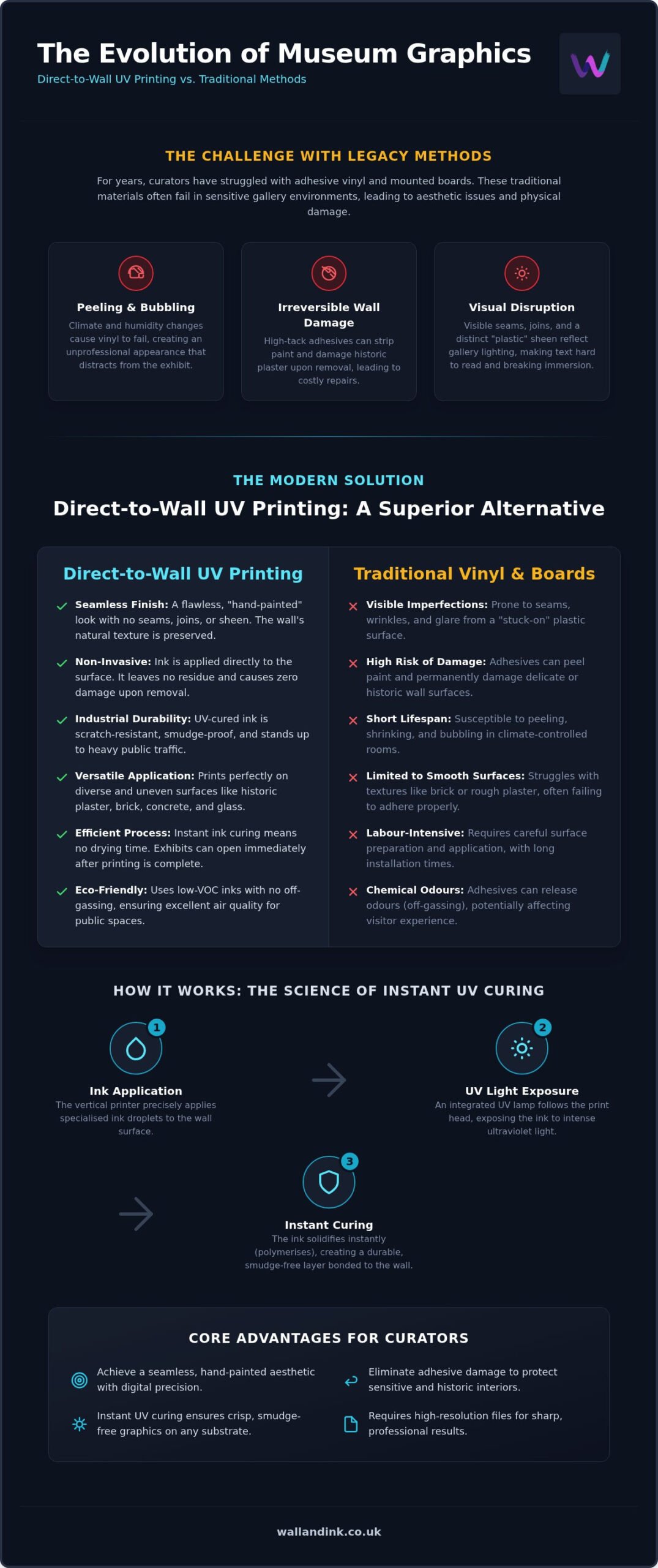
The standard choice for gallery displays has long been adhesive vinyl or mounted boards, but these traditional methods are often the very things that compromise the integrity of a world-class exhibit. Curators frequently face the frustration of seeing expensive graphics bubble in climate-controlled rooms or, worse, watching adhesive residues damage historic plaster during a de-installation. If you’ve struggled with the limitations of museum exhibit wall printing using traditional vinyl, you aren’t alone in seeking a more precise, industrial-grade solution.
Direct-to-wall UV printing offers a sophisticated shift in how we approach gallery design. This guide explains how this technology provides a durable, high-resolution, and non-invasive alternative to legacy materials. You’ll learn how direct application delivers a seamless finish that mimics hand-painted artistry whilst standing up to heavy public traffic. We’ll cover the technical specifications of UV curing, the benefits of bespoke digital visualisations, and the streamlined installation process that eliminates traditional industry pain points for good.
Key Takeaways
- Understand why direct-to-wall UV printing is replacing vinyl and boards by eliminating peeling, bubbling, and adhesive damage in sensitive gallery environments.
- Discover the technical advantages of instant UV curing, which ensures crisp, smudge-free graphics on diverse substrates including historic plaster, brick, and glass.
- Learn how to streamline your installation schedule with a process that significantly reduces on-site labour without compromising the precision required for professional displays.
- Explore how bespoke digital visualisations and professional museum exhibit wall printing allow curators to achieve a seamless, hand-painted aesthetic with industrial-grade durability.
- Identify the specific file preparation and technical requirements needed to transition from traditional large-format prints to direct vertical application.
Beyond Vinyl and Boards: Why Museum Exhibit Wall Printing is Evolving
The standard methodology for gallery displays is undergoing a fundamental shift. For decades, curators relied on mounted boards and adhesive-backed vinyl to convey information and create atmosphere. However, as exhibit design becomes more immersive and buildings more sensitive, these legacy materials are showing their age. Modern museum exhibit wall printing has emerged as a superior alternative, moving away from the “stuck-on” look toward a fully integrated architectural finish. It’s a transition from temporary signage to permanent-quality art that respects the structural integrity of the venue.
The Problem with Adhesive-Based Media
Traditional large-format graphics rely on chemical adhesives that often fail in the very environments designed to protect artefacts. Climate-controlled galleries, whilst essential for conservation, can be hostile to vinyl. Fluctuations in humidity and temperature cause adhesive-based media to bubble, peel, or shrink at the edges. This creates a maintenance burden that distracts from the visitor experience. Beyond the aesthetic failure, there’s a significant risk to the substrate. High-tack vinyl can cause permanent “ghosting” on historic plaster or rip away surface layers during de-installation. The cost of remedial wall repair after a temporary exhibition often exceeds the initial cost of the graphics themselves. Curators are increasingly rejecting these risks in favour of non-invasive, direct-to-surface methods that leave no residue behind.
The Aesthetic Advantage of Direct-to-Wall Graphics
Visual fidelity is the cornerstone of a successful display. Traditional decals often carry a distinctive “plastic” sheen that reflects gallery lighting, making text difficult to read from certain angles. Direct-to-wall printing eliminates this interference entirely. By applying ink directly to the surface, the texture of the wall remains part of the design. This creates a finish that mimics high-end hand-painted murals but with the precision of a digital file. This precision is underpinned by The Science of UV Curing, a process where ultraviolet light instantly solidifies the ink upon contact with the wall. This technology allows for complex, large-scale museum exhibit wall printing without the visible seams or joins found in wallpaper or vinyl sheets. The result is a clean, seamless environment where the graphics feel like a natural extension of the building. It offers the industrial precision required for modern museums without the traditional hassles of manual application.
The Science of Direct-to-Wall UV Printing for Galleries
Direct-to-wall UV printing relies on a specialised photochemical process that differentiates it from any other form of large-format graphics. Whilst traditional inkjet printers use solvents that evaporate over time, UV technology employs ultraviolet light to polymerise the ink instantly. This mechanical precision ensures that every drop of pigment stays exactly where it’s placed, eliminating the bleeding or smudging often seen on porous gallery surfaces. For museum exhibit wall printing, this means that even the most complex historical diagrams remain sharp and legible.
Public-facing environments require a commitment to safety and air quality. Our vertical wall printers use eco-friendly, low-VOC inks that are suitable for enclosed gallery spaces. Because the curing process is immediate, there’s no off-gassing period, allowing exhibits to open to the public as soon as the printing is complete. This efficiency is a hallmark of modern direct-to-wall printing services, providing a clean alternative to the chemical odours associated with traditional adhesives.
Precision and Resolution Standards
To meet professional Printing Industry Standards, our equipment operates at high DPI levels capable of rendering micro-text and intricate line work. This level of detail is vital for reproducing historical maps or scientific illustrations where accuracy is non-negotiable. Maintaining colour consistency across a thirty-metre exhibition wall requires rigorous calibration, ensuring that branding remains uniform from the entrance to the exit. UV wall printing is a digital-to-physical transfer process with zero drying time. This speed doesn’t compromise quality; instead, it provides a level of detail that rivals traditional silkscreening without the long lead times.
Compatibility with Museum Surfaces
The versatility of the vertical printer allows it to adapt to the unique architectural fabric of a museum. Whether the substrate is bare plaster, reclaimed wood, or glass, the ink bonds securely without the need for primers that could damage the original material. Because this is a non-contact printing method, we can apply graphics to delicate or uneven textures that would be impossible to wrap in vinyl. The printer’s sensors allow it to navigate around architectural features like light switches, fire alarms, and corners with millimetre precision. This capability ensures that museum exhibit wall printing remains a non-invasive process, preserving the building’s interior whilst transforming it into a high-resolution canvas.
Comparing Graphic Media: Direct Printing vs Vinyl and Silkscreen
Selecting the appropriate medium for museum exhibit wall printing requires a balance between aesthetic excellence and operational pragmatism. Whilst vinyl has served as the industry default for years, its status as a separate, adhesive layer introduces physical vulnerabilities that direct UV printing naturally avoids. Silkscreening remains a prestigious option but is often incompatible with the tight turnaround times of modern gallery schedules. Direct-to-wall application offers a superior middle ground, combining the rapid output of digital technology with the integrated finish of traditional artisan techniques.
Installation speed is where the technical superiority of direct printing becomes most apparent. Applying large-format vinyl requires meticulous alignment of multiple panels and intensive manual labour to prevent air bubbles and misalignments. A vertical wall printer operates with mechanical precision, often completing complex murals in a single pass and saving days of on-site work. This efficiency is vital for temporary exhibits with narrow installation windows. For permanent displays, the financial logic is equally compelling; by removing the need for expensive substrates and reducing waste, direct printing provides a more sustainable and cost-effective long-term solution.
Visual Fidelity and Lighting
Professional gallery lighting often reveals the flaws in adhesive-based media. Even high-quality vinyl graphics carry a synthetic sheen that reflects spotlights, creating glare that can make text unreadable for visitors. UV-cured ink produces a naturally matte finish that absorbs light. This ensures total legibility from every viewing angle, which is a critical factor for meeting modern accessibility standards. Many curators prefer this method because it delivers a hand-painted aesthetic. The ink bonds with the texture of the wall, ensuring the graphics look like an intentional part of the building’s architecture rather than a plastic overlay.
Maintenance and Longevity
In high-footfall museum corridors, graphics must be able to withstand constant physical proximity to the public. Whilst some competitors suggest laminated vinyl is the only durable choice, lamination often adds unnecessary bulk and an artificial texture. UV ink is exceptionally scratch-resistant and robust, bonding at a molecular level to the substrate. This makes the surface easy to clean with standard gallery maintenance kits without the risk of smudging. The “exit strategy” for a direct-to-wall print is also significantly cleaner. Instead of the tedious process of peeling vinyl and removing stubborn adhesive residues, you simply paint over the graphics to return the wall to its original state. This preserves the wall surface and simplifies the transition to the next exhibition programme.
Designing for Scale: Technical Requirements for Museum Wall Murals
Scaling a design from a desktop screen to a four-metre gallery wall requires more than just high resolution. It demands a systematic approach to digital asset management and environmental control. For museum exhibit wall printing, the transition from a digital proof to a physical mural relies on precise colour management and substrate preparation. We utilise bespoke digital visualisations to overlay designs onto the actual gallery space, allowing curators to assess the scale and impact of the graphics before the printing rig arrives on-site. This eliminates the uncertainty often associated with traditional proofs and ensures the final result aligns with the curatorial vision.
Managing colour profiles is a critical part of this process, particularly when matching institutional branding or specific historical palettes. Our technical team works within calibrated colour spaces to ensure consistency across various substrates. This precision is vital for maintaining a cohesive visual language throughout the exhibition. To begin your project with a technical assessment, contact our specialist team for a bespoke digital visualisation of your space.
Typography and Legibility Standards
In a professional gallery setting, the legibility of descriptive text is as important as the artefacts themselves. Using vector-based files is essential for large-scale typography to ensure that characters remain perfectly crisp without the pixelation common in rasterised images. Curators should adhere to established accessibility standards by selecting high-contrast colour pairings and sans-serif fonts. Research from the American Alliance of Museums suggests a minimum font size of 16 points for artefact labels to ensure readability for all visitors. This technical rigour ensures that museum exhibit wall printing remains a reliable solution for high-stakes professional environments where information must be conveyed clearly and accurately.
Site Survey and Preparation Checklist
The success of a direct-to-wall print depends on the physical condition of the environment. Unlike vinyl, which can sometimes hide minor wall imperfections, the vertical printer requires a clean, level surface to achieve millimetre precision. A comprehensive site survey is the first step in our process, where we assess several key factors:
- Vertical Clearance: Ensuring the ceiling height accommodates the height of the printing mast and track system.
- Floor Stability: The floor must be stable and relatively level to prevent vibrations that could affect print head alignment.
- Architectural Features: Onboard sensors allow the printer to navigate around pillars and alcoves, but these must be mapped during the design phase.
- Cleanliness: A dust-free environment is essential during the printing phase to prevent particles from interfering with the UV curing process.
By addressing these requirements early, we ensure a fast and clean installation that respects the sensitive nature of the gallery interior.
Implementing High-Resolution Wall Graphics with Wall & Ink
Wall & Ink provides a comprehensive national service for direct-to-wall UV printing, specifically tailored to the rigorous demands of the UK’s cultural institutions. Our approach moves beyond the logistical hurdles of traditional large-format graphics by offering a vertically integrated solution from initial concept to final execution. By eliminating the need for intermediary substrates, we provide a cleaner, more efficient path to world-class displays. This zero-residue methodology is the logical choice for modern curation, ensuring that the physical fabric of your building remains as pristine as the exhibits it houses. Our expertise in museum exhibit wall printing allows us to act as a reliable partner for high-stakes professional environments.
The Consultation and Visualisation Phase
Our process begins with a bespoke design consultation to adapt your vision for direct-to-wall application. We specialise in processing existing archives and high-resolution photography, ensuring that historical assets are optimised for large-scale reproduction without loss of detail. To facilitate the curatorial approval process, we provide digital visualisations that mock up the final space. This allows curators and exhibit designers to collaborate on thematic consistency and spatial flow before any ink is applied. This phase ensures that the technical requirements of museum exhibit wall printing are fully met, providing a reliable blueprint for the on-site team and ensuring the final result matches the intended aesthetic.
Professional On-Site Execution
Execution is handled by our specialist teams who operate across the United Kingdom, bringing advanced UV technology directly to your venue. The “clean install” is a primary benefit of our system; it’s a quieter, faster, and less invasive process than traditional graphic applications. Because there are no messy adhesives or toxic solvents, we can often work within active galleries with minimal disruption to visitor flow or sensitive climate controls. Once the printing rig is calibrated, the vertical application proceeds with industrial precision, curing the ink instantly for immediate durability.
Our final quality checks ensure that every line and colour matches the approved digital visualisation. The finished graphic is robust enough to withstand the rigours of high-traffic public spaces, requiring no additional lamination or protective layers. This streamlined workflow allows institutions to maintain ambitious exhibition schedules without the long lead times or remedial costs associated with legacy media. It’s a modern solution designed for pragmatic decision-makers who value quality and operational efficiency.
Elevate Your Gallery with Precision Wall Graphics
Transitioning to direct-to-wall UV printing represents a significant advancement in gallery design and conservation. By removing the physical limitations and risks associated with adhesive vinyl, curators can now achieve a seamless, hand-painted aesthetic with industrial-grade durability. This method ensures that intricate historical data and large-scale murals remain crisp whilst respecting the structural integrity of the building’s interior.
Our museum exhibit wall printing service provides a national UK solution that prioritises precision and cleanliness. With advanced UV ink technology for instant curing and expert digital visualisation included in every project, we eliminate the traditional hassles of exhibit installation. This zero-residue, curator-approved process allows you to transform any substrate into a high-resolution canvas without the fear of long-term damage or messy de-installations. It’s a modern approach for decision-makers who value efficiency and high-quality results.
Request a Bespoke Consultation for Your Museum Exhibit and discover how our specialised technical process can streamline your next display. We look forward to helping you bring your curatorial vision to life with unparalleled clarity and reliability.
Frequently Asked Questions
Is museum exhibit wall printing permanent or can it be removed?
Museum exhibit wall printing is designed for long-term durability but can be removed easily by painting over the graphic. Unlike vinyl, which requires tedious scraping and often leaves adhesive residue, our UV ink bonds with the substrate surface. When the exhibition ends, you simply apply a standard coat of gallery paint to return the wall to its original state. This preserves the underlying plaster and eliminates the need for aggressive chemical removers.
Can you print on historic or uneven plaster walls without causing damage?
Yes, our non-contact printing technology is specifically designed for sensitive surfaces like historic or uneven plaster. The printer uses advanced sensors to maintain a consistent distance from the wall, navigating slight imperfections without physical contact. Because there are no high-tack adhesives involved, there’s zero risk of the graphic pulling away surface layers of plaster or paint during the installation or the eventual decommissioning of the museum display.
How long does the direct-to-wall printing process take for a standard gallery?
The installation of a standard gallery mural typically takes significantly less time than traditional methods. Most projects are completed within a single day, depending on the scale and level of detail required. Because the UV ink cures instantly under ultraviolet light, the area is ready for public access immediately. This speed allows museums to reduce exhibition changeover times and lower on-site labour costs compared to vinyl.
What is the maximum height and width for a single printed mural?
Our vertical printing system can reach a substantial height in a single pass, whilst the width is virtually unlimited. For taller spaces, we can employ specialised rigging or multi-pass techniques to cover larger elevations. The horizontal track can be extended to span the entire length of a gallery, ensuring a seamless finish without the visible joins or overlaps common in wallpaper or large-format vinyl panels.
Is the UV ink used in wall printing safe for sensitive museum environments?
The UV inks we utilise are eco-friendly, low-VOC, and entirely safe for sensitive museum environments. Because the ink polymerises instantly during the printing process, there’s no off-gassing or lingering chemical odour often associated with solvent-based prints or adhesive decals. This makes the technology ideal for museum exhibit wall printing in enclosed gallery spaces where air quality and the preservation of nearby artefacts are primary concerns for curatorial teams.
How does the cost of direct wall printing compare to traditional vinyl graphics?
Whilst the initial investment for direct wall printing is comparable to premium vinyl, it offers superior long-term value. Traditional graphics involve hidden costs, such as the intensive labour required for bubble-free application and the inevitable wall repairs needed after vinyl removal. Our direct-to-wall method eliminates these secondary expenses. By providing a more durable finish that requires less maintenance, it reduces the total cost of ownership for both temporary and permanent exhibits.
Can you match specific Pantone colours for museum branding?
We can achieve exceptional colour accuracy to match institutional branding and specific Pantone references. Our digital workflow uses sophisticated colour management profiles to ensure that pigments are rendered precisely across various substrates. This level of control is vital for historical exhibits where colour fidelity is a requirement for scientific or artistic accuracy. Curators can review digital visualisations before execution to ensure the final output aligns perfectly with their thematic requirements.
Does the wall need special preparation before the printing team arrives?
The primary requirements for the site are a clean, dry wall and a stable, level floor for the printing rig. Unlike traditional wallpapering, our process doesn’t require messy primers or specialised surface treatments. We recommend that walls are finished with a standard matt emulsion at least 24 hours before we arrive. Ensuring the area is free from excessive dust during the printing phase will help achieve the highest possible resolution for graphics.