
The assumption that concrete requires a sacrificial layer of vinyl or a weeks-long painting schedule is officially outdated. For too long, designers have settled for graphics that peel away from porous surfaces or hand-applied murals that fail to capture technical detail. These legacy methods often fight against the substrate rather than working with it. Direct printing on concrete walls using specialised UV technology has transformed this process, allowing for industrial-grade precision on even the most rugged textures. By utilising inks that cure instantly under ultraviolet light, we create high-definition art that integrates directly into the building’s fabric, reflecting a global wall art market that reached over $70 billion in 2026.
You know that a professional environment demands a finish that’s both durable and visually striking. This guide promises to reveal how advanced UV machinery achieves bespoke, high-resolution results without the fumes or delays of traditional alternatives. We’ll preview the mechanical superiority of direct-to-wall applications, the longevity of modern ink formulations, and the streamlined installation process that ensures your branding looks like an intentional architectural feature. From retail spaces to industrial centres, discover why this method is the most reliable solution for permanent wall art.
Key Takeaways
- UV-curable ink technology ensures instant solidification, preventing graphics from bleeding into porous surfaces and maintaining absolute edge precision.
- Discover why printing on concrete walls offers a more durable, integrated finish than traditional vinyl graphics, which often peel or fail on textured substrates.
- Professional surface preparation is essential for a high-definition result, requiring a dry and stable environment for the machinery to operate with industrial precision.
- Every project includes bespoke digital visualisations, allowing you to approve a precise mock-up of how the mural will harmonise with the raw architectural texture.
- Direct UV printing is a sustainable choice for commercial interiors, utilising low-VOC inks that eliminate the fumes and long drying times associated with hand-painting.
Why Printing on Concrete Walls is the Modern Solution for Industrial Spaces
Concrete is the backbone of modern British architecture. It’s raw, durable, and increasingly left exposed to create a powerful industrial aesthetic in offices, retail units, and educational centres. However, decorating these spaces effectively has always been a logistical hurdle. Traditional methods like vinyl decals often fail because they cannot grip the uneven, dusty surface of the material. Hand-painting is equally problematic, often proving too slow and imprecise for complex logos or detailed murals. Printing on concrete walls using direct UV technology represents a significant shift in how we approach these surfaces. It’s a method that treats the wall as a direct substrate, ensuring the final graphic looks like an intentional part of the building’s design.
The Aesthetic Advantage of Raw Concrete
The cool, neutral grey of concrete provides a sophisticated canvas that enhances the vibrancy of modern inks. Designers are moving away from the sterile look of painted plasterboard, preferring the tactile, honest quality of raw stone and cement. Direct UV printing allows for bespoke branding whilst maintaining this “industrial chic” character. Because the ink is applied with mechanical precision, it can follow the contours of the concrete perfectly. This ensures that the corporate identity is visible and professional without concealing the very material that gives the space its architectural value. It’s about working with the texture, not against it.
Overcoming the Challenges of Porous Substrates
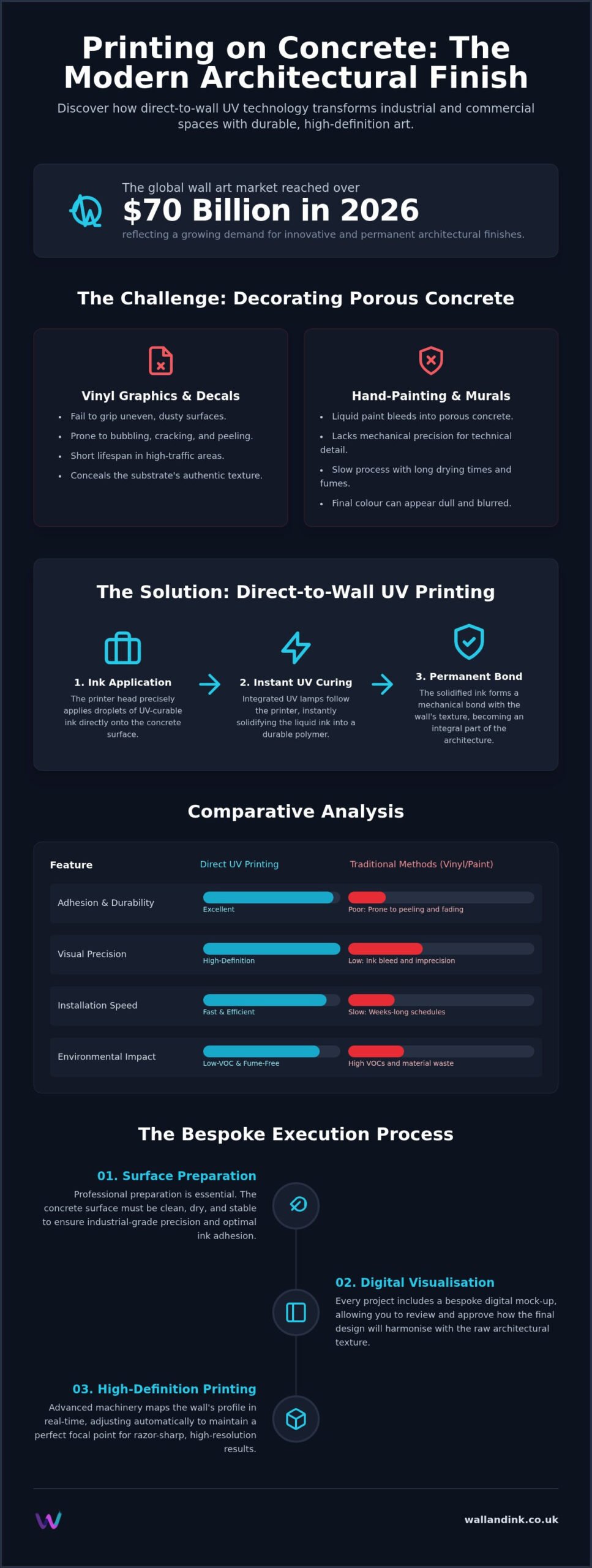
Concrete presents two main problems for traditional graphics: absorption and adhesion. As a porous material, it tends to “drink” liquid-based paints, which dulls the final colour and blurs fine details. At the same time, its uneven texture and tendency to shed dust make it a poor surface for adhesive-backed vinyls. These graphics eventually bubble, peel, or crack, often within months of installation. Printing on concrete walls solves these fundamental adhesion issues by bypassing the need for glues entirely. The science of UV curing changes the equation. By using ultraviolet light to solidify ink the moment it hits the wall, we prevent absorption. The ink stays on the surface, bonded to the microscopic peaks of the concrete. This creates a high-resolution, durable finish that resists the typical wear and tear of high-traffic industrial environments. It’s a clean, fast, and permanent solution that bypasses the failures of legacy alternatives.
The Science of UV Ink: How Direct-to-Wall Printing Bonds with Concrete
The effectiveness of printing on concrete walls relies on a specific photochemical reaction. Unlike traditional paints that dry slowly through evaporation, UV-curable inks undergo a transformation the moment they hit the substrate. As the printer head moves across the concrete, integrated ultraviolet lamps follow immediately, triggering a process that turns liquid ink into a solid polymer in less than a second. This rapid solidification is critical when preparing rigid substrates like concrete, as it prevents the ink from migrating into the material’s deep pores. By staying on the surface, the ink maintains razor-sharp edges and intense colour saturation that traditional methods simply cannot replicate.
Instead of relying on a chemical reaction with the concrete itself, the ink forms a robust mechanical bond with the microscopic irregularities of the surface. This ensures that the graphic becomes an integral part of the wall’s structure rather than a separate layer that can be peeled away. UV curing acts as the essential catalyst for achieving high-resolution graphics on rough, non-traditional surfaces.
High-Resolution Precision on Rough Textures
Modern wall printers utilise advanced sensors to map the surface profile in real-time. This allows the machine to adjust its distance from the wall automatically, maintaining a consistent focal point even on shuttered or board-marked concrete. For darker or more industrial surfaces, we often apply a white ink base layer. This provides a neutral foundation that ensures subsequent colours remain vibrant and true to your original design specifications. The result is a photorealistic finish that respects the underlying architectural texture whilst delivering crisp, professional visuals.
Durability and Scratch Resistance
Cured UV ink is exceptionally resilient. It’s naturally resistant to fading from ultraviolet light, making it a reliable choice for sunlit atriums or exterior installations. In high-traffic commercial corridors, the polymerised ink offers superior scratch resistance compared to traditional vinyl or hand-painted murals. Maintenance is equally straightforward; you can clean these murals using standard non-abrasive methods without risking damage to the artwork or the bond. If you’re looking to transform an industrial space, our commercial wall murals provide the long-term durability required for professional environments. This mechanical superiority ensures your branding remains sharp and professional for years, regardless of the environmental challenges of the site.
Direct UV Printing vs Traditional Concrete Decoration Methods
Legacy methods like vinyl and hand-painting were once the only options for branding industrial spaces. They’re no longer the most efficient. Printing on concrete walls via UV machinery offers a permanent, integrated solution that rivals the lifespan of the building itself. Unlike vinyl, which often carries a short lifespan before adhesive failure, UV-cured ink bonds mechanically to the substrate. This ensures the graphic remains stable for years without the risk of bubbling or degradation. It’s a shift from temporary signage to architectural integration.
The environmental profile of UV inks is a significant advantage for modern projects. These inks are low-VOC and eco-friendly, making them safe for sensitive indoor environments like schools and hospitals. Machine execution is also vastly superior in speed. A digital system can complete a complex, large-scale mural in a single afternoon, whereas a traditional muralist might require several days of site access. This efficiency reduces project lead times and lowers long-term costs by eliminating the need for frequent touch-ups or total replacements. It’s a logical choice for decision-makers who value both time and durability.
Why Vinyl Graphics Often Fail on Concrete
Vinyl is fundamentally unsuited for textured concrete. The material’s porous nature prevents a perfect vacuum seal, leading to the “orange peel” effect where the rough texture telegraphs through the film. Air bubbles are inevitable on such surfaces. Temperature fluctuations cause the concrete to expand and contract at different rates than the plastic film, which leads to edge lifting and peeling. When you eventually remove the vinyl, the aggressive adhesive often pulls away the concrete’s natural patina. This leaves a visible, permanent “ghost” of the previous graphic that can be impossible to clean.
The Limitations of Hand-Painted Murals
Hand-painting on concrete is an exercise in managing inconsistency. Because concrete is highly absorbent, traditional paints often dry with varying levels of saturation across a single wall. This creates a patchy, unprofessional appearance that lacks the crispness of digital art. Replicating high-resolution photography or complex corporate logos is also subject to human error. A machine maintains a consistent ink depth and colour accuracy across every square centimetre of the installation. It eliminates the risk of imprecise branding, ensuring that the final output matches the approved digital visualisation exactly.
Preparing Your Concrete Surface for High-Definition Printing
Precision in the final mural begins with the physical state of the substrate. Printing on concrete walls requires a methodical approach to surface stability because the UV machinery operates with millimetre-level accuracy. For the ink to bond effectively, the environment must be dry and stable. We assess every site for environmental factors that could compromise the installation, such as active damp or efflorescence. Efflorescence, the white salty deposit often seen on masonry, indicates moisture movement that can push the ink off the surface over time. Identifying these issues before the project begins ensures the longevity of the artwork.
A “ready” wall is one that has fully cured and reached a neutral state. New concrete typically requires at least 28 days to cure before any form of decoration is applied. We utilise digital moisture metres to verify that the substrate is sufficiently dry. If the surface is too cold or damp, the UV curing process may be uneven. Maintaining a controlled internal environment during the printing phase is a standard requirement for professional-grade results.
Surface Quality and Texture Assessment
Concrete isn’t a uniform material. The preparation for a polished, power-trowelled floor-to-wall finish differs significantly from that of a rough-cast or board-marked surface. Polished concrete is less porous, requiring the ink to rely more on its chemical bond, whilst rougher textures provide a larger surface area for mechanical adhesion. We inspect the face for structural cracks or deep voids. Small imperfections often add to the industrial character of the mural, but larger holes should be filled with a compatible cementitious repair mortar. The texture of the concrete will influence the final aesthetic of the digital artwork, often creating a sophisticated, matte finish that integrates with the building’s architecture.
Cleaning and Priming Requirements
The presence of dust, oils, or shuttering release agents is the primary cause of adhesion failure. Every surface must be vacuumed and wiped down to remove loose debris amongst the textured crevices. In many industrial environments, a clear, specialised primer is necessary. This doesn’t change the appearance of the raw concrete but creates a receptive “key” for the UV ink to grab onto. This step is particularly vital for exterior wall printing where the mural faces wind and rain. By ensuring the wall is chemically and physically clean, we guarantee a finish that remains vibrant and secure for the long term. If you are planning a project on a challenging substrate, our technical team can provide a site-specific preparation schedule to ensure total reliability.
Bespoke Design and Execution: The Wall & Ink Process
The journey from initial consultation to a completed mural is a structured, four-stage process. Unlike traditional decorating which often involves trial and error on site, our approach is digitally led and industrially precise. We prioritise transparency to ensure that printing on concrete walls meets exact architectural and branding requirements. This methodical workflow eliminates the uncertainty of manual application, providing a predictable timeline and a guaranteed aesthetic result. It’s a service designed for pragmatic decision-makers who value efficiency and high-quality outcomes.
Digital Visualisation and Bespoke Design
Every project begins with a bespoke design consultation. We create custom artwork tailored to the unique dimensions and surface characteristics of your concrete wall, ensuring that logos or graphics aren’t interrupted by structural features like pillars or expansion joints. To ensure total clarity, we provide digital mock-ups for every project. These visualisations allow you to see exactly how the vibrant UV inks will interact with the specific grey tones and textures of your substrate before the machinery arrives. We also adapt corporate brand colours to work harmoniously with concrete, ensuring that your identity remains legible and professional against an industrial backdrop.
Professional On-Site Installation
The physical installation phase is designed for maximum efficiency and minimum disruption. One of the primary advantages of our specialised UV technology is its cleanliness. Unlike spray painting or traditional mural work, there is no dust, no overspray, and no strong chemical odours. This allows us to operate in high-traffic professional environments, such as offices or retail centres, without requiring a total shutdown. We often organise our schedule around your business hours to ensure that your daily operations continue uninterrupted. Our precision UV printing equipment is set up with industrial rigour, using laser-guided sensors to maintain a perfect focus on the concrete face. This technical setup ensures that the machine follows the wall’s profile with millimetre accuracy.
The process concludes with a rigorous final inspection and handover. We verify the ink adhesion and colour accuracy across the entire span of the wall, ensuring every detail matches the approved digital mock-up exactly. Once the mural is cured, which happens instantly during the print, the wall is ready for immediate use. This streamlined execution makes printing on concrete walls the most practical choice for modern commercial spaces that value both high-definition quality and operational speed. It’s a modern solution that delivers a permanent, integrated architectural feature with none of the traditional hassles.
Elevate Your Architecture with Industrial Precision
Adopting advanced technology for printing on concrete walls represents a shift from temporary signage to permanent architectural features. This method eliminates the common failures of vinyl graphics whilst providing a level of detail that hand-painting can’t match. By utilising durable UV-cured technology, your graphics become an integrated part of the substrate, ensuring longevity in both interior atriums and exterior elevations. The precision of the application ensures that your branding remains sharp, professional, and resistant to the environmental challenges of industrial spaces.
Our process is built on industrial reliability, starting with bespoke design consultations and digital mock-ups that guarantee an exact result. We provide national UK coverage, delivering a clean and efficient installation process that respects your operational schedule. This modern approach ensures your space reflects the quality and precision of your brand without the traditional hassles of legacy decoration methods. Enquire about your custom concrete mural project today and discover how we can transform your raw concrete surfaces into high-definition assets. We’re ready to help you realise the full potential of your architecture.
Frequently Asked Questions
Can you print on rough or textured concrete walls?
Yes, our technology is specifically designed to handle surface irregularities without losing focus. The wall printer utilises laser-guided sensors to map the substrate in real-time, adjusting the distance between the print head and the wall automatically. This ensures that printing on concrete walls remains crisp and high-definition even on board-marked or rough-cast surfaces. Unlike vinyl, the ink follows the texture exactly, creating an integrated architectural finish that looks like part of the original structure.
How long does a print on a concrete wall last?
UV-curable murals are designed for long-term durability in both commercial and industrial environments. On interior walls, the ink is permanent and highly resistant to mechanical wear, whilst exterior applications remain vibrant for several years depending on exposure levels. Because the ink forms a mechanical bond with the concrete pores rather than sitting on a separate adhesive layer, it won’t peel or bubble. This makes it a significantly more reliable investment than traditional vinyl alternatives.
Is the ink used for concrete printing eco-friendly?
Yes, we utilise specialised UV-curable inks that are low-VOC and environmentally responsible. Because the ink solidifies instantly under ultraviolet light, there is no evaporation of harmful solvents into the atmosphere. This makes the process safe for use in sensitive environments such as schools, hospitals, and busy office centres. You won’t have to worry about lingering chemical odours or paint fumes, allowing the space to be occupied immediately after the installation is complete.
Can I provide my own design for the concrete mural?
We welcome client-provided artwork and can work with various high-resolution digital formats. Our creative team will review your files to ensure they meet the technical requirements for large-scale printing on concrete walls. If adjustments are needed to suit the concrete’s texture or tone, we provide bespoke design consultations as part of our service. We also supply digital mock-ups for every project, ensuring you’re satisfied with the visual integration before we begin the site work.
Does the concrete wall need to be painted or primed first?
Direct-to-wall printing is most effective on raw, unpainted concrete, though some preparation is usually required. The surface must be clean and free from oils, dust, or shuttering release agents. In some instances, we apply a clear, specialised primer to enhance adhesion without altering the natural industrial aesthetic of the substrate. If the concrete is particularly dark or uneven in colour, we can print a white ink base layer to ensure your final graphics remain vibrant.
Is direct-to-wall printing on concrete suitable for exterior use?
Yes, our UV printing technology is specifically engineered to withstand the rigours of exterior environments. The cured ink is naturally resistant to ultraviolet fading and moisture, making it ideal for outdoor branding or large-scale public murals. Unlike traditional hand-painted murals that may weather and flake, the mechanical bond between the UV ink and the concrete surface ensures the artwork remains stable. This provides a durable, high-impact solution for retail facades and industrial building exteriors.
How do I clean a printed concrete wall without damaging the art?
Cleaning a printed concrete mural is straightforward and requires no specialised chemicals. You should use a soft, damp cloth with a mild, non-abrasive detergent to remove surface dust or light marks. Avoid using high-pressure washers or aggressive scrubbing tools, as these could potentially damage the concrete patina or the ink bond. Because the UV ink is scratch-resistant and fully polymerised, it handles standard maintenance in high-traffic commercial corridors without any loss of detail or colour.
What is the maximum size for a concrete wall print?
The maximum size is virtually unlimited thanks to our track-based machinery. The printer can move along a wall of any length by extending the guide rails, and vertical heights can reach several metres in a single pass. For exceptionally large spans, we utilise a modular approach to ensure the graphics are perfectly aligned across the entire surface. This scalability makes the process ideal for everything from small office logos to massive murals in industrial warehouse centres.