
The most expensive architectural branding is the one that peels away six months after it’s installed. It’s a common frustration for property managers across the country: vinyl graphics that bubble on textured render or hand-painted murals that simply aren’t cost-effective for large-scale projects. Printing on rendered walls UK offers a sophisticated, industrial-grade solution that bypasses these traditional failures.
We recognise that you need branding that respects the architectural integrity of your building whilst delivering a flawless finish. This guide explains how industrial UV technology applies high-definition digital art directly to rendered facades, providing a durable and zero-maintenance alternative to traditional signage. We’ll examine the technical precision of the direct-to-wall method, the essential planning regulations for UK exterior murals, and how to achieve a permanent, vibrant outcome without the disruption of scaffolding or invasive drilling.
Key Takeaways
- Distinguish between decorative imprinted render and the precision of direct-to-wall digital printing to ensure your project meets professional branding standards.
- Understand how UV-cured technology adheres to modern substrates like K-Rend and Monocouche whilst maintaining the breathability and architectural integrity of the facade.
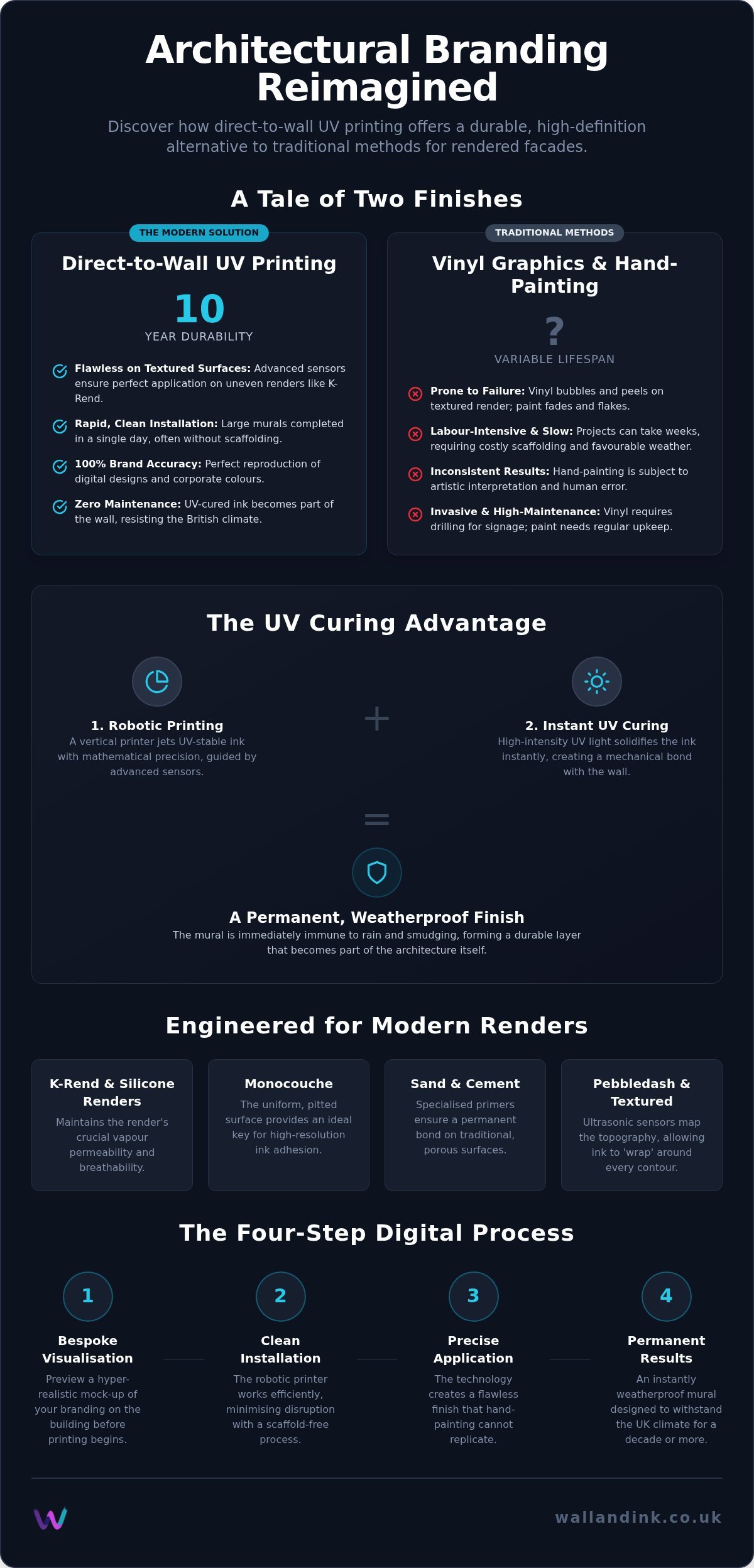
- Discover why printing on rendered walls UK offers superior durability compared to vinyl, with UV-stable inks designed to withstand the British climate for up to 10 years.
- Leverage bespoke digital visualisations to preview your architectural branding in situ before the clean, scaffold-free installation process begins.
- Explore high-impact commercial applications for retail and industrial wayfinding that eliminate the need for invasive drilling or high-maintenance traditional signage.
What is Digital Printing on Rendered Walls?
Direct-to-wall printing on rendered walls UK is a specialised industrial application where high-definition digital files are reproduced directly onto a cured facade. Unlike traditional methods, this process uses a robotic vertical printer to jet UV-stable ink onto the substrate. It’s crucial to distinguish this from “imprinted render” which you might find in many search results. Whilst imprinting involves stamping patterns into wet cement to mimic brick or stone, digital printing treats the finished, dry render as a high-resolution canvas for complex graphics and branding.
The mechanical advantage of this technology lies in its ability to manage the uneven topography of exterior plaster. Traditional vinyl graphics struggle with the peaks and troughs of textured render, often leading to air pockets and eventual peeling. Our vertical printing systems use advanced sensors to maintain a consistent distance from the surface. This ensures every drop of ink lands with mathematical precision regardless of the render’s grain or porosity, creating a finish that hand-painting cannot match.
The Technology: UV-Cured Ink vs. Traditional Paint
UV-cured ink represents a significant shift from the evaporative drying of traditional masonry paints. When the printer head passes over the render, it immediately follows with a high-intensity ultraviolet light. This light triggers a chemical reaction that solidifies the ink instantly. Digital mural techniques have evolved to create a robust mechanical bond where the ink effectively becomes part of the wall’s surface rather than a separate layer sitting on top. UV curing is an industrial process that ensures immediate weatherproofing. This means the mural is immune to rain or smudge damage the moment the machine finishes its pass, a vital benefit in the unpredictable UK climate.
Why Digital Printing Beats Hand-Painting
Hand-painting an exterior mural is a labour-intensive craft that often takes weeks to complete and is subject to the artist’s interpretation. Digital printing on rendered walls UK eliminates these variables through mechanical reliability.
- Consistency: Corporate logos and brand colours are reproduced with 100% accuracy. We match your digital assets exactly to maintain brand standards.
- Speed: A large-scale exterior mural that might take a traditional artist ten days can often be completed in a single afternoon.
- Cost-efficiency: Digital printing provides a more predictable budget framework by removing the need for extended labour and complex scaffolding setups.
By choosing a digital approach, you aren’t just commissioned an artwork; you’re investing in an architectural upgrade that prioritises precision and long-term durability.
Compatibility: Printing on K-Rend, Monocouche, and Sand/Cement
The success of printing on rendered walls UK depends heavily on the chemical and physical properties of the substrate. Not all renders are created equal. Modern through-coloured renders like K-Rend and Monocouche offer a vastly different canvas compared to traditional sand and cement. Our technology is engineered to interface with these specific textures, ensuring that the ink bonds without compromising the underlying material.
Modern Renders: K-Rend and Monocouche
Monocouche render is increasingly popular in UK construction due to its durability and clean aesthetic. Its uniform, slightly pitted surface is ideal for high-resolution digital art because it provides a consistent “key” for UV-cured ink. One common concern with silicone-based renders like K-Rend is breathability. Unlike traditional masonry paint, which can seal the surface and lead to moisture traps, UV printing applies a microscopic layer that allows the render to maintain its vapour permeability. We perform adhesion tests and, where necessary, apply specialised primers to ensure the bond is permanent without voiding render warranties. If you’re planning a large-scale project, it’s worth checking the UK planning regulations for murals to see if your design requires specific consent.
Rustic and Textured Surfaces
Applying digital art by printing on rendered walls UK even extends to more challenging surfaces like pebbledash or brick-effect render. These surfaces require a different technical approach. The robotic printer uses ultrasonic sensors to measure the wall’s topography in real-time. It adjusts the print head distance millisecond by millisecond. This allows the ink to “wrap” around the texture, following every contour of the stone or grain. The result is a mural that looks like it was grown into the wall rather than stuck onto it. You can see the natural grain of the render through the artwork, which adds a premium, architectural feel to the finish. This method is far superior to vinyl, which would simply bridge the gaps and eventually crack. If you’re unsure about your specific facade, our team can provide a professional surface assessment to confirm compatibility.
Durability: How Rendered Murals Survive the UK Climate
The British climate presents a unique set of challenges for exterior branding. From relentless rainfall to intense UV exposure across varied locations, any surface treatment must be resilient. Printing on rendered walls UK utilises UV-cured inks that are specifically engineered for these fluctuations. Unlike traditional paint that sits as a film, these inks form a mechanical bond with the render substrate. This ensures they don’t flake when the temperature drops or bubble when the sun finally emerges.
Resistance to Moisture and Salt
Render is naturally porous, which can lead to water ingress and damp issues if not managed correctly. The ink used in our direct-to-wall process creates a non-porous barrier that repels water whilst allowing the render beneath to breathe. This makes the technology particularly suitable for coastal properties facing salt spray and high winds, conditions that usually degrade traditional signage within months. UV-cured prints on render typically last 5 to 10 years outdoors. This longevity is achieved because the ink is chemically stable and does not react with the salts often found in masonry substrates.
Thermal Expansion and Contraction
One of the primary reasons vinyl graphics fail on UK facades is the “frost-thaw” cycle. When water gets behind a vinyl decal and freezes, it expands, forcing the graphic away from the wall. Direct-to-wall printing avoids this entirely. Because there is no adhesive layer or plastic film, there’s nothing to peel. The ink possesses a degree of flexibility that allows it to expand and contract in tandem with the render as temperatures shift between summer highs and winter lows. This protection is vital for maintaining the structural integrity of the facade whilst keeping the artwork pristine.
In various urban environments, traffic film and soot can dull the appearance of exterior walls. Maintaining a digital mural is straightforward and requires minimal intervention:
- Low Pressure Wash: A gentle rinse with water is usually sufficient to remove surface dust and grit.
- Neutral Detergents: For heavier urban grime, a mild, non-abrasive soap can be used without damaging the ink’s integrity.
- Pollutant Resistance: The cured surface is resistant to common pollutants, ensuring the colours remain vibrant amongst the rigours of city life.
By choosing an industrial-grade printing method, you ensure that your investment remains a permanent architectural feature rather than a temporary decoration that requires constant repair.
Commercial and Residential Applications
The versatility of printing on rendered walls UK extends far beyond simple decoration. It serves as a high-performance alternative for any environment where traditional signage or hand-painting falls short. By applying digital art directly to the facade, property owners can achieve a level of detail and permanence that was previously impossible on textured surfaces. This method transforms static walls into functional communication tools, whether for high-street retail or private residential spaces.
Homeowners are increasingly utilising this technology to enhance external living areas. Bespoke feature walls in garden courtyards or on modern rendered extensions allow for a personalised architectural finish. Because the ink bonds with the render grain, these murals feel like an integrated part of the building’s design rather than an afterthought. It’s a clean process that doesn’t involve the mess of traditional decorating, making it ideal for finished residential landscapes.
Retail and Hospitality Branding
For pubs, restaurants, and retail outlets, the exterior wall is often the most valuable marketing asset. Creating “Instagrammable” facades has become a core strategy for driving footfall and social media engagement. Permanent wall printing offers a significant advantage over temporary banners or vinyl wraps, which often look weathered after a single British winter. Photo-realistic graphics applied directly to the render provide a premium look that signals quality to potential customers. This approach allows hospitality venues to maintain a high-end aesthetic whilst communicating their brand identity with industrial precision.
Industrial and Educational Signage
In the industrial sector, wayfinding and large-scale branding are essential for operational efficiency. Industrial estates often feature vast expanses of rendered warehouse walls that are perfect for directional graphics. Printing logos directly onto these surfaces avoids the need for invasive drilling, which can compromise the thermal envelope or moisture barrier of the building. This method ensures brand consistency across multiple national sites, as digital files are reproduced with mathematical accuracy every time.
Schools and educational facilities also benefit from this durable application. External learning environments, such as playgrounds and corridors, require signage that can withstand heavy traffic and physical contact. Educational murals, ranging from world maps to motivational art, provide a vibrant and safe solution. These murals don’t peel or flake, ensuring the school environment remains professional and inspiring for years. If you’re ready to transform your facade with industrial-grade precision, you can book a design consultation here to start your project.
The Wall & Ink Process: National UK Service
Executing a large-scale exterior mural requires more than just high-end machinery; it demands a structured, industrial workflow that ensures consistency across every site. Wall & Ink operates a comprehensive national infrastructure, providing professional printing on rendered walls UK from our central operations to any location in the country. This national reach distinguishes our service from local agencies, allowing us to manage multi-site corporate branding projects with the same technical precision as a single residential installation.
Our process is designed for pragmatic decision-makers who value efficiency and the elimination of traditional decorating hassles. We move methodically from initial digital assessment to final handover, ensuring that every technical specification is met before the machine even touches the wall. This logical progression guarantees a result that is both architecturally sympathetic and industrially durable.
Design Consultation and Mock-ups
Every project begins with a detailed digital consultation. We don’t just take a file and print it; we adapt your artwork or corporate logos specifically for the texture and scale of your rendered facade. This phase involves creating bespoke digital mock-ups that place your design directly onto a photograph of your building. This visualisation allows you to see how the mural interacts with architectural features like windows, drainage pipes, and lighting before the installation begins.
Selecting the right colour palette is critical for exterior environments. We account for the specific light conditions of your site, whether it’s a north-facing industrial wall or a sun-drenched garden courtyard. By adjusting the digital file for these variables, we ensure the final output remains vibrant and legible in all weather conditions. This level of preparation eliminates guesswork and ensures the final result matches your brand standards exactly.
Professional On-site Installation
The on-site phase of printing on rendered walls UK is a clean, streamlined operation. Unlike traditional decorating, there’s no dust, no toxic fumes, and no risk of peeling vinyl. Our robotic systems are compact and require minimal space, often eliminating the need for expensive and disruptive scaffolding. On the day of installation, our team requires only a standard 230V power supply and a clear perimeter around the work area.
The precision of the vertical printer allows us to complete large-scale murals in a fraction of the time required for hand-painting. Once the machine is calibrated to your wall’s specific topography, the printing proceeds with mathematical accuracy. Because the UV-cured ink dries instantly under the integrated lamps, the wall is weatherproof the moment we finish. We conclude every project with a thorough quality inspection and provide a comprehensive guide on long-term care, ensuring your architectural branding remains a permanent asset for your property.
Elevate Your Architectural Facade with Industrial Precision
Transitioning from traditional signage to direct-to-wall murals represents a strategic shift toward long-term durability and aesthetic precision. By utilising industrial UV-stable ink technology, property owners can bypass the common failures of peeling vinyl and fading paint. Printing on rendered walls UK has matured into a reliable architectural solution that respects the substrate whilst delivering high-resolution branding. Whether you’re managing a retail shopfront or a large-scale industrial facility, the mechanical accuracy of our process ensures a flawless finish that survives the British climate.
Our professional national UK service handles every technical detail, from bespoke high-resolution digital mock-ups to clean, on-site execution. You don’t need to settle for invasive signage or high-maintenance murals when a permanent, zero-hassle alternative is available. We invite you to request a bespoke quote for your exterior rendered project and see how our specialised technology can transform your building’s exterior. Investing in your property’s curb appeal has never been more straightforward or reliable.
Frequently Asked Questions
How long does printing on rendered walls last in the UK?
UV-cured prints on rendered walls UK typically maintain their vibrancy for 5 to 10 years depending on the level of sun exposure. The ink is engineered to resist fading from solar radiation and won’t flake during the UK’s frost-thaw cycles. Unlike traditional paint, the bond is mechanical, which ensures the artwork remains an integrated part of the facade. Regular cleaning with low-pressure water helps preserve the finish amongst urban pollutants.
Can you print on rough K-Rend or pebbledash?
Our robotic printing technology is designed to handle textured surfaces including K-Rend, Monocouche, and even rustic pebbledash. Advanced ultrasonic sensors track the wall’s topography in real-time, adjusting the print head’s distance to ensure consistent ink coverage. This allows the digital art to follow the natural grain of the render. It provides a superior finish to vinyl graphics, which often fail to adhere to uneven or porous masonry surfaces.
Is exterior wall printing waterproof?
Exterior wall printing is completely waterproof the moment the UV light passes over the ink. The curing process triggers an instant chemical reaction that solidifies the pigment, creating a resilient barrier against rain and moisture. This technology is particularly effective for coastal properties in the UK where salt spray and high winds are prevalent. The non-porous nature of the cured ink prevents water ingress whilst allowing the render to breathe.
Do I need a special file format for my wall mural?
We recommend high-resolution digital files to ensure the best output quality for large-scale murals. Ideally, artwork should be provided in vector formats like PDF, AI, or EPS for logos and text. For photographic images, high-resolution TIFF or JPEG files at 300dpi are preferred. Our design team reviews every file during the initial consultation phase to ensure it translates perfectly to the scale and texture of your specific rendered wall.
How much does it cost to print on an exterior rendered wall?
The cost for printing on rendered walls UK is determined by several technical factors rather than a flat rate. Key considerations include the total square footage, the complexity of the surface texture, and whether a white ink base layer is required for dark-coloured renders. Accessibility and location also play a role in the final project budget. We provide transparent, itemised quotes following an initial site assessment and digital design consultation.
Can the wall print be removed if I rebrand?
Wall prints are a permanent architectural feature but can be removed or changed if your branding evolves. Because the ink is microscopic and bonds with the render grain, you can simply paint over the mural using high-quality masonry paint. This is a significant advantage over vinyl graphics, which can leave adhesive residue or damage the render during removal. It allows for a clean transition when you require a fresh facade design.
Does the UK weather affect the installation date?
Whilst the UV ink cures instantly and is immediately weatherproof, the installation date is subject to dry conditions. The render surface must be clean and dry before the printing process begins to ensure a perfect mechanical bond. We monitor local UK weather forecasts closely to schedule your project during an appropriate window. High winds or heavy rain can interfere with the precision of the robotic setup and the initial surface preparation.
Is wall printing more eco-friendly than traditional vinyl?
Digital wall printing is a more sustainable alternative to traditional vinyl graphics for several reasons. The process eliminates the need for large-scale plastic films, which eventually end up in landfill. Our UV-cured inks are low in Volatile Organic Compounds (VOCs) and produce no hazardous fumes during application. By choosing a direct-to-wall method, you’re opting for a long-lasting solution that reduces the environmental impact associated with frequent replacements and synthetic waste.