
The traditional image of a muralist perched on a ladder with a palette of wet paints is rapidly becoming a relic of the past for professional UK environments. Whilst hand-painted art has its place, the risk of human error and the disruption of lingering fumes often outweigh the aesthetic benefits for modern businesses. You likely recognise the need for a striking visual centrepiece, yet the fear of a messy, unpredictable installation process often stalls the project before it begins.
We understand that precision is non-negotiable when translating a complex mural design brief into a physical space. This article demonstrates how advanced UV printing technology transforms bespoke digital concepts into durable, high-resolution wall murals without any of the traditional mess. You will discover a process engineered for industrial reliability; one that ensures your brand-accurate artwork is applied with photorealistic clarity. We will guide you through the methodical journey from initial digital visualisation to the final, instant-cure print on your wall, ensuring a result that is as permanent as it is precise.
Key Takeaways
- Discover how digital engineering and UV technology provide an industrial level of precision that traditional hand-painted methods can’t match.
- Learn how a detailed mural design brief acts as the technical blueprint for adapting your brand assets into high-resolution, wall-ready formats.
- Understand the technical assessment process for printing directly onto various substrates, including brick, glass, and metal.
- Explore the benefits of a clean installation process that uses instant-cure inks to eliminate the mess and fumes of legacy alternatives.
- Gain insights into the long-term durability and maintenance of UV-cured murals in demanding, high-traffic professional environments.
Why the Mural Design Process is Evolving
The transition from manual craft to industrial engineering marks a definitive turning point in commercial interior design. Modern mural creation is no longer restricted to the capabilities of a handheld brush. Instead, it represents a technical synergy of digital design and visualisation and advanced UV printing technology. This evolution provides a level of precision that aligns with the requirements of professional brand standards. When a client prepares a mural design brief, they’re looking for a reliable, repeatable result that matches their digital assets exactly. The process has shifted from an artistic interpretation to a controlled, high-resolution application.
The Limitations of Traditional Methods
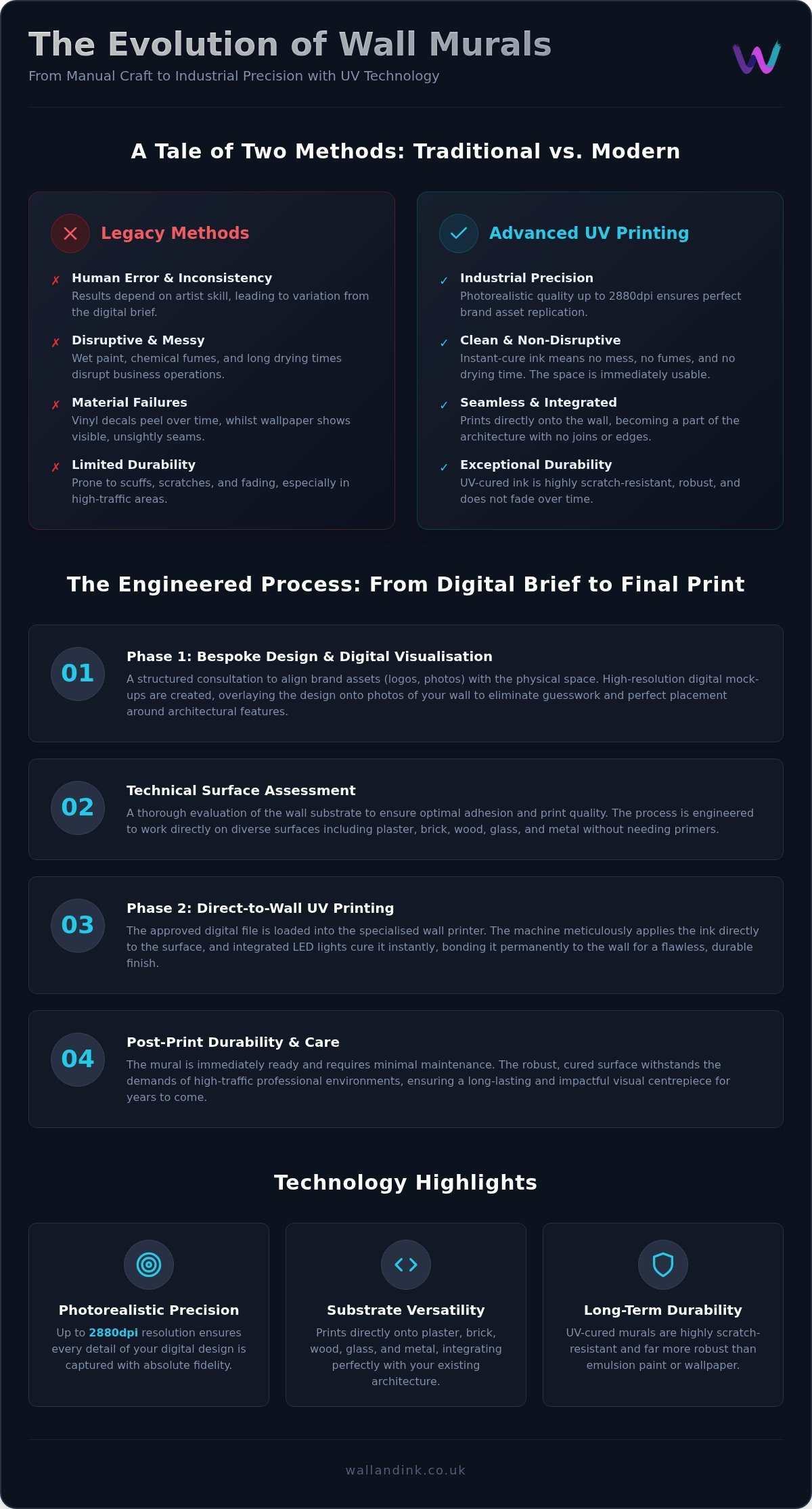
Legacy alternatives often fall short in demanding professional environments. Vinyl decals are notorious for peeling at the edges over time. Wallpaper presents the constant issue of visible seams, which is a common failure amongst commercial projects where a continuous image is required. Hand-painting, whilst visually striking, introduces different challenges. It involves significant mess, wet paint risks, and chemical fumes that can disrupt a school or office for days. Digital workflows solve these problems. They provide a permanent solution that maintains the cleanliness of the site. By using digital files, businesses ensure that brand-critical colours and complex logos are replicated with absolute fidelity, removing the margin for human error.
The Advantages of UV Printing Technology
The mechanical superiority of specialised UV wall printers allows for an output quality previously unavailable in the trade. These machines achieve resolutions of up to 2880dpi. This ensures that even the most intricate photography or fine-line illustrations remain sharp. The process offers several distinct benefits for the modern mural design brief:
- Instant Curing: UV ink hardens immediately under integrated LED lights. There is no drying time and no lingering odour, allowing for immediate occupancy of the room.
- Substrate Versatility: The technology prints directly onto plaster, brick, wood, glass, and metal without needing adhesive layers or primers.
- Durability: UV-cured murals are highly scratch-resistant and far more robust than standard emulsion paint or delicate paper.
This direct-to-wall approach eliminates the “middleman” materials like paper or plastic. It creates a seamless finish that becomes part of the architecture itself. For decision-makers, this means a faster installation and a result that lasts for years without fading or degrading. It is a modern solution to the perceived failures of legacy alternatives.
Phase 1: Bespoke Design and Digital Visualisation
The first stage of the modern process is a structured consultation designed to bridge the gap between a brand’s digital identity and the physical environment. When developing your mural design brief, the focus is on technical feasibility and brand alignment. We analyse your existing assets, such as high-resolution photography or vector-based logos, to determine how they can be adapted for a large-scale format without losing clarity. This ensures that the final output remains sharp, even when scaled to cover several metres of wall space. Our team designs the artwork to integrate seamlessly with your architecture, accounting for the placement of windows, light switches, and vents.
Consultation and Concept Development
During the initial consultation, we define the precise mood and purpose of the installation. Whether the goal is to inspire students in an educational setting or to reinforce corporate values in a reception area, every detail is captured. We require high-resolution source files at this stage; this is essential for maintaining the integrity of the design during the scaling process. Whilst the traditional mural design process often relies on physical site sketches, we utilise digital tools to account for architectural features with absolute precision. The bespoke design fee is an investment in this technical accuracy, ensuring that your artwork aligns perfectly with the building’s layout rather than appearing as an afterthought.
Digital Mock-ups: Seeing the Result Before Printing
Digital visualisation is the most critical safeguard in our workflow. We overlay the proposed artwork onto high-resolution photographs of your actual wall to eliminate guesswork. You can see exactly how the design interacts with existing furniture, lighting, and fixtures before a single drop of ink is applied. If a logo is obscured by a radiator or a key design element is cut off by a door frame, we adjust the scale and placement during this phase. This process also ensures colour accuracy through digital proofing, matching your corporate brand guidelines with industrial precision. If you’re ready to see how your space could look, you can enquire about a bespoke visualisation for your premises. This logical progression provides total transparency, allowing you to sign off on the project with confidence.
Technical Surface Assessment and Substrate Preparation
The success of a direct-to-wall project depends on the technical compatibility of the target surface. Whilst traditional muralists might use thick primers to hide wall flaws, our process involves a precise technical assessment to ensure the printer operates with maximum accuracy. This phase is a core component of the mural design brief; it defines how the digital artwork will interact with the physical substrate. The surface must be clean, dry, and structurally sound for the printer’s laser sensors to maintain a consistent focal length. This mechanical precision is what allows for the translation of complex digital files into physical reality.
One of the primary benefits of this method is the elimination of traditional site preparation. There is no requirement for extensive drop-sheets, dusty sanding, or hours of masking tape application. Because the UV ink cures instantly, there is no risk of drips or splatters. The equipment arrives, calibrates, and begins printing immediately. This efficiency is designed for pragmatic decision-makers who cannot afford the downtime or mess associated with legacy painting methods.
Printing on Plaster and Painted Surfaces
Newly plastered walls require specific attention. They must be fully dry and cured before printing begins; any residual moisture can interfere with ink adhesion. For the best results, we recommend a matt or silk emulsion base coat. High-gloss finishes are often avoided because they can be too reflective for the printer’s sensors and may offer less “key” for the UV ink to grip. If your wall has minor surface imperfections, the printer’s integrated laser sensors navigate these during the pass. The machine adjusts the print head height in real-time to maintain a resolution of up to 2880dpi, ensuring a sharp finish even on walls that aren’t perfectly plumb.
Industrial Surfaces: Brick, Stone, and Wood
The direct-to-wall process excels on textured, industrial substrates that are often difficult to paint or cover with vinyl. Printing directly onto exposed brick or reclaimed wood creates a sophisticated, integrated aesthetic where the texture of the material remains visible through the design. UV ink technology also allows for high-strength adhesion to non-porous surfaces such as glass, metal, and ceramic tiles. This is particularly effective for retail and hospitality environments where branding is required on unconventional fixtures. The printer uses advanced sensors to map uneven textures, ensuring that the ink is deposited with precision regardless of the substrate’s depth. This level of technical control ensures that your mural design brief is executed with the same clarity on a rough brick wall as it is on smooth plaster.
Phase 2: The Direct-to-Wall Printing Execution
Once the design is finalised, the execution phase begins with the on-site arrival of the specialised UV wall printing machine. This represents a significant departure from traditional methods that rely on projectors and manual tracing. Hand-tracing is inherently slow; it’s often prone to shaky lines and human error. Our automated process ensures that the technical specifications outlined in your mural design brief are translated to the wall with absolute fidelity. The equipment is compact and designed to operate within standard professional environments without requiring major site clearance.
Precision Setup and Calibration
The first step involves assembling the vertical rail system and levelling the machine. We ensure perfectly straight lines across any distance, regardless of whether the floor surface is uneven. Integrated laser sensors play a critical role here; they continuously monitor the distance between the print head and the wall. This prevents blurring and ensures the ink is deposited with consistent precision across the entire surface. We then upload the finalised digital design to the printer’s control interface. This direct link between the software and the hardware eliminates the guesswork often found in manual artistry.
The Printing Workflow
The printing process uses a methodical pass-by-pass movement. The print head travels along the vertical rail, applying high-quality CMYK+W inks to build the image with rich colour depth and vibrancy. This technology allows for a high-resolution output of up to 2880dpi, capturing every detail of the original digital file. Most installations are completed in a single day, offering a level of efficiency that hand-painting simply cannot match. There is no overspray, no drips, and no chemical odours during the process. Because the machine uses integrated LED lights, the ink cures instantly upon contact with the substrate. You can touch the mural immediately after the print head passes, making it ideal for high-traffic areas that need to remain operational. If you require a clean, high-resolution finish for your premises, you can book your direct-to-wall printing service to begin the transformation. This industrial approach ensures your brand assets are displayed exactly as intended, with no mess and no stress.
Post-Print Care and Long-Term Durability
The durability of a mural is as critical as the initial design. UV-cured ink provides a permanent, high-performance finish suitable for the most demanding UK commercial environments. Whilst traditional emulsion remains susceptible to scuffs and hand-painting can flake over time, the UV printing process creates a scratch-resistant layer that withstands the rigours of busy corridors and reception areas. This industrial longevity is a key reason why your mural design brief should account for the specific traffic patterns and environmental conditions of the space. The result isn’t just a decorative layer; it’s a robust technical application designed to last.
Maintenance and Cleaning Tips
Maintaining the visual integrity of the installation is straightforward due to the mechanical properties of the cured ink. In high-traffic zones such as schools, hospitals, and busy retail centres, walls are frequently subjected to physical contact. You can clean these murals easily without the risk of fading or smudging. A damp cloth is usually sufficient to remove surface dirt and fingerprints. Because the ink is instantly polymerised during the print phase, it creates a surface that is far more resilient than legacy alternatives.
- Cleaning Agents: Use water or mild, non-abrasive detergents for general maintenance.
- Chemical Resistance: Avoid harsh solvent-based cleaners or abrasive scrubbing pads that could compromise the ink bond over several years.
- Edge Integrity: Unlike vinyl graphics or wallpaper, there are no raised edges to catch or peel. This removes the primary failure point found in traditional wall coverings.
Future-Proofing Your Space
The UV-sensitive inks used in our process are engineered for high lightfastness. This prevents the sun-bleaching often seen in bright atriums, glass-fronted offices, or exterior settings. Your mural will maintain its original vibrancy and colour accuracy for years without requiring touch-ups or specialist maintenance. This consistency ensures that your brand remains represented with industrial precision long after the initial installation.
Pragmatic decision-makers also value the flexibility of this technology. If your branding requirements evolve or you decide to repurpose the room, the mural doesn’t require a complex removal process. You can simply treat the surface like any other wall and paint over it using standard emulsion. There’s no adhesive residue to scrape away and no paper to steam off. This makes it a permanent yet adaptable solution for any professional environment. If you’re ready to transform your facility with a durable, high-resolution finish, Contact Wall & Ink to start your bespoke design journey today.
Future-Proofing Your Commercial Environment
The transition from a conceptual digital file to a permanent physical installation is a technical journey that requires industrial precision. By prioritising a comprehensive mural design brief, you ensure that your brand identity is translated with photorealistic clarity onto any substrate. This direct-to-wall method effectively eliminates the common failures of vinyl and wallpaper, providing a clean, odourless, and efficient alternative to traditional hand-painting. Our process relies on bespoke digital visualisations to remove guesswork, ensuring the final result integrates perfectly with your building’s architectural features.
With UV-cured ink for instant durability and a national UK installation team, we provide a reliable solution for high-traffic professional settings. You gain a high-resolution finish that is scratch-resistant and easy to maintain over several years. Transform your space with a custom wall mural, get a quote today. It’s time to move beyond the mess of legacy alternatives and embrace a modern standard of wall art excellence.
Frequently Asked Questions
How long does the entire mural design process take from start to finish?
Most projects are completed within two to three weeks from the initial consultation. The design phase takes the majority of this time as we refine your mural design brief and create architectural mock-ups. Once you approve the final visualisation, the on-site printing is remarkably fast. We typically finish the installation in a single day, ensuring your business operations face minimal disruption compared to weeks of hand-painting.
Can you print a mural on a textured wall like brick or concrete?
Yes, our equipment prints directly onto textured surfaces including brick, concrete, and stone. The specialised printer uses integrated laser sensors to detect variations in the wall’s depth. It adjusts the print head in real-time to maintain a consistent gap, which prevents blurring. This mechanical precision allows us to achieve high-resolution results on industrial substrates that would be impossible to cover with traditional vinyl or wallpaper.
Is the wall printing process messy or does it produce strong fumes?
The process is entirely clean and produces no chemical odours. Because the UV ink cures instantly under LED lights, there is no wet paint, no overspray, and no risk of drips. You don’t need to clear the room or cover furniture with extensive drop-sheets. This makes the technology ideal for hospitals, schools, and offices where maintaining air quality and site cleanliness is a primary operational requirement.
Do I need to provide the artwork, or can you design it for me?
We offer a flexible approach where you can provide high-resolution files or utilise our bespoke design service. If you have existing brand assets, we adapt them to fit your specific architectural space. Alternatively, our specialists can develop a concept from scratch based on your goals. We include digital visualisations as standard to ensure the final result aligns with your brand standards before the printing begins.
How durable is a direct-to-wall printed mural compared to wallpaper?
Direct-to-wall printing is significantly more durable than wallpaper or vinyl decals. It doesn’t have edges that can peel or seams that can pull apart over time. The UV-cured ink is scratch-resistant and bonds directly to the substrate, making it suitable for high-traffic corridors and receptions. Whilst wallpaper often requires replacement after minor damage, our murals maintain their industrial-grade finish for many years with minimal maintenance.
What happens if I want to remove the mural in the future?
Removing the mural is as simple as painting over the wall with a standard emulsion. There is no adhesive residue to scrape away and no paper to steam off. Because the ink layer is incredibly thin and flat, it doesn’t leave a raised profile. This provides a future-proof solution for businesses that might need to update their branding or repurpose their interior spaces without incurring heavy remedial costs.
Can the mural design process include my company logo and specific brand colours?
Accurate brand representation is a core strength of our process. We use a CMYK+W ink system to replicate complex logos and specific corporate colours with high precision. During the mural design brief stage, we confirm your colour requirements to ensure the digital file matches your brand guidelines exactly. The 2880dpi resolution ensures that even small text and intricate graphic elements remain sharp and professional.
Is direct-to-wall printing suitable for exterior surfaces?
Yes, our UV-cured inks are highly resistant to environmental factors and suitable for exterior walls. The technology is engineered to withstand sun exposure without bleaching or fading. We can print directly onto external brickwork, render, or metal cladding. This provides a permanent branding solution for shop fronts and educational buildings that remains vibrant and robust against the British weather for several years without needing protective coatings.