
The assumption that a bespoke wall feature requires weeks of scaffolding and the unpredictable stroke of an artist’s brush is becoming obsolete. Whilst the “soul” of an artisan’s work is often praised, the reality for many UK facility managers and homeowners is a messy, prolonged installation that might not even match the original brief. When evaluating wall printing vs hand painted mural options, the decision usually rests on whether you value artisanal charm or industrial-grade precision.
You likely want a high-impact visual that transforms your space without the risk of amateurish finishes or the inevitable peeling of traditional wallpaper. We understand that your priority is a durable, professional result that withstands high-traffic environments like school corridors or retail centres. This guide provides a technical and aesthetic comparison between traditional hand-painting and modern direct-to-wall UV printing. You’ll discover how these methods perform on challenging substrates like brick and glass; you will also learn which solution offers the best long-term value for your specific environment.
Key Takeaways
- Contrast the mechanical precision of 2880 DPI resolution with manual brushwork to determine which method delivers the photorealistic detail your project requires.
- Compare the long-term durability of UV-cured inks against traditional emulsions to ensure your mural remains scratch-resistant and fade-proof in high-traffic corridors.
- Assess wall printing vs hand painted mural suitability for non-standard substrates, including the technical advantages of direct application on glass, metal, and textured brick.
- Recognise the operational benefits of “no mess, no stress” installations that offer instant curing and zero odour, minimising disruption to your daily operations.
- Determine the most efficient approach for your space by identifying when the speed of digital execution outweighs the artisanal qualities of traditional hand-painting.
Defining the Debate: Traditional Hand-Painting vs Digital Wall Printing
The UK market for vertical surface decoration has undergone a significant transformation. Decision-makers no longer have to choose between plain paint or expensive, peeling wallpaper. Instead, the debate now focuses on wall printing vs hand painted mural applications. This choice determines more than just the visual finish; it dictates the installation timeline, the maintenance requirements, and the long-term durability of the surface. Selecting the wrong method can lead to amateurish results or prolonged operational downtime.
The Mechanism of Direct-to-Wall UV Printing
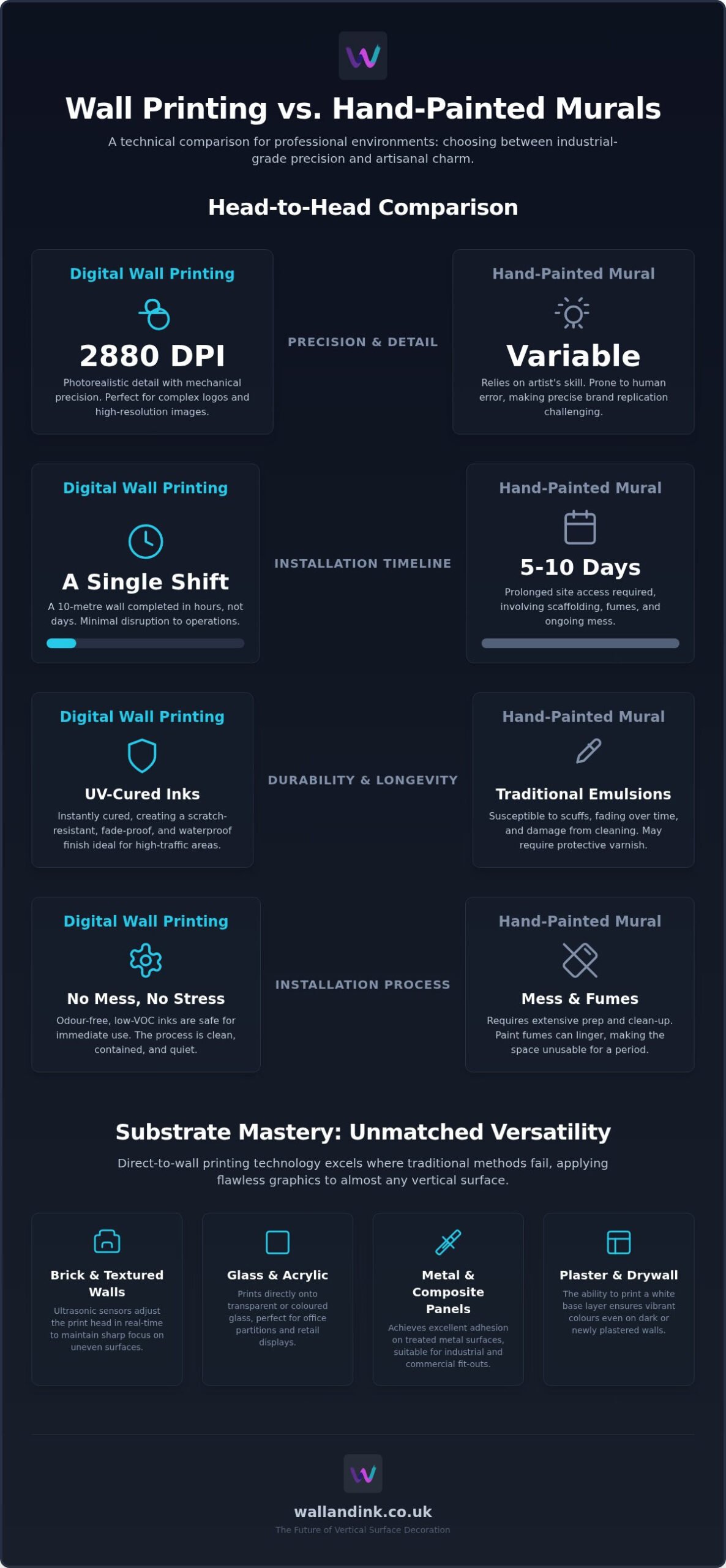
Direct-to-wall UV printing utilises a computer-controlled inkjet system mounted on precision vertical rails. Unlike traditional printing, this method applies ink directly to the substrate, whether it’s plaster, brick, or glass. Ultrasonic sensors track the surface in real-time. These sensors adjust the print heads to maintain a consistent distance from the wall, ensuring sharp focus even on uneven textures.
The use of UV-cured inks is a critical technical advantage. These inks cure instantly under ultraviolet light, resulting in a finish that’s smudge-proof and odour-free immediately upon completion. By 2026, these machines can achieve resolutions of up to 2880 DPI. This level of mechanical precision allows for photorealistic detail and perfect brand consistency that manual methods simply can’t replicate. It’s a “no mess, no stress” solution designed for environments where cleanliness and speed are non-negotiable.
The Artistic Process of Hand-Painted Murals
Traditional hand-painting relies on the artist’s ability to manipulate physical mediums. Mural techniques vary from classic brushwork to spray-painting, offering a tactile, organic texture that some find appealing for high-concept art. This human element creates a unique, one-off piece, but it introduces variables that aren’t ideal for commercial branding.
Replicating complex corporate logos or high-resolution photography with a brush is notoriously difficult and prone to human error. There’s also the issue of time. Whilst a wall printer can complete a large-scale mural in a matter of hours, an artist often requires days or weeks of site access. This often involves scaffolding, paint fumes, and the risk of a “messy” workspace. For pragmatic decision-makers, the unpredictability of manual labour often outweighs the perceived charm of a hand-painted finish. The choice between a wall printing vs hand painted mural ultimately comes down to a preference for industrial reliability over artisanal variability.
Speed, Detail, and Durability: A Head-to-Head Comparison
The industrial comparison of wall printing vs hand painted mural techniques reveals a stark divide in mechanical performance. Whilst the traditional mural creation process involves manual layering and subjective human interpretation, digital UV printing relies on fixed parameters and high-resolution output. This technical distinction impacts everything from the sharpness of a corporate logo to the longevity of the finish in a busy corridor.
Precision and Brand Accuracy
Mechanical precision is the primary differentiator for professional environments. A UV printer operates at a resolution of 2880 DPI, allowing for gradients and photorealistic details that a brush cannot achieve. This is particularly vital for commercial wall murals where brand identity is non-negotiable.
- Colour Consistency: Digital systems ensure exact HEX or Pantone matching across different surface types.
- Dark Substrates: The ability to print a white ink base layer allows for vibrant, high-contrast results on dark brick or charcoal-painted walls.
- Error Elimination: Computer-controlled movements remove the risk of shaky lines, drips, or anatomical errors in complex designs.
Timeline and Business Disruption
Efficiency is critical for active environments. A 10-metre wall can be fully printed in a single working shift. In contrast, a hand-painted mural of the same scale might require five to ten days of site access. This speed is supported by the “no mess” nature of the hardware. Modern UV inks are low-VOC and produce no lingering chemical smells, making them safe for immediate use in hospitals, schools, and offices.
The installation is fundamentally cleaner. There’s no dust, no paint splashes, and no need for extensive masking of floor areas. Because the ink cures instantly under ultraviolet light, there’s zero drying time. The result is a smudge-proof finish the moment the print head completes its pass.
Durability and Maintenance
The physical properties of UV-cured ink offer superior resistance to environmental stressors. Once cured, the ink forms a hard, scratch-resistant bond with the substrate. This makes it ideal for high-traffic corridors where walls are frequently brushed against or bumped. Unlike delicate hand-painted finishes that may flake or fade, UV prints are UV-stable and fully washable. You can wipe the surface clean with standard non-abrasive detergents without risking the integrity of the artwork. When choosing between a wall printing vs hand painted mural, the maintenance-free nature of UV printing offers a clear operational advantage for pragmatic facility managers.
Substrate Mastery: Printing on Brick, Glass, and Fresh Plaster
The versatility of vertical UV printing is most evident when applied to the diverse architectural substrates found across the UK. Whilst the modern mural painting process often requires extensive surface priming or gesso layers to ensure even coverage, direct-to-wall printing handles porous and non-porous materials with mechanical consistency. This flexibility is a primary factor in the wall printing vs hand painted mural debate, especially for businesses occupying industrial conversions or modern glass-fronted offices.
For porous surfaces like brick or timber, the UV ink is applied and cured instantly. This prevents the “bleeding” effect common with traditional emulsions, where the paint is absorbed unevenly into the grain or masonry. On non-porous substrates such as glass, metal, or high-gloss tiles, a specific degreasing process and a specialised primer ensure a permanent bond. This technical approach eliminates the peeling risks associated with vinyl decals or traditional wallpaper in high-traffic environments.
Uneven walls present no obstacle for modern printing hardware. Intelligent ultrasonic sensors continuously measure the distance between the print head and the wall, adjusting the output in real-time. This ensures that even on a rough breeze-block wall or a slightly bowed plaster surface, the image remains sharp and distortion-free. It’s a level of precision that manual brushwork cannot maintain over large, irregular areas.
Preparing UK Walls for Printing
Preparing UK walls requires attention to moisture levels, particularly in new builds. New plaster must be fully cured before printing begins; we recommend a minimum drying time of two to four weeks depending on the thickness and ambient temperature. Surface preparation is straightforward: walls must be clean, dry, and free from loose debris. Unlike wallpaper, there’s no need for “sizing” the wall, which further reduces the preparation timeline and ensures a cleaner installation environment.
Exterior vs Interior Applications
Exterior applications demand high resilience against environmental stressors. UV-cured inks are inherently fade-resistant and survive the British climate without the need for additional sealants or protective varnishes. The science of UV stability ensures that colours remain vibrant even when exposed to direct sunlight for several years. UV printing is superior for exterior brickwork because the ink does not form a solid plastic film, allowing the masonry to breathe and preventing moisture from becoming trapped within the wall. This breathability is essential for maintaining the structural integrity of older UK properties whilst delivering a high-impact visual finish.
The Professional Service Advantage: Why Result Beats Hardware
While some hardware manufacturers suggest that buying a machine is a simple entry point into the industry, the reality of the wall printing vs hand painted mural debate is that precision depends on the operator. Professional direct-to-wall printing is a specialised industrial trade, not a consumer-grade activity. Operating these machines requires constant calibration, meticulous nozzle health monitoring, and the ability to manage ultrasonic sensor errors in real-time. For 99% of UK businesses, a project-based service is far more cost-effective than managing industrial hardware in-house.
The hidden costs of DIY wall printing often outweigh the initial savings. Ink waste during calibration, the high price of replacement parts, and the steep learning curve for software integration can quickly drain a budget. A professional service absorbs these operational risks. We provide a guaranteed result that matches the building’s lifespan, ensuring that every drop of UV-cured ink is placed with mechanical accuracy. This eliminates the uncertainty that often accompanies manual labour or uncertified equipment operation.
Bespoke Design and Visualisation
A successful installation begins long before the printer arrives on site. We employ a “measure twice, print once” philosophy, using digital mock-ups to show exactly how the artwork interacts with architectural features like light switches, vents, or corners. This process involves adapting low-resolution files into wall-ready, high-definition assets that maintain their integrity at scale. Collaborative design ensures that specialists refine your vision, adjusting colour balances and contrast levels to suit the specific lighting conditions of your environment.
National Reliability and Logistics
Transporting industrial UV printers across the UK requires meticulous logistics and robust equipment. A professional service provides full insurance and quality assurance, ensuring the equipment is perfectly levelled regardless of the site’s floor conditions. One major advantage of this model is fixed-cost reliability. Unlike the “artist creep” often seen in hand-painted project fees-where additional hours, specialist materials, or protective varnishes can inflate the final invoice-professional printing offers radical transparency. You pay for a defined result within a set timeframe.
For those seeking a reliable, high-impact finish without the logistical burden of hardware management, you can organise a professional wall printing project to ensure industrial precision for your space.
Strategic Implementation: Finding the Perfect Fit for Your Space
Deciding between wall printing vs hand painted mural techniques depends on the functional requirements of your environment and the level of precision your brand demands. Hand-painting remains a suitable choice for high-concept art where the physical texture of the paint is the primary aesthetic goal. However, for pragmatic decision-makers, direct-to-wall UV printing is the strategic choice for projects requiring industrial precision, photorealistic detail, and high-traffic durability. It’s a modern solution that eliminates the variables of manual labour in favour of mechanical reliability.
Commercial and Educational Environments
UK schools and educational facilities prioritise safety and longevity over artisanal charm. UV-cured murals are smudge-proof and scratch-resistant, which is essential for busy corridors where surfaces are frequently handled by students. In professional office environments, the installation of high-resolution nature scenes or intricate corporate values improves the workspace atmosphere without the disruption of paint fumes or long drying times.
Retail branding presents a different challenge that only digital technology can solve effectively. The mechanical consistency of UV printing ensures that complex logos and brand colours remain identical across every national location. This level of replication is a critical requirement for maintaining brand integrity. Whilst a manual artist may struggle to duplicate a logo exactly across ten different branches, a UV printer delivers the same 2880 DPI result every time. This makes it the superior choice for retail and hospitality graphics where consistency is a non-negotiable metric.
Residential Innovation
Residential spaces are also seeing a shift towards digital innovation as homeowners seek bespoke feature walls without the traditional mess of decorating. Family photography, favourite landscapes, or custom digital designs can be printed directly onto plaster, eliminating the risk of peeling wallpaper edges or visible seams. Because the ink is applied and cured instantly, there is no need to vacate the room or worry about chemical odours.
The future of UK interiors involves integrating these digital processes into the initial architectural design phase. By treating walls as canvases for direct UV application, designers can eliminate the waste associated with legacy materials like vinyl decals. This approach ensures a durable, high-impact visual that requires zero maintenance. It positions wall printing as a permanent architectural solution for modern spaces, providing a level of detail that hand-painting cannot match. If you’re ready to upgrade your interior with industrial-grade precision, you can transform your space with professional UK wall printing services from Wall & Ink.
Selecting the Future of Your Interior Walls
Choosing between wall printing vs hand painted mural techniques is a decision that defines the longevity and professional finish of your space. Whilst traditional painting offers an organic feel, industrial UV printing delivers the mechanical precision and scratch resistance required for high-traffic environments. You’ve seen how direct-to-wall technology masters complex substrates like brick and glass whilst eliminating the mess and odour of traditional mediums.
Our comprehensive national service provides industrial-grade UV technology for instant-cure, smudge-proof results. We include bespoke digital visualisation with every consultation to ensure your vision translates perfectly to the wall. This expert-led approach removes the unpredictability of manual labour, offering a reliable, photorealistic outcome for schools, offices, and retail units across the UK.
Enquire about our bespoke wall printing services for your UK project and secure a durable, high-impact visual that requires zero maintenance. We look forward to helping you transform your environment with industrial precision.
Frequently Asked Questions
How much does a wall printer mural cost per square metre in the UK?
Professional wall printing costs depend on the total surface area, the complexity of the substrate, and the specific design requirements. We operate on a project-based pricing model that provides transparency from the initial consultation. This approach ensures that factors like surface preparation for non-porous materials or digital visualisation are accounted for. Unlike the variable rates in the wall printing vs hand painted mural market, our fees are fixed once the brief is finalised.
Can you use a wall printer on exterior brickwork or render?
Yes, direct-to-wall technology is highly effective on exterior brickwork, render, and concrete. The UV-cured inks are designed to be weather-resistant and UV-stable, ensuring the artwork survives the British climate without fading. Because the ink doesn’t form a solid plastic film like vinyl, it allows the masonry to breathe. This prevents moisture from becoming trapped, which is essential for maintaining the structural integrity of the building whilst delivering high-impact graphics.
How long does it take to print a standard 3-metre office feature wall?
A standard 3-metre office feature wall typically takes between two and four hours to complete. This timeline includes the setup of the vertical rails and the calibration of the ultrasonic sensors. Because the ink cures instantly under ultraviolet light, there’s zero drying time required. Your team can resume using the office immediately after the technician finishes, as the process is odour-free and produces no dust or messy paint splashes.
Is the UV ink used in wall printing safe for hospitals and nurseries?
The eco-friendly UV inks used in our process are entirely safe for use in hospitals, nurseries, and schools. These inks are low-VOC and cure instantly, meaning they don’t release lingering chemical odours or harmful particulates into the air. This makes them a superior choice for sensitive environments where air quality is a priority. The resulting finish is also washable and scratch-resistant, allowing for rigorous cleaning protocols without damaging the artwork.
Do I need to sand or prime my wall before the printer arrives?
Most standard walls only require a clean, dry surface that is free from loose debris or significant structural damage. If you have a new build, ensure that fresh plaster has been allowed to cure for at least two to four weeks. Whilst sanding isn’t usually necessary for painted plasterboard, non-porous surfaces like glass or high-gloss tiles may require a specialised degreasing treatment. We assess all surfaces during the initial consultation to ensure optimal ink adhesion.
Can a wall printer print on glass, mirrors, or ceramic tiles?
Our industrial UV printers are capable of applying high-resolution images to glass, mirrors, ceramic tiles, and metal. The technology uses advanced sensors to track the surface, ensuring the print head maintains precision on these smooth substrates. For these non-porous materials, we apply a specific primer that creates a permanent bond between the ink and the surface. This versatility allows for creative branding on windows and partitions that traditional methods cannot achieve.
How long will a direct-to-wall mural last before it starts to fade?
A direct-to-wall mural is designed for long-term durability, typically lasting up to 10 years indoors and 5 years in exterior environments. The UV-curing process creates a hard, scratch-resistant bond that is inherently resistant to sunlight and mechanical wear. Unlike hand-painted murals that may flake or fade over time, these prints maintain their colour saturation and detail. This longevity makes the technology a cost-effective architectural solution for commercial and residential feature walls.
What is the difference between a wall printer and a vinyl wall graphic?
The primary difference is that wall printing is a direct application, whilst vinyl is a plastic film stuck to the surface. Vinyl graphics often suffer from peeling at the edges and visible seams, particularly in high-traffic corridors. Direct-to-wall printing eliminates these failure points by bonding the ink directly to the substrate. It also offers a higher resolution and allows the wall to breathe, which is a critical advantage when comparing wall printing vs hand painted mural options.