
That high-quality vinyl wrap you just installed might be the very thing damaging your walls and your brand’s reputation. You want a professional finish that lasts, but you’re likely tired of seeing edges peel, air bubbles form, or plaster crumble during a simple removal process. This comparison of wall printing vs vinyl graphics UK explores why modern specialists are moving away from adhesive films in favour of industrial precision. It’s time to stop settling for temporary stickers that struggle with textured surfaces like brick or concrete.
Discover why direct-to-wall UV printing is disrupting the traditional vinyl market across the UK with superior durability and aesthetic precision. This guide explains how direct-to-surface application eliminates common industry pain points while offering a zero-maintenance, environmentally friendly alternative. We’ll examine the technical specifications, surface compatibility, and long-term cost benefits that make UV printing the logical choice for pragmatic decision-makers. From schools to high-stakes professional environments, you’ll learn how to achieve a permanent mural that feels like a part of the architecture rather than a fragile layer.
Key Takeaways
- Understand the mechanical distinction between surface-level adhesive films and direct-to-surface UV ink curing for a more integrated, permanent finish.
- Evaluate wall printing vs vinyl graphics UK to see how eliminating adhesives prevents common failures like peeling, bubbling, and edge-lift in high-traffic corridors.
- Discover how to apply high-resolution art to challenging substrates, including brick and breeze blocks, without the adhesion risks associated with traditional vinyl.
- Learn why PVC-free, low-emission UV inks provide a safer and more sustainable signage solution for sensitive environments like hospitals and schools.
- Use a professional framework to assess your project’s surface type and longevity requirements to ensure you select the most durable installation method.
The Core Difference: Wall Printing vs Vinyl Graphics
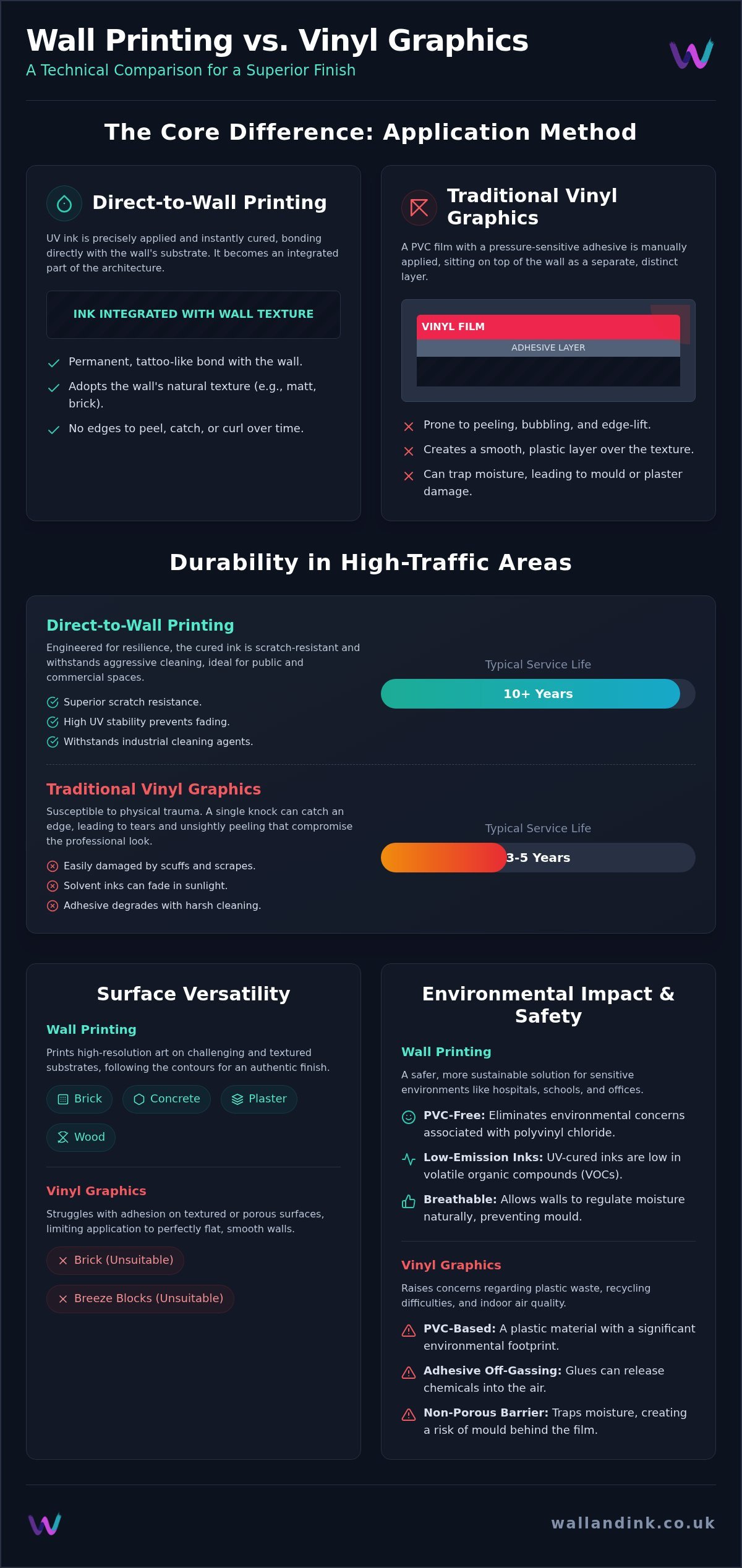
The fundamental choice between wall printing vs vinyl graphics UK comes down to how the medium interacts with the substrate. Traditional vinyl relies on a Polyvinyl Chloride (PVC) film. This film is held in place by a pressure-sensitive adhesive. It sits on top of the wall as a distinct, separate layer. In contrast, direct-to-wall printing utilises advanced UV technology to apply ink directly to the surface. The ink cures instantly under ultraviolet light. It doesn’t just sit on the wall; it integrates with it. This technical shift is why UK businesses are moving away from ‘stuck-on’ graphics toward integrated murals that feel like a permanent part of the architecture.
Mechanism of Application: Ink vs Adhesive
Think of wall printing as a digital tattoo for your interior. The printer nozzle moves across the surface, depositing droplets that bond with the plaster, wood, or brick. There is no physical margin or edge to catch or peel. Vinyl application is a manual process of sticking a plastic sheet to a surface. In the UK, temperature fluctuations often cause these adhesives to expand and contract. This leads to edge-curling and air bubbles. Whilst vinyl looks like a sticker, direct printing looks like a permanent mural. Both methods have roots in wide-format printing technologies, but their physical execution on a vertical surface is worlds apart.
Tactile finish is a major differentiator. Vinyl has a plastic, often glossy sheen that reflects light inconsistently. Direct-to-wall printing adopts the texture of the substrate. If you print on a matt plaster wall, the result is matt. If you print on textured brick, the art follows the contours of the mortar. This creates an authentic aesthetic that vinyl cannot replicate. It’s a matter of industrial precision versus manual overlay.
Material Composition: UV Ink vs PVC
UV-cured pigments offer industrial precision. They are robust, lightfast, and resistant to scratching. PVC-based vinyl is becoming a liability for some. Many UK commercial tenders now restrict the use of PVC due to environmental concerns and recycling difficulties. Breathability is another technical factor. Plaster is a porous material that needs to regulate moisture. Vinyl acts as a non-porous barrier. It traps moisture behind the film, which can lead to mould or plaster degradation. Wall printing maintains the wall’s natural breathability. The ink covers the surface without sealing it off.
- Adhesion: Ink bonds directly to pores; vinyl relies on a chemical glue layer.
- Breathability: Wall printing allows moisture transfer; vinyl creates a waterproof seal.
- Tactile Finish: Prints integrate with texture; vinyl creates a smooth plastic mask.
Engineering Durability: Why Ink Beats Adhesive in High-Traffic Areas
High-traffic environments like school corridors, hospital wards, and retail showrooms demand mechanical resilience. Vinyl graphics often fail in these settings because they are susceptible to physical trauma. A single trolley knock or a curious finger can catch a vinyl edge, leading to a permanent tear or unsightly peeling. Direct-to-wall printing eliminates this risk entirely. Because the ink is cured directly onto the substrate, there is no raised edge to catch. This ‘no-peel’ advantage makes it a superior choice for environments where durability isn’t just preferred, but required.
UV stability is another critical factor when comparing wall printing vs vinyl graphics UK. Standard vinyl prints often use solvent-based inks that can fade under direct sunlight within a few years. Our industrial UV pigments are engineered for high lightfastness. This ensures that a commercial mural in a glass-fronted lobby or a sunny retail centre maintains its saturation for a decade or more. The result is a finish that remains as vivid as the day it was installed, regardless of light exposure.
Maintenance and Longevity
Cleaning protocols in public spaces are often aggressive. Vinyl graphics can struggle with industrial detergents, which may degrade the adhesive or cause the edges to lift over time. Wall prints are inherently scratch-resistant and withstand standard cleaning procedures without loss of detail. Research into the durability of graphic materials highlights that whilst vinyl is a common choice, its physical lifespan in high-use environments is typically 3-5 years. In contrast, wall printing provides a service life of 10 years or more. UV curing is a technical process that creates an immediate, permanent bond between the ink and the wall surface.
The Cost of Failure: Repairing Vinyl vs Refreshing Print
When a vinyl graphic is damaged, the repair usually necessitates a full replacement of the entire panel. Matching colours between an old, faded panel and a new one is nearly impossible, often resulting in a patchy, unprofessional finish. If you need to update your branding, removing large-scale vinyl can damage the underlying plaster, leading to costly repair bills and downtime. Wall printing offers a more pragmatic solution for long-term facility management. If a rebrand is required, the print can simply be painted over like any other wall surface. When assessing the total cost of ownership over a 10-year period, the elimination of replacement cycles makes direct-to-wall printing the more efficient investment for UK businesses.
Surface Versatility: Beyond Flat Plaster
Vinyl graphics demand a near-perfect substrate. If a wall is uneven, the adhesive fails to create a continuous bond. This is particularly problematic with traditional British architecture featuring exposed brick, stone, or rough breeze blocks. In any assessment of wall printing vs vinyl graphics UK, the primary failure of vinyl on these surfaces is “ghosting”. This occurs when the film bridges the gaps in mortar or texture, creating a visible, fragile void. Direct-to-wall printing bypasses this mechanical limitation entirely. This technology is equally effective on wood and glass, allowing for bespoke designs on surfaces that traditionally reject standard adhesives.
Printing on Porous and Textured Substrates
The technical process involves high-resolution print heads that deposit UV ink into the very pores of the material. Whether it’s bare brick or fresh plaster, the ink adapts to the surface’s natural character. It doesn’t mask the texture; it integrates with it. This creates a “hand-painted” aesthetic that retains the industrial feel of the building whilst delivering digital precision. Unlike vinyl, which often looks like a cheap plastic overlay, direct printing feels like an original architectural feature. There is no risk of the art peeling away from the mortar or bubbling in the recesses of the brickwork.
Exterior Applications and Weather Resistance
UK weather presents a unique challenge for wall art. Frequent rain, frost cycles, and thermal expansion cause materials to move. Vinyl wraps and masonry have different expansion coefficients. This leads to the adhesive layer shearing away from the wall, resulting in bubbles and eventual failure. Direct-to-wall printing for external retail facades uses pigments that bond with the substrate. These prints are resistant to the elements and don’t suffer from the delamination issues common in adhesive-based products. When managing these installations, adhering to UK Health and Safety Executive guidance ensures that the application of industrial-grade inks is handled with professional care. This is especially vital for exterior work where public safety and environmental factors are at play.
Navigating architectural features is another area where industrial printers excel. Vinyl requires meticulous hand-cutting around pipes, sockets, and corners. This often leaves visible seams or areas where the adhesive is prone to lifting. A non-contact wall printer moves around these obstacles with millimetre precision. It allows for seamless art that flows over conduits and into alcoves without the need for unsightly joins or risky manual trimming.
Environmental Impact and Workplace Safety in the UK
UK businesses are increasingly prioritising PVC-free branding to align with national net-zero targets. Traditional vinyl graphics are composed of plastic films that are notoriously difficult to recycle. In the technical assessment of wall printing vs vinyl graphics UK, the environmental advantage lies with direct-to-surface application. This method eliminates the need for plastic substrates, adhesive layers, and non-recyclable backing paper. By removing these materials from the supply chain, organisations can significantly reduce their contribution to plastic waste.
Sustainability and the Circular Economy
The carbon footprint of traditional signage is often overlooked in commercial tenders. Shipping heavy rolls of vinyl across the country generates higher transport emissions than moving a compact digital printer. Waste reduction is another critical differentiator. Vinyl installation produces substantial off-cuts and protective films that cannot be processed by standard recycling streams. When a vinyl graphic reaches its end-of-life, it’s typically removed and sent to one of the UK’s 50 Energy from Waste (EfW) plants for incineration. Direct-to-wall printing produces zero physical waste during installation and has an average energy use of just 0.06 kWh per square metre. UV ink is considered a low-VOC alternative that ensures superior indoor air quality without the off-gassing associated with adhesive-based films.
Health and Safety in Public Spaces
Safety in sensitive environments like hospitals, clinics, and schools is a primary concern for facility managers. Traditional vinyl applications often involve solvent-based inks and chemical adhesives that emit strong odours, requiring rooms to be vacated for ventilation. Direct-to-wall printing uses GREENGUARD Gold certified inks that are virtually odourless and cure instantly under UV light. This allows public spaces to remain operational, with rooms ready for immediate use once the print head finishes its path.
Fire safety standards are equally vital. Applying a layer of PVC to a wall can alter the fire rating of the substrate, potentially creating a hazard in corridors or stairwells. Ink on plaster is inherently safer because it doesn’t provide a significant fuel source or produce the toxic smoke associated with burning plastic. Our application methods comply with stringent UK building regulations and healthcare hygiene standards, ensuring that high-resolution art doesn’t compromise safety. For organisations committed to meeting modern ESG goals, direct-to-wall printing offers a transparent, sustainable solution that legacy methods cannot match.
Making the Choice: When to Invest in Direct-to-Wall Printing
Deciding between wall printing vs vinyl graphics UK depends on your specific operational requirements and the desired longevity of the installation. Whilst vinyl serves as a functional tool for short-term, temporary displays, direct-to-wall UV printing is the industrial-grade choice for permanent architectural features. Pragmatic decision-makers choose this method when they require a finish that integrates with the building’s texture rather than masking it with a plastic film. This selection framework focuses on three primary factors: project duration, surface complexity, and the need for a seamless, professional aesthetic.
Premium commercial environments, such as corporate headquarters and high-end retail centres, increasingly move away from adhesive-based products. They prefer the “built-in” look that only direct ink application can provide. By choosing a method that bonds with the substrate, you eliminate the visual clutter of seams and the inevitable degradation of glue. This approach ensures your branding remains a high-resolution asset for years, rather than a maintenance liability.
The Wall & Ink Professional Process
We organise national projects through a methodical three-step journey designed to eliminate traditional installation hassles. Our process is built on technical precision and radical transparency.
- Step 1: Bespoke Design and Visualisation. Every project begins with a professional consultation. We provide digital mock-ups for architectural visualisation, allowing you to see exactly how the mural interacts with your specific space before a single drop of ink is cured.
- Step 2: Surface Assessment. Our specialists conduct a technical preparation phase. We assess the substrate, whether it’s bare brick, wood, or plaster, to ensure the UV ink achieves a permanent bond.
- Step 3: Precision Execution. Our teams deploy advanced UV printers on-site. The process is clean, odourless, and causes minimal disruption to your daily operations.
Future-Proofing Your Interior Branding
Transparency is a core value of our service. We utilise a clear price-per-square-metre model, which offers better clarity for UK buyers compared to the opaque pricing often found in the traditional signage industry. This model allows for accurate budgeting and ensures you only pay for the exact scale of your project. Beyond the initial investment, wall printing offers superior flexibility for future updates. When your branding evolves, you don’t need heat guns or chemical removers to strip away old vinyl. You simply paint over the existing mural and start fresh. This eliminates the risk of plaster damage and the costs associated with wall repairs.
For organisations that value efficiency, durability, and a modern aesthetic, the choice is clear. Direct-to-wall printing is the technical evolution of interior branding. It provides a permanent, high-resolution solution that legacy adhesive methods cannot replicate. To see how we can transform your space with industrial precision, explore our commercial wall mural services and discover the “no-peel” advantage for your next project.
Elevate Your Vertical Surfaces with Industrial Precision
Choosing between wall printing vs vinyl graphics UK requires a shift from temporary fixes to permanent architectural integration. Direct-to-wall UV printing eliminates the physical failures of adhesive films, such as edge-curling and air bubbles, whilst providing a finish that respects the original texture of your substrate. Whether you’re managing a high-traffic school corridor or a premium retail facade, the technical superiority of UV-cured ink ensures a durable, low-maintenance result that lasts for a decade or more.
We provide a streamlined service designed for pragmatic decision-makers. Our national UK installation team operates with radical transparency, utilising a clear price-per-square-metre model and providing full digital visualisation for every project. This methodical approach ensures your mural is executed with mechanical precision and zero environmental waste. It’s time to move beyond the limitations of PVC and invest in a solution that bonds directly with your vision. Book a Bespoke Design Consultation with Wall & Ink today to begin your transformation. We look forward to helping you create a space that reflects the quality of your brand.
Frequently Asked Questions
Is wall printing more expensive than vinyl graphics in the UK?
Wall printing typically involves a higher initial investment than basic vinyl, but offers better long-term value through its 10-year lifespan. Our pricing model is based on a transparent price-per-square-metre rate that includes technical execution and digital visualisation. When comparing wall printing vs vinyl graphics UK, businesses should consider the total cost of ownership. Vinyl often requires replacement every few years, whilst a direct-to-wall print remains a permanent architectural feature.
Can wall printing be removed if we rebrand our office?
You don’t need to strip or scrape the surface when it’s time for a rebrand. Unlike vinyl, which requires heat guns and can damage the underlying plaster, wall prints are easily updated by painting over the existing art. This makes it a pragmatic choice for commercial spaces that undergo periodic refreshes. You simply apply a standard primer and topcoat to return the wall to its original state, ready for a new design or a plain finish.
Does wall printing work on textured walls like brick or breeze block?
Direct-to-wall printing is specifically engineered to work on challenging substrates like brick, stone, and breeze blocks. The non-contact print heads deposit UV ink into the recesses of the material, maintaining the wall’s natural character. Vinyl graphics often struggle with these surfaces because the adhesive fails to bond in the mortar lines, leading to ghosting or peeling. Our technology ensures the artwork follows every contour for a seamless, integrated look that feels part of the building.
How long does a direct-to-wall print last compared to vinyl?
A direct-to-wall UV print is designed to last for 10 years or more in indoor environments. When evaluating wall printing vs vinyl graphics UK, this significantly outperforms standard vinyl graphics, which typically have a service life of 3 to 5 years before edges begin to lift or colours start to fade. The UV-cured pigments are highly resistant to light exposure and physical knocks. This industrial durability makes it the logical choice for high-traffic areas where longevity is required.
Is the ink used in wall printing safe for schools and hospitals?
The inks used in our direct-to-wall process are GREENGUARD Gold certified and entirely safe for sensitive environments. These pigments are low-VOC and virtually odourless, which means they don’t require the lengthy ventilation periods associated with solvent-based vinyl adhesives. This makes the technology ideal for schools and hospitals where air quality and patient safety are paramount. Spaces can be occupied immediately after the printing process is complete without any health risks to the occupants.
Can you print on exterior walls in the UK climate?
Our technology is fully compatible with exterior masonry and can withstand the variable UK climate. The UV-cured ink bonds with the substrate and resists the effects of rain, frost, and thermal expansion. Whilst exterior vinyl wraps often bubble or shear away from the wall due to moisture and temperature changes, direct printing remains stable. It provides a robust solution for retail facades and outdoor commercial murals that need to maintain their visual impact year-round.
What is the maximum size for a direct-to-wall mural?
There is technically no maximum size for a direct-to-wall mural. Our advanced UV printers operate on a modular rail system, allowing us to cover expansive areas by repositioning the equipment as needed. Whether you require a small corporate logo or a multi-storey educational mural, the process remains precise and seamless. We provide digital mock-ups during the planning phase to ensure the artwork is scaled correctly for your specific architectural space, regardless of its dimensions.
How do I prepare my wall for a professional printing project?
Preparing for a professional printing project is straightforward and requires the wall to be clean, dry, and structurally sound. A light-coloured, matt-finished surface provides the best canvas for high-resolution detail. If you’re printing on dark or heavily textured walls, we can apply a white ink base to ensure colour accuracy. Our team performs a technical surface assessment before installation to confirm the substrate is ready for the UV curing process, ensuring a permanent and flawless bond.