
The traditional belief that every hairline crack or surface imperfection requires a week of sanding and a professional plasterer’s fee is quickly becoming obsolete. You’ve likely spent hours battling peeling lining paper or worrying about the inevitable dust that comes with renovating old masonry. It’s a common frustration for property owners who want a high-end finish without the industrial mess. When faced with these challenges, many ask: can you print on uneven walls? The answer lies in the precision of modern UV technology, which can navigate surface variations that would cause traditional wallpaper to bubble or fail.
We understand that you value efficiency and a durable, professional result that lasts. This guide will show you how to transform damaged substrates into stunning visual features using a blend of targeted repairs and direct-to-wall printing. You’ll discover how we eliminate the need for traditional coverings whilst providing a finish that’s both resilient and aesthetically superior. We’ll explore the technical capabilities of UV ink and the specific methods used to achieve a smooth appearance on surfaces you once thought were beyond saving.
Key Takeaways
- Identify the structural causes of common plaster defects, such as moisture ingress and building movement, to determine the most effective restoration strategy.
- Evaluate the technical answer to “can you print on uneven walls” by leveraging UV ink technology that cures instantly on diverse substrates without the need for traditional wallpaper.
- Utilise strategic design principles and matte finishes to create a visual camouflage that masks surface pitting and breaks up the eye’s perception of depth.
- Minimise site disruption and eliminate the airborne dust associated with traditional sanding by opting for a direct-to-wall printing method for high-stakes environments.
- Ensure a high-resolution, durable result through digital visualisation, allowing for precise design calibration to your specific substrate before the printing process begins.
Understanding the Challenges of Imperfect Plaster Walls
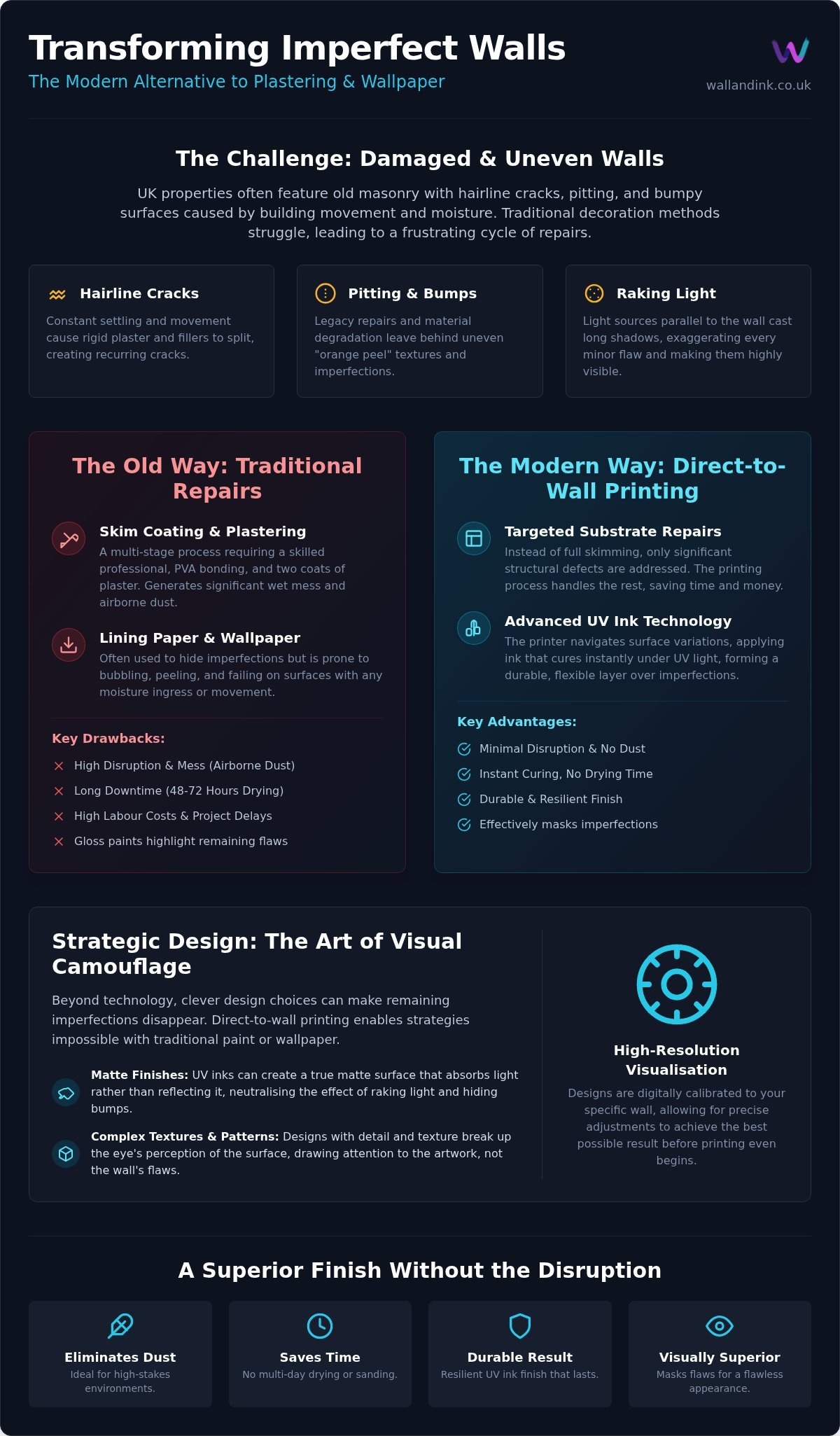
UK masonry often carries the weight of decades. The history of plasterwork shows that whilst the material is durable, it’s rarely static. Over time, buildings settle, moisture levels fluctuate, and historical repairs leave behind a legacy of unevenness amongst the original masonry. When property managers ask, can you print on uneven walls, they’re usually reacting to the visible failures of traditional decoration. These flaws often manifest as pitting, orange peel textures, or stubborn hairline cracks that refuse to stay hidden despite repeated painting.
Building movement is the primary culprit. As a structure shifts, the rigid plaster inevitably splits. Moisture ingress further complicates this, causing the substrate to expand and contract. In a residential setting, these imperfections feel like a constant maintenance burden. In a commercial environment, they project an image of neglect and poor standards. Understanding the difference between surface character (aesthetic flaws) and structural failure (subsidence) is the first step in any restoration project. True structural issues require engineering, but most walls simply suffer from age and poor historical maintenance.
Hairline Cracks vs. Structural Damage
Identifying the root cause of a crack is vital. A simple cosmetic flaw usually stays under 2mm in width. If a crack widens significantly or appears diagonally across window frames, it may signal subsidence rather than simple settling. Filling minor cracks is often a temporary measure. Because the building continues to move, traditional fillers will eventually crack again. This results in a recurring cycle of repair and failure. It’s a key reason why modern decision-makers ask: can you print on uneven walls? They want a decorative solution that doesn’t rely on brittle fillers or temporary patches.
The Problem with Bumpy Walls and Raking Light
The most significant enemy of an imperfect wall is raking light. This occurs when a light source sits parallel to the surface, casting long shadows into every pit and ridge. These shadows exaggerate minor bumps that would otherwise stay invisible. Achieving a “level 5” finish-the highest standard of smoothness-requires intense manual sanding and skim coating. It’s both expensive and messy. High-gloss paints act as a mirror for these defects. They reflect light off the peaks of the plaster, making even the smallest imperfection impossible to ignore. For a truly professional finish, you need a method that absorbs light rather than reflecting it.
Traditional Methods for Smoothing and Levelling Plaster
For decades, the default response to damaged plaster has been a total resurfacing. Property owners often assume they must revert to a blank canvas before any decoration can begin. Whilst these methods are well-established, they come with significant logistical burdens. When property owners ask can you print on uneven walls, they’re often weighing up the mess of a skim coat against the speed of a digital solution. Traditional repairs involve heavy-duty fillers or full replastering, both of which require extensive preparation and downtime.
The standard industry approach typically involves products like SmoothOver or traditional multi-finish plaster. These materials are designed to bridge gaps and create a level plane, but they’re only as good as the technician applying them. Manual application often leaves behind subtle ridges that only become apparent once the final decorative layer is applied. Beyond the material costs, the hidden expenses of traditional methods include multi-day labour and the inevitable professional cleaning required to manage the resulting debris.
Skim Coating: The Professional Gold Standard?
Skim coating is a multi-stage technical process. It begins with surface preparation and the application of a PVA bonding agent to ensure adhesion. A professional plasterer then applies two separate coats of finishing plaster. This requires a minimum of 48 to 72 hours of drying time before any paint can be applied. The primary drawback is the environmental impact within the building. Plastering generates significant wet mess and fine airborne dust that infiltrates HVAC systems and soft furnishings. In the current UK market, hiring a skilled plasterer also involves high labour costs and lead times that can delay a project by weeks.
Lining Paper and Traditional Wallpaper Constraints
Lining paper is frequently used to bridge minor cracks. It provides a uniform surface, but it isn’t a permanent solution. Over time, the adhesive can fail, leading to peeling at the seams or bubbling in humid environments. This is particularly common on old lime plaster found in period UK properties. If you’re looking for a high-end finish, traditional wallpaper often hides one problem whilst creating another. Similarly, vinyl graphics are notoriously unforgiving. Because vinyl is thin and flexible, it “telegraphs” every bump and pit underneath, actually highlighting imperfections rather than masking them. If you want to bypass these traditional hassles, exploring direct-to-wall printing offers a cleaner, more efficient alternative that works with your existing substrate.
Direct-to-Wall Printing: The Modern Disruptor for Uneven Surfaces
Direct-to-wall printing represents a fundamental shift in how we approach vertical surfaces. This technology bypasses the limitations of traditional media by applying ink directly to the existing substrate. It’s a technical solution designed for those who prioritise efficiency and precision. A primary concern for those managing older buildings is the substrate quality; specifically, can you print on uneven walls without the ink distorting? The answer lies in the sophisticated sensor technology of modern wall printers. These machines use ultrasonic sensors to detect surface variations in real time, adjusting the print head distance to maintain focus and clarity across minor undulations.
The mechanism relies on UV-curable inks. As the print head moves across the plaster, ultraviolet lamps follow immediately behind, curing the ink into a solid film. This process is superior to vinyl decals or traditional wallpaper because it eliminates the risk of adhesive failure. There are no seams to peel and no air pockets to bubble. The result is a high-resolution mural that integrates with the wall’s texture rather than fighting against it. It’s an industrial-grade application that treats the wall as a canvas, not just a support for a secondary layer.
The Technical Advantage of UV Ink on Substrates
UV-cured prints offer exceptional durability and scratch resistance. Once the ink is cured, it’s virtually permanent and can be cleaned without degrading the image. Unlike vinyl, which requires a perfectly flat “Level 5” finish to prevent peeling, UV ink adheres to the microscopic pits of the plaster. This creates a mechanical bond that’s far more resilient. Another critical factor for UK period properties is breathability. Traditional vinyl and some heavy wallpapers trap moisture behind the surface, leading to dampness and plaster degradation. Direct-to-wall printing allows the substrate to remain vapour-permeable, ensuring the long-term health of old lime plaster whilst delivering a modern aesthetic.
Eliminating the Mess Factor of Traditional Decor
The most immediate benefit of this method is the total absence of site debris. Traditional decoration requires a cycle of filling, drying, and sanding that produces fine dust. This dust can take weeks to fully clear from a building. Direct-to-wall printing is a clean, dry process. There is no airborne particulate matter and no chemical odour. This allows for the immediate use of the space post-installation; a retail unit or office can return to full operation the moment the machine is packed away. Digital alignment also ensures that graphics wrap precisely around architectural features or uneven corners, providing a level of accuracy that manual wallpapering simply cannot match.
Strategic Design: How to Use Visuals to Mask Surface Flaws
Digital printing isn’t just an application method; it’s a strategic tool for visual correction. Whilst the UV printer manages the physical undulations, the design itself performs the work of camouflage. Many clients ask, can you print on uneven walls without the imperfections showing through? The answer depends heavily on pattern choice and light management. Strategic design uses complex visuals to disrupt the human eye’s perception of depth, making physical ridges and pits virtually invisible. It transforms a liability into an aesthetic asset.
The choice of finish is equally critical. High-gloss finishes act as a mirror, reflecting light off every peak in the plaster and casting shadows into every trough. We recommend matte or satin finishes for imperfect substrates. These non-reflective surfaces diffuse light evenly across the wall, which effectively flattens the appearance of the substrate. By using trompe l’oeil effects, designs that create an illusion of three-dimensional space, we can even turn existing bumps into intentional textures. This might include the grain of weathered wood or the veins of natural stone, where the physical bump actually enhances the realism of the print.
Pattern Selection for Effective Camouflage
Organic, non-linear patterns are the most effective choice for problematic walls. Designs featuring botanical illustrations, abstract textures, or natural landscapes work with the wall’s character rather than fighting it. These complex visuals draw the focal point away from the substrate and onto the high-resolution detail of the print. Conversely, strict geometric grids and straight lines are the enemy of an uneven surface. When property managers evaluate can you print on uneven walls, they must consider how the eye tracks across the surface. If a wall is bowed or leaning, a straight horizontal line in the design will act as a level, immediately highlighting the structural deviation.
Lighting and Colour Theory for Uneven Surfaces
Colour choice plays a vital role in light diffusion. Darker, receding colours, such as deep navy, forest green, or charcoal, have the capacity to swallow minor shadows cast by surface pitting. Light, flat colours tend to reveal every variation in the plaster. Directional lighting, such as spotlights or wall-grazing lamps, can also be managed through design. We use digital visualisations to test how a specific mural will behave under your existing light conditions. This allows us to adjust the contrast and saturation of the artwork to ensure a flawless result before the machine arrives on site. To start your project, book a bespoke design consultation to see how these principles apply to your space.
The Wall & Ink Approach: Precision Printing on Every Substrate
Wall & Ink operates as a specialist partner for those managing complex or aged substrates across the UK. We understand that the primary concern for most property managers is the technical feasibility of the project. When you ask, can you print on uneven walls, you’re seeking a solution that bypasses the failures of legacy methods. Our end-to-end approach begins with a rigorous surface assessment. We evaluate the substrate’s integrity and texture to determine the optimal ink density and print head height. This pragmatic focus on the physical environment ensures that every mural we deliver meets our standards for industrial precision and visual clarity.
Bespoke Design and Digital Visualisation
Bespoke design at Wall & Ink involves more than simple image scaling. We technically adapt your logos or custom artwork to the specific geometry of the room. This process accounts for architectural quirks such as uneven corners, structural beams, and integrated services like sockets or vents. During the digital mock-up phase, we provide a precise visualisation of the final result. This allows you to verify the design’s interaction with the wall’s unique features before any ink is applied. By tailoring the mural to the specific architecture, we ensure a result that looks intentional and professional, regardless of the substrate’s original condition.
Professional Execution and Long-Term Durability
The on-site printing process is engineered for speed and cleanliness. Unlike the dusty, multi-day cycles of traditional plastering and painting, our machinery operates with minimal noise and zero debris. There’s no requirement for professional cleaning post-installation. The UV ink technology ensures that the mural is cured instantly, allowing the space to remain fully operational throughout the day. This is a critical advantage for commercial, educational, and hospitality sectors where downtime translates to lost revenue. Our technicians manage the entire setup, ensuring the printer navigates the wall with mechanical superiority.
Our murals are built for longevity. The UV-cured finish is highly scratch-resistant and can be cleaned with standard non-abrasive products without risk of degradation. Because the ink bonds mechanically with the plaster, it remains vapour-permeable, preventing the moisture traps that often lead to damp in older UK buildings. This combination of mechanical superiority and aesthetic precision makes our service a reliable choice for high-traffic environments. To see how we can transform your space, enquire about our national wall printing services today.
Modernising Your Approach to Damaged Plaster
The evolution of interior technology means that physical imperfections no longer dictate the quality of your finish. By moving away from the disruptive cycles of sanding and filling, you can achieve a high-resolution outcome that respects the architectural integrity of your building. We’ve explored how UV-cured ink technology and strategic pattern selection work together to resolve the question: can you print on uneven walls? This method provides a durable, vapour-permeable solution that traditional wallpaper and vinyl simply can’t match. It’s an efficient way to bypass the logistical burdens of traditional renovation whilst securing a result that lasts for years.
Choosing Wall & Ink ensures you benefit from our UK-wide professional installation and high-resolution UV ink technology. Every project starts with a bespoke design consultation included as standard, ensuring your mural is perfectly calibrated to your space. You don’t have to settle for the recurring cracks of the past when a modern, precision-engineered alternative is available.
Get a Bespoke Quote for Your Wall Project. Transforming your space into a professional masterpiece has never been more straightforward.
Frequently Asked Questions
Can you print directly onto old, cracked plaster?
Yes, we can print onto old plaster provided the substrate is structurally sound and the cracks are purely cosmetic. Our sensors adjust the print head in real time to navigate these minor imperfections without any loss of image clarity. If the plaster is blown or crumbling, it must be repaired first to ensure the UV ink has a stable surface to bond with for long-term durability.
Is direct-to-wall printing better than using lining paper?
Direct-to-wall printing offers significant technical advantages over lining paper by eliminating the risk of peeling seams, bubbling, or adhesive failure. Our UV ink technology creates a durable, scratch-resistant finish that integrates with the wall’s texture rather than masking it with a temporary layer. This provides a more permanent result whilst allowing the wall to remain vapour-permeable, which is essential for the health of older UK masonry.
How long does it take to print a full-scale wall mural?
Printing times depend on the dimensions and complexity of the artwork, but a standard feature wall is typically completed within a single working day. Because the UV ink cures instantly under ultraviolet lamps, the space is ready for immediate use the moment the printing process finishes. This efficiency minimises disruption to your home or business environment, making it a pragmatic choice for high-traffic areas that require a fast turnaround.
Do I need to sand my walls before you arrive to print?
Sanding is usually unnecessary for most projects as our technology is designed to work with the existing character of the substrate. When clients ask, can you print on uneven walls, they’re often relieved to learn that our process eliminates the dust and debris associated with traditional preparation. We only require the surface to be clean, dry, and free from loose debris or significant structural protrusions before our technicians begin the installation.
Is the UV ink used in wall printing safe for homes and schools?
Yes, the UV ink we utilise is specifically engineered for safety in sensitive environments like schools, hospitals, and residential spaces. The ink cures instantly during the printing process, which means there are no lingering chemical odours or harmful Volatile Organic Compounds (VOCs) released into the air. Our process meets rigorous indoor air quality standards, ensuring a vibrant finish that is safe for children and staff to be around immediately after completion.
How much does professional wall printing cost per square metre?
Pricing is calculated based on the total print area and the specific complexity of the surface material. We provide a transparent, project-based fee that covers the technical execution and the industrial-grade ink required for a durable finish. Every project is unique, so we recommend a bespoke consultation to receive an accurate quote. This approach ensures you only pay for the exact area covered, providing a cost-effective alternative to traditional methods with high labour costs.
What happens if the plaster wall has deep holes or missing chunks?
Deep holes or missing sections of plaster require filling and levelling before we can begin the printing process. Whilst our technology excels at navigating minor undulations and textures, it cannot bridge significant voids in the substrate. We recommend using a high-quality filler to bring these areas flush with the rest of the wall. Once the repair is dry and stable, we can print over it, using strategic design to ensure the patch remains invisible.
Can the printed mural be removed or painted over in the future?
Yes, the mural is a permanent finish that can be easily updated if your requirements change. The surface can be lightly sanded and painted over with a standard emulsion, just like any other decorated wall. There is no requirement for the laborious scraping or steaming associated with removing traditional wallpaper. This flexibility makes direct-to-wall printing a future-proof solution for properties that may require periodic rebranding or aesthetic updates without the traditional hassle.