
Traditional decorative methods often fail the very surfaces they’re meant to enhance. You’ve likely seen vinyl decals peeling away from textured masonry or thick paint layers that completely obscure the raw, industrial aesthetic you chose in the first place. Finding a permanent solution for porous substrates is notoriously difficult, especially when you want to preserve the material’s original character. However, modern innovations in printing on concrete walls have fundamentally changed the approach to large-scale murals and branding.
You’ll discover how advanced UV technology now enables high-definition, permanent digital printing directly onto raw concrete. This process ensures that your artwork looks like it’s part of the wall rather than just a layer on top of it. We’ll guide you through the technical advantages of instant UV curing, the benefits of a mess-free installation with no chemical odours, and how this method maintains the refined industrial finish required for professional environments. By the end of this guide, you’ll understand why direct-to-wall application is the reliable choice for durable, precision-engineered design in 2026.
Key Takeaways
- Learn how advanced UV curing technology enables permanent ink bonding through micro-penetration into masonry pores, ensuring your mural becomes a durable part of the substrate.
- Discover why printing on concrete walls is superior to vinyl decals, as it preserves the material’s natural breathability and prevents the common issues of bubbling or peeling.
- Identify the essential preparation requirements for raw concrete, including how to correctly assess for efflorescence and surface contaminants before printing begins.
- Understand the aesthetic advantages of digital UV application for maintaining a high-definition, industrial finish that respects the original character of the wall.
- Gain insights into the professional commissioning journey, covering everything from initial digital visualisations to national on-site delivery for commercial and residential spaces.
Why Concrete Presents a Unique Canvas for Modern Wall Printing
Direct-to-wall printing on concrete is a specialised digital UV ink application that transforms raw masonry into a high-definition display. Unlike 3D concrete construction methods, this technology focuses on the decorative and functional enhancement of existing vertical surfaces. The demand for high-quality printing on concrete walls has grown alongside the popularity of industrial-inspired architecture, where the texture of the building is celebrated rather than hidden. Whilst traditional signage often feels like an afterthought, modern mural techniques allow for a permanent integration of graphics that respects the substrate’s structural integrity.
The versatility of concrete makes it an ideal substrate for this process. We work with a variety of finishes, including:
- Smooth, polished concrete for a sleek corporate look
- Rough, shuttered textures that add depth to industrial designs
- Pre-cast panels with visible joints and bolt holes
- Weathered exterior masonry requiring durable, UV-stable finishes
The Aesthetic Appeal of Raw Masonry
Interior designers across the UK increasingly favour the exposed look for modern office environments. Printing on concrete walls allows for precise branding and bespoke artwork without obscuring the concrete’s natural grey tones or unique surface variations. In retail settings, the combination of cold industrial textures and vibrant digital ink creates a powerful psychological contrast. It signals a brand that is both grounded and forward-thinking. Because the ink is translucent in specific areas, the underlying character of the masonry remains visible, ensuring the mural feels like a part of the building’s history rather than a temporary sticker. This approach is particularly effective in large-scale commercial lobbies where traditional art might feel dwarfed by the architecture.
Overcoming the Challenges of Porous Surfaces
Concrete is a notoriously difficult surface to decorate using standard paints or vinyl. Its porous nature means that traditional liquids are often absorbed unevenly, leading to dull colours and blurred edges. Moisture absorption is another critical factor; it often causes conventional adhesives to fail, resulting in peeling or bubbling over time. UV wall printing is a non-contact digital process that cures ink instantly. This rapid curing prevents the ink from bleeding into the pores, maintaining sharp lines and intense saturation regardless of the wall’s thirst. It eliminates the mess of traditional methods whilst providing a scratch-resistant finish that withstands high-traffic environments.
The Technical Advantage: How UV Ink Bonds with Concrete Substrates
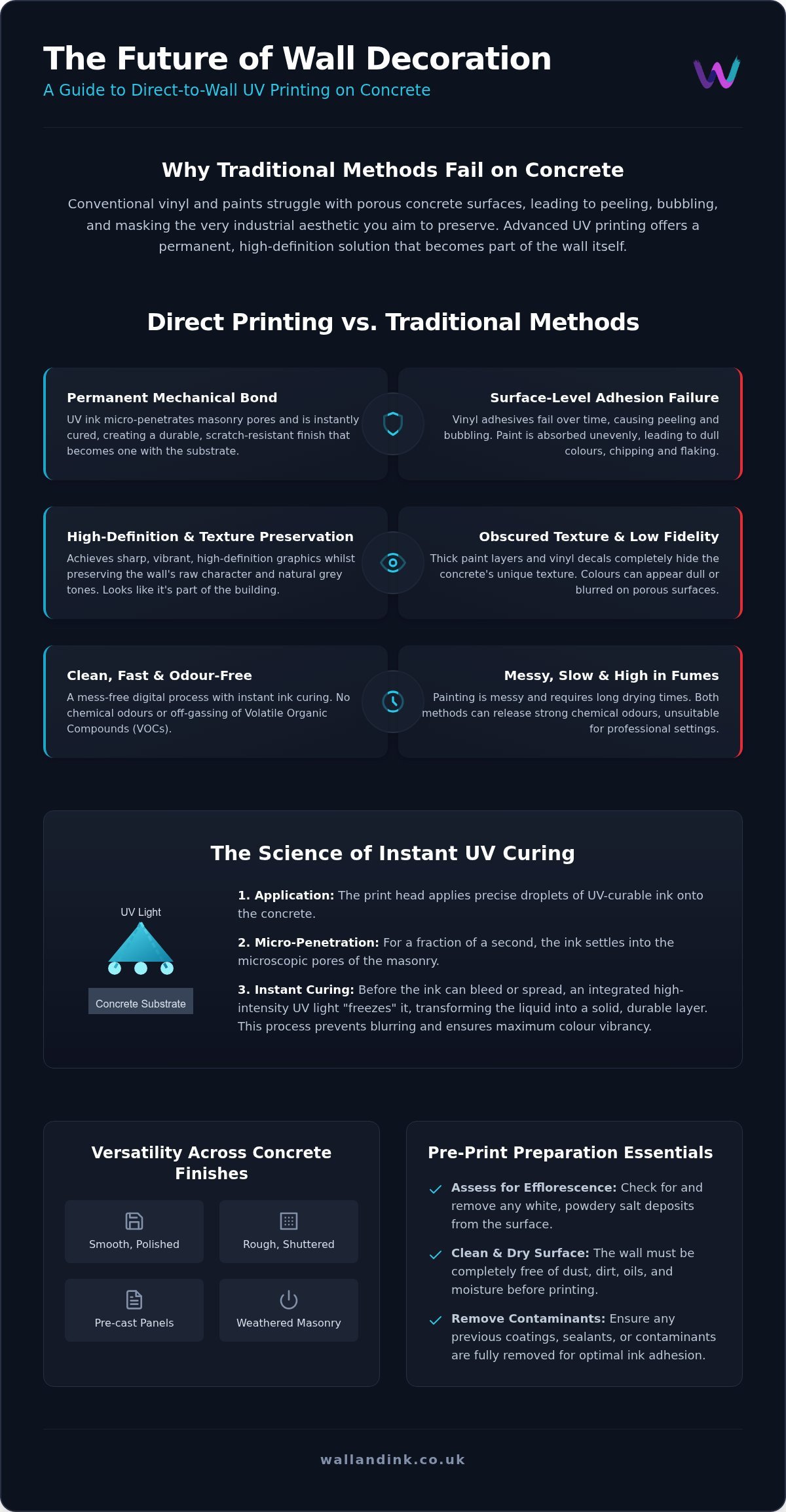
The reliability of printing on concrete walls depends entirely on the chemical transition of the ink. Unlike traditional paints that rely on slow evaporation, UV-curable inks undergo a near-instantaneous transformation from liquid to solid. This process is triggered by high-intensity ultraviolet light mounted directly on the print head. When the ink droplets hit the concrete, they don’t just sit on the surface; they achieve a level of micro-penetration into the masonry’s pores. Before the ink can bleed or blur, the UV light “freezes” it in place, creating a mechanical bond that is far superior to standard topical coatings.
The Science of Instant UV Curing
Modern UV-Curing Technology for Concrete ensures that the application remains crisp regardless of the substrate’s thirst. Traditional solvent inks often struggle with porous masonry because the liquid spreads through capillary action before it dries. Our process eliminates this issue. The instant curing also provides significant environmental benefits; because the ink solidifies immediately, there’s no off-gassing of Volatile Organic Compounds (VOCs). This makes the method ideal for professional environments where air quality and the absence of chemical odours are critical requirements.
Resolution and Colour Precision on Grey Tones
Achieving vibrant results on a neutral or dark grey background requires a specific layering strategy. Concrete naturally absorbs light, which can dull standard colours. To counter this, we utilise white ink under-printing. By applying a high-opacity white base layer first, we create a digital “canvas” that allows the subsequent CMYK colours to pop with their intended brilliance. This technique maintains high-definition detail at resolutions up to 2880 dpi, ensuring that even complex gradients and fine text remain legible against the rugged texture of the wall.
Concrete surfaces are rarely perfectly flat. Whether it’s a shuttered finish or a weathered exterior wall, the printer must account for physical irregularities. Our equipment uses advanced ultrasonic sensors to “track” the wall’s profile in real-time. This constant adjustment maintains a precise distance between the print nozzles and the substrate, preventing distorted images or mechanical collisions. If you’re planning a large-scale project, you can view our previous industrial murals to see how these technical details translate into high-quality visual results. The result is a scratch-resistant, lightfast finish that won’t fade under heavy UV exposure or peel away due to surface moisture.
Direct Printing vs Traditional Methods: A Comparative Analysis
Traditional decorative methods frequently struggle with the physical demands of raw masonry. Deciding between legacy applications and modern technology requires an understanding of how different materials interact with concrete’s porous, uneven surface. Whilst vinyl and wallpaper rely on external adhesives, printing on concrete walls creates a bonded finish that functions as part of the substrate itself. This fundamental difference in application dictates the long-term viability and aesthetic success of the installation.
Why Vinyl Struggles with Concrete Texture
Vinyl decals are fundamentally ill-suited for textured concrete. The mechanical failure of adhesives is common because the film cannot achieve 100% surface contact on pitted or shuttered masonry. This leads to “texture ghosting,” where the underlying concrete pattern creates unsightly bumps in the plastic, or “bridging,” where the vinyl spans across gaps and eventually punctures. In UK environments such as unheated warehouses or retail units, significant temperature fluctuations cause vinyl to contract and expand at a different rate than the wall. This thermal stress eventually leads to edge curling and peeling. Direct UV printing eliminates these failures by removing the plastic carrier entirely, leaving only the pigment behind.
Breathability and Moisture Management
Concrete is a “breathing” material that naturally regulates moisture. Traditional wallpaper and heavy vinyl wraps act as a vapour barrier, trapping dampness between the wall and the decorative layer. This often results in mould growth or adhesive rot, particularly on exterior-facing walls. UV-curable ink is applied as a series of microscopic dots. This pattern maintains the substrate’s natural breathability, allowing moisture to pass through without compromising the art. It’s a technical requirement for maintaining the structural health of the building whilst achieving high-end visual results.
Maintenance and Longevity Comparison
Durability is a primary concern for pragmatic decision-makers. Hand-painted murals are often fragile and difficult to clean without damaging the pigment. In contrast, our UV-curable inks are scratch-resistant and wipeable, making them ideal for high-traffic environments like school corridors or hospitality venues.
- Installation Cleanliness: No messy glues, no sanding dust, and no lingering chemical odours.
- Cost-Effectiveness: UV printing avoids the 3-5 year replacement cycle common with vinyl, offering a stable 10-year lifespan in most interior settings.
- Reversibility: If branding changes, the art can be painted over with standard masonry paint or removed via professional abrasion without leaving sticky residue.
The process is designed for efficiency. We provide a professional alternative that avoids the traditional hassles of peeling edges and moisture traps. By choosing an integrated digital solution, you ensure that your investment remains intact for the life of the interior design rather than failing due to predictable mechanical weaknesses.
A Practical Checklist for Preparing Concrete Walls for Digital Art
Professional preparation is the foundation of any successful project involving printing on concrete walls. Unlike traditional coatings that often require aggressive acid etching, our digital process demands a clean, stable, and dry environment. You must first assess the surface for loose particles, oils, or formwork release agents that could prevent the UV ink from achieving a permanent bond. A simple touch test can reveal if the concrete is “dusting,” which may indicate the need for a stabilising treatment.
Pay close attention to efflorescence. These white, powdery salt deposits occur when moisture moves through the masonry and evaporates at the surface. If left untreated, these salts can eventually push any coating off the wall from behind. Whilst dry-brushing or vacuuming is usually sufficient for interior surfaces, the source of any underlying moisture must be addressed to ensure the long-term durability of the mural.
Surface Preparation for Optimal Adhesion
Cleaning doesn’t require heavy industrial machinery. A thorough wipe-down with a lint-free cloth and a mild degreaser often suffices for most professional environments. If the concrete is particularly porous, a clear water-based sealer can be applied to stabilise the surface. However, we often recommend printing directly onto raw concrete to maintain the authentic “industrial chic” aesthetic. Any existing loose paint or failing decals must be mechanically removed to provide a sound substrate for the new digital art.
Digital Visualisation and Design Adaptation
The physical characteristics of the wall, such as shuttering lines, bolt holes, and colour variations, should be integrated into the design rather than ignored. We provide bespoke digital mock-ups that overlay your artwork onto a photograph of the actual surface. This allows you to choose between a “faded industrial” look, where the concrete’s grey tones show through the ink, or a “vibrant modern” finish using a high-opacity white base layer.
Digital visualisations help organise the project before a single drop of ink is laid. This step ensures that critical elements of the graphic don’t clash with structural features like expansion joints or electrical conduits. It’s a vital part of our precision-led workflow. If you’re ready to see how your design will look on your specific surface, you can request a digital mock-up to begin the process. Our team will ensure the final output respects both the architecture and your branding requirements.
Commissioning Your Custom Concrete Mural with Wall & Ink
Commissioning a professional mural requires a partner who understands the mechanical nuances of masonry. At Wall & Ink, our end-to-end process is designed for clarity and precision. We begin with a bespoke design consultation to ensure your branding or artwork is correctly adapted for the specific texture of your wall. This is particularly vital for logos, where subtle adjustments in opacity or line weight can make the difference between a graphic that looks “stuck on” and one that feels integrated into the architecture. It’s this level of technical foresight that makes our technology the preferred choice for architects across Britain who require reliable, high-spec finishes.
National Reach and Professional Installation
Our commitment to efficiency means we provide a national UK service that fits into your operational schedule. Printing on concrete walls is a remarkably clean process. Unlike traditional painting or wallpapering, there is no sanding dust, no adhesive spillages, and no lingering chemical smells. This allows us to work within active office or retail environments without causing disruption to your staff or customers. Most of our commercial murals are completed in a single day, providing a rapid transformation that legacy methods simply cannot match. We arrive with all necessary equipment, execute the digital print, and leave the site as clean as we found it.
Transforming Spaces: From Warehouses to Living Rooms
The applications for direct-to-wall UV printing are as varied as the concrete itself. For industrial clients, we frequently execute large-scale branding on exterior concrete facades, providing a durable alternative to metal signage that won’t rust or rattle in high winds. In the residential sector, we specialise in creating sophisticated feature walls for modern loft apartments and open-plan living areas. These projects often focus on maintaining the “raw” feel of the substrate whilst adding a bespoke artistic layer. Whether you are managing a national retail rollout or a private renovation, our technology delivers a precision-engineered result.
Before the first drop of ink touches your wall, we ensure every detail is perfect. If you’re ready to see the potential of your masonry, Contact Wall & Ink for a bespoke digital visualisation of your concrete wall. This digital mock-up provides the transparency you need to make an informed decision, ensuring the final installation meets your exact technical and aesthetic standards.
Advancing Your Architectural Design with Precision Printing
Digital UV technology has redefined how we approach decorative masonry. By choosing a method that bonds directly with the substrate, you avoid the inevitable peeling and moisture traps associated with legacy vinyl applications. This process ensures that your branding or artwork remains a permanent, high-definition feature that respects the raw, industrial character of the building. The result is a scratch-resistant and UV-stable finish that withstands the rigours of commercial and residential environments alike.
Our approach focuses on technical reliability and operational efficiency. We provide a no-mess, dust-free installation that can be completed in a single day, ensuring your project progresses without the traditional hassles of chemical odours or lengthy drying times. With our national UK coverage and bespoke design consultations, we’re ready to help you integrate precision graphics into any concrete surface. If you’re looking for a durable, high-spec solution for printing on concrete walls, we have the expertise to deliver it.
Enquire about our UK-wide concrete wall printing services to start your project. We look forward to helping you transform your space with industrial precision.
Frequently Asked Questions
Can you print on rough or textured concrete walls?
Yes, our technology is specifically designed for textured surfaces. The printer uses advanced ultrasonic sensors to track the physical profile of the wall in real-time, maintaining a precise distance between the nozzles and the masonry. This prevents image distortion on rough or shuttered finishes. Unlike vinyl, which often bridges gaps or bubbles on uneven masonry, the digital ink follows every contour to create a mural that looks like it is part of the structure.
How long does a printed mural last on an exterior concrete surface?
Longevity is a primary advantage of UV-curable ink. These pigments are highly lightfast and scratch-resistant, making them ideal for the variable UK climate. Whilst interior murals can last for over a decade, exterior durability depends on the specific exposure to environmental factors. The ink achieves a mechanical bond with the concrete pores, ensuring it won’t peel or flake away over time. We provide specific maintenance guidance based on your project’s location and substrate type.
Is the ink used for wall printing eco-friendly and safe for indoor use?
The inks used in our process are safe for all indoor environments, including schools and healthcare facilities. Because the UV light cures the ink instantly, there is no off-gassing of Volatile Organic Compounds (VOCs). This eliminates the lingering chemical odours associated with traditional paints or adhesives. The process is entirely dust-free and no-mess, allowing for professional installation in occupied offices or residential spaces without compromising air quality or requiring lengthy ventilation periods.
Do I need to prime my concrete wall before you arrive to print?
In most cases, no priming is required for printing on concrete walls. We prefer to work with raw masonry to maintain the authentic industrial aesthetic. However, the surface must be clean, dry, and free from loose particles or oils. If the concrete is excessively porous or “dusting,” we may recommend a stabilising sealer. We assess these requirements during the initial consultation to ensure the substrate is technically sound before the printing process commences.
Can the printed art be removed from the concrete if we move offices?
Printed art is designed for permanence, but it can be removed or updated if your branding requirements change. Because the ink bonds with the masonry pores, it cannot be peeled away like a sticker. The most efficient removal method is to simply paint over the mural using a high-quality masonry paint. Alternatively, professional abrasive cleaning can be used to return the concrete to its original state without leaving the adhesive residue common with traditional vinyl signage.
How much does it cost to print a custom mural on a concrete wall?
We operate with a transparent pricing structure based on the total square footage of the print area. The complexity of the surface material and the requirement for bespoke design services also influence the final project fee. Because we provide an end-to-end service including digital visualisations and professional installation, our quotes are comprehensive with no hidden costs. This allows pragmatic decision-makers to budget accurately for high-quality, durable murals without the need for multiple contractors.
What is the maximum size of mural you can print on a masonry surface?
Our printing system is modular, meaning there is no practical limit to the width of a mural. The printer moves along a precision rail, allowing us to cover expansive warehouse walls or long retail facades in a single, continuous pass. Vertical height is typically governed by the height of the printer’s mast, though we can organise larger projects by printing in aligned sections. This versatility ensures we can accommodate both small residential feature walls and large-scale commercial installations.
Does the printer work on curved or uneven concrete walls?
Uneven vertical surfaces are managed by real-time sensors that adjust the print head’s position. For printing on concrete walls with a horizontal curve, the feasibility depends on the radius of the curve and the ability to position the floor-based tracks. We evaluate these structural details during the digital visualisation phase to prevent image distortion. If the curve is within our machine’s tolerances, we can achieve a seamless finish that maintains high-definition detail across the entire concrete surface.