
Why settle for the inevitable peeling seams and generic patterns of mass-produced wallpaper when your home could feature an industrial-grade, high-resolution masterpiece printed directly onto the substrate? You likely recognise the frustration of traditional decorating: the adhesive mess, the bubbles that refuse to flatten, and the disappointment when a piece of residential wall art doesn’t quite fit the proportions of your room. It’s a compromise that pragmatic homeowners have tolerated for decades, but the technology has finally caught up with your expectations.
We’re here to show you how innovative direct-to-wall printing technology is revolutionising home decor by replacing fragile paper with durable, UV-cured bespoke art. This 2026 guide explores the precision of digital application and the elimination of traditional installation hassles. We’ll examine the technical superiority of UV-curable inks, the practicalities of modern application, and how this seamless method ensures your chosen design is perfectly scaled to your specific environment.
Key Takeaways
- Learn how UV-cured ink technology ensures instant drying and long-term durability on almost any domestic substrate.
- Discover why bespoke residential wall art is replacing mass-produced prints by offering perfectly scaled, high-resolution imagery integrated into your home.
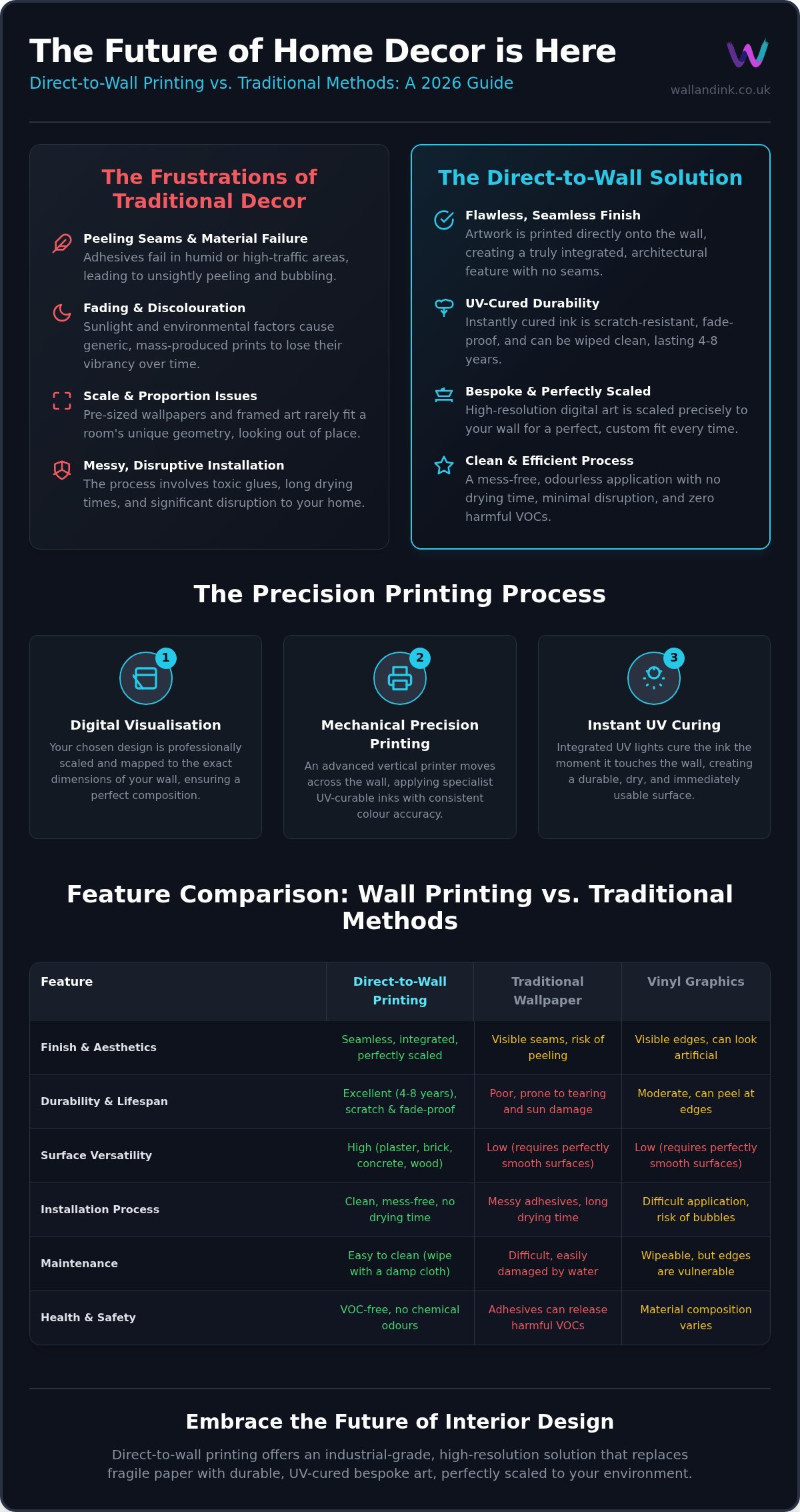
- Compare the seamless finish of direct-to-wall printing against traditional wallpaper and vinyl to understand why eliminating seams prevents common failures.
- Understand the importance of digital visualisation and professional consultation in achieving a precise, mess-free installation.
- Explore the technical shift towards industrial-grade precision that delivers a professional aesthetic with minimal disruption to your daily routine.
Beyond the Frame: The Evolution of Residential Wall Art
Modern interior design has moved beyond the constraints of the picture frame. Residential wall art is no longer a secondary decorative layer; it’s an architectural component that defines the character of a living space. While the history of mural painting demonstrates a long-standing desire to integrate art into our environment, the methods used to achieve this have changed. We’ve shifted from mass-produced prints that lack scale to bespoke, integrated murals that respect the specific geometry of a room.
Pragmatic homeowners now prioritise technical reliability alongside aesthetics. They’re moving away from generic solutions in favour of customisation that reflects personal identity through digital precision. This evolution is driven by a need for durability and a professional finish that traditional methods simply cannot replicate in high-traffic domestic areas.
The Limitations of Traditional Decor
Traditional decorating methods carry inherent technical flaws that compromise the longevity of a feature wall. Wallpaper, for instance, is vulnerable to environmental factors. You’ve likely seen the common failures: peeling seams, air bubbles, and gradual fading from sunlight. These issues aren’t just aesthetic; they’re signs of material degradation. Framed art presents a different set of challenges. It often feels disconnected from the room’s architecture, and finding a piece that fits the exact scale of a unique space is an inefficient process. Common pain points include:
- Material failure: Adhesives in wallpaper often fail in humid or high-traffic zones.
- Scale issues: Pre-sized frames often look undersized on large feature walls.
- Maintenance: Traditional paper is difficult to clean without risking damage to the surface.
What is Direct-to-Wall Printing?
Direct-to-wall printing is an industrial process that applies high-resolution imagery directly onto a substrate. It’s a technical departure from hand-painted murals or vinyl decals. Using advanced UV-curable inks, the printer moves across the wall surface, curing the ink instantly with ultraviolet light. This creates a bond that is both durable and scratch-resistant. Unlike traditional painting, which relies on the manual skill and speed of an artist, this method ensures mechanical precision and consistent colour accuracy. It’s a mess-free alternative that eliminates the need for toxic glues or long drying times, making it the superior choice for modern residential wall art projects.
The Technology Behind High-Resolution Direct-to-Wall Art
The transition from industrial applications to residential wall art requires a level of mechanical precision that traditional methods cannot match. At the core of this shift is UV-curable ink technology. Unlike standard inkjet printing or manual painting, which rely on evaporation or absorption, UV printing uses ultra-violet light to harden the ink the moment it touches the wall. This chemical reaction creates a permanent bond with the surface, ensuring the image remains sharp and vibrant for years.
UV Ink: Durability and Safety
Safety is a primary concern for homeowners, particularly when decorating nurseries or bedrooms. Traditional paints and wallpapers often release volatile organic compounds (VOCs) for days after installation. UV-cured ink eliminates this issue. Because the curing process is instantaneous, there’s no drying time and no residual chemical odour. The result is a surface that’s immediately safe to touch and live around. It’s a clean, efficient solution for those who value both health and high-quality aesthetics.
Durability is another significant advantage. UV prints are engineered to withstand the rigours of daily home life. They’re inherently scratch-resistant and fade-proof, maintaining their integrity even in rooms with high levels of natural light. Verified industry data indicates that UV-cured prints on interior walls typically last between 4 and 8 years under normal conditions without requiring specialised maintenance. You can simply wipe the surface with a damp cloth to remove dust or fingerprints, making it a highly practical solution for high-traffic areas like hallways or kitchens.
Printing on Diverse Substrates
One of the most impressive aspects of this technology is its versatility across different materials. The vertical printing mechanism is designed to maintain consistent distance and pressure, whether the substrate is smooth plaster or textured brick. This capability allows for the creation of bespoke residential wall art on surfaces that were previously considered difficult to decorate, such as:
- Exposed brickwork and concrete
- Natural wood panels
- Glass and acrylic partitions
- Standard painted plasterboard
The precision of the printer ensures that even on uneven surfaces, the resolution remains high. This is essential for maintaining the impact of complex designs or photographic murals. By using high-resolution digital files, the technology captures every detail with industrial-grade accuracy, providing a level of depth and clarity that hand-painted alternatives often struggle to achieve. Every drop of ink is placed with mathematical certainty, ensuring your chosen artwork is reproduced exactly as intended.
Comparing Direct Printing, Wallpaper, and Vinyl Graphics
Selecting the right medium for residential wall art requires a pragmatic assessment of aesthetic finish, durability, and installation efficiency. Traditional wallpaper and vinyl graphics have served as the industry standard for decades, yet they carry inherent technical limitations. Direct-to-wall printing disrupts these legacy methods by offering a seamless application that eliminates the structural vulnerabilities of adhesive-based products.
The aesthetic difference is immediate. Wallpaper is restricted by panel widths, inevitably creating visible seams that can disrupt complex patterns. In contrast, UV printing creates a continuous, high-resolution image across the entire substrate. Installation time also varies significantly. Whilst a professional wallpaper installation can span several days and involve significant mess, direct-to-wall projects are often completed in under 5 hours. This efficiency reduces disruption to your home life whilst delivering a superior, industrial-grade result.
Direct-to-Wall vs. Traditional Wallpaper
Wallpaper often fails in humid environments or high-traffic zones because the adhesive is susceptible to moisture. This leads to the “peeling corner” problem, where edges lift and collect dust. Direct-to-wall printing removes this risk entirely. The UV-cured ink bonds directly to the plaster, wood, or brick, creating a surface that doesn’t peel or bubble. When it’s time to redecorate, you don’t need to endure the laborious process of stripping paper and steaming walls. You simply paint over the mural and start again, making it a more cost-effective solution over the life of your interior design.
Direct-to-Wall vs. Vinyl Decals
Vinyl graphics are often perceived as a temporary solution, and their appearance reflects this. They sit on top of the wall, creating a “stuck on” look that lacks the depth of integrated art. Direct-to-wall printing provides a “painted on” aesthetic that respects the texture of the underlying substrate. Beyond the visual impact, there are health and maintenance considerations. Vinyl is a non-breathable plastic layer that can trap moisture against the wall. UV-cured ink allows the surface to breathe, maintaining the health of the building fabric whilst offering a scratch-resistant finish that is far more durable than adhesive-backed vinyl. It’s a professional choice for those who prioritise long-term reliability over temporary fixes.
Planning Your Bespoke Mural: A Step-by-Step Design Process
Unlike purchasing mass-produced prints from high-street retailers, creating bespoke residential wall art involves a structured technical consultation. This stage ensures the artwork is not just a decorative layer but an integrated part of the room’s architecture. We start by assessing the wall substrate and identifying architectural features such as doors, windows, or alcoves that require precise scaling. The first step involves a technical assessment of the substrate. We examine the wall surface to ensure it’s stable and clean, as this is vital for the UV-cured ink to bond correctly. Whether you’re dealing with a standard plasterboard wall or an exposed brick feature, the preparation is minimal compared to the stripping and sanding required for traditional wallpaper.
Digital Visualisation and Mock-ups
This is the critical phase where we eliminate guesswork. By using digital visualisation, you can see exactly how the mural will look in your specific room before any ink is applied. We adjust the composition to ensure the focal point isn’t obscured by furniture or interrupted by architectural features like light switches. Colours are calibrated to complement your existing interior palette. This methodical approach ensures the final result is a perfect fit for your space, avoiding the common disappointment of generic artwork that feels out of proportion. It’s about achieving a level of precision that “off-the-shelf” solutions simply can’t provide.
The Printing Day: What to Expect
On the day of installation, the process is efficient and clean. The direct-to-wall printer is calibrated on-site to account for the specific texture and level of the wall. During the calibration phase, laser sensors on the printer track the wall’s contours. This ensures the print head maintains a consistent distance from the surface, even if the wall isn’t perfectly flat. It’s this level of industrial precision that allows us to deliver high-resolution residential wall art that remains sharp across the entire span of the mural.
Unlike wallpapering, which requires clearing the room and protecting every surface from adhesive paste, our UV technology is a clean, dry solution. There are no toxic glues and no drying times. The equipment is compact, allowing us to work in tight spaces with minimal disruption. Installations are often completed in under 5 hours, and because the ink cures instantly, you can resume using the room immediately. To start your project, you can book a bespoke design consultation with our specialist team.
Transforming Your Home with Wall & Ink’s Specialist Service
Wall & Ink operates as a specialist disruptor in the UK home decor market. We provide a technical solution to the aesthetic and functional failures of wallpaper and vinyl. By choosing an end-to-end design and print service, you eliminate the risks associated with multi-vendor projects. We manage every stage, from the initial digital visualisation to the final UV-cured application. This ensures that the mechanical precision of our equipment is matched by the quality of the artwork. Our service is designed for pragmatic decision-makers who value efficiency and high-quality results.
Bespoke Design Expertise
Our process centres on collaboration. We work with you to develop one-of-a-kind imagery that reflects your personal style whilst adhering to professional standards. If you have high-resolution photography, our team can transform these files into wall-sized murals without losing clarity or depth. Professional creative direction is a vital component of our service. We don’t simply print images; we ensure they are scaled and positioned to enhance the architectural features of your specific home. This level of technical oversight prevents the common errors found in self-service decorating. We help you curate a space that reflects your personal story with a level of authenticity that mass-produced products cannot achieve.
National Service and Reliability
Reliability is built into our operational model. We offer national UK coverage, bringing industrial-grade direct-to-wall technology to private residences across the country. Our reputation is based on transparency and measurable results. We lead with clear processes and technical justifications for every step of the installation. This authoritative approach provides the reassurance that your residential wall art project is in the hands of hands-on specialists. You aren’t just buying a mural; you’re investing in a durable architectural element that is easy to clean and resistant to the wear of daily life. Our “no-mess” promise ensures that your home remains a functional living space throughout the process.
Starting your project is a straightforward process. We value your time and operate with radical honesty regarding costs and timelines. If you’re ready to move beyond the limitations of traditional decor and embrace modern precision, we invite you to take the first step. Contact Wall & Ink for a bespoke residential consultation today to discuss your specific requirements and see how we can transform your interior surfaces.
Future-Proofing Your Home Interior with Direct-to-Wall Precision
Direct-to-wall printing represents a fundamental shift in how we approach domestic environments. By moving away from the structural failures of traditional wallpaper and the temporary nature of vinyl, you can now achieve industrial-grade durability previously reserved for commercial spaces. Advanced UV printing technology delivers high-resolution, scratch-resistant results that bond directly to your walls, ensuring your investment remains vibrant for years. This methodology ensures that your chosen residential wall art is a permanent architectural feature rather than a fragile decorative layer.
The integration of bespoke digital visualisation ensures that every project respects the unique architecture of your room; this eliminates the scaling errors common with off-the-shelf products. This methodical approach delivers a seamless finish without the mess associated with legacy decorating methods. Whether you’re looking to create a single feature wall or a comprehensive interior theme, our specialist service provides the technical reliability you require.
Wall & Ink offers national UK-wide installation, bringing this innovative application method to your doorstep with expert precision. Book your bespoke residential wall art consultation with Wall & Ink and take the first step toward a more durable and personalised living space.
Frequently Asked Questions
Can you print on any wall surface in a residential home?
UV printing technology is compatible with almost any domestic substrate. This includes standard painted plasterboard, exposed brickwork, natural wood panels, and glass partitions. The vertical printing mechanism uses sensors to track the wall’s contours; this allows the machine to maintain a consistent distance even on textured surfaces. As long as the substrate is stable and clean, the ink will bond effectively to create high-resolution residential wall art.
Is direct-to-wall printing more durable than traditional wallpaper?
Direct-to-wall printing offers superior durability compared to traditional wallpaper. Because the UV-cured ink bonds directly to the substrate, it eliminates common failure points like peeling seams or air bubbles. The resulting surface is scratch-resistant and fade-proof, maintaining its integrity for 4 to 8 years in typical indoor conditions. Unlike wallpaper, which can degrade in humid environments, this industrial-grade application remains stable and easy to maintain over the long term.
How long does it take to print a residential wall mural?
Most residential projects are completed in under 5 hours. The speed of installation depends on the total square footage and the complexity of the design, but the mechanical process is significantly faster than traditional decorating. Because the UV ink cures instantly under ultraviolet light, there’s no drying time required. You can resume using the room immediately after the final pass, making it a highly efficient solution for busy households.
Is the UV ink used in wall printing safe for children’s bedrooms?
UV-cured ink is an exceptionally safe choice for nurseries and children’s bedrooms. The curing process is a chemical reaction triggered by UV light that hardens the ink instantly; this means there’s no evaporation of solvents and no release of volatile organic compounds (VOCs). Unlike traditional paints or adhesives that can emit chemical odours for several days, this method is odourless and safe for immediate occupation once the printing process concludes.
Can I use my own photographs for a bespoke wall mural?
You can certainly use your own high-resolution photographs to create a bespoke mural. Our design team provides a consultation service to assess the quality of your digital files and ensure they’re suitable for large-scale reproduction. We specialise in adapting personal imagery into professional residential wall art, ensuring the composition is correctly scaled to fit your architectural space. This process includes digital visualisation so you can see the result before installation begins.
What happens if I want to change the art or paint over it in the future?
Updating your decor is a straightforward process that involves simply painting over the existing mural. Because the ink layer is incredibly thin and bonds flush with the substrate, it doesn’t create a thick or uneven profile on the wall. You don’t need to endure the mess of stripping wallpaper or steaming off old adhesives. Once you apply a standard primer or base coat, the wall is ready for a new colour or a different printed design.
Does the wall require special preparation before printing?
Preparation is minimal and focuses on ensuring the surface is clean, dry, and structurally sound. We recommend that walls are finished with a standard emulsion and are free from loose debris or cracks. Unlike wallpapering, which often requires extensive sanding and priming to hide imperfections, the precision of the UV printer can accommodate minor textures. Our technical team will assess the wall during the initial consultation to confirm it meets the required standards.
How do I clean a direct-to-wall printed mural?
Cleaning a printed mural requires nothing more than a soft, damp cloth. The UV-cured ink creates a durable, non-porous surface that’s resistant to moisture and light abrasion. You can easily remove dust or fingerprints without worrying about smudging the ink or damaging the artwork. This low-maintenance quality makes it a practical choice for high-traffic areas like hallways or kitchens where traditional wallpaper or hand-painted murals might be susceptible to staining or wear.