
The most expensive mural you’ll ever buy is the one you have to replace after a single British winter. It’s frustrating to watch a significant investment in outdoor branding or decor succumb to the elements. You’ve likely seen the common failures of traditional methods: vinyl decals peeling at the edges, wallpaper bubbling due to damp, and colours that fade under UV exposure until the original vision is unrecognisable. We agree that constant maintenance shouldn’t be the price of high-quality aesthetics.
This article explores the science behind truly weather resistant murals and demonstrates how direct-to-wall UV printing technology eliminates these common failure points. You’ll discover how to achieve a permanent, professional finish directly on brick or render that remains vibrant for years without the need for frequent replacements. We’ll break down the mechanical superiority of UV-cured inks and explain why removing the substrate layer entirely is the only way to ensure long-term durability in the UK’s unpredictable climate.
Key Takeaways
- Understand why traditional wallpaper and vinyl fail in the British climate due to adhesive degradation and moisture-induced bubbling.
- Discover the science of direct-to-wall UV printing and how it creates permanent weather resistant murals by bonding ink directly to the surface.
- Learn how to achieve a professional finish on challenging exterior substrates like brick and render while preserving the natural texture of the building.
- Compare the long-term durability and maintenance requirements of direct-to-wall applications against legacy alternatives like vinyl decals.
- Explore the bespoke design and digital visualisation process that ensures your large-scale outdoor artwork is perfectly adapted for its environment.
Why Traditional Wall Murals Fail in British Weather
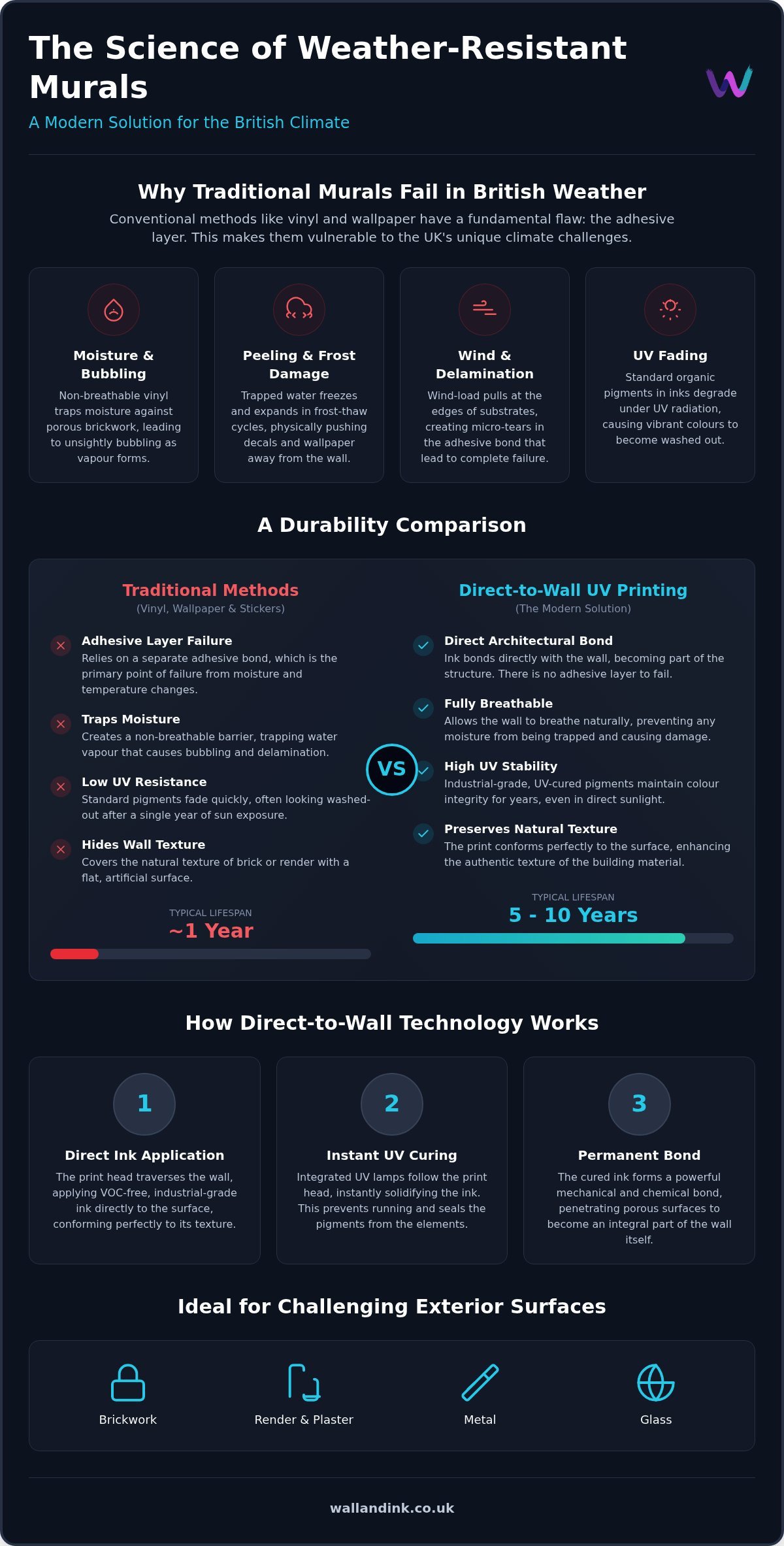
Traditional outdoor decorations often fall victim to the specific demands of the UK environment. Whilst products like “waterproof” wallpaper or heavy-duty vinyl decals are marketed as exterior solutions, they possess a fundamental mechanical flaw: the adhesive layer. These materials rely on a bond between a substrate and the wall, creating a vulnerability that the British weather exploits with precision. True weather resistant murals require a different approach that removes this secondary layer entirely.
Exterior masonry, such as brick or render, is naturally porous. It needs to breathe. When you apply a non-breathable vinyl sticker, you trap moisture behind a plastic barrier. As temperatures fluctuate, this moisture turns to vapour, creating the unsightly “bubbling” effect that ruins the professional finish. Standard stickers simply cannot conform to the deep textures of exterior masonry, leaving gaps where water and frost can accumulate. During frost-thaw cycles, this trapped water expands, physically pushing the material away from the wall and leading to total failure.
The Problem with Adhesives and Humidity
Humidity and rain are constant factors in the UK. When moisture penetrates the edges of a vinyl decal, it begins a process of delamination that is impossible to reverse. Traditional wallpaper paste, even those rated for exterior use, eventually breaks down under the persistent damp found in British winters. Beyond chemical failure, these materials face physical stress. Wind-load acts on the surface of a hanging or sticker, pulling at the edges and creating micro-tears in the adhesive bond. Once the seal is broken, the mural’s lifespan is effectively over.
UV Fading: Why Standard Pigments Lose Vibrancy
A mural must withstand more than just rain; it must resist the sun. Standard printer inks often rely on organic pigments that degrade rapidly when exposed to ultraviolet radiation. You’ve likely seen murals that look vibrant in June but appear washed out by the following spring. It’s a common misconception that “waterproof” means “sun-proof”. Without the industrial precision of UV-stable inks, high-exposure facades quickly lose their aesthetic impact. The result is an aesthetic decline amongst high-traffic areas, turning what should be a brand asset into a maintenance liability that requires frequent, costly replacement.
The Technology Behind UV-Stable and Weather Resistant Murals
Direct-to-wall UV printing represents a shift from decorative overlays to architectural integration. Unlike fabric or wallpaper, which sit on top of a surface, this technology applies industrial-grade ink directly to the substrate. This process creates weather resistant murals that function as part of the building itself rather than an external attachment. By removing the need for a secondary material layer, we eliminate the risk of peeling, tearing, or adhesive failure.
The ink establishes a powerful chemical bond with various materials. On porous surfaces like brick or render, the ink penetrates the micro-fissures of the wall to create a permanent anchor. On non-porous surfaces like glass or metal, it forms a high-tension surface grip. This mechanical superiority ensures the artwork cannot be caught by the wind, which is a common failure point for the fabric alternatives often found in the market. This results in truly weather resistant murals that withstand the physical stress of high-traffic outdoor environments.
We utilise VOC-free UV inks, which are essential for maintaining air quality in public or school environments. These inks don’t off-gas, making them a responsible choice for both indoor and outdoor applications. The final finish is exceptionally hard-wearing and resists scratches, meaning the mural can handle the occasional physical contact typical of retail or hospitality settings without losing its professional appearance.
The Science of Instant UV Curing
The core of this precision lies in the curing process. As the print head traverses the wall, integrated UV lamps follow immediately behind, using specific light frequencies to solidify the ink in milliseconds. This instant transition from liquid to solid prevents the ink from running or smudging, ensuring sharp lines even on uneven surfaces. This rapid cure also seals the pigments against oxidation, which is the primary cause of ink degradation in standard printing methods.
Long-Term UV Stability
Durability is built into the ink’s molecular structure. Standard dyes break down under sun exposure, but our UV-stable pigments are designed to maintain colour integrity for 5 to 10 years in typical British exterior conditions. These pigments reflect ultraviolet light rather than absorbing its energy, which prevents the fading that plagues traditional signage. If you are planning a high-impact facade, our exterior wall printing services provide the technical assurance that your investment will remain vibrant through years of direct exposure.
Comparing Durability: Direct-to-Wall Printing vs. Vinyl and Wallpaper
When evaluating the longevity of outdoor art, the comparison between direct-to-wall printing and legacy methods reveals a significant gap in performance. Vinyl decals, whilst low-cost, are essentially temporary stickers. They sit on the surface, creating a visible edge that is prone to lifting. In contrast, weather resistant murals created via direct-to-wall printing follow the exact contour of the masonry. This isn’t just an aesthetic preference; it’s a structural advantage. Without an edge to catch the wind or a surface to trap moisture, the artwork remains stable.
Traditional hand-painted murals offer a bespoke feel but lack the industrial precision and speed of digital execution. A direct-to-wall printer reproduces complex gradients and fine details that would take a human artist weeks to complete. This reduces time-on-site and ensures the final result matches the digital visualisation exactly. Over a five-year period, the cost-benefit analysis heavily favours the direct-to-wall method. While the initial investment might be higher than off-the-shelf vinyl, the absence of replacement costs makes it the more efficient choice. If a vinyl mural fails after 18 months due to edge-peeling, the total cost of ownership-including removal and re-application-quickly exceeds that of a single, permanent installation.
Adhesive-Free Advantages
The primary point of failure in most outdoor signage is the glue layer. By removing this, we allow the wall to function as intended. Moisture can pass through the ink layer without causing the art to detach. This breathable quality is vital for the long-term health of the building’s facade. Visually, this creates an integrated, “painted-on” look that preserves the character of the substrate, rather than the artificial, glossy appearance of a sticker.
Maintenance and Cleaning
Maintenance is straightforward and requires no specialist equipment. Because the UV-cured ink forms an architectural bond, the surface can be cleaned with mild detergents or low-pressure water without risk of the art smearing or lifting. The finish is resistant to common environmental pollutants and chemicals. If the wall itself suffers physical damage, surface repair is simpler than with wallpaper. You don’t need to strip and replace an entire panel; instead, the specific area can be touched up or reprinted, maintaining the integrity of the weather resistant murals without a full overhaul.
Best Surfaces and Substrates for Exterior Wall Murals
The success of weather resistant murals depends entirely on the physical characteristics of the wall. Unlike vinyl, which attempts to mask the substrate, direct-to-wall printing integrates with it. This creates a finish that is as durable as the building itself. Choosing the right surface is the first step in ensuring a permanent result that withstands the British climate.
Printing on brickwork is a popular choice for commercial and industrial spaces. This method embraces the natural texture of the wall to create an industrial aesthetic that stickers or wallpaper simply cannot replicate. The print head follows the mortar lines and micro-textures of the brick, ensuring the art looks painted on rather than stuck on. Render and plaster offer a different advantage, providing a smooth surface that allows for high-definition, gallery-quality results outdoors. These surfaces are ideal for detailed branding or intricate educational murals.
Concrete and stone present more challenging environments, but they remain excellent candidates for hard-wearing art. These materials are often found in high-traffic public areas where durability is non-negotiable. Because our UV-cured inks form a mechanical bond with these dense materials, the artwork resists the scuffs and abrasions common in retail or urban settings. Unlike the vinyl alternatives discussed previously, direct-to-wall printing doesn’t suffer from edge-lift on these textured surfaces.
Porous vs. Non-Porous Substrates
Ink penetration differs significantly between materials. On porous surfaces like brick or render, the ink is absorbed into the micro-fissures of the masonry, creating a mechanical lock. On non-porous materials like glass or metal, the UV curing process creates a high-tension surface bond instead. UV technology is uniquely suited for uneven architectural features, as the print head maintains a consistent distance from the wall regardless of mortar depth or surface irregularities. Optimal substrate compatibility for exterior masonry requires a stable, dry surface capable of supporting high-tension ink bonds.
Surface Preparation Requirements
A clean canvas is essential for longevity. We require the removal of all loose debris, dust, and organic growth, such as algae or lichen, which can interfere with the ink bond. We also assess the wall for hydrostatic pressure or rising damp. If moisture is actively pushing through the masonry from the inside, it can compromise the print over time. In cases of high-gloss surfaces or particularly difficult stones, we apply a specialised primer to ensure maximum adhesion. If you’re unsure about your building’s suitability, our exterior wall printing experts can assess your specific substrate requirements.
Bespoke Exterior Murals: From Digital Visualisation to Permanent Installation
The transition from a digital concept to a permanent outdoor installation requires technical precision. We don’t provide off-the-shelf stickers or generic sizes that ignore the unique architectural features of your building. Instead, our process ensures that weather resistant murals are tailored to the specific dimensions and textures of your facade. This bespoke approach allows for a level of integration that standard products cannot match, turning a simple wall into a durable brand asset.
Digital visualisation is a critical part of our workflow. Before the printer ever touches the wall, we provide a digital proof of the artwork in situ. This allows you to see exactly how the mural interacts with windows, doors, and architectural quirks of the building. It eliminates guesswork and ensures the final result aligns with your professional standards. This stage is where we refine the scaling to ensure the artwork complements the physical environment perfectly.
Bespoke Design and Scaling
We start with high-resolution digital files to ensure every detail remains crisp, regardless of the mural’s final scale. Standard printing methods often struggle with pixelation when enlarged for a large warehouse or school facade, but our system maintains industrial-grade clarity across vast areas. This precision is vital when adapting brand logos or specific colour palettes for outdoor visibility. You have total creative freedom; the technology handles complex gradients and intricate patterns that would be impossible to achieve with traditional stencils or hand-painting.
Professional National Installation
The installation journey is designed for efficiency and minimal disruption. When our direct-to-wall UV printer arrives on-site, it operates with a level of cleanliness that traditional methods lack. There are no messy adhesives, no rolls of paper to manage, and no toxic fumes. The machine traverses the wall with mechanical precision, curing the ink instantly as it moves. This speed of execution means a large-scale commercial project can often be completed in a fraction of the time required for manual painting or vinyl application.
Our service provides comprehensive national coverage, transforming commercial and residential environments across the United Kingdom. We handle the logistics of the on-site printing process from start to finish, ensuring a professional result on every substrate. If you’re ready to upgrade your exterior facade with a permanent, maintenance-free solution, you can enquire about our UK-wide wall printing services to begin your project consultation and discover the benefits of direct-to-wall technology.
Future-Proofing Your Exterior Wall Art
Direct-to-wall printing represents the shift from temporary decoration to permanent architectural integration. By eliminating the adhesive layer entirely, we’ve solved the most common failure points in the industry: peeling, bubbling, and moisture trap. Our specialised UV-stable ink technology provides an industrial bond that remains vibrant for years, even in the most challenging UK weather conditions.
The process is built on precision. We use high-resolution digital visualisations to ensure the artwork fits your facade’s unique geometry, whilst our national UK installation team handles the technical execution with minimal disruption. You’re no longer limited by the fragility of vinyl or the maintenance requirements of traditional wallpaper. These weather resistant murals provide a professional, gallery-quality finish directly on your masonry.
It’s time to invest in wall art that lasts as long as your building. Request a bespoke quote for your exterior mural today to explore how our specialised printing technology can transform your commercial or residential space. We’re ready to help you achieve a maintenance-free result that truly stands out.
Frequently Asked Questions
Are wall murals really weather resistant in the UK?
Yes, direct-to-wall UV prints are engineered specifically for the British climate. Unlike vinyl or wallpaper, which rely on adhesives that degrade in damp conditions, our UV ink forms a permanent bond with the masonry. This mechanical integration ensures weather resistant murals can withstand heavy rain, frost, and wind without peeling or lifting. It’s a robust solution for high-exposure facades that require long-term durability and industrial-grade reliability.
Will the colours fade in direct sunlight?
No, we utilise UV-stable pigments that are designed to resist solar degradation. Standard printer inks often break down under ultraviolet radiation, but our specialised inks reflect this energy to maintain colour integrity. You can expect your mural to remain vibrant for 5 to 10 years even on south-facing walls. This industrial precision ensures the aesthetic impact doesn’t decline over time, protecting your branding investment from the bleaching effects of the sun.
Can you print on rough exterior surfaces like brick or render?
Yes, our technology is specifically designed to print on textured architectural surfaces including brick, render, concrete, and stone. The print head maintains a precise distance from the wall, allowing the ink to penetrate mortar lines and micro-fissures. This creates a “painted-on” look that preserves the natural character of the substrate. It’s a significant advantage over vinyl stickers, which often fail to adhere to rough masonry or leave unsightly gaps.
How long does a direct-to-wall outdoor mural last?
An exterior mural applied using direct-to-wall UV technology typically lasts between 5 and 10 years in the UK. The exact lifespan depends on the wall’s exposure to the elements and the condition of the underlying substrate. Because the ink is cured instantly and bonds chemically with the wall, it doesn’t suffer from the edge-peeling or bubbling that limits the life of traditional outdoor graphics and temporary adhesive-based decals.
Is the ink waterproof and can it be cleaned?
Yes, the cured UV ink is entirely waterproof and highly resistant to environmental pollutants. Maintenance is straightforward as the surface can be cleaned using low-pressure water and mild detergents without damaging the artwork. The hard-wearing finish also provides a level of scratch resistance, which is essential for murals located in high-traffic public areas, retail environments, or school playgrounds where physical contact and general wear are frequent factors.
What happens if the wall gets damp behind the print?
Our UV-printed murals are breathable, which allows moisture to pass through the ink layer rather than becoming trapped. This is a critical differentiator from non-porous materials like vinyl, which cause bubbling and adhesive failure when dampness occurs. By allowing the masonry to breathe, the mural remains stable even if the wall experiences natural moisture fluctuations, preventing the structural damage and aesthetic decline often associated with traditional plastic-based wall coverings.
Do I need to prime my exterior wall before printing?
Most standard masonry surfaces like brick or render don’t require a primer, provided they are clean and dry. However, we may recommend a specialist primer for high-gloss tiles, polished stone, or surfaces with existing coatings to ensure maximum adhesion. Our team assesses each substrate during the initial consultation to determine the necessary preparation, ensuring the weather resistant murals achieve the longest possible lifespan on your specific architectural wall type.
Is UV printing environmentally friendly for outdoor use?
Yes, we use VOC-free UV inks that are safer for both the environment and the public. These inks don’t release harmful volatile organic compounds during or after the printing process, making them ideal for schools, hospitals, and residential areas. Additionally, by eliminating the need for plastic-based vinyl substrates and chemical adhesives, direct-to-wall printing offers a more sustainable approach to large-scale outdoor branding and public art installations across the United Kingdom.