
Can a nature scene truly feel immersive if your eye is constantly drawn to a visible vertical seam or a peeling corner? For many professionals, the dream of bringing the outdoors inside is often undermined by the physical limitations of traditional wallpaper and vinyl. You likely recognise the frustration of seeing high-quality nature scene wall graphics ruined by adhesive failure in a busy corridor or air bubbles on a textured plaster surface. It is a compromise that pragmatic decision-makers should no longer have to accept in an era of industrial precision.
This guide demonstrates how direct-to-wall UV printing delivers a more durable, photorealistic, and entirely seamless result than any legacy alternative. You will discover how our specialised process eliminates traditional installation hassles whilst ensuring your mural becomes a permanent part of the architecture. We will examine the technical superiority of UV-cured inks, the clean and dust-free application method, and why this technology provides a maintenance-free solution that remains vibrant for over a decade indoors.
Key Takeaways
- Learn how biophilic design through nature scene wall graphics transforms windowless environments to improve occupant well-being and productivity.
- Understand the technical role of high DPI and UV ink technology in achieving microscopic detail and photorealistic depth on any scale.
- Evaluate the long-term cost-efficiency and durability of direct-to-wall printing compared to the recurring maintenance issues of wallpaper and vinyl.
- Discover how to select the optimal colour palettes and imagery types, such as active waterfalls or passive meadows, to complement your existing interior architecture.
- Explore the professional digital visualisation process and the capability to print directly onto diverse substrates including raw brick, plaster, and wood.
Integrating Nature Scene Wall Graphics through Biophilic Design
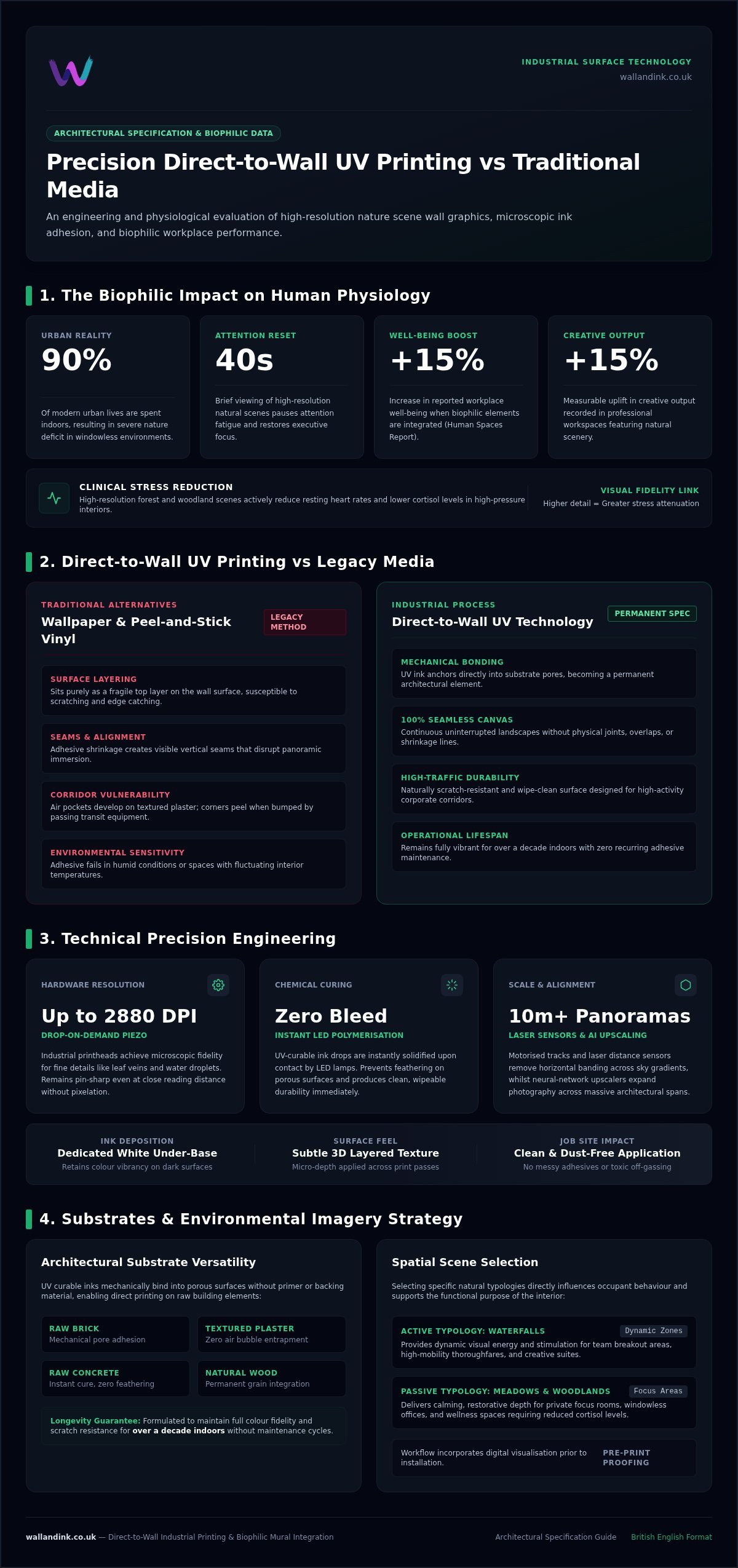
Modern urban populations spend roughly 90% of their lives indoors, a reality that often leads to a profound nature deficit in professional environments. Biophilic design is the strategic practice of connecting occupants to the natural world through built environments and imagery. By following the principles of biophilic design, architects and facility managers can transform sterile spaces into restorative zones. This is not about simple decoration; it’s about biological performance. When windowless offices lack a physical connection to the outdoors, nature scene wall graphics provide the essential visual bridge required to maintain cognitive function and emotional stability.
The Psychology of Natural Imagery in Professional Interiors
The impact of natural scenery on human physiology is well-documented and measurable. Exposure to high-resolution woodland or forest scenes has been shown to reduce heart rates and lower cortisol levels in high-pressure environments. In spaces where architectural windows are impossible, these graphics create a “perceived view”. This visual trickery is highly effective; neurocognitive research suggests that viewing high-resolution natural scenes for as brief as 40 seconds can pause attention fatigue and restore executive task focus. Data from the Human Spaces Global Workplace Report reinforces this, showing that biophilic elements in the workplace can lead to a 15% increase in reported well-being and a 15% boost in creative output. By integrating these scenes, you aren’t just covering a wall; you’re optimising the human capital within the building.
Moving Beyond Temporary Vinyl and Peeling Wallpaper
Pragmatic decision-makers are increasingly moving away from decorative “stickers” and temporary solutions. Traditional “peel and stick” vinyl graphics are notorious for failing in high-traffic corridors, where edges catch on passing equipment and air pockets develop over time. Similarly, traditional wallpaper often fails in humid or temperature-fluctuating professional spaces. Adhesive shrinkage leads to visible vertical seams that ruin the immersion of a landscape and require constant maintenance. Direct-to-wall UV printing serves as the permanent, professional alternative. Unlike legacy methods that sit as a fragile layer on top of the surface, UV-curable ink adheres mechanically to the pores of the substrate. This process works across diverse surfaces including raw brick, plaster, and concrete, ensuring the graphic becomes a durable part of the architecture itself.
Technical Precision in High-Resolution Nature Murals
The mechanical superiority of direct-to-wall printing relies on industrial drop-on-demand piezo printheads. Unlike consumer-grade vinyl printers, these systems achieve native hardware resolutions of up to 2880 DPI. This level of precision is critical for nature scene wall graphics. Microscopic details in leaf veins or water droplets define the realism of the mural. High-resolution output ensures that even at a distance of a few centimetres, the image remains sharp and free from the pixelation common in mass-produced wallpapers.
The chemistry of UV-curable ink provides a significant advantage on porous substrates like plaster and brick. Because the ink is instantly polymerised by LED lamps during the printing process, there is zero “bleed” or feathering. The ink remains exactly where it is deposited. This creates a finished product that is naturally scratch-resistant and wipe-clean. It is a robust solution for busy environments where durability is as important as aesthetics.
Achieving Photorealistic Detail with UV Ink
To ensure a truly immersive experience, the printing rig utilises motorised tracks and laser height sensors to maintain a consistent distance from the wall. This precision eliminates horizontal banding in sky and water gradients. These areas are notoriously difficult for traditional printers to render smoothly. For large-scale projects, such as a 10-metre forest panorama, we utilise neural-network upscalers to boost photography to print-ready resolutions. This technical rigour is supported by research on biophilic indoor interventions; this data confirms that higher visual fidelity makes an intervention more effective at lowering stress markers.
Colour Accuracy and Depth for Immersive Scenes
Industrial UV printing allows for the layering of ink. This creates a subtle 3D texture on the wall surface. It is particularly effective when printing on dark or uneven surfaces. In these cases, a dedicated white under-base layer is applied first to ensure colour vibrancy. In corporate settings, we precisely match brand colours within the natural scenery to maintain brand consistency. Every print is finished with a matte texture to prevent glare from overhead office lighting. This ensures the scene remains visible from all angles. If you are planning a project that requires this level of mechanical reliability, you can explore our direct-to-wall printing options to see how we handle complex substrates.
Comparing Direct-to-Wall Graphics with Traditional Alternatives
Pragmatic facility managers often overlook the secondary costs associated with legacy wall coverings. Traditional wallpaper installation demands a multi-stage process involving wall primers, heavy-duty adhesives, and specialised labour. If the substrate is slightly uneven, the paper risks bubbling or misaligning, leading to costly re-works. Direct-to-wall printing eliminates these variables. It’s a dry, dust-free process that requires no water or messy pastes. This makes it ideal for clinical or professional environments where downtime must be minimised and cleanliness is a priority.
The primary failure of traditional nature scene wall graphics is the vertical join. Even the most skilled installer cannot hide the physical overlap of paper rolls. In a panoramic landscape, these lines break the psychological immersion and create points of weakness where the material can catch or fray. Direct-to-wall technology prints a continuous image across the entire architectural surface. It handles corners, recesses, and light switches without the need for cutting or overlapping material. The result is a seamless horizon that feels like an integrated part of the building.
Wall Printing vs Conventional Wallpaper Joins
Seams are the first point of failure in any wall graphic. In humid environments or spaces with fluctuating temperatures, adhesive shrinkage causes wallpaper joins to separate or curl. This not only ruins the aesthetic but also creates a hygiene risk in healthcare settings where dust can accumulate in the gaps. Direct printing removes this risk entirely. By applying the ink directly to the wall’s pores, we create a single, uninterrupted panorama. This provides a significant aesthetic benefit, ensuring the horizon line of a forest or mountain range remains perfectly level and unbroken.
Why Direct UV Ink Beats Vinyl Decals for Longevity
Vinyl decals rely on chemical adhesives that degrade over time. In high-traffic corridors or schools, edges inevitably lift and peel when bumped by equipment or passers-by. Direct UV printing achieves a mechanical bond with the substrate. The ink doesn’t sit as a separate film; it becomes part of the wall itself. This makes the finished print highly resistant to peeling and physical wear.
Environmental impact is another critical consideration for modern projects. Traditional vinyl wraps involve massive plastic sheets and solvent-based adhesives that contribute to landfill waste. Additionally, following EPA guidance on volatile organic compounds, many organisations are moving away from materials that off-gas harmful chemicals. UV-curable inks are polymerised instantly by LED lamps. This results in an odourless, low-VOC finish that is safe for immediate occupancy in schools and hospitals. It’s a cleaner, more sustainable method for bringing nature indoors.
Selecting the Right Nature Scene for Your Environment
Selecting nature scene wall graphics requires an analytical approach to the existing architectural environment. Pragmatic designers don’t simply choose a “pretty” image; they select imagery based on the intended behavioural outcome of the space. For instance, “active” imagery featuring dynamic waterfalls or crashing waves creates a sense of energy suitable for high-traffic retail or hospitality entryways. Conversely, “passive” imagery like meadows or still lakes fosters a contemplative atmosphere. Lighting is also critical. Positioning track lighting to graze the wall surface enhances the depth of the UV ink, highlighting the subtle textures created during our industrial printing process. We recommend matching the dominant colours of the mural with existing interior furniture to ensure a seamless integration. A forest scene with deep mossy greens, for example, pairs effectively with walnut or dark oak finishes.
Woodland and Forest Scenes for Professional Calm
Woodland and forest scenes are highly effective in high-pressure professional environments. Green-heavy palettes are biologically linked to improved focus and reduced cognitive fatigue. Beyond psychology, there is a structural benefit: the vertical lines of tree trunks can be used to increase the “perceived” height of a ceiling. This makes them ideal for boardrooms, study areas, and healthcare waiting rooms where a sense of openness is required but physical space is limited. By aligning the verticality of the image with the room’s architecture, you create a more cohesive environment. This method effectively masks the boxy nature of modern office construction without requiring structural changes.
Coastal and Mountain Vistas for Spatial Expansion
Coastal and mountain vistas are powerful tools for manipulating spatial perception in confined areas. The “horizon effect” uses a clear, distant vanishing point to push back the perceived boundary of a wall. This is a practical solution for narrow corridors or windowless lobbies that feel restrictive. Mountain scenery, with its vast scale, projects a sense of ambition and stability. This makes it a preferred choice for corporate lobbies and reception areas. Balancing cool blues and whites provides a clean, modern aesthetic that complements contemporary office furniture whilst maintaining a professional tone. Using leading lines, such as a shoreline or a mountain ridge, directs the eye across the space, making small rooms feel significantly larger.
If you’re ready to transform your commercial space with high-resolution imagery, you can view our range of commercial wall murals to find the right fit for your environment.
Bespoke Nature Murals: The Wall & Ink Professional Process
The transition from a digital concept to a physical installation requires technical rigour. Wall & Ink manages this entire lifecycle to ensure the final nature scene wall graphics meet industrial standards. Unlike DIY platforms that leave the measurement and scaling to the customer, our process is built on precision. We operate a nationwide UK service model that delivers consistent results across diverse architectural environments. This professional approach eliminates the common failures of traditional methods, such as misaligned patterns or poor adhesion. Because the UV printing process is quiet and dust-free, installation can often occur during standard business hours without disrupting your organisation’s operations.
Digital Visualisation and Custom Design Consultations
The visualisation stage is the foundation of a successful project. We provide digital mock-ups by overlaying your chosen nature scene onto a photograph of your actual wall. This allows us to adjust the scale and crop of the image with surgical precision. It ensures that critical elements of the landscape aren’t obscured by light switches, radiators, or permanent furniture. Finding the perfect high-resolution file is a collaborative effort. We ensure the image density is sufficient for the wall’s dimensions, preventing the pixelation often seen in consumer-grade prints. This stage removes the guesswork, providing a clear blueprint before the printhead ever touches the wall.
Nationwide Installation on Any Surface Substrate
Our vertical UV printing rigs are designed to be surface-agnostic. Whilst traditional wallpaper requires a perfectly smooth, primed surface, our technology adheres to the natural pores of raw brick, plaster, concrete, and wood. Each substrate requires a specific technical preparation, which our specialists handle on-site. On installation day, you can expect a clean and quiet environment. There are no heavy fumes, no wet pastes, and no drying times to manage. The UV light cures the ink instantly, meaning the wall is touch-dry immediately after the printer passes. There is no need to cordoned off the area for days whilst waiting for adhesives to set.
Maintaining your nature scene is straightforward. Because the ink is polymerised and scratch-resistant, the surface can be cleaned with standard non-abrasive wipes. This durability is why our murals are preferred in high-traffic sectors like education and healthcare. You receive a permanent architectural feature that requires zero maintenance and remains vibrant for over a decade indoors. If you’re looking for a reliable partner to handle your next project, you can explore our bespoke wall printing services to see the results we achieve on challenging substrates.
Advancing Your Architectural Environment with Precision Printing
Direct-to-wall UV printing represents a significant shift from legacy wall coverings. By eliminating physical seams and adhesive failure, you ensure that nature scene wall graphics remain a permanent, integrated part of your building’s architecture. This method doesn’t just decorate a space; it applies the principles of biophilic design to enhance occupant well-being and cognitive focus through high-resolution, photorealistic imagery. The result is a restorative environment that supports both productivity and psychological health.
Our industrial process delivers UV-stable inks that won’t fade and seamless graphics that avoid the common pitfalls of wallpaper joins. Whether your substrate is raw brick, wood, or smooth plaster, our technology provides a durable, maintenance-free finish that lasts for over a decade. This technical reliability ensures that your investment remains as vibrant as the day it was printed, even in high-traffic professional settings.
Transform your space with a bespoke nature mural from Wall & Ink and experience the efficiency of our professional nationwide UK installation. Investing in high-calibre visual interventions is a pragmatic step towards creating a modern, high-performance workspace.
Frequently Asked Questions
How long do nature scene wall graphics last when printed directly?
Nature scene wall graphics printed with UV-curable ink typically last for 10 to 12 years in indoor environments without significant fading or cracking. For exterior applications, the lifespan ranges from 2 to 5 years, though this can be extended to 10 years with a protective UV topcoat. This durability is achieved because the ink cures instantly under LED lamps, creating a mechanical bond with the substrate that resists environmental degradation better than traditional adhesives.
Can you print nature graphics on textured walls like brick or breeze block?
Our industrial printing rigs are specifically designed to be surface-agnostic, allowing for high-resolution printing on brick, breeze block, and raw concrete. Unlike wallpaper or vinyl, which require perfectly flat surfaces to prevent bubbling, the UV printhead adjusts to the wall’s texture using laser sensors. This ensures that the ink penetrates the pores of the substrate, creating a seamless nature mural that follows the tactile contours of the architectural material.
Is the UV ink used in wall printing eco-friendly and safe for indoor use?
The UV-curable inks utilised in our process are low-VOC and entirely odourless, making them safe for immediate occupancy in schools, hospitals, and offices. Because the ink is polymerised instantly by LED lamps during the printing process, there is no off-gassing period associated with solvent-based vinyl or traditional adhesives. This method adheres to modern indoor air quality standards, providing a cleaner alternative for organisations prioritising environmental health and safety.
What happens if the wall gets scuffed or damaged after printing?
The finished print is naturally scratch-resistant and durable enough to withstand the typical scuffs found in busy commercial corridors. If the underlying wall substrate suffers significant physical damage, such as a deep gouge in the plaster, the affected area can be repaired and then over-printed to restore the image. For routine maintenance, the surface is wipe-clean with non-abrasive materials, ensuring the nature scene remains vibrant without the risk of peeling at the edges.
How do I choose the right resolution for a full-wall nature mural?
Choosing the correct resolution is part of our bespoke consultation process, where we ensure nature scene wall graphics meet a native hardware standard of up to 2880 DPI. For large-scale nature murals, we employ neural-network upscalers to boost photographic files without losing detail or introducing pixelation. This technical rigour ensures that the final print maintains photorealistic clarity even when viewed from a close distance, which is essential for creating an immersive biophilic environment.
Can direct-to-wall nature graphics be removed or painted over?
Direct-to-wall graphics are designed for longevity, but they can be easily removed by painting over them with two coats of standard emulsion. Unlike vinyl decals or wallpaper, there is no need for harsh chemical strippers or physical scraping that could damage the drywall paper. This makes the technology a flexible solution for leased spaces or environments where the interior design may need to be updated or rebranded in the future.
How long does the professional wall printing process take from start to finish?
The physical printing process is highly efficient and can often be completed in a single day, depending on the mural’s total area. A standard wall mural typically takes between 3 to 5 hours to print once the rig is calibrated. However, the end-to-end timeline includes a digital visualisation stage where we provide mock-ups for approval. This methodical approach ensures that the installation is right the first time without unnecessary downtime.
Do I need to prepare my wall in a special way before the printer arrives?
Your wall should be clean, dry, and free from loose debris or peeling paint before our technicians arrive. Whilst our printers work on diverse substrates like brick and wood, a consistent base colour ensures the best results for high-resolution graphics. We handle the technical calibration and surface inspection on the day of installation. This eliminates the need for the extensive priming or sanding required for traditional wallpaper hanging or vinyl application.