
Your high-traffic commercial corridor doesn’t need another layer of vinyl that will inevitably peel at the corners. You’ve likely dealt with the frustration of wallpaper seams bubbling or decals failing to grip onto textured brick and concrete; it’s a common headache for facility managers and designers who require a premium aesthetic but keep getting stuck with temporary, high-maintenance solutions. We understand that in a professional environment, industrial durability is just as vital as the initial visual impact.
Industrial-grade uv wall printing offers a permanent architectural finish that bypasses these legacy limitations entirely. You’ll discover how this direct-to-surface technology creates vibrant, high-resolution masterpieces that won’t fade in sunlight or succumb to heavy wear. By using advanced UV-cured inks, we transform any vertical surface into a durable asset without the mess of traditional adhesives or pastes. This guide provides a technical overview of the process, from the science of instant molecular curing to the practical benefits of printing on challenging substrates like raw stone and glass. We’ll show you why this modern specialist approach is the most reliable way to achieve a clean, mess-free installation that stands the test of time.
Key Takeaways
- Understand how direct-to-surface application integrates artwork into the wall substrate, permanently eliminating the risks of peeling edges or bubbling seams.
- Discover the technical precision of uv wall printing, which uses instant ultraviolet curing to achieve high-resolution results on challenging surfaces like brick, glass, and concrete.
- Learn about the industrial durability of UV-stable inks that offer superior scratch resistance and maintain colour vibrancy even in sun-drenched atriums.
- Explore the end-to-end project journey, including professional site surveys and digital visualisations that ensure accurate placement and scale before printing begins.
- Gain clarity on transparent pricing structures that allow for precise budgeting based on square footage and surface complexity across all UK sectors.
What is UV Wall Printing? The Modern Alternative to Wallpaper
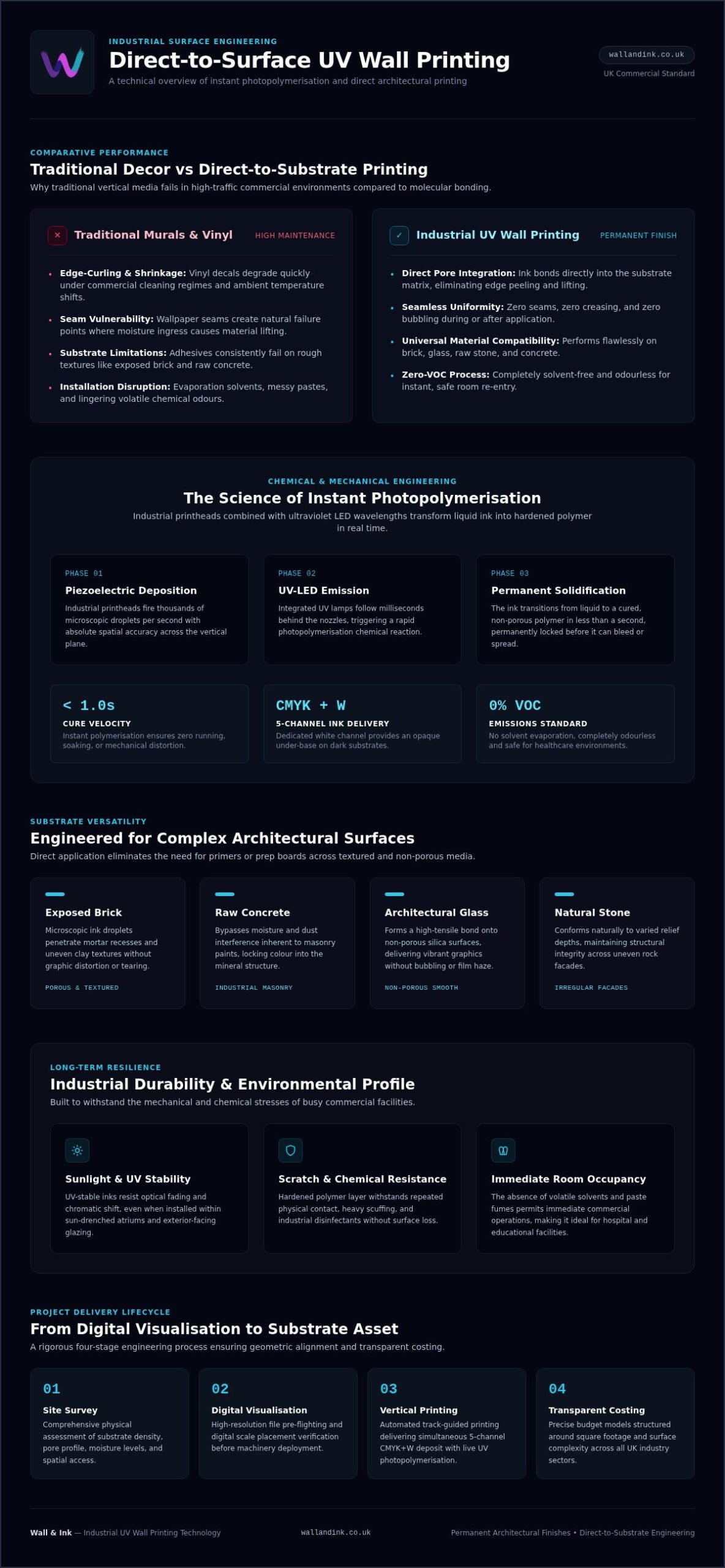
UV wall printing represents a fundamental shift in how we approach vertical design. Rather than applying a decorative layer over a surface, this technology integrates art directly into the substrate itself. It’s a digital application method that utilises industrial-grade machinery to spray specialised inks that are cured instantly by ultraviolet light. This UV curing process ensures that the ink transforms from a liquid to a durable solid the millisecond it touches the wall. It’s not a sticker or a sheet of paper; it’s a permanent architectural finish designed for longevity.
The equipment used in this process is built for industrial reliability. Unlike consumer-level printers or DIY vinyl kits, these systems use piezoelectric printheads to deliver microscopic droplets with absolute precision. This level of engineering allows for high-resolution graphics that retain their clarity and colour depth on almost any material. It’s a clean, efficient alternative to traditional decorating that avoids the mess and chemical odours associated with legacy methods.
Why Traditional Murals Often Fail in Commercial Spaces
In high-traffic environments, traditional murals often become a maintenance liability. Vinyl decals are prone to edge-curling and shrinkage, especially when exposed to temperature changes or cleaning routines. Wallpaper presents a different set of problems. The seams act as natural points of failure where moisture and physical contact cause the material to lift. Once a seam begins to peel, the entire aesthetic is compromised. Paper-based products don’t handle industrial cleaning well. Scuffs and marks are difficult to remove without damaging the print, making them unsuitable for schools, hospitals, or busy retail centres.
The Direct-to-Surface Advantage
The primary benefit of uv wall printing is that the ink becomes part of the wall’s physical structure. By bonding into the pores of the substrate, the ink is protected from the mechanical stresses that cause wallpaper to fail. This method eliminates the bubbles, creases, and alignment errors that plague manual installations. There are no seams to split and no adhesives to dry out. UV wall printing is a solvent-free, instant-dry process. Because the inks contain no volatile organic compounds (VOCs), the installation is completely odourless and safe for sensitive environments like healthcare facilities.
- No peeling at the edges or corners.
- Zero risk of bubbling or creasing during application.
- Superior scratch and chemical resistance.
- Immediate room re-entry due to lack of fumes.
The Science of UV Curing: Precision Engineering on Any Substrate
UV wall printing relies on the technical process of photopolymerisation to achieve its permanent finish. As the industrial printhead traverses the vertical surface, integrated UV-LED lamps follow immediately behind the ink nozzles. These lamps emit specific ultraviolet wavelengths that trigger an instant chemical reaction, transforming the liquid ink into a hardened polymer in less than a second. This rapid transition locks the pigment in place before it can spread or soak into the material. Because the process doesn’t rely on solvent evaporation, it significantly reduces the volatile organic compounds impact on indoor air, ensuring the environment remains safe for immediate occupancy.
The system utilises a five-channel CMYK+W ink set to produce a full spectrum of colour. The inclusion of a dedicated white ink channel is vital for architectural projects involving dark or non-standard backgrounds. By depositing a precise white under-base, the printer creates a neutral foundation that allows colours to remain vibrant and true to the original design, regardless of the substrate’s base shade. Industrial piezoelectric printheads manage this delivery with microscopic accuracy, firing thousands of droplets per second to replicate complex digital files with absolute fidelity.
Printing on Challenging Surfaces: Brick, Glass, and Concrete
The mechanical superiority of our printing technology allows for direct application on almost any architectural substrate. On textured materials like exposed brick or breeze blocks, the ink settles into the natural recesses whilst maintaining the underlying character of the wall. For non-porous surfaces such as polished glass, ceramic tiles, or metal, we apply specialised adhesion promoters to ensure the bond is permanent and resistant to mechanical abrasion. Wood and natural stone surfaces offer unique aesthetic opportunities; the process allows us to overlay intricate graphics whilst keeping the natural grain or texture visible. This creates a sophisticated, integrated finish that traditional decorative layers cannot achieve.
High-Resolution Detail and Colour Accuracy
Achieving photographic realism on a large scale requires sophisticated colour management and high-resolution output. Our systems handle complex gradients and fine shadows without the banding issues often found in lower-grade equipment. A key technical advantage is how the ink interacts with porous materials. UV ink prevents bleeding on porous surfaces like fresh plaster because it cures before the liquid can be absorbed into the wall’s structure. This ensures that fine lines remain sharp and brand colours stay consistent across the entire mural. If you are currently designing a space that requires this level of technical precision, you can explore our commercial wall murals to see how these specifications translate into physical installations.
Durability, Maintenance, and Sustainability: Why UV Ink Outlasts Vinyl
The resilience of uv wall printing stems from the structural nature of the cured ink. Unlike vinyl decals that rely on pressure-sensitive adhesives, UV-curable inks form a rigid, cross-linked polymer matrix. This chemical stability makes the finish highly resistant to mechanical abrasion and common scuffs. In high-traffic commercial environments, such as hospital corridors or school hallways, this durability is essential. You can clean these surfaces using standard non-abrasive detergents without risking pigment loss or surface delamination. The print doesn’t just sit on the wall; it becomes a resilient part of the architectural fabric that often outlasts the building’s interior design cycle.
UV Stability: Art That Does Not Fade
Solar degradation is the primary cause of failure for traditional murals. Standard digital prints often suffer from “bleaching” when exposed to direct sunlight through South-facing windows or in glass-roofed atriums. UV-curable inks are engineered with high-grade photoinitiators that create a permanent molecular bond, protecting the pigments from ultraviolet radiation. Whilst commercial vinyl wraps typically show signs of fading or edge-shrinkage within 3 to 5 years, a professionally applied UV mural maintains its colour integrity for 10 to 15 years indoors. This longevity makes it the preferred choice for external facades and sun-drenched professional spaces where visual consistency is mandatory.
Eco-Friendly Credentials and Indoor Air Quality
Modern building standards place a heavy emphasis on the chemical profile of interior finishes. Traditional solvent-based inks and PVC-heavy wallpapers frequently release volatile organic compounds (VOCs) into the environment long after installation. Because our process involves instant photopolymerisation, there’s no solvent evaporation and zero off-gassing. This makes the method safe for sensitive environments including nurseries, healthcare facilities, and schools where air quality is a priority. The process is also inherently less wasteful than traditional decorating. You don’t have to manage the disposal of backing papers, adhesive liners, or wallpaper offcuts. We print only the ink required for the design, creating a clean and sustainable installation process that minimises environmental impact.
Planning Your Project: From Digital Concept to Physical Reality
Successful execution starts with a rigorous technical site survey. We don’t just look at the wall; we assess the physical environment to ensure the vertical track system has sufficient clearance and stable footing. This involves checking wall levels and identifying potential obstructions such as radiators, light switches, or skirting boards. This phase is about eliminating logistical risks and ensuring the machinery can operate with industrial precision before the installation date arrives.
The design phase adapts your brand assets or bespoke artwork for large-scale output. High-resolution vector files or raster images at a minimum of 300 DPI are essential for maintaining clarity at architectural scales. We refine the positioning of logos and bespoke art to ensure they integrate naturally with the room’s unique features. It’s a collaborative process that translates your digital vision into a format ready for the specific requirements of our printing hardware.
The Digital Visualisation Process
We remove the uncertainty often associated with traditional hand-painted murals by providing a comprehensive digital visualisation. By overlaying your chosen design onto high-resolution photographs of your actual space, we show exactly how the final uv wall printing project will look in situ. This allows you to adjust the scale, colour balance, and positioning during the planning phase. It ensures the final result matches your expectations perfectly before a single drop of ink is cured, providing a level of confidence that manual decorating methods simply cannot match.
Surface Preparation: Ensuring the Perfect Bond
Achieving a permanent architectural finish requires specific wall conditions. The following checklist ensures the substrate is ready for a successful application:
- The surface must be clean and free from dust, grease, and loose debris.
- Avoid using “easy-clean”, “wipeable”, or silicone-based paints as a base layer. These are engineered to repel liquids and will prevent the UV ink from bonding correctly to the surface.
- Newly plastered walls must be allowed to dry thoroughly for at least 4 to 6 weeks. Moisture trapped within the substrate can lead to delamination over time.
- For non-porous surfaces like glass or polished metal, we will manage the application of specialised adhesion promoters during the installation process.
On the day of installation, the environment must be prepared for industrial work. We require a standard 240V power supply and a minimum of 1.5 metres of floor clearance in front of the target wall. This space allows the printer to move smoothly along its horizontal track without interruption. If you’re ready to begin the technical planning for your space, you can organise a site survey with our team to assess your specific requirements and ensure a seamless delivery.
The Wall & Ink Process: Professional Execution and Transparent Pricing
Wall & Ink manages every phase of the project, from the initial technical consultation to the final execution. Our national UK coverage ensures that professional uv wall printing is accessible to businesses and private clients regardless of location. We prioritise industrial precision in every installation. Most projects are completed within a single working day. Because the process is direct-to-surface and uses instant-curing ink, there is zero mess, no drying time, and no lingering chemical odours. You can return the space to full use immediately after the printer finishes its final pass. This efficiency is a core advantage for busy commercial environments that cannot afford extended downtime.
National UK Service and Sector Expertise
We maintain a deep understanding of architectural requirements across various sectors. In commercial offices, we help define brand identity through precise graphics. In educational facilities, we create durable, engaging environments that withstand the rigours of high student traffic. Retail and hospitality sectors benefit from our ability to print on diverse substrates like ceramic tiles and polished metal. We coordinate directly with site managers and other trades during refurbishments or new builds. This ensures that the printing phase fits seamlessly into your project timeline without causing delays to other contractors on-site.
Understanding Project Costs
We operate with radical transparency regarding our fee structure. Many competitors hide their rates behind complex consultation requirements, but we believe in providing clear information from the start. Our pricing is calculated using specific metrics based on the total square footage of the mural and the complexity of the substrate. Smooth drywall represents the baseline. Textured surfaces like reclaimed brick or non-porous glass require additional preparation or specialised adhesion promoters, which is reflected in the final cost. Design time for bespoke artwork adaptation is also factored into the initial quote.
Choosing uv wall printing offers a significantly higher return on investment than traditional wallpaper. The extreme durability and UV stability mean the mural won’t require replacement or repair for over a decade. You avoid the recurring costs and logistical hassles associated with peeling vinyl or torn paper. Our commitment to accuracy means the price we quote is the price you pay. Request a bespoke quote for your project to receive a detailed breakdown tailored to your specific surface and design requirements.
Transforming Vertical Surfaces with Industrial Precision
The transition from traditional decorative layers to integrated architectural finishes is a logical progression for any modern professional space. By adopting uv wall printing, you eliminate the recurring failures of peeling edges and bubbling seams common with legacy methods. This technology provides a permanent, high-resolution result that bonds directly to your chosen substrate, whether it’s textured brick, polished glass, or raw concrete. It’s a pragmatic solution for decision-makers who value efficiency and long-term durability over temporary fixes.
Our national UK service includes bespoke design and digital visualisations to ensure absolute accuracy before the installation begins. We use odourless, VOC-free inks that are safe for use in hospitals, schools, and high-traffic commercial corridors. This commitment to industrial-grade reliability ensures your mural remains vibrant and scratch-resistant for years to come. Explore our professional wall printing services and transform your space. We look forward to helping you create a durable, high-impact finish that defines your environment.
Frequently Asked Questions
Is UV wall printing permanent?
UV wall printing is a permanent architectural finish that integrates art directly into the wall substrate. Once the ink is cured by ultraviolet light, it forms a durable polymer bond that resists scratching and chemical cleaning. Indoors, these murals typically last between 10 and 15 years without visible fading or degradation. Unlike traditional vinyl, there are no adhesives to fail, meaning the finish won’t peel, bubble, or lift at the edges over time.
Can you print on textured surfaces like brick or stone?
Our industrial equipment is specifically designed to handle textured substrates including exposed brick, natural stone, and breeze blocks. The printhead maintains a precise distance from the surface, allowing the ink to settle into natural recesses whilst preserving the underlying character of the material. This versatility makes it ideal for industrial-style offices or exterior facades where traditional wallpaper or vinyl decals would fail to adhere to the uneven surface profile.
How long does the wall printing process take?
Most projects are completed within a single working day with zero drying time required. The actual speed of uv wall printing varies based on the resolution and complexity of the design, generally ranging between 2 and 6 square metres per hour. Because the UV ink cures instantly, you don’t have to wait for the surface to dry before returning the room to full use. This efficiency minimises disruption in busy commercial environments.
Is the ink used in wall printing safe for schools and hospitals?
The inks we use are completely safe for sensitive environments such as schools, hospitals, and nurseries. They are solvent-free and produce zero volatile organic compounds (VOCs) during or after the application process. Because the curing happens instantly under UV-LED lamps, there are no lingering chemical odours or off-gassing. This allows for immediate room re-entry, making it a clean and green alternative to traditional paints or solvent-based vinyl applications.
What happens if I want to change the design later?
If you decide to change your design, the mural can be painted over just like any other decorated wall. You simply need to lightly sand the surface to ensure a key for the new paint and then apply a standard primer or base coat. There’s no need to strip away layers of paper or scrape off stubborn adhesive residues. This makes it a highly flexible option for evolving retail or corporate spaces.
Does the wall need special preparation before printing?
Walls should be clean, dry, and free from loose debris or dust. It’s vital to avoid using silicone-based or “easy-clean” paints as a base, as these are engineered to repel liquids and will prevent the ink from bonding. Newly plastered walls require a minimum of 4 to 6 weeks to dry thoroughly. For non-porous surfaces like glass or metal, we apply a specialised adhesion promoter on-site to ensure a permanent bond.
How much does professional UV wall printing cost per square metre?
Professional fees are calculated based on the total square footage of the project and the complexity of the surface material. Standard drywall applications represent our baseline rate, whilst more challenging substrates like brick, glass, or metal involve additional technical preparation. Every project also includes bespoke design and digital visualisation. We provide radical transparency in our pricing, ensuring you receive a detailed, fixed-price quote tailored to your specific architectural requirements and design scale.
Is UV wall printing suitable for exterior use?
UV wall printing is highly suitable for exterior applications on substrates like brick, concrete, and metal. The UV-stable pigments are resistant to weathering and solar degradation, maintaining their vibrancy in outdoor conditions. Whilst an indoor print lasts over a decade, an exterior mural typically has a lifespan of 2 to 5 years. This can be extended to 8 years or more by applying a specialised UV-resistant clear coat or varnish after the printing is complete.