
A University of Exeter study revealed that enriching an office environment with artwork can boost employee productivity by 17%, yet finance directors routinely dismiss wall installations as discretionary perks. If you are trying to solve how to get budget approval for office murals, the friction rarely stems from your design concept. It happens because leadership views workplace art as a frivolous decorative cost rather than a strategic asset that drives measurable performance.
You already know that bland drywall drains team engagement, but pitching an installation often triggers legitimate executive anxieties around lost working hours, lingering paint odours, or cheap vinyl graphics that peel within months. This guide shows you how to build an airtight business proposal that dispels financial scepticism and secures rapid sign-off. We examine the complete five-stage approval workflow, the data linking workspace aesthetics to staff retention, and the clean execution methods that guarantee long-term durability without causing a single hour of office disruption.
Key Takeaways
- Reframe workplace graphics from discretionary decoration into a tangible operational driver that strengthens staff retention and brand identity.
- Learn how to get budget approval for office murals using a structured five-step workflow designed to align facilities, brand, and finance teams.
- Compare specifications objectively to see how direct-to-wall UV printing prevents the peeling edges, adhesive breakdown, and replacement costs common to vinyl wraps.
- Construct a comprehensive five-year Total Cost of Ownership model that exposes the hidden maintenance and downtime expenses of legacy installation methods.
- Eliminate aesthetic subjectivity and committee hesitation by using precision digital mock-ups to de-risk the project before printing starts.
Building the Strategic Business Case: Why Office Murals Are Commercial Assets
Pitching a workplace installation as an interior embellishment invites instant rejection from the board. To solve how to get budget approval for office murals, you must reframe environmental artwork from a discretionary overhead cost into a functional performance tool. Corporate environments perform best when they reinforce strategic priorities, which makes visual design an active contributor to operational output rather than decorative fluff.
Every square metre of corporate real estate carries a baseline cost. Blank painted plaster yields zero return on that capital outlay. Conversely, integrated graphics turn dead space into an active communications channel that anchors brand identity and strengthens team alignment. Modern facilities integrate graphic treatments into effective office space planning to improve navigation, zone distinct functional teams, and define shared cultural standards across disparate departments.
Data consistently connects interior stimulation with workplace engagement:
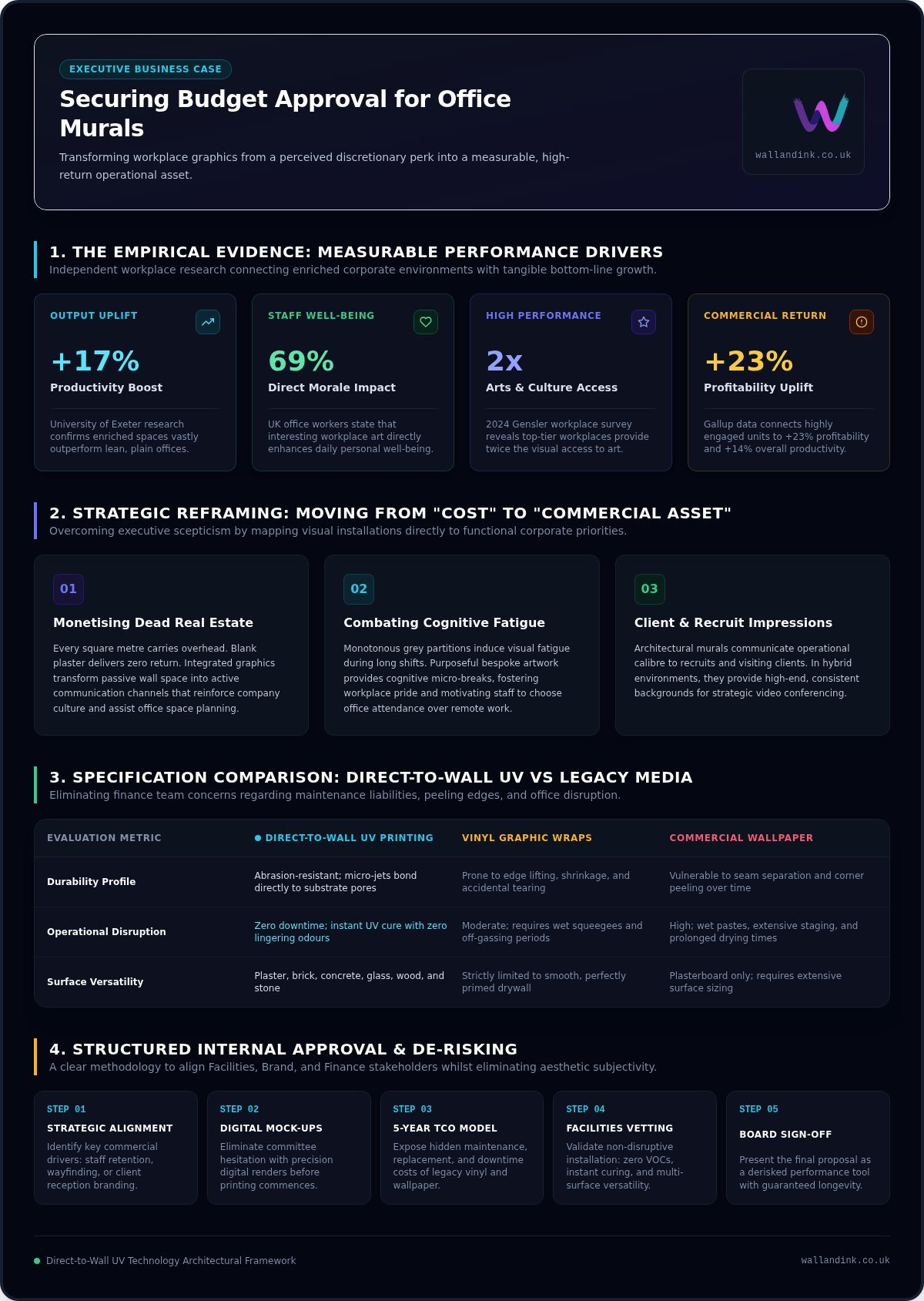
- Heightened focus: Research from the University of Exeter demonstrates that personnel working in enriched environments are 17% more productive than those working in plain, lean offices.
- Direct well-being impact: 69% of UK office workers report that interesting workplace artwork directly improves their daily personal well-being.
- High-performance benchmarks: A 2024 Gensler workplace survey revealed that high-performing workplaces offer twice as much visual access to arts and culture compared to low-performing counterparts.
- Engagement economics: Gallup research shows that highly engaged business units deliver a 23% increase in profitability and a 14% uplift in overall productivity.
Connecting Environmental Design to Staff Retention and Productivity
Monotonous grey partitioning induces visual fatigue and drains employee energy throughout long working sessions. Replacing blank expanses with purposeful wall art gives the brain micro-breaks that combat mental exhaustion. When teams share spaces defined by intentional, bespoke designs, they build shared identity. Those shared visual markers cultivate workplace pride, turning an ordinary room into a collaborative destination that encourages staff to choose the office over remote work.
Reinforcing Brand Identity for Prospective Recruits and Visiting Clients
First impressions carry immense commercial weight during executive recruit interviews and client pitches. A bespoke architectural mural immediately telegraphs financial stability, modern operational standards, and clear cultural identity to anyone walking past reception. In hybrid workplaces, purposeful wall designs also serve as polished, consistent architectural backdrops for high-value video conference calls, ensuring your visual branding remains intact on screen.
Selecting the Right Specification: Direct-to-Wall UV Printing vs Traditional Media
Finance directors evaluate physical infrastructure on operational longevity and maintenance requirements. If you want to know how to get budget approval for office murals, you must present a technically sound medium. Traditional workplace media carry hidden liabilities: vinyl stickers suffer from adhesive failure, hand-painted artwork requires days of cordon-offs, and wallpaper paste creates messy seams that split over time. Direct-to-wall printing removes these weak points by deploying vertical multi-axis printheads that micro-jet UV-curable ink directly onto your vertical substrates.
| Metric | Direct-to-Wall UV Printing | Vinyl Graphic Wraps | Traditional Commercial Wallpaper |
|---|---|---|---|
| Durability Profile | Abrasion-resistant; bonds to substrate pores | Prone to edge lifting, shrinkage, and tears | Vulnerable to seam separation and corner peels |
| Operational Disruption | Zero downtime; instant UV cure with zero odours | Moderate; requires wet squeegees or off-gassing | High; wet pastes, extensive staging, prolonged drying |
| Surface Versatility | Plaster, brick, concrete, glass, wood, stone | Strictly smooth, perfectly primed drywall | Plasterboard only; requires extensive sizing |
| End-of-Life Process | Paint straight over with standard emulsion | Labour-intensive scraping; leaves adhesive residue | Steam stripping required; risks damaging plaster |
Academic research on the impact of workplace art underscores that aesthetic changes improve employee connection only when the physical installations convey quality and care. Degraded graphics convey neglect. Specifying precision direct-to-wall printing ensures your installation remains an asset rather than a maintenance hazard.
Durability and Maintenance: Eliminating Peeling Edges and Seam Separation
Vinyl film relies on chemical adhesives that degrade under standard workplace climate control. Sunlight and fluctuating temperatures cause vinyl to contract, exposing sticky borders that collect airborne grime and curl outwards. Commercial vertical UV printing eliminates film layers entirely. The liquid ink keys straight into the surface texture, curing into a hardened, non-porous finish. When cleaning crews wash the perimeter walls, the mural resists routine cleaning chemicals without tearing or delaminating.
Zero Downtime: Avoiding Odours, Wet Inks, and Workplace Disruption
Traditional painting commissions require multi-day installations, noisy scaffolding, and noxious solvent emissions that trigger employee complaints. Modern vertical printers solve this through low-energy UV lamps attached directly beside the print carriage. The lamps cure the specialised ink instantly upon contact. The process generates zero VOCs and no lingering fumes, allowing your team to work uninterrupted in the adjacent room while the installation finishes.
Substrate Versatility: Printing Across Plaster, Brick, Glass, and Wood
Self-adhesive vinyl bubbles on uneven surfaces and fails on porous textures. In contrast, vertical printheads use active distance sensors to adjust their throw distance in real time. This mechanical agility allows accurate image reproduction across rough masonry, architectural timber, unpolished concrete, or raw brickwork without surface flattening.
Financial Justification: Total Cost of Ownership and Defeating Budget Objections
Finance directors review requests through an operational lens: initial capital outlay versus long-term maintenance overhead. Knowing how to get budget approval for office murals requires shifting the financial dialogue from a one-off decorative expense to a multi-year asset lifecycle. When leadership scrutinises visual upgrades, they often fear continuous upkeep cycles. Presenting an objective Total Cost of Ownership (TCO) model dismantles that hesitation by proving that industrial direct-to-wall printing prevents the recurring costs associated with fragile graphic media.
Traditional interior graphics carry recurring liabilities that rarely appear on the initial invoice. Self-adhesive vinyl signs and printed wallpapers routinely suffer from physical deterioration within two to three years. Seams lift, surface laminate scratches, and edge curls attract dust, eventually forcing facilities managers to fund complete removals and re-installations. In contrast, precision UV-cured inks bond straight to the architectural substrate, maintaining colour integrity and scratch resistance over a protracted asset life.
Formulating the Total Cost of Ownership Model for Workplace Graphics
To quantify the financial advantage, construct a five-year TCO equation for executive reviewers:
- Initial Capital Outlay: Include hardware mobilisation, bespoke surface design adaptation, and primary application costs.
- Cumulative Maintenance Spend: Factor in zero re-gluing or seam-repair calls for direct UV printing, compared against regular patch repairs for damaged vinyl sheets.
- Downtime Penalties: Account for zero operational disruption during printing, whereas traditional multi-day installations require clearing desks and reallocating workspace.
- Refurbishment Life: Map the full lifecycle against rolling redecoration schedules. Direct prints eliminate recurring graphic purchases by standing firm until the entire floorplate undergoes planned refurbishment.
Countering Common Finance Department Objections with Practical Proof
When the finance team pushes back, counter their operational concerns with definitive engineering parameters rather than design theory:
- “This is vanity spend with unproven returns.” Counter: Gallup research confirms highly engaged teams are 23% more profitable. Environmental graphics transform passive, paid-for real estate into active drivers of employee performance and corporate culture.
- “Lease dilapidation clauses will penalise custom wall graphics.” Counter: Direct-to-wall UV inks do not pull off surface plaster upon removal. When the commercial tenancy expires, facilities teams can simply emulsion directly over the mural using standard architectural undercoats, eliminating costly adhesive-stripping fees.
- “Installation will disrupt office productivity.” Counter: Cold-curing UV technology produces zero solvents, wet mess, or toxic odours, ensuring nearby personnel can continue daily operations without facility shutdowns.
Before submitting your figures, review your wall condition early; consult Wall & Ink on bespoke commercial specifications to secure precise scope details for your business case.
The 5-Step Process to Securing Internal Sign-Off for Office Murals
Securing executive sign-off demands an orderly internal governance pathway rather than an ad-hoc pitch. Understanding how to get budget approval for office murals requires managing cross-functional risk across branding, facilities, health and safety, and finance. Progressing systematically through five disciplined stages transforms an abstract creative proposal into an airtight operational requisition.
- Spatial and Objective Scoping: Pinpoint underutilised vertical assets and secure initial departmental alignment.
- Cross-Departmental Stakeholder Audits: Consult internal brand custodians, facilities managers, and risk assessors.
- Technical Due Diligence: Capture exact structural dimensions, lighting angles, and substrate conditions.
- Procurement Specification: Secure digital mock-ups and material safety sheets to satisfy corporate standards.
- Executive Dossier Submission: Deliver a board-level business paper contrasting longevity benefits against alternative media.
Before assembling your formal submission, request an architectural digital visualisation to provide executive decision-makers with exact photographic validation of the finished installation.
Phase 1: Defining Spatial Objectives and Aligning Cross-Functional Stakeholders
Begin by selecting high-impact zones such as the primary reception foyer, central client boardroom, or main collaboration breakout area. Next, approach your marketing leadership to confirm the project reinforces existing visual identity standards. Simultaneously, engage facilities managers to evaluate wall integrity, structural coatings, ambient humidity, and electrical clearance, preventing practical roadblocks before the business case reaches executive desks.
Phase 2: Procuring Accurate Digital Visualisations and Technical Scopes
Subjective debates derail creative proposals. Eliminate guesswork by taking precise millimetre measurements and high-resolution photographs of the selected architectural footprint. Then, commission true-to-scale digital mock-ups that demonstrate how your proposed bespoke artwork interacts with ambient lighting, surface contours, and perimeter fixtures. Secure comprehensive technical specification sheets proving non-toxic chemical formulations and surface fire-rating compliance for internal risk registers.
Phase 3: Assembling and Delivering the Executive Approval Dossier
Combine your findings into a concise business dossier for the final sign-off meeting. Structure the document around strategic priorities: corporate identity enhancement, asset longevity, and zero disruption to active business operations. Include the direct-to-wall printing specifications alongside peeling-prone vinyl alternatives to underline your risk-averse methodology. Conclude with a transparent implementation schedule that guarantees the entire application finishes cleanly without disrupting standard office workflows.
De-Risking Your Proposal: Partnering with Direct-to-Wall Specialists
Procurement teams reject proposals that carry unresolved delivery variables. Mastering how to get budget approval for office murals relies heavily on isolating and eliminating every execution hazard before presenting to the board. Handing senior executives an open-ended artistic brief creates anxiety around brand dilution and unquantifiable installation overruns. Partnering with a dedicated industrial print specialist replaces artistic subjectivity with verified technical parameters, guaranteeing predictable delivery across commercial workspaces nationwide.
Specialist direct-to-wall contractors de-risk physical delivery through structured site readiness audits. Prior to running vertical print machinery, technicians assess substrate integrity, surface alkalinity, and ambient environmental conditions. This meticulous diagnostic phase ensures the UV-curable ink keys directly into the underlying plaster, brick, or composite panel, guaranteeing a resilient bond that withstands daily commercial wear.
How Bespoke Digital Mock-Ups Remove Subjectivity from Board Decisions
Internal committees frequently stall when members struggle to picture the finished installation. Precision architectural visualisations resolve this impasse by rendering the bespoke artwork directly onto high-resolution photographs of your physical walls. These digital mock-ups show exact positioning around power points, door frames, and architectural light fixtures, letting stakeholders inspect scale, contrast, and layout beforehand. Any brand revisions take place digitally within design files, protecting corporate identity guidelines before a single drop of ink touches the substrate.
Ensuring Clean, Precision Execution Across Modern Corporate Spaces
Traditional redecoration projects often fail basic health and safety hurdles due to solvent fumes, bulky scaffolding, and adhesive waste. Vertical UV wall printing hardware operates within an ultra-compact physical footprint, moving smoothly along dedicated ground tracks set close to the wall. Because the print carriage pairs micro-jet delivery directly with instant UV curing lamps, the process generates no toxic fumes, airborne mist, or hazardous runoff. Workspaces remain clean, safe, and functional throughout the visit.
Ready to build a watertight business case for your leadership team? Take the final step and request a commercial consultation and visualisation from Wall & Ink to turn your visual concept into an approved operational asset.
Transforming Your Workplace Concept into an Approved Corporate Asset
Securing executive sign-off comes down to presenting a technically sound, operationally harmless investment. When you resolve how to get budget approval for office murals through objective commercial metrics, the discussion changes from decorative indulgence to asset performance. Deploying advanced vertical UV printing technology directly onto walls eliminates the peeling seams, adhesive breakdown, and surface damage that make finance teams wary of legacy vinyl graphics.
Highlighting zero-peel, zero-seam durability alongside a clean, odourless application ensures your proposal satisfies facilities concerns while guaranteeing zero operational downtime. You don’t need to leave the final visual outcome to committee imagination. Request a bespoke digital visualisation for your office with Wall & Ink to demonstrate exact architectural alignment prior to printing, and present your leadership team with a risk-free proposal built for immediate approval.
Frequently Asked Questions
How do I calculate the return on investment for an office mural project?
Quantify returns by linking environmental design to measurable operational gains rather than decorative value. Frame returns around reduced turnover costs and recorded uplifts in workplace focus, citing established research on workplace performance. When preparing how to get budget approval for office murals, compare the single upfront capital outlay against the ongoing expense of replacing degraded visual branding or repainting plain plasterboard every few years.
Will installing an office mural disrupt our daily business operations?
Direct-to-wall printing causes zero operational downtime. The specialised vertical print rigs operate quietly on a compact track system adjacent to the wall surface. Because the high-resolution inks cure instantaneously under integrated UV lamps, the area remains entirely free from drying wet paint, chemical fumes, and messy application paste. Personnel can continue working safely in the same room throughout the installation process.
Why should we choose direct-to-wall printing instead of traditional vinyl decals?
Traditional vinyl decals fail mechanically over time due to adhesive shrinkage, bubbling, and perimeter edge-peeling. Direct-to-wall printing jets UV-curable ink directly into substrate pores, eliminating adhesive films and noticeable seams. The resulting installation is scratch-resistant, washable, and stable against commercial HVAC fluctuations. It delivers a permanent architectural appearance without the rolling maintenance and peeling issues common to synthetic sticker films.
Can direct-to-wall printing be applied to rough or textured surfaces?
Yes, vertical wall printing functions across varied architectural substrates where standard vinyl or wallpaper fails. Advanced sensor arrays actively adjust the printhead distance across uneven textures, allowing crisp image reproduction across raw brickwork, structural concrete, textured plaster, timber panelling, and glass. This mechanical flexibility lets organisations brand architectural feature walls without having to skim-coat or apply costly sub-framing.
What happens to an office mural if we relocate or end our lease?
Decommissioning a direct-to-wall print requires no scraping, steaming, or abrasive chemical stripping that risks damaging the wall. Because the cured UV ink forms a microscopically thin, resilient layer flush against the substrate, facilities teams can simply roll two coats of standard commercial emulsion directly over the artwork. This straightforward reinstatement easily satisfies commercial lease dilapidation clauses without incurring specialist contractor removal costs.
How do digital visualisations assist in getting budget approval from leadership?
Digital visualisations eliminate creative subjectivity, which is the main barrier when presenting how to get budget approval for office murals. Overlaying the exact proposed artwork onto high-resolution photographs of your actual office walls shows leadership the true architectural scale, colour balance, and sightlines around existing doorways and furniture. Presenting an accurate preview eliminates executive doubt and speeds up sign-off.
Does direct-to-wall printing produce hazardous fumes or chemical odours in the office?
No, vertical UV printing generates zero hazardous fumes or noxious chemical odours. Unlike solvent-based coatings or aerosol spray paints, UV inks contain no volatile organic compounds (VOCs). The chemical cross-linking occurs instantaneously as the ink passes under cold-curing ultraviolet lamps. The cured surface is immediately dry to the touch, non-hazardous, and completely scent-free, keeping indoor air quality safe for working teams.