
The most suitable finish for a difficult wall may be no finish at all until you know what the surface is telling you. The right solutions for decorating difficult walls depend on whether the challenge is unevenness, texture, damage or an awkward shape. Choosing a finish before identifying the cause can lead to poor adhesion or a result that makes every flaw more noticeable.
If you’re unsure whether a wall is simply irregular or needs repair, you’re not alone. Paint, wallpaper and other coverings have different preparation needs, and none is a reliable shortcut around an unsuitable surface. This guide compares practical options, explains what to check before you choose and helps you decide when a professional assessment is sensible.
We’ll also look at direct-to-wall printing for suitable surfaces, not as a universal fix. Bespoke design and digital visualisation can help you consider how a mural might work around an awkward wall or within a room. Start with the surface, then choose the finish.
Key Takeaways
- Identify whether the challenge is surface damage, texture or wall shape before choosing a finish.
- Compare paint, wallpaper, coverings and direct-to-wall printing by their suitability and preparation needs.
- Use a practical inspection checklist to record defects, measurements, surface material and nearby features.
- Find out which solutions for decorating difficult walls may suit your surface, and when it needs a professional assessment first.
- Consider direct-to-wall printing for a suitable wall, using a digital visualisation to assess how a bespoke mural could fit the space.
Solutions for Decorating Difficult Walls Start with Identifying the Problem
A “difficult” wall doesn’t always have a serious defect. It may simply be textured, uneven or shaped in a way that makes standard finishes harder to apply. The first step is to distinguish a cosmetic limitation from a sign that needs investigating before you decorate.
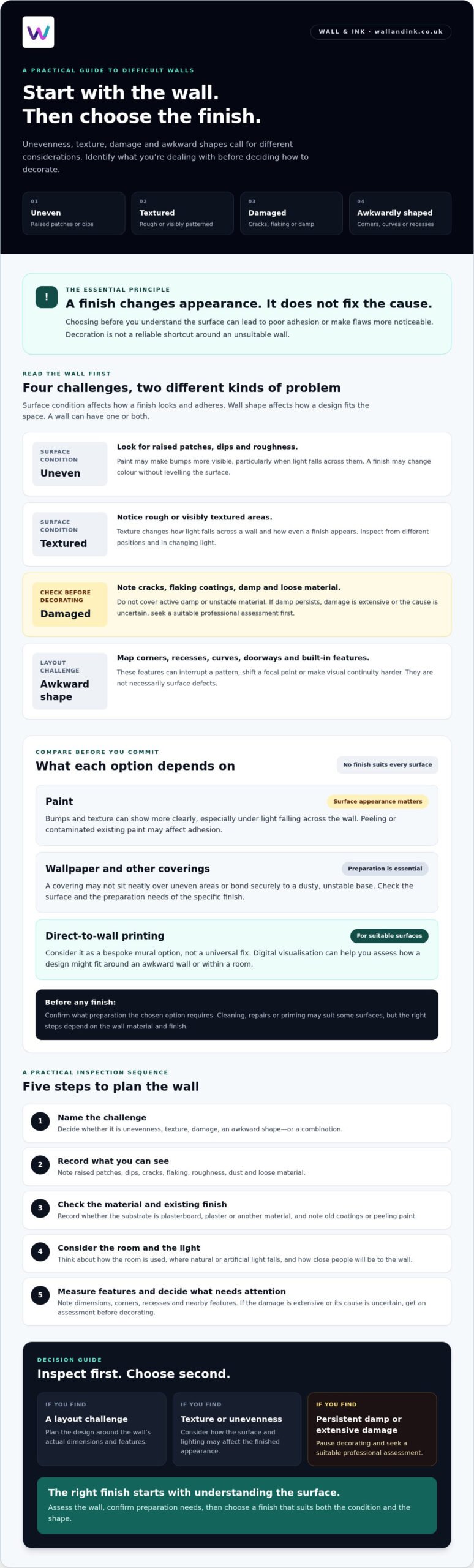
Identify the cause before choosing a finish: decoration can change how a wall looks, but it won’t resolve an underlying problem. Bumps and roughness can affect how even a painted surface appears. A recess or curved section is a layout challenge, not necessarily a defect. Damp, loose material or extensive cracking needs investigation before you add paint or a covering.
Is the wall uneven, textured, damaged or simply awkwardly shaped?
Look across the wall for raised patches, dips, cracks, flaking coatings and rough or visibly textured areas. Note whether the challenge follows an architectural feature, such as a corner, recess or curve, or appears across a flat section. An awkward angle may limit where a design can sit, while surface irregularities can affect the finish itself.
Appearance alone doesn’t confirm the cause. A crack or discoloured patch can have different explanations, so don’t assume it’s only cosmetic. Seek a qualified assessment if damp persists, damage is extensive or you’re unsure whether there may be a structural concern.
What should you check before choosing a decorating solution?
Record the wall material, visible condition and intended use of the room. The surface may be plasterboard, plaster or another substrate, and its material and existing finish can affect the preparation required. For background on plasterboard and its finishing, see understanding drywall surfaces. This is useful context, not a substitute for checking the actual wall.
- Surface: Note the material, texture, uneven areas, cracks and other visible defects.
- Existing finish: Look for old coatings, dust, flaking paint or loose material that could affect preparation. Don’t cover a surface issue without finding out whether it needs attention.
- Room and viewing conditions: Consider how the room is used, where natural or artificial light falls, and how close people will be to the wall.
Light can cast shadows across bumps and texture, making them more noticeable. Viewing distance can also affect how clearly small irregularities show. Inspect the wall from different positions and, if the light changes, at different times of day. These checks help you compare solutions for decorating difficult walls against the actual surface, rather than choosing from appearance alone.
How Surface Condition and Wall Shape Affect Decorating Results
A finish follows the surface beneath it. Paint may make bumps more visible under raking light, while a covering may not sit neatly over uneven areas or bond securely to a dusty, unstable base. Roughness, residue and old coatings can all affect preparation, but the right steps depend on the finish and the wall.
A finish can only be recommended after the surface has been assessed. An assessment helps distinguish preparation needs from defects that require attention first. Cleaning, repairs or priming may be appropriate for some surfaces, but no single method suits every material or decorating option. Confirm the requirements for the finish you’re considering before work begins.
Why do texture and existing damage matter?
Texture affects how light falls across a wall and how evenly a finish appears. A coating may change the colour, but it won’t necessarily level dips or hide raised patches. Existing paint can also affect how a new layer adheres, particularly if it’s peeling or contaminated. Older plaster may need a different repair approach from a modern board surface. The National Park Service guide to Repairing Historic Plaster describes considerations for plaster repair before redecoration.
Don’t cover active damp or loose, unstable material. The cause should be addressed first, or the new finish may not perform as intended. If damage is extensive or you’re uncertain about its source, seek a suitable professional assessment before decorating.
How do corners, recesses and large wall features change the plan?
A recess, curved section, doorway or built-in feature changes the space available for a design. It can interrupt a pattern, shift a focal point or make visual continuity harder to achieve. That’s a layout issue, not necessarily a surface fault, so plan around the wall’s actual dimensions and features.
Measure the wall and note the position of corners, openings, shelves and other fixed elements. Photographs taken straight on and from the sides can help show the shape of the space. For custom artwork, a digital visualisation can help you review the design in context before deciding how it should fit around architectural features.
These checks help narrow down solutions for decorating difficult walls without assuming every surface suits every method. If you’re considering a printed mural, explore direct-to-wall printing for custom artwork and confirm whether the wall is suitable for the proposed application.
Compare Decorating Solutions for Difficult Walls Before You Commit
The best choice depends on both the finish you want and the surface beneath it. Paint, wallpaper, wall coverings and direct-to-wall printing each have different preparation and installation considerations. None suits every wall or every defect, so use this comparison as a starting point and confirm the requirements for the specific material and room.
| Option | Surface suitability | Preparation to consider | Design flexibility | Disruption to plan for |
|---|---|---|---|---|
| Paint | May suit a sound surface where the intended finish works with its texture. | Cleaning, repairs or priming may be needed, depending on the wall and paint system. | Broad choice of colours and finishes; surface irregularities may remain visible. | Allow for preparation, application and drying. The extent depends on the work involved. |
| Wallpaper | Depends on the wall condition, paper and installation requirements. | The surface may need to be clean, stable and prepared for the chosen paper. | Offers varied patterns and imagery, but layout needs to account for joins and features. | Plan for fitting and any preparation needed beforehand. |
| Wall coverings | Suitability varies by covering, room use and underlying surface. | Check what the material requires and whether edges can be finished neatly. | Can introduce different colours, patterns or surface effects. | Consider how fitting, joins and detailing affect the room during installation. |
| Direct-to-wall printing | Requires a surface confirmed as suitable for the proposed application. | Preparation requirements depend on the substrate and should be confirmed with the printing specialist. | Custom imagery can be designed for a mural or artwork in the space. | Discuss the on-site process and site requirements in advance. |
When might paint, wallpaper or a wall covering be worth considering?
Paint can be a practical choice for a simpler finish, provided the wall is prepared appropriately. It won’t automatically conceal unevenness, and lighting can make texture more apparent. Wallpaper may suit a room where pattern or imagery is the priority, but check the wall’s condition and the installation requirements for the paper you choose. For a wall covering, consider how the material will meet corners, openings and edges, as well as how the room is used.
When could direct-to-wall printing be considered?
UV direct-to-wall printing applies custom imagery directly to a suitable wall. It may be worth exploring for bespoke graphics, murals or residential wall art, but it decorates the surface rather than repairing it. Wall & Ink offers bespoke design and digital visualisations to help you assess how artwork might sit within the room. Confirm substrate suitability and preparation with the printing specialist before proceeding.
Compare solutions for decorating difficult walls against the same practical questions: Is the surface suitable? What preparation is required? How will the design work around features? What needs to happen on site? Clear answers make it easier to choose a finish based on the wall, not assumptions.
Plan a Difficult-Wall Decorating Project in Five Practical Steps
A clear plan helps you compare solutions for decorating difficult walls without committing to a finish that doesn’t suit the surface. Work through these steps before arranging materials or installation.
- Inspect the wall. Look across the full surface for uneven areas, cracks, staining, peeling coatings, unusual textures and signs of damp. Note whether the challenge is the surface itself or the shape of the space.
- Document what you find. Record approximate measurements, the wall material if known, visible defects, previous coatings and nearby features such as doors, recesses, corners or built-in units. Take clear photographs in good light, including close-ups of problem areas.
- Address underlying issues. Don’t decorate over persistent damp, loose material or damage whose cause is unclear. Ask a suitable building professional to assess concerns that may need investigation. A decorator can advise on preparation and finish requirements once the surface is stable.
- Compare finishes. Consider the room’s purpose and the result you want, then weigh up preparation, design, edges and joins, and the work needed on site. Project variables include the area to be covered, the wall’s condition, preparation needs and design complexity. There’s no reliable cost estimate without those details.
- Confirm suitability. Before deciding, ask the relevant provider how they assess the substrate and what preparation they expect. For direct-to-wall printing, confirm with a specialist that the specific wall is suitable for the proposed application.
What information should you gather before requesting advice?
Make your photographs useful: take a clear view of the whole wall, followed by close-ups of cracks, rough patches, peeling or other concerns. Add approximate height and width, the surface material if known, and any previous coatings you’re aware of. Describe how the room is used and what you want the finished wall to achieve, such as a plain painted finish or custom imagery.
How can you reduce the risk of choosing the wrong finish?
Ask how the wall will be assessed, what preparation is required and which surface conditions could affect the proposed method. If a design needs to fit around a recess, doorway or other feature, request a digital visualisation to review the artwork in context before confirming the plan. Persistent damp or uncertain structural concerns should be assessed by an appropriate building professional, not treated as decorating issues.
If direct-to-wall printing appears suitable for your project, explore Wall & Ink’s direct-to-wall printing service and discuss the wall surface, design and preparation requirements.
Explore Direct-to-Wall Printing as a Bespoke Solution for Suitable Surfaces
Direct-to-wall printing is one of the solutions for decorating difficult walls worth considering when you want custom imagery rather than a standard finish. Wall & Ink uses UV printers to apply artwork directly to a wall, with bespoke design, digital visualisation and professional on-site printing as part of the process. The key condition is suitability: the wall must be assessed for the proposed application.
Printing changes the appearance of a surface; it doesn’t repair it. It won’t resolve damp, unstable material, cracks or other underlying defects. Those issues need to be investigated and addressed before decoration is considered. An awkwardly shaped wall may still be worth exploring for a custom design, but its surface and features need to be reviewed first.
What happens during a bespoke wall-printing project?
The process starts with discussing the space and the visual result you want. Share your brief and any imagery you’d like considered, such as a logo or artwork. Bespoke design can then be developed around the project, rather than relying on a fixed pattern or format.
A digital visualisation helps you review how the proposed artwork may look in the room. This is especially useful if a recess, doorway or other architectural feature affects the composition. It gives you a chance to consider placement and scale in context before the on-site work is planned.
Before printing, discuss the wall material, visible condition and any previous coatings with the specialist. Confirm preparation requirements and technical compatibility for that specific surface. Professional on-site printing follows, with the approach depending on the agreed project and the wall’s suitability.
Is direct-to-wall printing right for your difficult wall?
It may be worth assessing if you want bespoke imagery on a surface confirmed as suitable. It isn’t a workaround for poor wall condition. Persistent damp, significant damage or loose, unstable material should be dealt with before any decorative finish is applied.
To help establish whether this approach fits, share clear photographs, approximate measurements, details of the substrate if known, and any concerns about the surface. Ask what preparation is expected and whether the proposed artwork can be visualised in the room. Suitability should be confirmed, not assumed.
If you’re considering custom wall artwork, discuss your wall and explore a suitable printing approach with Wall & Ink.
Choose a Finish That Works With Your Wall
The most dependable solutions for decorating difficult walls begin with understanding the surface. Texture, damage and unusual shapes create different challenges, so identify the cause before comparing finishes. Paint, wallpaper, coverings and direct-to-wall printing each have preparation needs, and no option suits every wall.
For a bespoke mural or artwork, direct-to-wall printing may be worth exploring if the surface is confirmed as suitable. Wall & Ink offers design consultations, digital visualisations and professional on-site UV wall printing for residential and commercial projects across the UK. A visualisation can help you consider how custom imagery might fit your room, while a discussion about the surface can clarify suitability and preparation.
Share details of your wall and what you want to achieve to discuss your wall and explore a bespoke direct-to-wall printing solution. With the right assessment, you can move forward with a clear plan and a finish chosen for the surface, not just its appearance.
Frequently Asked Questions
Can you decorate an uneven wall?
Yes, an uneven wall can be decorated, but the suitable finish depends on how pronounced the irregularities are and what caused them. Minor cosmetic dips may call for preparation, though this isn’t a guaranteed fix. Cracks linked to movement, loose material or other damage need assessment before decorating. Check the substrate and the result you want, then compare solutions for decorating difficult walls against the wall’s condition and the preparation each finish requires.
What is the best way to decorate a textured wall?
There isn’t one best finish for every textured wall. The texture, existing coating, room use and appearance you want all affect the choice. Check the preparation needed and whether the selected product or method is suitable for that surface before proceeding. If you’re considering custom printed artwork, share details of the wall with the printing specialist. Don’t assume every texture or substrate is suitable for direct-to-wall printing.
Can wallpaper hide a damaged wall?
Wallpaper may change how a wall looks, but it shouldn’t be treated as a repair for damp, loose material or significant damage. An unresolved surface issue can affect adhesion and the finished appearance. Investigate the cause first, then have the wall repaired where appropriate. Before installation, check the wallpaper manufacturer’s preparation guidance and ensure the surface meets the requirements for the chosen paper.
Can you print a mural directly onto a difficult wall?
Direct-to-wall printing may suit custom artwork, but suitability depends on the wall material, condition and preparation. Printing decorates a suitable surface; it won’t repair defects or resolve damp. Share photographs and details of the substrate with a printing specialist, then confirm the preparation requirements for your specific wall. A digital visualisation can help you review how the proposed artwork may look in the room before agreeing the design.
How do you prepare a wall before decorating?
Start by identifying the substrate and checking for dirt, loose coatings, cracks or signs of moisture. There’s no universal preparation procedure: the required steps depend on the wall’s condition and the finish you’ve chosen. Follow the product or provider’s guidance before starting work. If you find extensive damage, persistent damp or an underlying problem you can’t identify, seek qualified advice before applying a decorative finish.
What should I do about damp before decorating a wall?
Don’t cover active or unexplained damp with a decorative finish. First identify and address the cause, seeking suitable professional help if needed. Unresolved moisture can compromise the decorating result, so painting or covering the area may not solve the problem. Once the underlying issue has been dealt with, reassess the wall’s condition and confirm what preparation is needed before choosing and applying a finish.
How can I decorate a wall with awkward corners or recesses?
Measure and photograph the area, noting corners, openings, recesses and changes in depth. Compare finishes by how their layout and installation will work around those features. For a bespoke mural, a digital visualisation can help you review the artwork in the space and consider how the composition fits. Before work begins, confirm the measurements, surface suitability and installation details with the provider you choose.