
The blank walls in a new build can make a carefully designed home feel unfinished. Choosing wall murals for new builds is about more than finding an image you like: the design needs to suit the room, and the wall and project schedule need to be ready for printing.
It can be difficult to picture how artwork will look across a full wall, especially before furniture is in place. New walls also need consideration before artwork is printed directly onto them. This guide explains how to match a mural to a room’s proportions and purpose, assess wall readiness and plan the work around decorating and moving in.
Bespoke design and digital visualisations can help you review artwork in the room before it is printed. Wall & Ink’s direct-to-wall printing applies the design to the physical wall surface, rather than using wallpaper. From developing the design to professional on-site printing, the aim is to make personalising your new home a considered part of the build, not a last-minute decision.
Key Takeaways
- Choose a feature wall by considering the room’s proportions, natural light and how furniture will sit in the space.
- Plan wall murals for new builds in stages: define the design brief, review a room-specific visualisation and schedule the printing.
- Assess the physical wall separately from approving the artwork. Design sign-off does not establish that the surface is ready.
- Compare direct-to-wall printing and wallpaper by their application methods, preparation needs and project workflows.
- Prepare room photographs, wall measurements, design references and your moving-in timeline to help shape a clear mural plan.
Why wall murals can make a new build feel like home
A new build gives you a clean starting point, but neutral finishes and uninterrupted walls can make rooms feel less individual. A wall mural is a large-scale visual feature designed for a particular wall or space. Instead of occupying a small area like framed art, it makes the wall itself the setting for an image, pattern or scene.
A mural can create a focal point without changing the room’s layout. Its colours and subject can reflect the people who live there while leaving flooring, fittings and furniture as they are. Rather than choosing an image without reference to the room, plan the artwork around the wall’s proportions and the way you use the space.
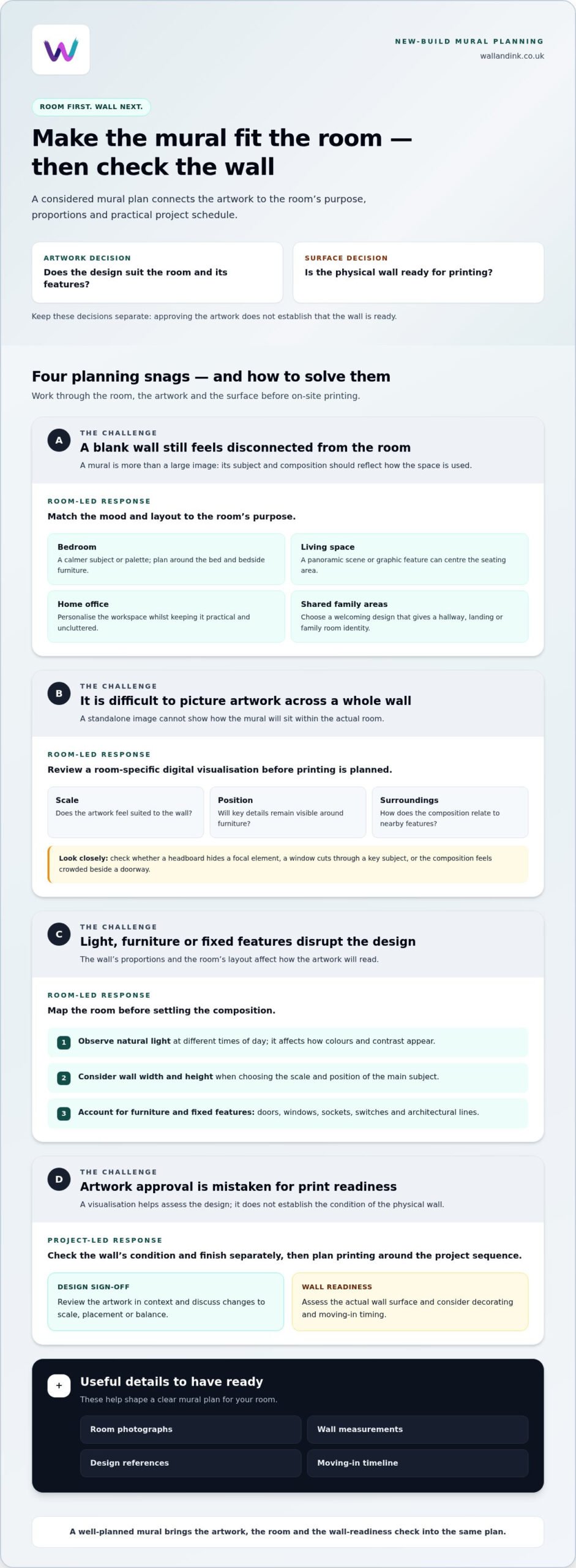
Good planning involves more than choosing a subject. The design, the physical condition of the wall and the project sequence all matter. A visualisation helps you judge the artwork, but it doesn’t establish that the wall is ready for printing. Keeping these decisions connected helps wall murals for new builds feel like part of the home’s design, rather than an afterthought.
What can a mural add to a newly built room?
A mural can give the eye a natural place to settle, such as the wall behind a bed or the end wall of a living area. Its composition can be tailored to the space, with the main subject positioned to work around doors, windows and furniture. This room-specific approach takes the room’s proportions into account, rather than relying on a generic image selected without reference to the wall.
Scale is the main distinction from framed art. One or two pictures occupy defined areas, while a mural can cover a much larger part of the wall and shape the room’s visual character. It might draw on a resident’s interests, a favourite landscape or a considered colour palette. For background on the history and techniques of murals, murals have been used in many settings to make images part of the surrounding architecture.
Which rooms can benefit from a new-build wall mural?
Start with the room’s purpose and the wall you want to emphasise. Artwork should feel appropriate to daily use, not simply fill an empty surface. For example:
- Bedrooms: A calmer subject or palette can support a restful feel, with the composition planned around the bed and bedside furniture.
- Living spaces: A panoramic scene or graphic feature can give a seating area a visual centre without requiring a different furniture arrangement.
- Home offices: A carefully chosen image can make the workspace more personal while keeping the main area practical and uncluttered.
- Shared family areas: A welcoming, easy-to-live-with design can give a hallway, landing or family room a stronger sense of identity.
Not every wall is automatically suitable. Consider its condition and finish before scheduling printing. Wall & Ink’s design consultation and digital visualisations help relate the proposed artwork to the room, while professional on-site UV printing applies the approved design directly to the wall. Treat design approval and wall readiness as separate steps when planning the project.
How to plan a wall mural around your new-build design
A strong mural plan starts with the room, not a catalogue image. Work through the decisions in order: choose the wall, define the brief, develop the artwork, review a visualisation and plan the printing. This keeps the design connected to the space and helps identify practical considerations before the on-site work.
Observe the room at different times of day. Natural light affects how colours and contrast appear, while the wall’s width and height influence the scale and position of the main subject. Consider furniture too. A bed, sofa or desk may cover part of the artwork, so place key details where they will remain visible.
Map fixed features before settling the layout. Doors, windows, sockets, switches and architectural lines can interrupt an image or provide useful boundaries. A design can work around them, but account for them from the start rather than treating them as last-minute obstacles.
How do you choose the right wall and artwork?
Choose a wall that supports the room’s layout and intended use. In a living space, that might be the wall that anchors the seating area; in a bedroom, it could be the surface behind the bed. Then decide what the artwork needs to do: introduce a subject, connect existing colours or create a distinct focal point. There is no single style that suits every new home.
Build the brief around the room’s existing finishes, including flooring, fitted furniture and paint colours. The artwork can complement them without matching them exactly. Photographs, logos or bespoke artwork can also inform the design. Explain where each element should sit and which details matter most to you. For wall murals for new builds, this turns a broad preference into a composition developed for a particular space.
Why visualise a mural before printing?
A digital mock-up lets you judge the proposed artwork in relation to the room before printing is planned. A room-specific digital visualisation places proposed mural artwork into a view of your space so you can assess its scale, position and relationship to surrounding features. It is easier to evaluate the design in context than as a standalone image.
Review the mock-up for details that could be hidden or compete with the room: a focal element behind a headboard, a window cutting through a key subject or a composition that feels crowded beside a doorway. This is the time to discuss adjustments to scale, placement or balance. Visual approval and physical wall readiness are separate decisions, but settling the artwork first gives the project a clearer design direction.
Wall & Ink provides bespoke design consultation and digital visualisations, followed by professional on-site UV printing directly onto the wall. If you’re developing an idea, explore bespoke wall mural design as a way to shape the artwork around your room.
New-build wall readiness: what to consider before printing
Approving the artwork and assessing the wall are separate stages. A digital visualisation can show how a design sits in the room, but it cannot confirm that the physical surface is ready for direct-to-wall printing. Before scheduling the work, consider the wall’s condition and finish as they are now, not just how they appeared on a plan or at an earlier build stage.
A practical review can help identify details to discuss during project planning:
- Cleanliness: Look for dust, marks or residue left by decorating or other building work.
- Visible damage: Note dents, cracks, patched areas or other repairs that may affect the appearance of the finished wall.
- Finish consistency: Check whether the surface looks even across the intended print area, including changes in texture or finish.
- Access: Consider whether the full wall can be reached safely and kept clear during the planned work.
These observations do not replace project-specific technical guidance. Preparation and suitability depend on the wall and its finish, so requirements should be based on the actual project rather than assumed from a general rule. Wall murals for new builds need both a settled design and a surface considered in its finished condition.
What wall details matter in a new build?
Surface texture and condition are useful details to record during planning. A wall that looks smooth may still have local repairs or uneven areas, while changes in finish can be noticeable across a large feature wall. Note incomplete decorating, marks, patches and areas that may need attention. Sharing these observations early makes the preparation discussion specific to the wall, rather than relying on general assumptions about surface suitability.
When should mural printing fit into the move-in plan?
Arrange a wall review when its intended finish can be assessed. If decorating is incomplete or repairs are still planned, the final condition may change. Consider the sequence of other trades, access to the room and whether furniture will obstruct the wall. Printing before a room is furnished can make access simpler, but the best order depends on the wider project and the wall itself.
Include the mural in the project schedule rather than treating it as a final-day detail. Allow time for design development, visualisation, wall review and coordination with other work. If painting or repairs are still under way, account for those tasks before planning the on-site print. Timing should follow the actual finishing schedule and project-specific surface requirements.
Keep the decisions distinct: settle the artwork, review the physical wall and its finish, then coordinate printing with room access and the remaining work. This gives the design and installation plan a practical basis without assuming that a newly built wall is automatically ready.
Direct-to-wall printing or wallpaper for a new-build feature wall?
Both direct-to-wall printing and wallpaper can create a feature wall, but they apply the artwork differently. Direct-to-wall printing uses UV printing to apply the design to the physical wall. A wallpaper mural is a separate covering fitted to the surface. The right option depends on the finish and process you want, as well as the wall’s condition and your project schedule.
How does direct-to-wall printing differ from a wallpaper mural?
With direct-to-wall printing, the artwork is printed onto the wall itself. Wall & Ink brings design development and professional on-site printing together in a planned process. A wallpaper mural is produced as a material and then installed on the wall. Both approaches can display a large-scale image, but one applies it directly to the surface while the other uses a separate wall covering.
| Consideration | Direct-to-wall printing | Wallpaper mural |
|---|---|---|
| Application method | UV printing applies artwork directly to the physical wall. | A separate wallpaper covering is fitted to the wall. |
| Design process | Artwork can be developed for the specific room and reviewed through a digital visualisation. | The selected mural design is produced as a wall covering; the process depends on the chosen design and format. |
| Room preparation | The physical wall’s condition and finish need to be assessed for the project. | The wall must be prepared in line with the requirements for the covering and its installation. |
| Project workflow | Plan design development, wall assessment and on-site printing together. | Plan the covering, wall preparation and installation as connected stages. |
Which approach fits your new-build project?
Start with the application method you prefer. If you want artwork printed onto the wall and shaped around the room, direct-to-wall printing takes the design from development through to on-site application. If you prefer a separate wall covering, a wallpaper mural keeps the image on its own material. Neither format is right for every project; they involve different installation processes.
Then consider the actual wall. Its finish, visible condition and any outstanding decorating work can affect how you plan the project. Room access matters too: furniture, other trades and the move-in schedule all influence when the wall can be worked on. Design approval is not confirmation that the surface is ready. Keep the artwork decision and physical wall assessment as distinct planning steps.
For wall murals for new builds, compare the formats against the room-specific design you want, the wall’s condition and the work still scheduled in the space. If direct-to-wall printing suits your plans, plan a bespoke wall mural with Wall & Ink, from design development through to on-site printing.
Plan your new-build wall mural with Wall & Ink
A clear project journey connects the room, the artwork and the practical arrangements for printing. Wall & Ink’s bespoke mural service begins with a design consultation, develops the artwork for the space, uses a digital visualisation to support your review and moves to professional on-site printing once the design and project arrangements are in place.
What happens during a bespoke mural project?
The consultation establishes which room and wall the mural is for, how the space is used and what visual result you want. Share the wall’s dimensions, nearby features and design references to shape a brief around the actual room, rather than an abstract idea of a feature wall.
Next, the artwork is developed for the space. A digital visualisation gives you a room-specific view of the proposed design, helping you review its scale and placement before the on-site stage. It is a practical way to consider how the composition sits alongside the room’s layout and fixed features.
Once the artwork is agreed, plan the physical work. Wall condition, access and the timing of other decorating or building tasks help determine when printing can be arranged. Wall & Ink’s professional installation uses UV printing to apply the bespoke artwork directly to the wall.
What should you prepare before starting?
You do not need a complete design to begin. A few details about the room and your priorities can give the consultation a clear starting point. Gather:
- Wall measurements: Note the intended print area, including the position of doors, windows and other fixed features.
- Room photographs: Include views that show the wall in context, along with surrounding finishes and nearby furniture.
- Design references: Collect photographs, colour references, logos or artwork that communicate the subjects and visual direction you have in mind.
- Project timing: Record planned decorating, other trades, furniture delivery and your intended move-in schedule.
Also note whether furniture will be in place and how the wall can be accessed during the work. If finishing tasks are still under way, include them in your timing notes so the mural can be planned around the room’s progress. Wall readiness and design approval are separate considerations, so mention visible repairs or incomplete work as part of the project discussion.
With this information to hand, you can discuss a new-build mural project with Wall & Ink and develop a design around the space, from visual review through to planned on-site printing.
Make your new home feel distinctly yours
A mural can be more than a finishing touch. Planned around the room and the way you live in it, it can help a new build feel personal from the moment you move in. Start by turning your ideas into a project plan that accounts for both the design and the wall itself.
Wall & Ink supports that process with bespoke design consultation and digital visualisations, followed by UV printing directly onto the physical wall and professional on-site installation across the UK. This gives you a practical route from an initial concept to artwork considered in its intended setting.
If you’re ready to explore wall murals for new builds, bring your room ideas and project timing into the conversation. Discuss your new-build wall mural with Wall & Ink and take the first step towards a feature wall that feels at home in your space.
Frequently Asked Questions
Can I use my own photograph for a new-build wall mural?
Yes, your photograph can inform a bespoke mural design. Share the original image and explain which parts matter most, such as a person, landscape or particular detail. The design can be arranged for a larger wall, rather than simply enlarged without adjustment. Make sure you have permission to use the photograph, especially if someone else took it, and discuss how it could work in the space.
How do I measure a wall for a mural?
Measure the full width and height of the intended area, recording the figures clearly and in the same units. Note anything that interrupts the surface, such as a door, window, radiator or fitted cupboard, and measure its position from the nearest wall edges. Take room photographs as a visual reference, but do not rely on them instead of dimensions. These details help the design team understand the area the mural needs to occupy.
Will a wall mural work in a small new-build room?
Yes, a mural can be planned for a smaller room, but the composition needs to suit the available wall and viewing distance. An image with several competing focal points may feel busy, while a simpler arrangement can give the eye a clearer place to rest. Consider what will be visible from the doorway and where furniture sits. A digital visualisation can help you assess the proposed scale in context before the design progresses.
Can a wall mural include doors, windows or sockets in its design?
Yes, these features can be considered when developing the composition. A window might frame part of a scene, while a socket or switch could sit within a quieter area of the image. Share accurate positions and photographs so the design can account for the room’s layout. Some features may interrupt important details, so review their relationship to the artwork in the visualisation before approving the design.
Does a wall mural need to match the new-build developer’s interior scheme?
No, it does not have to match the original scheme exactly. Use existing finishes as context, then decide whether the mural should complement their colours or introduce a deliberate contrast. For instance, artwork in a room with neutral flooring and fitted furniture could bring in a personal colour choice without changing those fixtures. Aim for a considered relationship with the room, not a perfect match to every finish.
Can a wall mural be changed if I redecorate later?
A future change is possible, but the next step depends on how the mural was applied and what finish you want afterwards. Direct-to-wall printing is applied to the physical wall, so do not assume it can be removed like a separate covering. Before planning a new colour or treatment, consider the existing wall and the work needed to prepare it for the updated scheme. Project-specific surface guidance can help inform those plans.
How should I clean a printed wall mural?
Follow the care guidance provided for your specific printed surface rather than applying a general cleaning method. Do not assume household sprays, abrasive cloths or vigorous rubbing are suitable, as the correct approach depends on the wall and finish. If a mark appears, note its location and the material involved before deciding how to treat it. This helps avoid an untested cleaning method affecting the printed artwork or surrounding surface.