
Hospitality graphics should do more than make a wall look finished. Planned well, they can make your venue more recognisable, help guests navigate key spaces and express your identity while fitting the way your venue operates.
It’s understandable to be unsure where graphics will have the most impact, or whether a design will work with your walls, surfaces and existing interiors. Practical concerns matter too: plan printing around the venue’s operations, choose a design that suits the setting and check every brand detail before printing begins.
This guide explains how to plan hospitality graphics around the guest journey, from entrances and reception areas to restaurants, bars and shared spaces. You’ll learn how to choose suitable locations, align the design with your venue and consider durability and operational needs. We’ll also explain how Wall & Ink’s consultation and free design visualisation help you review a concept before professional direct-to-wall printing brings it to life on site.
Key Takeaways
- Plan hospitality graphics around the guest journey, with different priorities for arrival areas, dining spaces and busy shared zones.
- Use consistent imagery, colour and typography to make your venue’s identity recognisable across guest-facing spaces.
- Compare wall-graphic formats by their finish, surface suitability, design flexibility and practical limitations.
- Build a useful project brief with clear objectives, accurate wall measurements, photographs and brand assets.
- See how WALL&INK’s consultation, design visualisation and professional on-site direct-to-wall printing can take a concept into your venue.
How hospitality graphics shape a more coherent guest experience
Hospitality graphics are visual communication applied to guest-facing spaces to express a venue’s identity and shape how people experience it. They can include imagery, colour, typography and graphic compositions printed or displayed on walls. In practical terms, hospitality graphics connect a brand to the physical spaces where guests arrive, wait, dine and spend time together.
The strongest approach goes beyond filling an empty wall. A mural might draw on a restaurant’s menu or interior palette, while a carefully placed graphic could introduce the story behind a hotel’s design. Repeating selected visual elements across different areas creates familiarity, even when each space has a distinct purpose. A consistent type style, for example, can help a welcoming reception and a relaxed dining room feel part of the same venue.
There’s a useful distinction between graphics that are purely decorative and those with a clear role. Decorative imagery can establish atmosphere or provide a focal point. Graphics can also support orientation by making an area’s function more apparent, or tell a brand story through images and visual details. They should complement clear service, signage and navigation, not replace them. Guests still need to find their way and understand how a space works.
Which guest needs can hospitality graphics support?
Guests begin forming an impression as they enter. A graphic at the entrance can signal whether a venue feels formal, lively, contemporary or connected to a particular theme. In a waiting area, a considered feature wall can make the space feel intentional. In a dining area, imagery can reinforce the mood without competing with conversation or the food.
Shared areas serve different needs. A visual feature might help distinguish a lounge from a corridor or give guests a recognisable point of reference. These choices work best when they reflect how people use the space. Hotel design principles and history provide helpful context for understanding how a hotel’s functions and spaces fit together, and where visual communication can contribute.
Where does visual consistency matter across a venue?
Consider each area on its own terms. An entrance may need to make a clear first impression; reception can express the brand more directly; dining spaces may benefit from imagery that supports their atmosphere; and shared guest areas should feel connected without becoming visually busy. A graphic that works behind a reception desk may not suit a high-traffic corridor or a quiet lounge.
Build the brief around a shared visual language, not identical walls. Select recurring cues, such as a colour palette, image style or typographic treatment, then adapt their scale and placement to each area’s function. This balance makes a venue recognisable as guests move through it, while allowing each space to feel suited to its purpose.
Plan hospitality graphics around the guest journey and venue function
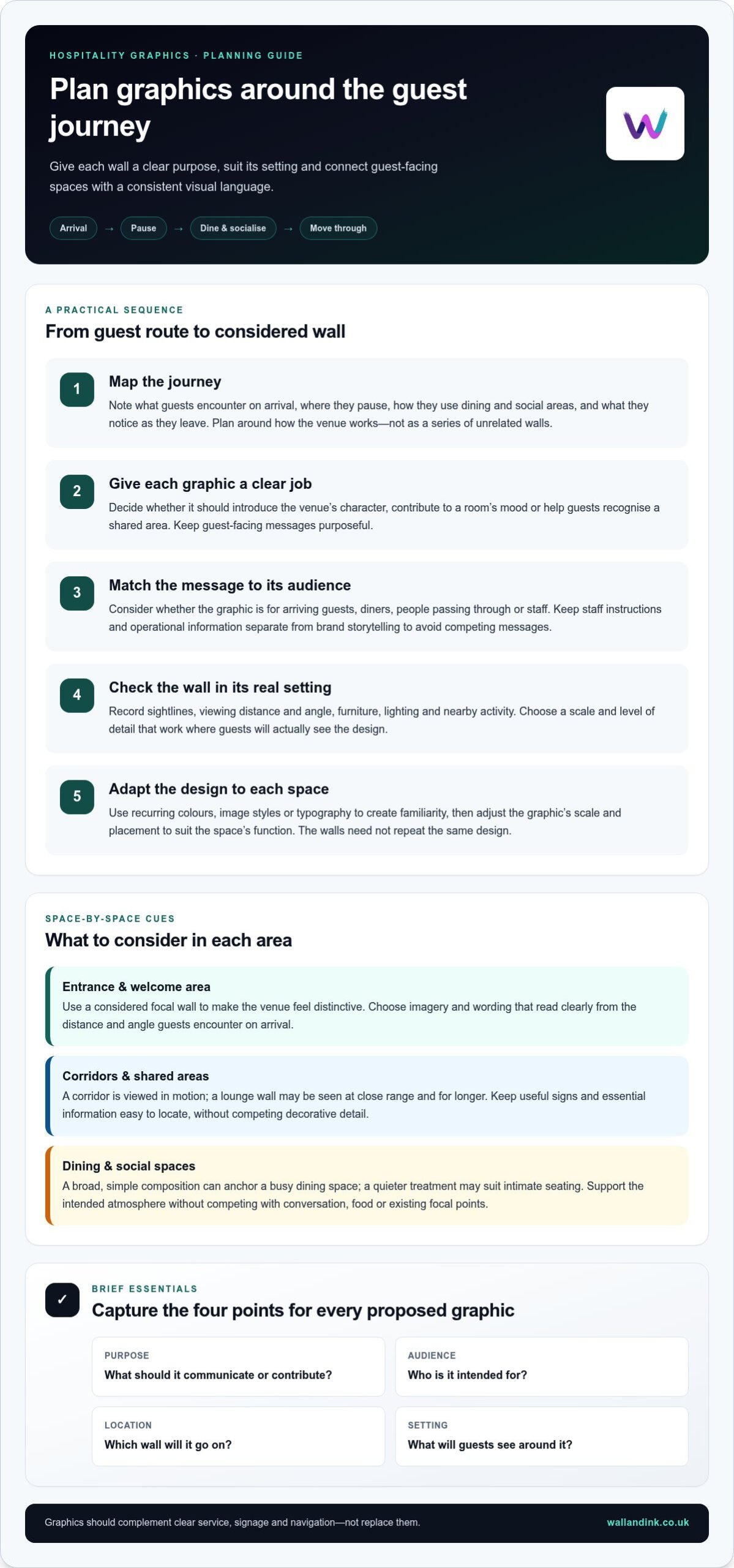
Map the guest journey before choosing a wall or developing artwork. Consider what a person encounters on arrival, where they pause, how they use dining and social areas, and what they notice as they leave. This keeps hospitality graphics connected to the way the venue works, rather than treating each wall as a separate design opportunity.
Give each graphic a defined job. It might introduce the venue’s character, contribute to the mood of a dining space or help guests recognise a shared area. Guest-facing messages should be clear and purposeful. Staff instructions and operational information have a different audience, so avoid combining them with brand storytelling on one wall. Too many competing messages make it harder to understand what matters.
Use arrival and shared spaces to establish the venue identity
A considered focal wall can make an entrance or welcome area feel distinctive. Choose imagery and wording that suit the distance and angle from which guests will see them. Fine detail may disappear from across a reception area, while a large, high-contrast element can dominate a compact waiting space. Note sightlines, furniture, lighting and nearby activity in the brief, so the design works in its actual setting.
Shared areas need their own assessment. A corridor is viewed in motion; a lounge wall may be seen at close range and for longer. Think about what guests can see from the entrance, a seat or a natural stopping point. Keep essential information easy to locate, and avoid placing decorative detail where it competes with directions, staff interactions or useful signs.
Make dining and social spaces feel intentional
Scale and visual density influence a room’s character. A broad, simple composition can give a busy dining space a visual anchor, while a quieter treatment may suit an intimate seating area. Consider the existing finishes and focal points, including artwork, lighting and furniture. The aim is to support the intended atmosphere without making the wall compete with the activity around it.
A shared design system can link different zones through recurring colours, image treatments or typography. It doesn’t require every wall to repeat the same graphic. Use a stronger expression in a social area and a more restrained version near quieter seating, while keeping the overall visual language coherent.
Before developing artwork, record four points for each proposed graphic:
- Purpose: What should this graphic communicate or contribute?
- Audience: Is it intended for arriving guests, diners, people passing through or staff?
- Location: Which wall will it go on, and what will guests see around it?
- Response: What should guests notice, understand or feel?
This short checklist helps turn a collection of visual preferences into a useful design brief. For a hospitality wall-printing project, WALL&INK’s direct-to-wall printing can translate a venue concept into a graphic planned for its specific space.
Compare hospitality graphic formats by surface, finish and use
The right format depends on the surface, the design brief and how the finished graphic will be used. Hospitality graphics might be printed directly onto a wall, produced as wallpaper or applied as a vinyl graphic. Each method creates a different finish and involves different practical considerations. No single option suits every wall or venue.
| Format | Seamless appearance | Surface compatibility | Design flexibility | Practical considerations |
|---|---|---|---|---|
| Direct-to-wall printing | Can create a continuous mural without wallpaper panel joins. | Depends on the wall’s condition, finish and suitability for printing. | Artwork is printed onto the wall itself and can be tailored to the space. | The wall needs to be assessed and prepared for the print method. The finish becomes part of the wall surface. |
| Wallpaper | Panels meet at joins, so alignment can affect the overall appearance. | Suitability depends on the wall and the wallpaper system being used. | Printed patterns and murals can cover a broad area, subject to panel layout. | Installation involves applying material to the wall; joins and edges form part of the finish. |
| Applied vinyl | Individual pieces or sections may have visible edges. | Depends on the surface and how well it suits an applied graphic. | Can suit defined shapes, lettering or selected graphic elements. | Application and edges need to be considered in relation to the wall and design. |
When direct-to-wall printing may suit a hospitality interior
Direct-to-wall vertical printing applies the design to the wall itself. It can suit a brief that calls for a continuous visual treatment, such as a mural spanning a feature wall without wallpaper panel joins. WALL&INK’s prints are moisture-resistant, but not waterproof, so consider this distinction when choosing the location and intended use.
Surface condition and dimensions influence the result. A large, uninterrupted wall may suit a continuous composition, while obstructions, changes in wall plane or an existing textured finish can affect how the artwork reads. WALL&INK’s direct-to-wall printing service includes a project-specific design visualisation to show the proposed graphic in context.
Assess alternatives against the wall and project brief
Start by recording the wall’s material, existing finish, dimensions and any features that interrupt the print area. Then consider the required appearance: a wall-integrated mural, a wallpaper finish or separately applied graphic elements. Let the brief and the actual surface guide the decision, rather than assuming one format always performs best.
Also consider how the wall will be used and maintained. A graphic in a dining area has different exposure from one in a busy shared space. Define the required finish and intended use before selecting a format. The right graphic format is the one that fits the surface, the brief and the way the space is used.
Prepare a hospitality graphics brief that works in the real space
A clear brief connects the design idea to the wall it will occupy. It gives the design team practical information about the venue, the intended audience and the result you want before artwork is finalised. Surface type and condition, wall dimensions, lighting and nearby fixtures all influence the print plan, so include them from the outset.
Build a useful brief from brand assets and space details
Start by identifying who the graphic is for, what it should communicate and exactly where it will sit. Note how it relates to existing branding, such as the venue’s colours, logo, typography and imagery. Share original brand assets and photographs where possible. These give the design process a clear reference and help adapt the concept into wall-ready artwork.
Record the wall’s height and width, and mark any areas that cannot be printed, such as doors, shelves or fixed equipment. Include a clear photograph of the whole wall, taken as straight-on as possible, plus closer views of its surface and any visible damage or texture. Mention the wall material and finish if known. Accurate measurements and surface details help establish the scale, placement and preparation required for the proposed artwork.
Review the design in context before printing
A digital visualisation places the proposed graphic in the room, making it easier to judge scale and position than viewing artwork on a screen alone. WALL&INK includes a free design visualisation and free consultation with every booking. Use the review to consider whether the composition suits the wall and remains legible from the viewpoints guests are likely to have.
Check the details carefully before approving artwork. Does the design compete with a menu board or sign? Will a fixture obscure part of the image? Does lighting create glare or leave important areas in shadow? Look at contrast against the wall and surrounding finishes, and review how the artwork meets edges, corners and openings. Small changes at this stage can help avoid a mismatch between the approved design and the physical space.
Use this sequence to move from initial idea to a prepared site:
- Define the objective. State what the graphic should communicate or contribute to the guest space.
- Identify the audience and location. Specify who will see it and where they will view it from.
- Gather dimensions and references. Supply wall measurements, photographs, surface details and brand assets.
- Review the visualisation. Assess scale, contrast, composition and nearby fixtures in context.
- Prepare the site. Plan how the area, furniture and access will be managed for on-site printing, and make sure the wall is ready for the work.
Practical planning helps the design and the venue work together. Explore WALL&INK’s hospitality graphics service to develop the brief and review a visualisation for your space.
How WALL&INK delivers hospitality graphics with direct-to-wall printing
WALL&INK’s Retail & Restaurant Wall Printing UK service gives hospitality venues a direct route from a design concept to a professionally printed wall. Instead of applying a separate graphic covering, direct-to-wall printing places the approved artwork on the surface itself. It can create a continuous mural that carries a venue’s identity across a feature wall or brings a considered design to a defined area.
What to expect from WALL&INK’s wall-printing process
The project begins with a free consultation to discuss the venue, the proposed wall and the result you want. The wall’s dimensions, surface and condition help inform the practical plan, while your brand assets and creative direction guide the artwork. WALL&INK can print on plaster, brick, concrete, painted walls, wood, tile and glass, with the project tailored to the surface and brief.
Next, a free digital design visualisation shows how the artwork could appear in the space. This gives you an opportunity to review scale, placement and composition before printing. Consider the design alongside nearby fixtures, furniture and lighting, and make any refinements before approving the final artwork. Once approved, WALL&INK carries out professional on-site printing, applying the design directly to the wall.
UV-cured inks are odourless, quick-drying and safe for indoor use, including in nurseries, schools and healthcare settings. The process is planned around the physical wall and approved visual, rather than relying on a one-size-fits-all graphic. Sharing accurate measurements, clear photographs and relevant brand files helps the consultation and visualisation reflect the venue more closely.
Understand the finish, protection and next step
The printed finish is moisture-resistant, not waterproof, and resists light surface scratches. An optional clear protective coating is available for high-traffic areas. Keep these practical considerations in mind when deciding where artwork should go and how it will be used. A 12-month warranty covers ink fading, peeling or material defects under normal indoor conditions.
Pricing is transparent, with no hidden costs. Standard wall printing starts from £120 per m² for smooth, light-coloured walls without a base coat. Printing on dark or textured surfaces starts from £150 per m² and includes a white base layer. A minimum job fee of £300 applies to all wall-printing projects. The consultation and visualisation help establish the artwork and its placement before the on-site print, so you can review decisions with the intended wall in view. Plan access to the wall and consider any furniture or fixtures that need attention before printing.
For venues planning distinctive hospitality graphics, discuss a hospitality graphics project with WALL&INK and take the next step from brief to wall-ready design.
Give your venue’s next wall a clear purpose
A considered wall can do more than fill an empty space. It can become a recognisable part of the guest experience, reflecting what makes your venue distinct. Start with one clear priority: decide which area would benefit most from a stronger visual identity, then define what you want guests to notice or take away from it.
That focus gives your hospitality graphics a practical starting point. It keeps design decisions connected to the venue, rather than adding detail for its own sake. As ideas take shape, involve the people responsible for the space and consider how the finished wall will fit its everyday use.
When you’re ready to develop that first idea, discuss your hospitality graphics project with WALL&INK. A purposeful brief is a solid first step towards a guest space that feels considered, distinctive and true to your venue.
Frequently Asked Questions
Can hospitality graphics be printed directly onto different wall surfaces?
Yes. WALL&INK can print directly onto plaster, brick, concrete, painted walls, wood, tile, glass and most painted surfaces. The existing wall still matters: its material, finish and condition can affect how the design is planned. Include a clear photograph and accurate measurements in your brief, and identify any uneven areas, openings or fixtures that could affect the print area.
Are UV-cured inks suitable for indoor hospitality spaces?
Yes. WALL&INK uses UV-cured inks that are odourless, quick-drying and safe for indoor use, including nurseries, schools and healthcare settings. That makes them suitable for guest-facing interiors such as reception areas, restaurants and hotel rooms. The finished design can be planned around the room’s use and existing interior details. For the best visual result, review the artwork in context, including its contrast with the wall and nearby furnishings.
Are hospitality wall graphics waterproof?
No. WALL&INK’s hospitality wall prints are moisture-resistant, but they aren’t waterproof. Don’t treat moisture resistance as protection for a wall that is regularly exposed to water. Consider the conditions in the intended location before choosing where the graphic will go. An optional clear protective coating is available for high-traffic areas, but it doesn’t change the stated moisture limitation.
Can a business use its existing logo or photographs in hospitality graphics?
Yes. WALL&INK can adapt existing logos and photographs into wall-ready artwork. Supply the original files where possible, rather than a small screenshot, and share any brand colours or layout guidance to be followed. Explain where the graphic will sit and which parts of an image must remain visible. This helps shape the design for the available wall area and show how it will appear in the room.
How long does a hospitality wall-printing project take?
The schedule depends on the project, so allow time for consultation, artwork preparation, visualisation review, site preparation and on-site printing. The wall’s size and condition, the design requirements and the time needed to review the visualisation all affect planning. Share operational constraints early, such as access to the wall or periods when the space is in use, so they can inform the arrangements.
What warranty applies to WALL&INK hospitality wall prints?
WALL&INK provides a 12-month warranty covering ink fading, peeling or material defects under normal indoor conditions. The coverage applies to normal indoor use, so it shouldn’t be read as a claim that the print is waterproof or suitable for every environment. Keep the warranty scope in mind when selecting the wall and intended location for your hospitality graphic.