
A recognition wall should make appreciation visible, specific and easy to keep current. The strongest employee recognition wall ideas use three or four clear categories, put shout-outs where colleagues will see them and add fresh recognition regularly. That turns an empty display into a practical way to celebrate contributions and shared values.
It’s easy to see why a team might want a place to recognise good work. What makes the difference is meaningful praise: name the action, explain its impact and connect it to the behaviours your organisation values. This guide explores creative ways to recognise individuals and teams, keep a wall active and make it work for your workplace, whether you choose a physical feature or a digital format.
Key Takeaways
- Choose a physical, digital or virtual format that suits how your team works and where employees can access recognition.
- Make praise specific by describing the action, its impact and the shared value it demonstrates.
- Keep the display current with a clear owner and a regular refresh schedule, so recognition stays visible and relevant.
- Use creative features such as team milestones or process improvements to celebrate contributions beyond individual targets.
1. Why You Need An Employee Recognition Board?
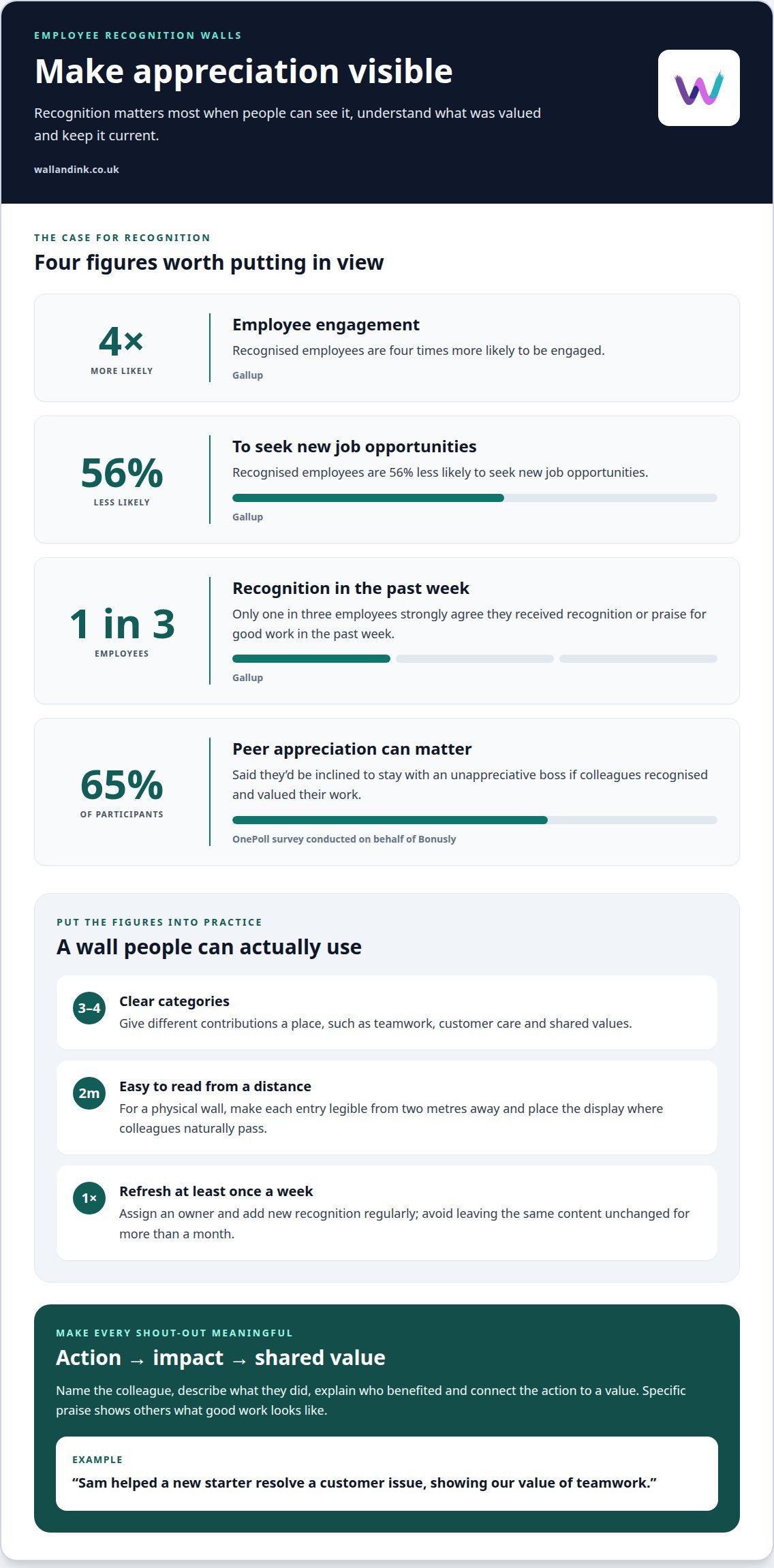
A recognition board gives good work a visible place beyond a manager’s inbox. Gallup reports that only 1 in 3 employees strongly agree they received recognition or praise for good work in the past week. A board can make contributions easier to notice across the workplace, from positive customer feedback to a colleague helping solve a delivery problem. The right format depends on who needs to see recognition and where they work.
A physical wall works well in a shared office, meeting room or communal area. Place it where employees naturally pass, and make each entry legible from two metres away. Use 3-4 categories, such as teamwork, customer care and shared values, so different contributions have a clear place. A template that’s easy to update weekly helps keep milestones and everyday achievements visible.
A digital wall can bring employees together across different sites and working patterns. Set it up in a shared digital workspace where staff can view shout-outs and submit nominations. Keep the layout simple: group posts by category, make names and reasons easy to scan, and provide a clear way to add contributions. Colleagues can also revisit the recognition when they’re away from the office.
A hybrid format pairs a physical display with one digital source of truth. For example, publish nominations in a shared feed, then select highlights for an office screen or printed wall. This helps remote and office-based employees see the same recognition instead of splitting updates across disconnected displays. For teams working asynchronously, a virtual wall keeps recognition accessible without relying on everyone being present.
How can you make recognition fair and inclusive? Set clear categories and consistent criteria, then let colleagues across roles and shifts nominate one another. Review who receives recognition and which contributions appear, so visibility doesn’t depend only on proximity to leaders.
For a digital board, appoint a moderator to review submissions and keep personal details appropriate for the audience. Set a simple routine: collect nominations, check that each post names a specific action, then publish it to the agreed feed. Embed the board in a digital workspace employees already use, and share a physical summary for colleagues who rely on on-site displays. Build access and upkeep into the format from the start.
2. Benefits of employee recognition walls
A recognition display makes contributions easier to notice beyond an employee’s immediate team. Gallup found recognised employees are four times more likely to be engaged. Gallup also found they are 56% less likely to seek new job opportunities. These findings underline why appreciation should be visible, specific and connected to everyday work. A spotlight on collaboration, customer care or a colleague’s practical help can show others what success looks like. It gives leaders a concrete reason to celebrate actions, not just outcomes.
For a physical office display, choose a spot people naturally pass, such as the route to a shared kitchen or a meeting-room entrance. Put the main highlights at eye level, use clear headings and leave enough space around each entry. A wall crowded with text makes individual achievements harder to notice. Separate team successes, personal milestones and examples of shared values in a simple layout. Staff can then find relevant recognition quickly, whether they stop briefly or take a closer look.
Keep participation active by assigning an owner and setting a refresh routine. Add new entries at least once a week, and avoid leaving the same content unchanged for more than a month. Rotate highlights across roles and teams instead of focusing only on highly visible departments. Cards or a magnetic surface make a physical board easy to update. Rewards can accompany public appreciation, but choose them to suit the achievement and the person. Recognition itself should explain what someone did and why it mattered.
A welcome wall can help new employees connect names with teams and responsibilities. Add a short introduction, the person’s role and a detail they’re happy to share, such as a work interest or favourite project type. Ask before publishing personal details, including birthdays. Refresh the display when responsibilities change, so the information remains useful. For a lasting visual setting that gives workplace highlights a defined home, explore wall display possibilities.
3. Employee shout-outs and values
Peer shout-outs recognise effort that managers may not see directly. In a OnePoll survey conducted on behalf of Bonusly, 65% of participants said they’d be inclined to stay with an unappreciative boss if colleagues recognised and valued their work. That makes everyday messages from teammates a useful part of workplace culture, not simply a formal award.
What should you include on an employee recognition wall? Name the colleague, describe the specific action, explain its impact and connect it to a shared value. For example: “Sam helped a new starter resolve a customer issue, showing our value of teamwork.” This gives readers a clear reason for the recognition and makes the praise more meaningful than a general “great job”.
Make peer-to-peer shout-outs easy to write and understand. A short prompt can ask: “What did they do?”, “Who benefited?” and “Which value did it demonstrate?” One colleague might thank a teammate for sharing clear handover notes; another could recognise someone who stepped in during a busy shift. Specific examples help celebrate contributions across roles, not just highly visible projects.
For remote and hybrid teams, publish messages in a shared digital space that colleagues can access wherever they work. Invite employees to nominate peers, then carry selected shout-outs onto a physical display if the office has one. A daily update can capture timely praise, while a weekly Friday recap can highlight thank-yous given and a colleague receiving recognition for the first time.
Keep the process authentic by accepting recognition regularly, without treating every routine task as an award. Include examples linked to values such as collaboration, customer care or sharing expertise. Before publishing, check that the message names an action and its effect, and that the person is comfortable with public recognition. This simple review keeps the wall respectful and gives each shout-out a clear purpose.
4. Creative recognition ideas
A memorable wall can tell a story, not just list names. Build a company-success timeline featuring key achievements and the people behind them. Add a process-improvement feature showing what changed, who contributed and how colleagues benefit. These employee recognition wall ideas make praise specific and show how everyday effort supports wider progress. Rotate highlights onto an office screen or printed display so remote and on-site teams can share the same recognition.
How do you create an employee recognition wall step by step? Choose a purpose, such as celebrating teamwork or improvements, then pick a physical, digital or hybrid format. Set clear categories, invite nominations and decide who updates the display. Add a dated example for each achievement, then review the wall regularly. A quarterly leaderboard can recognise awards across a three-month period, but pair rankings with stories about contribution.
Small businesses can start with a whiteboard, coloured pens and sticky notes. Give the board a clear title, leave room for handwritten shout-outs and assign someone to refresh it weekly. A Friday-reset board can be photographed and wiped every Friday afternoon, ready for new messages. This simple approach needs no elaborate platform, while a shared digital document can include remote colleagues.
Vary the content. Recognise a shift worker’s reliability, such as having zero absences in a quarter, or celebrate a colleague who improved a business process. Add team photos only with the pictured colleagues’ agreement. A monthly theme, such as customer care or collaboration, can prompt relevant nominations. Avoid turning the board into a contest: include individual stories and team achievements alongside any leaderboard.
Keep the display active by rotating achievements from the previous week, month or quarter. A wall left unchanged can become background within a fortnight, so refresh its content and remove outdated highlights. For a lasting visual feature, plan a recognition wall display that gives achievements a clear place in your workplace. These employee recognition wall ideas can help make that space purposeful and engaging.
Wall & Ink: Direct-to-Wall Printing
Wall & Ink creates custom wall graphics using Direct-to-Wall Printing, giving recognition displays a permanent, purpose-designed setting. It’s a practical option when a business wants its values, team milestones or recognition themes integrated into the workplace rather than pinned to a temporary board.
For offices, Commercial Wall Murals can turn a suitable wall into a coordinated visual feature. Residential Wall Art and School and Educational Murals offer alternatives for other spaces where recognition should feel relevant to its audience. Wall & Ink develops bespoke designs and digital visualisations, helping you picture how the finished wall will fit the space before on-site installation.
Planning a lasting recognition feature? Contact Wall & Ink or visit wallandink.co.uk.
Make recognition part of your workplace identity
Think beyond how the wall looks on launch day. Decide what it should communicate over time: which behaviours matter to your culture, whose contributions deserve visibility, and how recognition can evolve as teams and priorities change. That forward-looking brief can guide wording, imagery and layout before design begins. Consider how the feature will stay clear as new messages are added.
Before developing the concept, gather the phrases employees use for shared values, the moments worth recognising and the visual style that suits your space. Keep the direction focused rather than trying to display every achievement at once. A considered design gives your recognition programme room to grow without losing its purpose. The best employee recognition wall ideas connect with real people and how they work, rather than feeling like a separate decorative exercise.
When you’re ready to develop that concept into a wall feature, contact Wall & Ink about your recognition wall. Start with a clear idea and create a space your team can make its own.
Frequently Asked Questions
Why do you need an employee recognition board?
An employee recognition board helps teams notice contributions that routine reporting can miss. It creates a shared record of useful work, such as a colleague documenting a fix that prevents repeated customer queries. That record can support team discussions, onboarding and retrospectives by showing how workplace values appear in real decisions. It works best alongside direct, personal thanks, not as a replacement.
What are creative employee recognition wall ideas for an office?
Feature a “lessons shared” panel where colleagues recognise someone whose expertise helped others. For example, a team member could share a spreadsheet shortcut that saves time and credit the colleague who taught it. Another option is a “firsts and discoveries” section for new approaches, useful questions or skills learned. These prompts celebrate contribution without relying only on targets or awards.
How often should an employee recognition wall be updated?
Add recognition once a specific contribution has been verified, rather than waiting for a monthly ceremony. In a regular review, remove outdated posts, check that different teams are represented and look for gaps in nominations. If submissions are sparse, offer a focused prompt, such as recognising helpful knowledge-sharing. This keeps the display relevant without filling it with routine praise or rushed entries.
What are the risks of employee recognition walls, such as favouritism or privacy concerns?
Public displays can create perceptions of favouritism if the same roles or people appear repeatedly. Posts can also expose sensitive information if they include personal circumstances, performance details or identifiable customer stories. Set boundaries for what can be shared, avoid ranking colleagues publicly and offer a private way to raise concerns. Regular reviews can reveal patterns and help keep recognition respectful.