
The traditional method of branding an office with vinyl wraps and wallpaper is a waste-management crisis disguised as interior design. Most facilities managers recognise the frustration of peeling away expensive decals during a rebrand, only to find the surface damaged and the materials destined for a landfill. As you work to meet the rigorous emissions evaluations required by LEED v5 whilst maintaining a premium brand image, finding genuine eco-friendly office branding solutions has become a matter of regulatory necessity rather than just a design preference.
You don’t have to choose between a high-end aesthetic and your net-zero obligations. Discover how to transform your corporate environment with zero-waste, direct-to-surface branding that eliminates the environmental impact of traditional vinyl and wallpaper. This guide examines the technical precision of direct-to-wall printing, explains how it bypasses the VOC challenges inherent in legacy materials, and demonstrates why removing the substrate is the only way to achieve true sustainability in 2026.
Key Takeaways
- Learn how to move beyond greenwashing by adopting circular economy principles that focus on measurable waste reduction in your 2026 workplace design.
- Understand the technical process of using UV-curable inks to print directly onto any surface, effectively creating eco-friendly office branding solutions without the need for plastic substrates.
- Analyse the lifecycle costs and carbon footprints of different branding methods to see why eliminating vinyl and wallpaper reduces long-term maintenance and removal expenses.
- Follow a step-by-step guide on auditing your office surfaces and collaborating with specialists to align your wall graphics with corporate ESG targets.
- Discover how digital visualisation and industrial precision ensure your branding is executed flawlessly across multiple substrates with minimal disruption to your daily operations.
The Evolution of Eco-Friendly Office Branding Solutions in 2026
The year 2026 represents a fundamental shift in how corporate environments are engineered. For over a decade, sustainability in office design was often treated as a secondary aesthetic choice or a box-ticking exercise. Today, the focus has moved toward measurable waste reduction and the integration of circular economy principles into every fit-out. True eco-friendly office branding solutions are no longer defined by recycled-content claims that lack transparency. Instead, they are defined by the total elimination of waste substrates. Pragmatic decision-makers now prioritise permanent, durable surface art over temporary stick-on graphics that inevitably degrade and require replacement.
Why Sustainability is No Longer Optional for UK Workplaces
Modern UK businesses face intense pressure from both institutional investors and a workforce that demands ethical, low-impact environments. Integrating Green building principles into your office design is a strategic requirement for achieving BREEAM or LEED v5 certifications. These standards now demand rigorous emissions evaluations rather than simple VOC content checks. Beyond compliance, there is a clear link between sustainable interiors and talent retention. Employees in the UK increasingly prefer working in spaces that reflect their own values. A brand that invests in long-term, sustainable workplace graphics demonstrates a commitment to technical excellence and environmental responsibility that resonates far more than superficial marketing.
The Hidden Environmental Cost of Traditional Signage
Traditional branding methods rely heavily on PVC-based vinyl and composite wallpapers. These materials present a significant lifecycle problem. Whilst some manufacturers claim their vinyl is recyclable, the reality of the UK waste infrastructure often makes this impossible. Most used vinyl ends up in landfill because the adhesives and backing papers contaminate the recycling stream. Traditional wallpaper pastes also introduce VOCs that compromise indoor air quality for months after installation. By moving away from these legacy materials, you eliminate the cost and hassle of removal whilst significantly reducing your carbon footprint. The shift toward direct-to-surface application ensures that your branding remains a high-resolution, permanent feature of the architecture, rather than a piece of plastic destined for disposal.
Direct-to-Wall Printing: A Zero-Waste Approach to Workplace Graphics
Achieving a zero-waste office environment requires a departure from traditional physical substrates. Whilst vinyl and wallpaper introduce additional layers of plastic and adhesive into a space, direct-to-wall printing applies high-resolution graphics straight onto your existing architecture. This method represents the pinnacle of eco-friendly office branding solutions by eliminating the manufacturing, transport, and disposal waste associated with traditional materials. The process uses industrial-grade machinery to deposit ink with microscopic precision. It ensures that the final output is as durable as it is sustainable, turning your walls into a high-performance canvas without the environmental baggage of legacy media.
The Science of UV-Curable Inks and Indoor Air Quality
The environmental superiority of direct printing lies in the chemistry of UV-curable inks. Traditional solvent-based printing relies on the evaporation of chemicals into the air to dry, which releases harmful pollutants. In contrast, UV inks undergo an instant photochemical reaction. As the print head moves across the surface, an integrated UV light source cures the ink immediately. This process traps pigments in a solid, durable film, preventing the release of Volatile Organic Compounds (VOCs). It’s a critical advantage for maintaining healthy indoor air quality, especially in sealed, climate-controlled corporate centres where solvent odours can linger for weeks. By choosing a low-VOC finish, you ensure your workspace meets the strictest emissions standards whilst providing a safer environment for your staff.
Versatility Across Surfaces: From Bare Plaster to Industrial Brick
Traditional graphics often struggle with architectural textures, leading to peeling or unsightly air bubbles. Direct-to-wall printing thrives on these challenges. The technology maintains consistent resolution whether you’re branding smooth glass partitions or rugged industrial brickwork. Because the ink bonds directly to the substrate, there’s no risk of mechanical failure or edge-lifting in high-traffic corridors. This creates an integrated aesthetic where the artwork feels like a natural part of the building’s structure rather than a temporary addition. If you’re looking to implement these technical advantages in your next project, you can explore specialised Direct-to-Wall Printing services that prioritise both precision and sustainability.
The longevity of UV ink is a key factor in its lifecycle value. Once cured, the graphics are highly resistant to fading from sunlight and mechanical wear from daily office life. This durability ensures that your branding remains vibrant for years, significantly reducing the frequency of rebrands and the associated environmental toll. It’s a pragmatic solution for decision-makers who value efficiency and long-term performance over the disposable nature of legacy alternatives. By removing the material layer, you’ve removed the primary source of failure in workplace graphics.
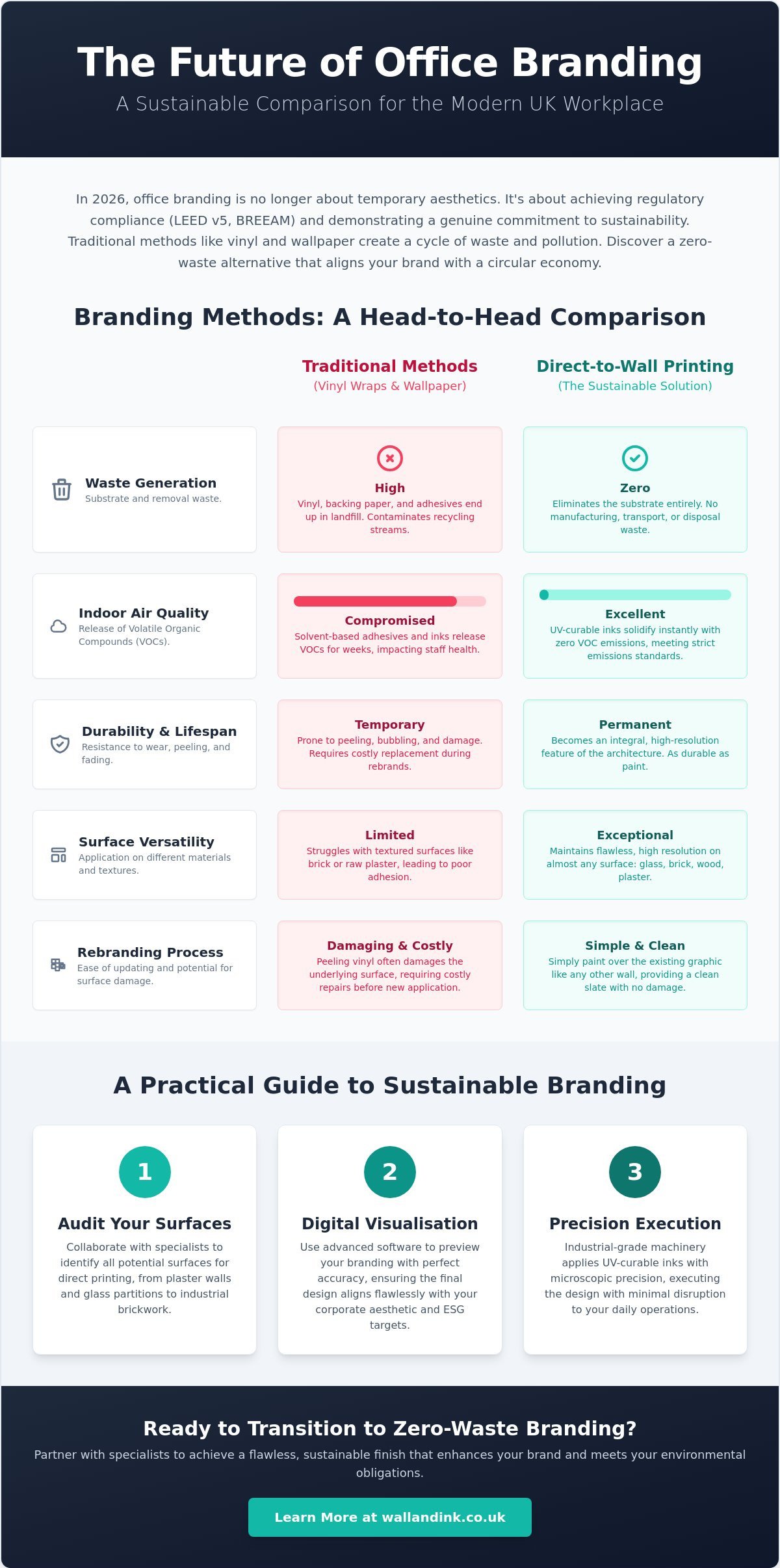
Comparing Branding Substrates: Vinyl, Wallpaper, and Direct Printing
Pragmatic decision-makers must look beyond the initial visual impact of workplace graphics to evaluate the total lifecycle cost and environmental footprint. Traditional eco-friendly office branding solutions often rely on “green” versions of legacy materials, yet these still require physical substrates that eventually become waste. When you compare vinyl, wallpaper, and direct-to-surface printing, the distinction in technical efficiency becomes clear. Whilst vinyl and wallpaper serve as physical carriers for ink, direct printing uses the wall itself as the medium, fundamentally altering the carbon equation of your office fit-out.
The PVC Problem: Why Modern Offices are Moving Away from Plastics
Polyvinyl chloride (PVC) remains a significant challenge for sustainable procurement due to its energy-intensive manufacturing and the toxic byproducts released during its lifecycle. Even “PVC-free” vinyl alternatives often require complex adhesives and siliconised backing papers that are technically difficult to recycle within the UK’s current waste infrastructure. By eliminating the physical substrate entirely, you achieve a 100% reduction in material waste and a significant decrease in the carbon emissions associated with the production and transport of plastic carriers. This technical shift ensures that your branding aligns with the decarbonisation goals of LEED v5 without compromising on the durability or resolution of the final artwork.
The Myth of Vinyl Ease and the Reality of Removal Costs
There is a common misconception that vinyl is the faster, more flexible option for temporary branding. Whilst the initial application may seem straightforward, the hidden costs emerge during the removal phase. Traditional decals often bond aggressively to the wall, requiring heat guns and chemical solvents for removal, which frequently results in surface damage and the need for expensive plaster repairs and repainting. In a standard five-year lease, these “exit costs” can significantly inflate your branding budget. Direct-to-wall printing offers a more industrial and reliable alternative; when a rebrand is required, the surface is simply painted over with a standard emulsion, providing a clean slate for new graphics without the mechanical stress or chemical waste of stripping plastic layers.
Wallpaper vs. Direct Printing: Maintenance and Hygiene
In high-traffic areas such as office canteens and breakout zones, the physical integrity of your branding is constantly tested. Wallpaper seams represent a primary point of failure, as they tend to lift or peel over time, creating traps for dust and bacteria. Direct-to-surface printing eliminates these seams entirely, resulting in a flush finish that is far more hygienic and easier to maintain. Because the UV-cured ink bonds directly to the substrate, the graphics can be cleaned with standard detergents without risk of water ingress or edge-lifting. This mechanical superiority ensures that your branding maintains its premium image throughout the duration of your tenancy, providing a durable solution that withstands the rigours of a busy commercial environment.
Designing Your Sustainable Office: A Practical Implementation Guide
Implementing eco-friendly office branding solutions requires a methodical approach that begins with a comprehensive site audit. You need to identify every potential surface, from smooth glass in meeting rooms to textured plaster in the lobby. Unlike vinyl, which hides surface imperfections, direct printing celebrates the architectural substrate. This initial assessment ensures that the design choice matches the physical reality of the building. It eliminates the guesswork and technical failures often associated with mismatched materials. Every surface has a different absorption rate, so identifying these variables early is essential for a durable, high-resolution finish.
Creating a Cohesive Brand Narrative Through Sustainable Art
Your office walls are a tool for communicating corporate mission. Large-scale murals allow you to integrate biophilic elements, such as intricate leaf patterns or natural landscapes, directly into the workspace. These designs improve employee well-being whilst reinforcing your commitment to the environment. When adapting your existing brand guidelines, focus on how logos can be rendered as part of the wall itself. This creates a permanent, high-resolution finish that feels like a deliberate architectural feature rather than a temporary sticker. It’s a way to tell your ESG story without creating the plastic waste of traditional signage.
Technical Preparation for a Flawless Finish
Achieving industrial-grade results depends on the quality of the preparation. Surfaces must be clean, dry, and free from dust. We avoid harsh chemical pre-treatments that compromise indoor air quality, sticking to mechanical cleaning methods where possible. To eliminate the waste of physical sampling, we utilise high-resolution digital visualisation. This allows you to see exactly how the artwork interacts with your specific lighting and furniture before a single drop of ink is applied. It’s a pragmatic way to ensure stakeholder approval whilst maintaining a zero-waste workflow. No physical prototypes are required, which further reduces the carbon footprint of the design phase.
The actual printing process is designed for modern efficiency. The machinery is compact and quiet, allowing for installation during standard office hours with minimal disruption to your team. There are no toxic fumes, no messy adhesives, and no drying time to contend with. Once the UV light cures the ink, the space is immediately ready for use. By choosing a professional installation team, you guarantee the technical precision required for complex graphics on challenging surfaces. It’s a streamlined journey from digital file to finished wall. If you’re ready to begin your transition to a lower-carbon workplace, you can contact us for a site audit and design consultation to discuss your specific surface requirements.
Partnering with Wall & Ink for Nationwide Sustainable Branding
Wall & Ink provides the technical infrastructure required for large-scale eco-friendly office branding solutions. We aren’t a traditional design agency; we’re hands-on specialists who prioritise industrial precision. Our method replaces the failures of legacy alternatives with a streamlined, digital-to-surface workflow. By choosing a partner that understands the physical reality of various substrates, from textured brick to smooth glass, you ensure a durable result that meets your corporate ESG targets without the traditional hassle of vinyl application. Our commitment to technical reliability ensures that every mural we print maintains the same high-resolution standard, regardless of the architectural challenges of your site.
A Disruptive Service Designed for Professional Environments
We’ve engineered our process to eliminate the inconveniences typically associated with office renovations. There is no dust from sanding, no disruptive noise from heavy machinery, and no lingering chemical smells from solvent-based glues. We operate with radical transparency, providing clear pricing structures that allow for accurate project budgeting from the outset. This level of honesty distinguishes us from competitors who often hide costs behind mandatory consultation requirements. Whether you’re managing a single boutique office or a nationwide portfolio of corporate centres, we deliver consistent, expert results across the UK. Our mobile printing units are designed for rapid deployment, ensuring that your branding is executed with the mechanical superiority your environment demands.
Our digital visualisation service eliminates guesswork by allowing you to approve artwork in situ before any ink is applied. We lead with a problem-solution framework that addresses your specific site constraints, whether that involves printing in high-traffic corridors or branding exterior surfaces. This methodical approach ensures that the final UV execution is flawless and permanent. You don’t have to worry about the maintenance issues found with wallpaper seams or the peeling risks of vinyl decals. We provide a service designed for pragmatic decision-makers who value efficiency and the elimination of traditional office branding failures.
Ready to Transform Your Workspace?
Transitioning to sustainable workplace graphics is a straightforward process when you work with specialists. We handle the technicalities of surface preparation and digital visualisation so you don’t have to manage multiple contractors. Our portfolio of commercial wall murals demonstrates the high-resolution quality achievable through our direct-to-wall method. It’s time to move away from disposable plastics and invest in a permanent, zero-waste branding solution that reflects your brand’s modernity. Enquire about our eco-friendly wall printing services today to begin your site audit and design consultation. Our team is ready to guide you through a logical, methodical journey from your initial concept to the final UV execution.
Future-Proofing Your Corporate Environment
Transitioning to a net-zero workplace requires more than just recycled materials; it demands a total elimination of unnecessary waste streams. By removing the physical substrate, you’ve removed the primary source of environmental failure in office design. Direct-to-surface application ensures your branding remains a permanent architectural feature rather than a temporary plastic addition. Our use of UV-curable ink for zero-VOC emissions and direct-to-surface technology eliminates PVC waste; this provides a technically superior result that aligns with the strictest 2026 regulatory standards. You don’t have to sacrifice a premium brand image to meet your sustainability obligations.
We provide the expertise needed to implement high-performance eco-friendly office branding solutions that withstand the rigours of commercial use. Bespoke digital visualisation is included in every project to ensure industrial precision from the initial concept. Book your sustainable office branding consultation with Wall & Ink to discuss your surface requirements and ESG objectives. Investing in durable, substrate-free graphics is a pragmatic choice for any forward-thinking UK business. It’s time to brand your space with the precision it deserves.
Frequently Asked Questions
Is direct-to-wall printing truly more eco-friendly than vinyl?
Yes, direct printing is significantly more sustainable because it eliminates the need for plastic substrates and silicone-coated backing papers. Traditional vinyl involves energy-intensive manufacturing and results in non-recyclable waste at the end of its lifecycle. By applying ink directly to the wall, you reduce the carbon footprint of your project by removing material layers entirely. This makes it a leading choice amongst eco-friendly office branding solutions for businesses focused on circular economy principles.
How long do UV-printed wall murals last in a busy office environment?
Our UV-printed murals are designed for long-term durability, typically lasting as long as the underlying paintwork. The ink is scratch-resistant and highly stable, meaning it won’t peel or fade like traditional decals. In high-traffic corridors or breakout areas, the artwork maintains its high-resolution finish for years without the mechanical failure often seen at the edges of vinyl wraps. This longevity reduces the frequency of rebrands and the associated environmental impact.
Can you print on any office surface, including glass and brick?
Our technical process allows for high-precision printing on almost any architectural surface found in modern workplaces. This includes bare plaster, industrial brickwork, wood, and glass partitions. The machine’s sensors adjust for texture, ensuring a consistent resolution regardless of the substrate’s irregularities. This versatility makes it ideal for offices that feature a mix of traditional and industrial materials, allowing for a cohesive brand narrative across the entire workspace.
Does direct-to-wall printing produce any harmful VOCs or smells?
Direct-to-wall printing produces zero harmful VOCs and has no perceptible odour during or after installation. Because the UV-curable ink dries instantly under a specialised light source, no solvents are evaporated into the atmosphere. This is a critical advantage for maintaining healthy workplace environments, as it allows for installation during standard hours without affecting indoor air quality. You won’t have to deal with the lingering chemical smells associated with traditional wallpaper adhesives.
How do I update or remove the branding if my company moves or rebrands?
Updating your branding is a simple, zero-waste process that involves painting over the existing graphics with standard emulsion. Unlike vinyl or wallpaper, there is no need for mechanical stripping, heat guns, or chemical solvents that can damage the wall surface. This eliminates the “removal cost” and the environmental burden of disposing of plastic materials in a landfill. It provides a clean slate for new artwork without the hassle of traditional renovation methods.
What is the typical turnaround time for a large-scale office mural project?
Turnaround time depends on the design’s complexity, but most single-wall projects are completed within one working day. Our industrial printing units operate with microscopic precision, allowing for rapid execution without compromising quality. Because there is no drying time or off-gassing period, your team can return to the space immediately. We provide a methodical schedule during the consultation phase to ensure the project fits seamlessly into your operational hours.
Is direct-to-wall printing more expensive than traditional wallpaper?
Whilst the initial installation cost may differ from basic wallpaper, direct printing offers superior long-term value and lower lifecycle costs. You avoid the hidden expenses of surface repairs and disposal fees that occur when removing traditional materials. When you factor in the durability and the ease of updating, it’s a highly cost-effective option for eco-friendly office branding solutions. Pragmatic managers prioritise this technical efficiency over the perceived savings of lower-quality, temporary alternatives; to maintain this level of organisational efficiency across your workplace assets, you can learn more about DymoOnline’s professional labelling systems.
Can I use my own bespoke designs and company logos for the printing?
Yes, our service is entirely bespoke and designed to accommodate your specific brand guidelines and high-resolution digital files. We can print any design, including complex logos, intricate patterns, and detailed photography, straight onto your walls. Our digital visualisation process ensures that your artwork is correctly scaled and positioned for your specific wall dimensions before the printing begins. This eliminates errors and ensures the final result is a perfect reflection of your corporate identity.