
The most sustainable wall mural isn’t made of recycled paper or “eco-friendly” vinyl; it isn’t actually made of any physical substrate at all. While the UK home décor market is projected to reach £1.82 billion in 2026, the environmental cost of traditional wallpaper remains a significant burden. If you are searching for eco-friendly wall murals UK, you likely recognise the frustration of managing VOC emissions from adhesives and the waste generated by backing paper and offcuts. You shouldn’t have to settle for materials that eventually peel or require frequent, plastic-heavy replacements.
We agree that high-quality interiors shouldn’t compromise air quality or environmental standards. This guide demonstrates how direct-to-wall printing technology provides a zero-waste, low-VOC alternative that bypasses traditional installation hassles entirely. You will discover how this precision-engineered method meets the strict 2026 UK standards for indoor air quality whilst delivering durable, bespoke art. We will detail the technical advantages of substrate-free application, the impact of upcoming formaldehyde regulations, and why removing the material layer is the only way to achieve a truly sustainable feature wall.
Key Takeaways
- Learn why eliminating physical substrates like paper and vinyl is the most effective method to achieve a zero-waste installation.
- Understand how UV-cured ink technology meets strict 2026 VOC regulations for eco-friendly wall murals UK whilst maintaining industrial-grade durability.
- Compare the full life cycle of direct-to-wall printing against traditional wallpaper to see the long-term environmental benefits of ink-only application.
- Discover the technical preparation required to ensure your wall surface is correctly primed for a permanent, high-precision digital mural.
- Explore how bespoke digital visualisation ensures your design fits the specific dimensions of your space with absolute mechanical accuracy.
Defining Eco-Friendly Wall Murals in the UK Market
In the British interior design sector, the term “eco-friendly” is frequently misused. It is often reduced to a simple aesthetic choice, such as selecting botanical patterns or earthy tones. However, a truly sustainable approach focuses on the mechanical reality of the installation. For those seeking eco-friendly wall murals UK, sustainability is defined by three measurable pillars: minimal waste, near-zero emissions, and high durability. To understand what is a mural in a modern context, we must look beyond the image and examine the physical impact of the application method on the environment.
Traditional decorating relies on layers of physical material. This legacy approach isn’t compatible with the UK’s commitment to a circular economy. We’re seeing a definitive shift from vinyl-based products toward digital application methods that eliminate the need for substrates entirely. This transition is driven by pragmatic decision-makers who prioritise carbon-conscious design and long-term asset protection over disposable décor. By removing the need for physical paper, we reduce the demand for raw materials and the energy required for their manufacture. It’s a move away from “fast interiors” toward a more industrial, precise standard of decoration.
The Problem with Traditional Wallcoverings
PVC-based vinyl and non-recyclable backing papers present a significant environmental challenge. During a standard installation, the trimming and pasting process generates immediate offcut waste that inevitably ends up in landfill. These materials don’t biodegrade and often contain plasticisers that leach into the environment over time. There is also the hidden carbon footprint associated with logistics. Shipping heavy, bulky rolls of wallpaper across the country requires more energy than transporting a compact digital printing unit. The weight of traditional materials adds to the total carbon output of every project before the installation even begins.
VOCs and Indoor Air Quality
Volatile Organic Compounds (VOCs) are carbon-based chemicals that evaporate at room temperature and negatively impact indoor air quality standards across the UK. Traditional adhesives and solvent-based inks are primary sources of these emissions. By choosing methods that bypass these materials, businesses and homeowners create healthier living and working centres. This is particularly vital in high-occupancy environments like schools or hospitals where air quality standards are strictly monitored. Modern eco-friendly wall murals UK utilise UV-cured technology to ensure that once the art is applied, it remains inert and safe for all occupants. This eliminates the chemical odour that often signals the presence of harmful airborne pollutants.
The Technology Behind Sustainable Wall Printing
Direct-to-wall printing represents a technical departure from traditional decorating methods. Instead of applying a pre-printed physical layer to a surface, this technology uses a vertical inkjet system to deposit pigment directly onto the substrate. This mechanical shift is fundamental to the delivery of eco-friendly wall murals UK, as it eliminates the carbon-heavy manufacturing processes associated with wallpaper production. By moving from a multi-layered material approach to a single-layer digital application, we remove the environmental burden of adhesives and backing papers entirely.
The precision of this digital application ensures that only the exact volume of ink required for the design is utilised. There is no excess. There is no over-ordering. Unlike traditional wallpaper, which requires extra rolls for pattern matching and trimming, direct printing operates on a “print-to-order” basis with absolute accuracy. This industrial efficiency is a core component of our commercial wall murals, providing a streamlined solution for high-stakes professional environments that prioritise both quality and waste reduction.
UV-Cured Inks: A Greener Choice
The primary driver of this technology’s sustainability profile is the use of UV-cured inks. These pigments don’t rely on evaporation to dry; instead, they undergo a photochemical reaction when exposed to specific UV light frequencies. This process is instantaneous and prevents chemical leaching into the surrounding environment. The absence of solvents is a critical factor, especially as UK government data on printing emissions highlights the ongoing challenge of managing non-methane volatile organic compounds (NMVOCs) in industrial applications.
Because the ink cures immediately, it becomes inert. This makes it a preferred choice for sensitive locations such as residential nurseries, schools, and hospitals. These inks are engineered for mechanical superiority, resisting fading and scratching without the need for additional plastic laminates or protective coatings. This durability is a key sustainability factor; art that lasts longer doesn’t need to be replaced as frequently, reducing the total material demand over the building’s life cycle.
Zero-Waste Application Methods
Traditional installations are inherently wasteful. They involve heavy rolls of paper, plastic-lined packaging, and significant offcuts generated during the “trimming and pasting” phase. Direct-to-wall printing bypasses these issues completely. The printer moves along a set track, applying the design with millimetre precision to the wall surface. This method adapts to various textures, from smooth plaster to raw brick, whilst maintaining its eco-integrity.
- No Packaging: Eliminates the cardboard tubes and plastic wrap used for wallpaper rolls.
- No Adhesives: Removes the need for solvent-based glues that can fail over time.
- Minimal Logistics: Transporting a digital unit is more energy-efficient than shipping bulky pallets of paper.
By focusing on the physical reality of the application, we can ensure that eco-friendly wall murals UK are more than just a design trend. They’re a practical solution for modern specialists who value efficiency and environmental responsibility.
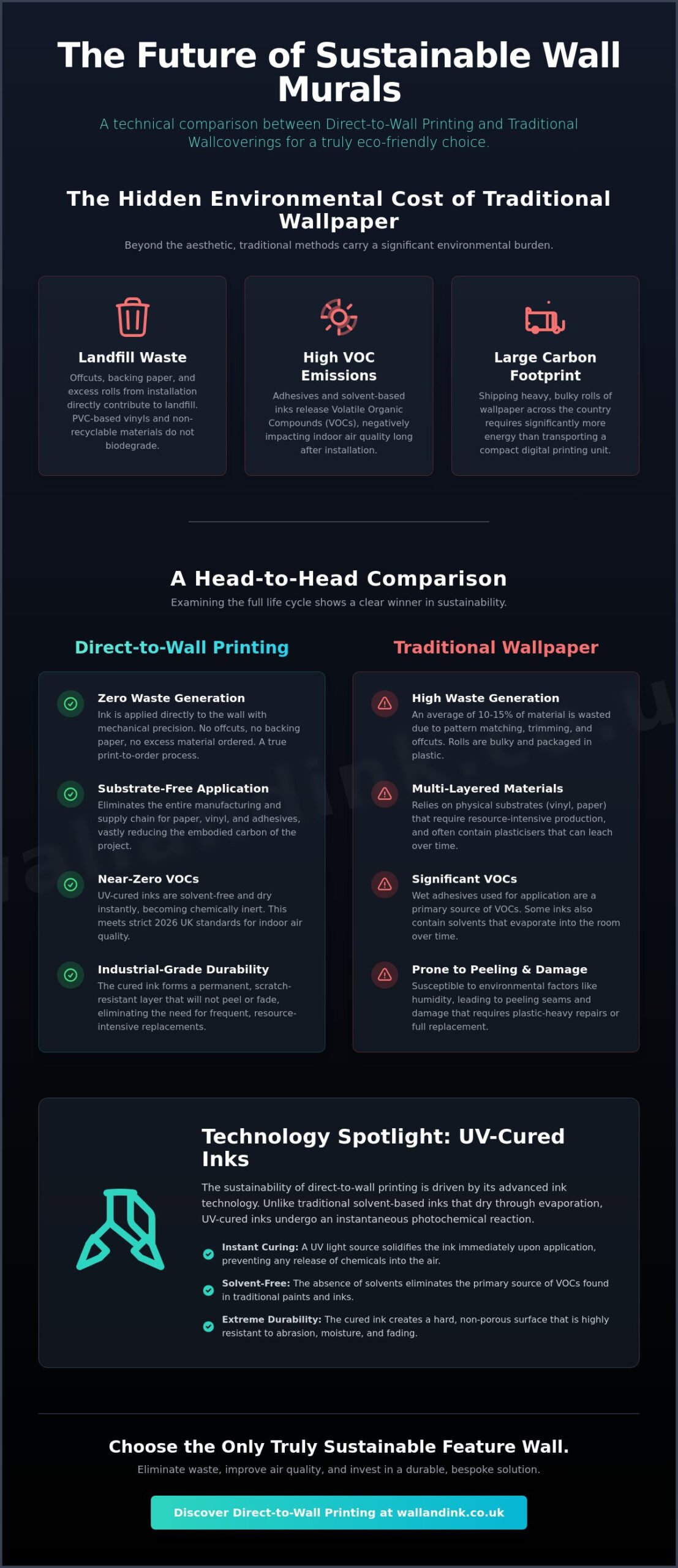
Direct-to-Wall Printing vs Traditional Eco-Wallpaper
Choosing between traditional wallpaper and digital application requires a full life cycle analysis. Even “eco-friendly” wallpapers involve a multi-stage resource drain: the harvesting of pulp, the chemical processing of paper, and the manufacturing of adhesives. In contrast, eco-friendly wall murals UK delivered via direct-to-wall technology use only the pigment required for the image. This removes the entire physical substrate from the equation, aligning perfectly with circular economy principles by reducing the total volume of material entering the building.
The environmental cost of removal is often overlooked during the design phase. Stripping traditional murals usually involves chemical agents and significant water usage to dissolve old paste. Once removed, the wallpaper is rarely recyclable due to ink and adhesive contamination. Direct-to-wall art offers a cleaner alternative. When a design needs refreshing, the surface is simply painted over with standard eco-friendly emulsion. This process eliminates the generation of landfill waste and avoids the use of harsh stripping chemicals.
Sterile environments also benefit from this lack of physical layers. Without seams or overlapping edges, there are no crevices for dust or bacteria to accumulate. This makes direct-to-wall printing the superior choice for healthcare centres and food preparation areas where hygiene is as critical as aesthetic quality.
Material Efficiency and Resource Management
Digital application achieves a 100% reduction in substrate material usage. By applying pigment directly to the wall, we avoid the resource-heavy production of paper and vinyl rolls. This efficiency extends to the artwork’s visual longevity. The high UV stability of our inks ensures that your favourite colours remain vibrant without the fading typically seen in traditional paper-based murals. This mechanical precision means the mural retains its professional finish for years, reducing the need for premature replacements.
Longevity and Performance in UK Climates
The UK’s varied climate, often characterised by high humidity and damp, presents a challenge for traditional paper. Wallpaper seams are prone to lifting or peeling in moist environments like kitchens or coastal properties. UV-printed murals are fundamentally different. They bond directly with the wall surface, making them resistant to humidity and temperature fluctuations. UV-printed murals typically offer a lifespan of up to 15 years for internal applications, significantly outlasting the 5 to 7-year average of standard wallpaper installations.
Planning Your Sustainable Mural Project
Precision planning is the foundation of any high-specification interior project. When integrating eco-friendly wall murals UK into a space, the goal is to eliminate the trial-and-error approach that often leads to material waste. Successful execution requires a methodical look at how digital art interacts with the physical environment. By treating the wall as a permanent canvas rather than a temporary surface for paper, you ensure a result that meets both aesthetic and environmental performance standards. We recommend a structured process that begins with digital visualisation and ends with a technically sound substrate.
Selecting Sustainable Artwork
The choice of imagery is a critical factor in the longevity of the installation. In 2026, the trend of biophilic design remains a dominant force in British interiors, with botanical motifs and natural textures used to improve wellbeing. Choosing bespoke, high-resolution designs prevents the “generic” look of mass-produced wallpaper, which often leads to premature replacement and unnecessary waste. Digital mock-ups allow you to see the exact placement of the art on your specific wall before any ink is applied. This visualisation process ensures the scale and colour balance are correct the first time, removing the risk of design errors that would otherwise require correction or re-application.
Surface Considerations and Preparation
Direct-to-wall printing is versatile, but the quality of the output depends on the stability of the substrate. The UV-cured ink bonds best to surfaces that are dry, clean, and structurally sound. If you are printing on bare plaster, ensure it has fully cured and is free from dust. For previously painted surfaces, the existing finish must be stable; peeling or flaking paint will compromise the mechanical bond of the mural. To maintain the project’s eco-integrity, we advise using low-VOC primers and emulsions for the surrounding wall areas. This creates a consistent environmental profile across the entire room, supporting healthier indoor air standards as discussed in previous sections.
Organising a low-impact installation involves working with specialists who understand the mechanical requirements of the hardware. Our team coordinates every aspect of the process to ensure minimal disruption to your home or business centre. If you are ready to move away from disposable décor and invest in a permanent, high-precision feature, you can explore our options for residential wall art to see how this technology transforms private spaces. By focusing on durability and precision, you contribute to a more sustainable approach to British interior design.
The Wall & Ink Approach: Leading the UK in Sustainable Murals
Wall & Ink operates at the intersection of industrial precision and environmental responsibility. We use advanced UV technology to deliver eco-friendly wall murals UK across the country, moving beyond the limitations of traditional decorating. Our process is designed for pragmatic decision-makers who require high-quality results without the associated waste of legacy methods. By applying pigment directly to the substrate, we ensure a permanent bond that meets the mechanical standards of modern construction and interior design. This approach eliminates the need for physical layers, providing a clean and efficient solution for any space.
Bespoke Design for Residential and Commercial Spaces
Our service transforms professional and private environments by adapting high-resolution photography, bespoke artwork, or corporate logos for direct printing. Whether we are working in a busy corporate centre, a primary school, or a residential living room, our technical process remains consistent. We use digital visualisation to ensure every pixel aligns with the physical dimensions of the wall. This eliminates the guesswork and material waste discussed in our planning guide. Our nationwide service brings sustainable mural technology to your doorstep, providing a reliable partner for projects of any scale, from single accent walls to large-scale commercial developments.
Transparency in Pricing and Process
We believe that professional services should operate with radical honesty. Our pricing is structured logically based on square footage and the complexity of the design, ensuring you only pay for the exact resources utilised. This transparency allows project managers and homeowners to budget with confidence. On a standard installation day, you can expect a clean, efficient process. There are no heavy rolls to carry, no chemical pastes to mix, and no offcuts to dispose of. The hardware is set up with mechanical precision, the design is printed directly onto the surface, and the area is left ready for immediate use without any drying time or chemical odours.
This direct-to-wall method is the logical conclusion for anyone seeking eco-friendly wall murals UK. It removes the physical layer, reduces the carbon footprint of logistics, and provides a durable finish that resists the damp and humidity of the UK climate. By choosing an ink-only application, you avoid the plastic-heavy waste of vinyl decals and the environmental cost of traditional wallpaper stripping. If you are ready to transition to a zero-waste decorating model, you can enquire about your eco-friendly mural project with Wall & Ink today. We provide the technical expertise and industrial-grade hardware needed to deliver a superior, long-lasting result.
The Future of Professional Wall Art in the UK
The shift toward eco-friendly wall murals UK is driven by a requirement for both industrial precision and environmental accountability. As established throughout this guide, removing the physical substrate is the only viable method to achieve a truly zero-waste installation. By opting for direct-to-wall application, you eliminate the carbon-heavy logistics and chemical waste typically associated with traditional wallpaper. This transition ensures that your interiors meet the highest standards of durability and indoor air quality whilst providing a bespoke finish that remains vibrant for years.
Our commitment to sustainable decorating is backed by technical superiority. Every project utilises UV-cured, low-emission ink technology and includes a comprehensive digital visualisation phase to ensure absolute accuracy before any pigment is applied. This methodical approach guarantees a hassle-free experience with zero material waste and no lingering chemical odours. If you’re ready to upgrade your commercial or residential space with a modern, high-performance solution, Explore our sustainable wall printing services for your next UK project. We’re here to help you achieve a cleaner, more efficient standard of interior design.
Frequently Asked Questions
Are direct-to-wall murals more eco-friendly than recycled wallpaper?
Direct-to-wall printing is more sustainable than recycled wallpaper because it removes the requirement for physical materials entirely. Whilst recycled paper reduces raw material demand, it still requires heavy manufacturing, transport of bulky rolls, and the use of adhesives. By choosing eco-friendly wall murals UK applied directly to the wall, you eliminate the carbon footprint of substrate production and the landfill waste generated by backing papers and trimmings.
Do UV-cured inks produce any harmful smells or VOCs?
UV-cured inks don’t produce harmful smells or VOCs because they dry instantly through a photochemical reaction rather than evaporation. Traditional solvent-based inks release chemicals into the air as they dry, but our UV process ensures the pigment is inert the moment it’s applied. This mechanical drying method makes the technology safe for immediate occupancy in residential and professional spaces without the risk of respiratory irritation or chemical odours.
How long does an eco-friendly wall mural last in a busy UK office?
An internal wall mural applied with UV-cured ink typically lasts up to 15 years in a busy office environment. This durability is a significant advantage over traditional wallpaper, which often peels or scuffs within 5 to 7 years. The ink bonds directly with the wall surface, resisting the mechanical wear and tear of high-traffic areas. This longevity ensures that your eco-friendly wall murals UK remain a permanent asset rather than a disposable decorative layer.
Can I print an eco-friendly mural on a newly plastered wall?
You can print on a newly plastered wall once the substrate is fully cured and dry. It’s essential that the plaster has settled to prevent moisture from being trapped within the wall, which could affect the ink’s adhesion. We recommend a minimum drying time based on the plaster thickness and environmental conditions. Once stable, the surface provides an ideal canvas for high-resolution digital art without the need for traditional lining papers.
What happens if I want to change the mural in the future?
Changing a direct-to-wall mural is a straightforward process that involves simply painting over the existing design with a standard eco-friendly emulsion. Unlike wallpaper, there’s no need for chemical strippers, steam, or physical scraping that can damage the wall. This approach supports a circular economy by removing the generation of non-recyclable waste. You can refresh your space as often as needed without the environmental cost of stripping and disposing of physical materials.
Is the direct-to-wall printing process messy or dusty?
The direct-to-wall printing process is exceptionally clean and produces no dust or liquid waste. The printer operates as a precision inkjet system, moving along a vertical track to apply pigment with millimetre accuracy. There’s no trimming of paper, no mixing of paste, and no protective floor covering required beyond standard precautions. This industrial efficiency allows us to work in active business centres or private homes without causing disruption or requiring a post-installation deep clean.
Are eco-friendly murals suitable for use in UK schools and hospitals?
These murals are highly suitable for UK schools and hospitals due to their low-emission profile and hygienic properties. The lack of seams and overlapping edges prevents the accumulation of dust and bacteria, which is critical in sterile environments. Because the UV-cured inks are inert and scratch-resistant, they withstand the rigorous cleaning schedules and high-occupancy behaviour typical of educational and healthcare facilities whilst maintaining a safe environment for all users.