
True architectural seamlessness isn’t achieved by sourcing wider rolls of vinyl or hiring more meticulous decorators; it’s achieved by removing the material layer entirely and printing directly onto the substrate. You’ve likely seen how a high-resolution corporate mural can be undermined by a single visible seam or a peeling corner in a busy corridor. It’s a common frustration for pragmatic decision-makers who value precision, as traditional wallpaper and adhesive vinyl often succumb to bubbles and edge failure whilst under the pressure of high-traffic environments.
In this guide, you’ll discover how direct-to-wall UV printing provides the definitive solution for seamless wall graphics without joins. By eliminating the physical media, this technology creates a finish that is integrated into the wall rather than just stuck onto it. We’ll examine the technical specifications that make this process superior for commercial settings, the minimal maintenance requirements involved, and how this modern, industrial approach ensures your graphics remain pristine for over a decade. This is the shift from temporary coverings to permanent, high-quality surface engineering that prioritises durability and visual perfection.
Key Takeaways
- Identify why vertical seams and installation misalignment are the primary causes of failure for traditional wall murals in high-traffic commercial environments.
- Learn how vertical printing technology applies UV ink directly to the substrate to achieve seamless wall graphics without joins of any kind.
- Contrast the 0mm profile of direct-to-wall printing with the 2mm thickness of vinyl to understand why removing the carrier medium prevents peeling and bubbling.
- Explore the versatility of direct-to-wall applications across diverse substrates, including standard plaster, raw brick, and concrete, without losing the underlying texture.
- Discover how digital visualisation and bespoke design ensure your graphic is perfectly tailored to your architectural layout before the printing process begins.
The Problem with Joins: Why Traditional Wall Graphics Fail
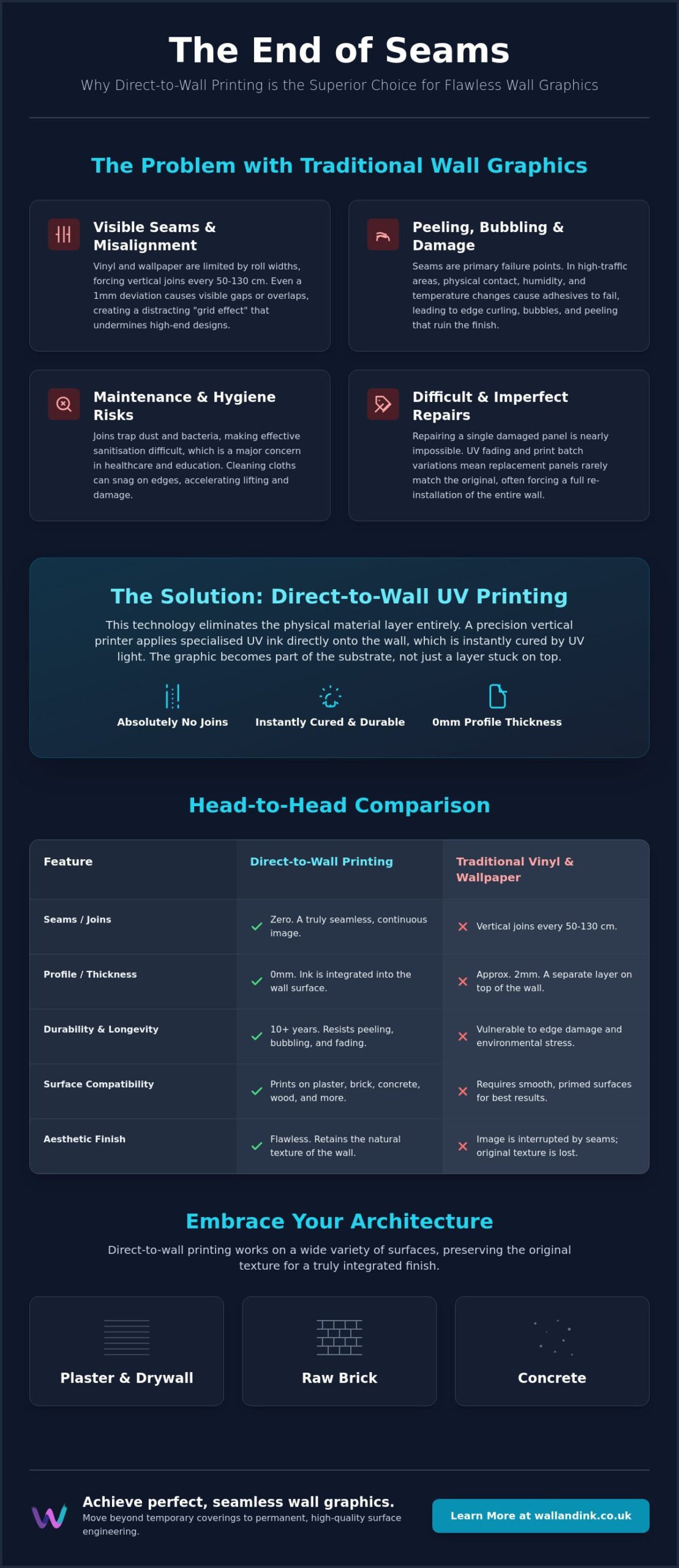
Traditional wall covering methods are inherently limited by the physical dimensions of the material rolls. Whether you select vinyl or wallpaper, you’re forced to manage vertical seams every 50 to 130 centimetres. These joins represent the primary failure point in any large-scale installation. In high-traffic environments, these physical edges are vulnerable to mechanical damage and environmental stress. When the integrity of the graphic relies on an adhesive bond at a thin edge, the risk of failure is constant.
Misalignment during the application process is a frequent issue that compromises high-resolution geometric designs. A deviation of just one millimetre at the ceiling level can translate into a visible gap or an unsightly overlap by the time the installer reaches the skirting board. This inconsistency destroys the illusion of a continuous image. Environmental factors in UK commercial spaces, such as fluctuating humidity and temperature, often cause the adhesive to dry out over time. This leads to edge curling, where the tension of the material pulls away from the substrate, exposing the wall beneath and ruining the finish.
The Aesthetic Impact of Visible Seams
Visible joins interrupt the visual flow of bespoke photography and complex branding. In large-scale commercial projects, this often results in a “grid effect” that detracts from the professional finish expected by premium brands. Whilst traditional mural techniques involved manual painting to avoid these interruptions, modern digital alternatives have struggled to replicate that fluidity until now. When a high-resolution image is bisected by a vertical line, the eye naturally gravitates toward the flaw rather than the artwork. This is why achieving seamless wall graphics without joins is no longer just a preference; it’s a requirement for high-end interior specifications.
Maintenance and Longevity Issues
The physical presence of a join creates a hygiene risk that is often overlooked. In healthcare or educational settings, these small crevices trap dust and bacteria, making the surface difficult to sanitise effectively. Cleaning chemicals used in standard maintenance schedules can also snag on vinyl edges. Once a cleaning cloth catches an edge, the lifting process begins, leading to premature failure of the entire installation. This is particularly problematic in corridors where bags or equipment frequently brush against the walls.
Repairing traditional graphics is notoriously difficult. If a single panel is damaged, the replacement often fails to match the colour profile of the surrounding panels due to UV fading or batch variations. This necessitates a full re-installation of the entire wall. Even “seamless” fabric alternatives, which boast 3-metre widths, eventually reach a physical boundary. These products still require mechanical fixings or adhesive borders that are susceptible to the same peeling and lifting issues found in standard wallpaper. Direct-to-wall printing eliminates these risks by removing the carrier medium entirely.
What is Direct-to-Wall Printing? Achieving True Seamlessness
Direct-to-wall printing represents a fundamental shift in how we approach interior surfaces. Unlike traditional methods that have defined the history of wallpaper for centuries, this process removes the need for a carrier medium entirely. Instead of printing onto paper or vinyl and then adhering that material to a wall with chemical glues, we apply specialised UV ink directly to the substrate. This technical distinction is what allows for the creation of seamless wall graphics without joins, as the image becomes part of the wall itself rather than an additional layer sitting on top of it.
The system utilises a vertical wall printer that operates on a precision rail system. As the machine moves along the wall, the print head travels vertically, depositing ink in a continuous, automated motion. This method eliminates the physical boundaries of a roll of material. There are no edges to align and no vertical seams to hide. Because the ink is cured instantly by high-intensity UV lamps, the result is a durable, smudge-proof surface that is ready for use the moment the machine finishes its pass. This technical durability ensures that indoor prints can last for 12 years or more without the fading associated with standard digital inks.
By removing the vinyl layer, we also remove the common failure points associated with traditional murals. Traditional graphics rely on adhesives that can degrade or peel, but direct-to-wall printing bonds at a microscopic level. This is why our direct-to-wall printing services are increasingly specified for high-traffic environments where longevity is non-negotiable. The lack of a physical edge means there is nothing for a cleaning cloth to snag on, ensuring the graphic remains intact for its entire lifespan.
The Science of UV Ink Adhesion
The process relies on the ink bonding to the microscopic pores of the wall surface. This bond is far more resilient than a standard adhesive layer. UV ink is also naturally resistant to fading from sunlight, outperforming standard digital prints in both longevity and colour vibrancy. Modern wall printing formulations are free from Volatile Organic Compounds (VOCs). This makes them a safer choice for healthcare and educational settings where air quality and hygiene are priorities. Because there are no adhesives to off-gas, the environment remains clean and safe for immediate occupancy.
Precision Engineering vs. Manual Application
Manual installation is always subject to human error; a slight tilt at the start of a roll becomes a major gap several metres later. Digital pathing removes this variable entirely. The print head is engineered to maintain its trajectory and ink deposition within a fraction of a millimetre. Advanced sensors allow the machine to compensate for wall imperfections, such as slight bows or texture variations, whilst maintaining perfect image integrity across the entire surface. This ensures that even the most complex geometric patterns remain perfectly aligned across the entire wall.
Comparing the Options: Direct-to-Wall vs. Seamless Wallpaper
When evaluating surface finishes, the most immediate distinction lies in the physical profile of the application. Traditional vinyl and wallpaper products possess a measurable thickness, typically ranging from 1mm to 2mm. This creates a raised edge that is susceptible to mechanical damage. In contrast, direct-to-wall printing has a 0mm profile. Because the ink is absorbed by and bonded to the substrate, there is no material layer to peel, crack, or bubble. This technical advantage is the only way to ensure seamless wall graphics without joins that remain flush with the architectural surface.
Many suppliers market “seamless” wallpaper, but this term is often a misnomer. These products are generally limited to a 3-metre width. Whilst this covers many standard residential heights, any wall exceeding this dimension—common in commercial atriums or long corridors—will inevitably require a physical join. Direct-to-wall printing operates on a continuous rail system, allowing the machine to print across infinite lengths without a single break in the image. The machine does not have a “roll limit,” providing a truly infinite canvas for large-scale branding.
Safety and sensory experience also differentiate these methods. Traditional PVC vinyl is a plastic-based material that can carry specific fire safety risks in enclosed public spaces. UV ink, applied in a microscopic layer directly onto a non-combustible substrate like plaster or brick, offers a superior fire-safety profile. Furthermore, the “touch test” reveals that direct printing preserves the natural texture of the wall. Whilst wallpaper creates a synthetic, uniform mask, our printing method allows the industrial character of concrete or the grain of timber to remain visible and tactile beneath the design.
Architectural Integration
Direct printing functions as a permanent architectural feature rather than a temporary overlay. This integration is most evident when handling wall obstacles. Traditional installers must manually cut wallpaper around light switches, sockets, and data points, often leaving untidy edges or gaps. The vertical printer maintains image integrity by printing directly up to and around these fixtures with digital precision. We utilise CMYK UV printing, which provides superior colour consistency compared to the dye-sublimation processes used for fabric wall coverings, ensuring that brand colours remain accurate across different surface types.
Cost-Benefit Analysis Over Time
The initial investment in direct-to-wall technology is justified by its industrial-grade durability. Indoor UV prints are rated for a lifespan of 12 years or more, significantly outperforming the 3 to 5-year cycle of traditional commercial wallpaper. Businesses must also consider the hidden costs of removal. Stripping adhesive-backed vinyl often damages the underlying plaster, requiring expensive skimming and repainting before a new graphic can be applied. Direct-to-wall graphics can simply be painted over when a brand refresh is required, eliminating the labour-intensive removal process and protecting the building’s infrastructure.
Surface Compatibility: Where Can You Print Join-Free Graphics?
The versatility of direct-to-wall printing is rooted in its mechanical ability to adapt to various textures. Whilst traditional vinyl graphics require a perfectly flat, non-porous surface to prevent adhesive failure, UV ink bonds effectively with almost any architectural substrate. This capability allows designers to implement seamless wall graphics without joins on surfaces previously considered unsuitable for high-resolution imagery. From standard office partitions to rugged industrial features, the technology maintains image integrity regardless of the underlying material.
Standard plaster remains the most frequent choice for UK office environments. However, the process is equally effective on raw brickwork, concrete, and timber. Printing on brick allows the natural mortar lines and texture to remain visible, creating an integrated aesthetic that feels part of the building’s structure. For high-stakes retail or hospitality environments, we also apply graphics to glass and metal. The primary requirement for a successful application is a substrate that is clean, dry, and free from loose debris. This ensures the UV ink can achieve an optimal mechanical bond with the surface pores.
Preparing Your Wall for a Seamless Finish
Surface preparation is a technical necessity. Plaster must be fully cured before printing begins; typically, this means waiting until the surface has turned a uniform pale pink. We recommend a mist coat or a standard primer even on new plaster. Whilst “bare plaster” printing is possible, a primed surface provides a consistent base that enhances colour accuracy. Any minor imperfections, such as deep scratches or protrusions, should be filled and sanded beforehand. A smooth starting point ensures that the print head can maintain a consistent distance from the wall, resulting in a flawless finish.
If you have a specific surface in mind, our team can advise on the best preparation route for our Direct-to-Wall Printing services to ensure a permanent result.
Exterior vs. Interior Applications
Direct-to-wall printing is not limited by the building’s envelope. The UV inks used in the process are engineered to withstand the British climate, offering high resistance to rain and temperature fluctuations. Outdoor prints typically retain their vibrancy for around 5 years, whilst indoor applications can last over a decade. These graphics also possess inherent anti-graffiti properties; the cured ink is resistant to many solvent-based cleaners, allowing for easier maintenance in public spaces. Even in direct sunlight, the UV-stable pigments prevent the premature fading that often plagues traditional digital prints.
The Wall & Ink Process: From Bespoke Design to Installation
The transition from a design concept to a finished installation is managed through a methodical, multi-stage workflow. We provide national UK coverage, bringing this specialised vertical printing technology directly to your facility. Our process prioritises technical accuracy and architectural integration, ensuring that the final result meets the high standards required for professional environments. By following a structured path from initial consultation to final execution, we ensure that every project delivers seamless wall graphics without joins that are perfectly scaled to your specific environment.
Consultation is the foundation of our service. We work with pragmatic decision-makers to identify the best sectoral applications, whether that involves school murals, retail graphics, or corporate branding. Every project begins with a technical assessment of the substrate and the intended visual outcome. This phase ensures that the design is not just aesthetically pleasing but is also technically compatible with the wall’s physical properties. Our goal is to provide a reliable partner experience that eliminates the traditional hassles associated with large-scale wall decor.
Bespoke Design and Digital Mock-ups
We adapt your existing logos, photography, and brand assets for large-scale application using advanced digital pathing. To achieve a pixel-perfect finish, we require high-resolution files, typically at 300 DPI at a manageable scale. Before any ink is applied, we provide a digital visualisation. This mock-up allows you to see exactly how the mural will sit within your room, accounting for architectural features like doors, windows, and sockets. Whilst we often work from client-supplied assets, our design team can also assist in tailoring art to fit complex spaces. A site survey is often organised to verify measurements and surface conditions, ensuring the vertical rail system can be positioned with total precision.
What to Expect on Installation Day
The on-site printing experience is engineered for efficiency and minimal disruption. Our UV wall printing equipment has a compact footprint, allowing it to operate in corridors and offices without requiring the total clearance associated with wallpapering tables and ladders. Because the process uses an automated vertical printer, it is significantly quieter and cleaner than traditional methods. There is no “wallpaper smell” and no messy adhesive cleanup. The UV curing process is instant, meaning the wall is dry and durable the moment the print head completes its pass.
Once the print is finished, we conduct a final walkthrough to ensure the image meets our rigorous quality standards. We provide clear care instructions to help you maintain the mural’s longevity, although the nature of UV-cured ink means maintenance is minimal. This streamlined approach allows businesses to refresh their space and return to normal operations on the same day. Our commitment to transparency and industrial precision ensures that the final result is a permanent, high-quality architectural feature.
Enquire about our seamless wall printing services today to transform your space with a join-free, durable finish.
Elevate Your Architectural Surfaces with Precision
Adopting direct-to-wall printing is a strategic decision for decision-makers who prioritise industrial-grade longevity and visual precision. By removing the carrier medium entirely, you eliminate the common failure points of peeling, bubbling, and the inevitable misalignment of traditional panels. Our specialised UV ink technology ensures a minimum of 10-year durability whilst maintaining the tactile integrity of your original substrate. This innovative process is the only verified method for delivering seamless wall graphics without joins, providing a permanent architectural finish that traditional mass-produced vinyl simply cannot match.
Every project we undertake includes bespoke design consultations to ensure your branding or artwork translates perfectly to the specific dimensions of your space. Our method involves no messy adhesives and no flammable PVC vinyl, ensuring a clean and efficient installation that respects your environment’s air quality and safety standards. To start your transition from temporary coverings to superior surface engineering, Get a Bespoke Quote for Your Seamless Wall Project. We are ready to help you achieve a flawless, high-resolution finish that stands the test of time.
Frequently Asked Questions
Is direct-to-wall printing truly seamless?
Direct-to-wall printing is entirely seamless because it eliminates the physical carrier medium of paper or vinyl. The machine operates on a continuous rail system, applying ink in a single, uninterrupted pass across the substrate. This ensures seamless wall graphics without joins regardless of the wall’s length, removing the vertical seams that define traditional mural installations.
Can you print on textured walls like brick or breeze blocks?
You can apply graphics to a wide variety of textured surfaces, including brick, breeze blocks, and rough-cast plaster. The vertical printer uses advanced sensors to maintain a consistent distance from the substrate, allowing the ink to settle into the recesses of the material whilst preserving the industrial character of the wall. This versatility is a primary advantage over vinyl, which requires a perfectly smooth surface for adhesion.
How long do direct-to-wall graphics last?
Indoor direct-to-wall prints are engineered for long-term durability, typically lasting 12 years or more without significant fading. For exterior applications, the UV-resistant inks are designed to withstand the British climate for approximately 5 years. The process creates a mechanical bond with the wall that prevents the peeling and edge curling common in traditional wall coverings.
Is the ink safe for schools and hospitals?
The UV ink used in our process is entirely safe for sensitive environments like schools and hospitals. It contains no Volatile Organic Compounds (VOCs) and is cured instantly by high-intensity lamps during the printing process. This means there are no lingering chemical odours or off-gassing, allowing rooms to be safely occupied immediately after the installation is complete.
Can the graphics be removed or painted over?
Graphics can be easily removed by painting over them with a standard primer and emulsion. Unlike vinyl or wallpaper, there is no adhesive residue to strip and no risk of damaging the underlying plaster. This makes it an ideal solution for commercial spaces that require periodic branding updates without the high cost and mess of traditional wall repair.
What is the maximum size for a seamless wall print?
There is no physical limit to the length of a seamless print, as the machine rail system can be extended indefinitely. The height is typically governed by the vertical reach of the printer, which covers most standard commercial and residential ceiling heights up to approximately 4 metres. For exceptionally large atriums, we can often engineer solutions to cover the required area without visible interruptions.
How much does direct-to-wall printing cost per square metre?
Pricing for direct-to-wall printing is calculated based on the total surface area, the complexity of the substrate, and the geographic location of the site. Whilst initial costs may differ from mass-produced wallpaper, the industrial-grade durability and lack of maintenance fees often result in a lower total cost of ownership over a decade. We provide transparent, per-unit metrics during the initial consultation phase.
Do I need to prepare the wall before you arrive?
The wall must be clean, dry, and free from loose debris or significant structural cracks. For newly plastered surfaces, a mist coat or primer is recommended to ensure optimal ink absorption and colour accuracy. Our team conducts a technical assessment prior to installation to verify that the substrate is ready for a pixel-perfect finish.