
What if the greatest risk to your brand’s physical environment isn’t the cost of the artwork, but the lack of mechanical precision in its execution? When you decide to commission a mural for a large wall, you are making a significant investment in your space’s identity. You likely want a result that is as sharp and professional as your business, yet the traditional process of hand-painting often introduces unwanted variables. From the mess of scaffolding to the fear that the artist might miss the mark on a grand scale, the legacy approach can feel remarkably unpredictable.
We understand that pragmatic decision-makers value efficiency and high-quality outcomes over artistic whimsy. With the global UV printing market expected to reach $10 billion by 2026, this technology has moved from a niche alternative to a dominant industrial standard. This guide will demonstrate how modern direct-to-wall UV printing transforms expansive surfaces with industrial precision and zero mess. You will discover how to achieve a high-resolution, durable finish that perfectly matches your original vision whilst eliminating common industry headaches like peeling vinyl or hidden costs. We will break down the technical specifications of UV-cured inks and explain why this automated method is the most reliable way to organise large-scale installations.
Key Takeaways
- Understand why traditional painting methods often fail on expansive surfaces and how industrial precision ensures your design remains perfectly in perspective.
- Learn about UV ink technology and how instant curing creates a scratch-resistant, durable finish on substrates ranging from brick and wood to glass.
- Discover how to commission a mural for a large wall in a fraction of the time required for hand-painting whilst ensuring 100% digital accuracy to your approved design.
- Follow a logical five-step framework from the initial site survey to bespoke design development to ensure a seamless and clean installation process.
- Explore the strategic value of direct-to-wall art in enhancing brand identity within corporate offices and retail centres through high-resolution, permanent graphics.
The Challenge of Scale: Why Large Wall Murals Require Precision
Scale dictates the technical requirements of any architectural project. When you commission a mural for a large wall, typically defined as any surface exceeding 10 square metres, the primary challenge is maintaining perspective and detail. Traditional methods rely on the artist’s ability to step back and assess the work. In a narrow corridor or a high-traffic retail centre, this is often physically impossible. This leads to perspective drift, where the proportions of a logo or image become distorted as the human hand moves across the expansive substrate. Precision isn’t just an aesthetic choice; it’s a structural necessity for large-scale visual branding.
The evolution of muralism has shifted from the charcoal sketches of Paleolithic caves to the high-output requirements of the 21st century. Modern commercial spaces require industrial reliability that matches their architectural standards. High-definition digital files are essential in this process. They provide a fixed, mathematical blueprint that a machine can execute with micron-level accuracy. This level of mechanical superiority is exactly what Flatbed UV printers and direct-to-wall systems provide. By using digital coordinates, these machines ensure that every drop of ink lands exactly where the design dictates, regardless of the wall’s total length.
The Limitations of Traditional Hand-Painting at Scale
Hand-painting is a romantic concept that often fails to meet the demands of a professional environment. It’s incredibly time-intensive. A 20-metre wall can take weeks to complete by hand, requiring prolonged use of scaffolding and creating significant disruption to daily operations. There’s also the issue of colour fidelity. Manual mixing makes it difficult to achieve exact brand colour matching across a vast surface area. Wet paint also presents a mess risk that most modern offices or schools won’t tolerate. If you want a clean, fast, and predictable result, the manual approach introduces too many variables.
The Problem with Large-Scale Vinyl Decals
Vinyl murals are often seen as a quick fix, but they rarely survive the rigours of a commercial setting. Because vinyl is a plastic-based material, it reacts to temperature changes by expanding and contracting. This leads to peeling seams and bubbling, especially on walls over 5 metres wide. Unlike direct-to-wall printing, vinyl creates a barrier that prevents the wall from breathing.
- Aesthetic quality: Vinyl has a distinct plastic sheen that can cheapen the look of a premium architectural space.
- Durability: Seams are prone to lifting in high-traffic areas, leading to a tatty appearance within months of installation.
- Substrate damage: Removing large-scale vinyl often strips the underlying paint or plaster, leading to costly repairs.
Direct-to-wall UV printing eliminates these failures by applying ink directly into the texture of the substrate. It’s a modern solution for those who value long-term durability and visual perfection.
Technical Specifications for Direct-to-Wall UV Printing
Direct-to-wall UV printing is defined by its mechanical reliability and chemical stability. When you commission a mural for a large wall, the technical specifications of the ink determine the project’s long-term success. Unlike traditional acrylics that dry through evaporation, UV inks undergo a process called photopolymerisation. As the print head moves across the surface, high-intensity ultraviolet lamps follow immediately behind, curing the ink into a solid, cross-linked film in milliseconds. This instant curing means there’s no bleeding or smudging, even on non-porous surfaces like glass or polished metal.
This technology eliminates the need for traditional primers on most substrates. Whether the surface is rough-textured brick, smooth plaster, or natural wood, the ink bonds directly to the material’s fibres or pores. This flexibility is a significant advantage for exterior wall printing, where weather resistance is paramount. Because the ink is cured instantly, it’s inherently more resilient to UV degradation and moisture than standard emulsions. Additionally, the process is environmentally responsible. Traditional paints often release Volatile Organic Compounds (VOCs) for days after application, but UV-curable inks are virtually odourless and VOC-free. This makes the technology ideal for sensitive environments like healthcare centres or schools where air quality is a priority.
High-Resolution Art on Diverse Substrates
The precision of the process is maintained by advanced ultrasonic sensors that detect the distance between the print head and the wall. This allows the machine to adjust for irregularities in bare brick or uneven plaster, ensuring the image remains sharp across the entire surface. To ensure the art looks crisp from a distance of just one metre, we utilise high-resolution settings of up to 1440 DPI. This digital ink management provides superior colour accuracy, allowing us to replicate complex gradients and brand-specific palettes with total fidelity. You can explore our full range of direct-to-wall printing services to see how these technical standards apply to different commercial environments.
Durability and Maintenance in Commercial Spaces
In high-traffic areas like corridors or retail foyers, durability is a non-negotiable requirement. UV-printed murals are significantly more scratch-resistant than traditional paint or vinyl. The cured ink doesn’t chip or peel, making it a permanent architectural feature rather than a temporary decoration. Maintenance is straightforward; the surface can be cleaned with a damp cloth and mild detergent without risking the integrity of the artwork. In interior settings, these murals are designed to last for decades without fading, whilst exterior installations are rated for high-level weather resistance against rain and sunlight.
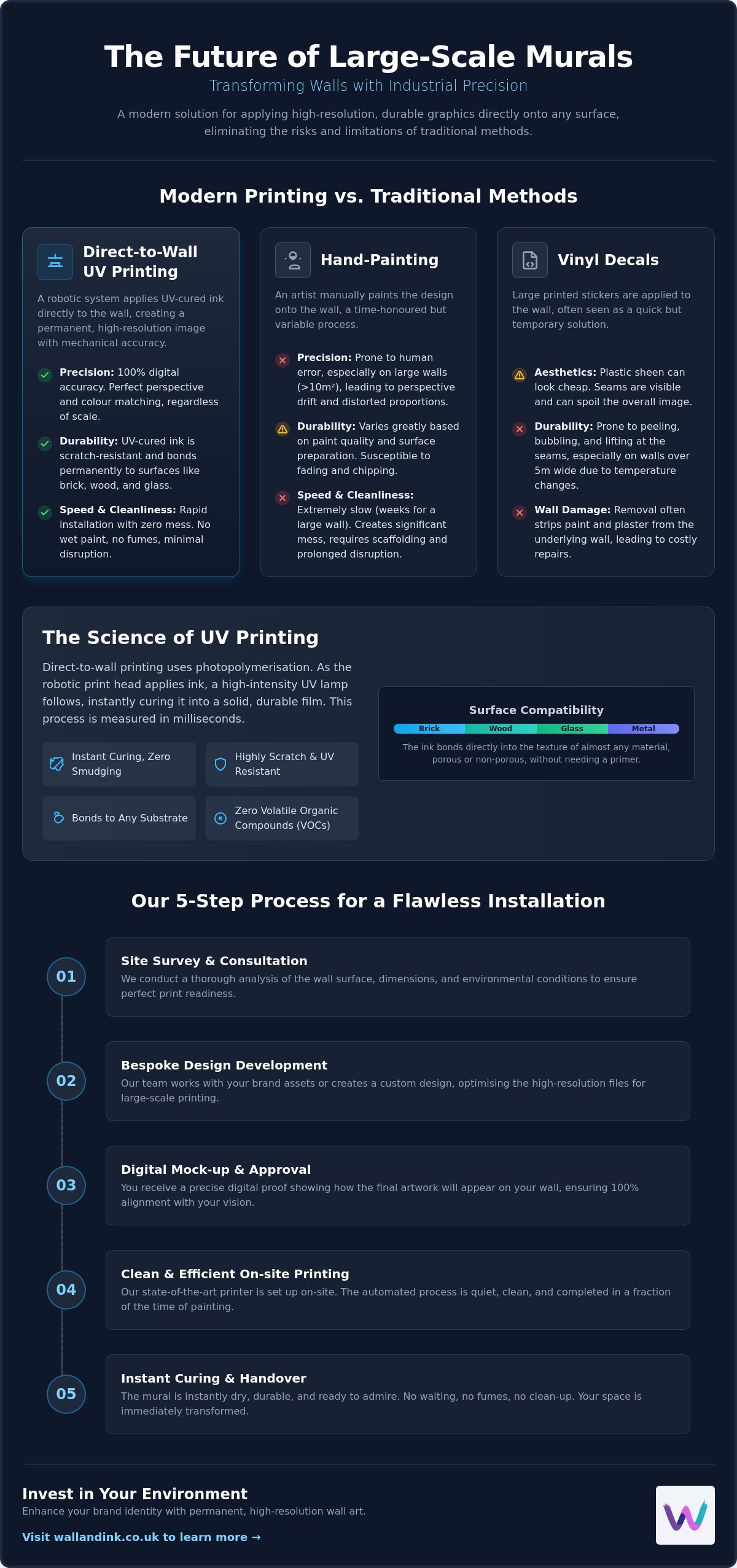
Commissioning UV Printing vs. Traditional Murals: A Comparison
Choosing to commission a mural for a large wall often involves a trade-off between artistic flair and industrial reliability. Traditional murals rely on the interpretation of a human artist, which introduces a level of subjectivity that many commercial clients find risky. In contrast, UV printing is a process of execution rather than interpretation. Because the machine follows a digital file, the final result is a 100% match to the approved design. This predictability is vital for corporate branding where logo proportions and specific colour palettes must remain consistent across expansive surfaces.
Speed and cleanliness are the most immediate benefits of the industrial approach. Whilst a hand-painted project of significant scale can occupy a space for several weeks, a direct-to-wall printer can complete the same area in a matter of hours. There is no requirement for long-term scaffolding, no lingering smell of wet paint, and no risk of spills on expensive flooring. For businesses operating in high-stakes environments, this lack of disruption is often as valuable as the artwork itself. The process is methodical, fast, and entirely contained.
Industrial Precision vs. Artistic Subjectivity
Traditional murals offer a “painterly” aesthetic, yet this often comes at the cost of precision. For a workspace or retail centre, the “pixel-perfect” finish of UV technology is usually preferred. It ensures complex graphics look sharp even when viewed from a close distance. While hand-painted art has emotional value, modern brands require a technical print that eliminates human error. This repeatability allows for the exact same mural to be installed across multiple national locations, ensuring a unified identity that manual painting cannot replicate.
Cost-Efficiency at Scale
Labour constitutes the largest portion of most mural budgets. Traditional muralists often charge high day rates for manual execution over several weeks, which can lead to escalating costs on larger walls. By contrast, UV printing reduces the total man-hours required on-site. This efficiency allows for a transparent price-per-square-metre metric, facilitating accurate budgeting without hidden fees or consultation requirements. The durability of UV-cured ink also means the mural won’t require frequent touch-ups, providing better long-term value for the investment.
For businesses aiming to maintain this level of industrial quality across all aspects of a launch or promotional event, sourcing equipment from specialists like Advent.lt ensures a cohesive and high-impact brand environment.
The 5-Step Process to Commission a Large Wall Mural
To commission a mural for a large wall is to manage an engineering project as much as an artistic one. We follow a methodical five-step framework designed to eliminate the risks associated with traditional hand-painting. The process begins with a comprehensive site survey and consultation. During this phase, we assess the substrate’s structural integrity and take precise laser measurements of the dimensions. We evaluate whether the surface is bare brick, polished glass, or standard plaster to determine the optimal ink delivery settings. This technical foundation ensures that the design remains perfectly proportioned across the entire expansive surface.
Bespoke design development follows the survey. We transform your existing brand assets, high-resolution photographs, or conceptual sketches into digital files ready for industrial application. Unlike manual methods where the artist’s interpretation can vary, our process relies on digital files that act as a mathematical blueprint. This ensures that every line, gradient, and colour value is locked in before the printing equipment arrives on-site. It’s a system built for pragmatic decision-makers who require a predictable, high-quality outcome without the typical hassles of the art world.
Digital Visualisation: Eliminating the Guesswork
Digital visualisation is the most critical step for ensuring brand consistency. We overlay your proposed design onto a high-resolution photograph of your actual wall, allowing you to see exactly how the mural interacts with your space’s lighting and architecture. This phase allows you to assess scale and placement with total clarity. You can request precise adjustments to the positioning or colour saturation whilst the project is still in the digital phase. By the time we arrive to print, the guesswork has been entirely removed, and you can be confident that the final result will match the approved mock-up 100%.
Preparing Your Space for the Printer
Technical preparation is essential for optimal ink adhesion and mechanical operation. The printer operates on a precision rail system that requires a clean, unobstructed environment. Use this checklist to prepare your space:
- Surface cleaning: Remove all dust, grease, and loose debris from the wall.
- Hardware removal: Detach all electrical sockets, switches, and wall-mounted fixtures.
- Clearance: Ensure a minimum of 1.5 metres of floor space is clear in front of the wall for the printer to navigate.
- Environmental control: The area should be dry and free from significant airborne dust during the printing window.
The ideal wall condition for UV ink adhesion is a flat, structurally sound surface that has been properly cleaned and dried.
On-site execution is the final stage. The UV wall printer operates silently and efficiently, moving across the wall to apply and cure ink in a single pass. Because the curing happens instantly, there’s no drying time and no risk of smudging. The space remains clean, and the mural is ready for public view the moment the machine finishes. If you’re ready to transform your commercial or educational environment, you can commission a mural for a large wall through our professional direct-to-surface service.
Investing in Your Environment: The Value of Direct-to-Wall Art
Investing in your physical space is a strategic decision that impacts brand perception and user behaviour. When you commission a mural for a large wall, you’re not simply purchasing decoration; you’re installing a permanent architectural asset. This method of environment management is designed for those who prioritise long-term durability over temporary fixes. Whether you’re enhancing a corporate headquarters or a public retail centre, direct-to-wall art provides a level of permanence and precision that traditional media cannot match. Our national service reach ensures that you can organise a professional commission anywhere in the UK, maintaining consistent quality across multiple sites.
Commercial and Educational Applications
In large-scale commercial buildings, murals serve a dual purpose of wayfinding and brand storytelling. High-resolution graphics can guide visitors through complex layouts whilst reinforcing corporate identity in every corridor. For educational settings, the impact is even more profound. Schools require surfaces that can withstand the rigours of high-traffic environments. UV-printed murals are ideal for this because they don’t chip or peel under heavy use. This technology also facilitates the creation of “interactive” walls. Educational graphics can be printed with high-contrast detail to serve as teaching aids or inspirational landmarks that remain vibrant for years.
Residential property owners also see a significant return on investment with bespoke feature walls. Unlike wallpaper, which is prone to peeling at the seams and requires intensive labour to install, a printed mural is a one-time application. It increases property appeal by offering a unique, high-end finish that looks integrated into the building’s structure. It’s a clean, modern way to elevate a living space without the mess of traditional decorating methods.
Transparency in Pricing and Execution
We believe that professional art services should be as transparent as any other industrial process. That’s why we lead with clear pricing based on total square footage. This allows project managers and homeowners to budget with total accuracy from the start. You won’t find hidden consultation fees or vague estimates here. Our approach is fundamentally authoritative and expert, positioning us as a technical partner rather than just a design agency. We handle the complexities of substrate assessment and digital calibration so that you can focus on the result. If you’re ready to transform your expansive surfaces with industrial precision, you can commission your large-scale mural with Wall & Ink today.
Transform Your Architectural Environment with Industrial Precision
Choosing to commission a mural for a large wall is a commitment to your space’s long-term identity. We’ve explored how direct-to-wall UV printing eliminates the mess of traditional paint whilst delivering a level of mechanical accuracy that manual methods simply cannot achieve. The process is methodical. By utilising advanced UV ink technology and a structured five-step framework, you ensure that your vision is executed with 100% digital fidelity across any substrate.
Bespoke digital visualisation removes the risk of human error on an expansive scale. It allows you to approve every detail before the first drop of ink is applied. Whether your project is situated in a high-traffic school corridor or a premium retail centre, our national UK coverage provides a reliable partner for professional on-site installation. We replace industry ambiguity with radical transparency and technical superiority. You can view our price-per-square-metre and start your commission today to secure a durable, high-resolution finish. We look forward to bringing modern industrial standards to your next architectural project.
Frequently Asked Questions
How much does it cost to commission a mural for a large wall?
Pricing is calculated using a transparent price-per-square-metre model based on the total surface area and design complexity. This industrial approach allows for precise budgeting and eliminates the hidden design fees or fluctuating day rates often found in the traditional art world. Because the process is highly efficient and less labour-intensive than hand-painting, it provides a predictable investment for commercial and residential projects alike.
Can you print a mural on a rough exterior brick wall?
Yes, our equipment is specifically designed to print on textured substrates including bare brick, stone, and rough plaster. Advanced ultrasonic sensors continuously monitor the wall’s surface, adjusting the print head to maintain a consistent distance from the substrate. This ensures that the UV ink bonds deeply into the crevices of the material, providing a durable finish that vinyl decals cannot achieve on uneven surfaces.
How long does the UV printing process take for a 10-metre wall?
A 10-metre wall can typically be completed in a single working day, with most projects finishing within 5 to 8 hours. This speed is a primary benefit of our industrial method, as it avoids the weeks of disruption required for manual painting. Since the UV ink cures instantly under integrated lamps, the space is ready for immediate use the moment the printer completes its final pass.
Do I need to prime my wall before the mural is printed?
Priming is usually unnecessary for standard architectural surfaces like plaster, brick, wood, and glass. The UV-curable ink is engineered to bond directly with these materials through a process of photopolymerisation. Whilst a primer isn’t required, the wall must be structurally sound and free from damp. If you’re printing a vibrant design onto a very dark wall, a light-coloured base coat may be suggested during your initial site survey.
Is the ink used in wall printing safe for schools and hospitals?
The inks used in our direct-to-wall printing process are virtually odourless and entirely free from Volatile Organic Compounds (VOCs). Unlike traditional paints that release chemical vapours for days, our UV-cured ink is non-toxic and safe for immediate exposure. This makes it the ideal solution for educational murals and healthcare environments where maintaining high air quality is a critical safety requirement.
What happens if I want to remove the mural in the future?
Removing a UV-printed mural is as simple as painting over the surface with two coats of standard high-quality emulsion. There’s no need for chemical strippers, heat guns, or abrasive scraping. This is a significant advantage over vinyl graphics, which often leave behind stubborn adhesive residue or cause structural damage to the underlying plaster during the removal process.
Can you print any digital image or photo as a mural?
We can print any high-resolution digital file, including corporate logos, professional photography, and bespoke vector illustrations. When you commission a mural for a large wall, the clarity of the final output depends on the resolution of the source image. Our technical team performs a full digital review of your files to ensure the art remains crisp and professional when scaled up to expansive dimensions.
How do I prepare my wall for a direct-to-wall print commission?
Preparation requires ensuring the wall is clean, dry, and free from any physical obstructions. You’ll need to remove electrical sockets, switches, and any wall-mounted hardware before the installation team arrives. Additionally, the floor area in front of the wall must be cleared of furniture to provide a 1.5-metre clearance for the printer’s rail system. A flat, dust-free surface ensures the highest level of ink adhesion and visual precision.