
Your wall graphics shouldn’t look like a giant sticker that’s destined to peel away from the substrate within two years. Most facilities managers and interior designers have grown tired of the inevitable air bubbles, visible seams, and lifting edges that plague traditional vinyl installations in high-traffic environments. Understanding the benefits of printed walls over vinyl is now essential for those seeking a permanent, high-end branding solution that meets modern 2026 standards. We’ve moved beyond the era of plastic overlays toward a more integrated, industrial approach that prioritises precision and longevity.
This article explains why direct-to-wall UV printing has surpassed legacy methods in durability, aesthetics, and environmental sustainability. You’ll learn how eliminating the PVC layer creates a breathable, scratch-resistant finish that bonds directly to brick, plaster, or wood surfaces. We’ll examine the technical superiority of UV-curable inks, the impact of low-VOC regulations on indoor air quality, and why this precision-led process is the superior choice for commercial, retail, and educational spaces that require a professional, maintenance-free finish.
Key Takeaways
- Learn how direct-to-wall UV printing creates a permanent chemical bond with the substrate, eliminating the adhesive failures and peeling common with vinyl.
- Discover the long-term benefits of printed walls over vinyl, focusing on superior scratch resistance and durability within high-traffic professional environments.
- Understand why PVC-free, low-VOC printing is the modern standard for meeting UK sustainability requirements and ensuring healthy indoor air quality.
- Explore the technical capability to print directly onto textured surfaces like brick and wood, removing the need for costly wall preparation or smoothing.
- Gain insight into the precision engineering process that ensures exact colour accuracy and a high-resolution finish that looks like an integral part of the architecture.
Direct-to-Wall Printing vs Vinyl: A New Standard for UK Interiors
In 2026, the UK interior design market has reached a critical turning point. Pragmatic decision-makers no longer accept the limitations of temporary plastic overlays. One of the primary benefits of printed walls over vinyl is the total removal of the physical substrate. Traditional graphics rely on a layer of PVC that sits on top of the wall, creating a vulnerable barrier. Direct-to-wall printing applies pigment directly into the surface pores. This creates a seamless, integrated aesthetic that vinyl simply cannot replicate. It’s a shift from merely decorating a room to engineering a permanent visual environment.
Understanding the benefits of printed walls over vinyl is essential for anyone managing high-traffic commercial spaces. We’ve moved beyond the era of “good enough” stickers. Modern branding requires a solution that bonds with the architecture rather than fighting against it. By choosing direct application, you eliminate the risks associated with adhesive failure whilst achieving a finish that looks like high-end commissioned art.
What is Direct-to-Wall UV Technology?
This process utilises advanced Digital Printing Technology to map the vertical surface in real-time. High-precision sensors track the wall’s contours, ensuring the print head maintains a consistent distance from the substrate. This allows for extreme accuracy even on slightly uneven surfaces. The ink is cured instantly by integrated UV lights. This curing process creates a smudge-proof, durable finish that is ready for immediate use. Because the system is entirely digital and doesn’t require adhesives or solvents, it’s a clean technology. It’s perfectly suited for hospitals, schools, and sterile commercial environments where air quality and cleanliness are non-negotiable.
The Problem with Traditional Vinyl Graphics
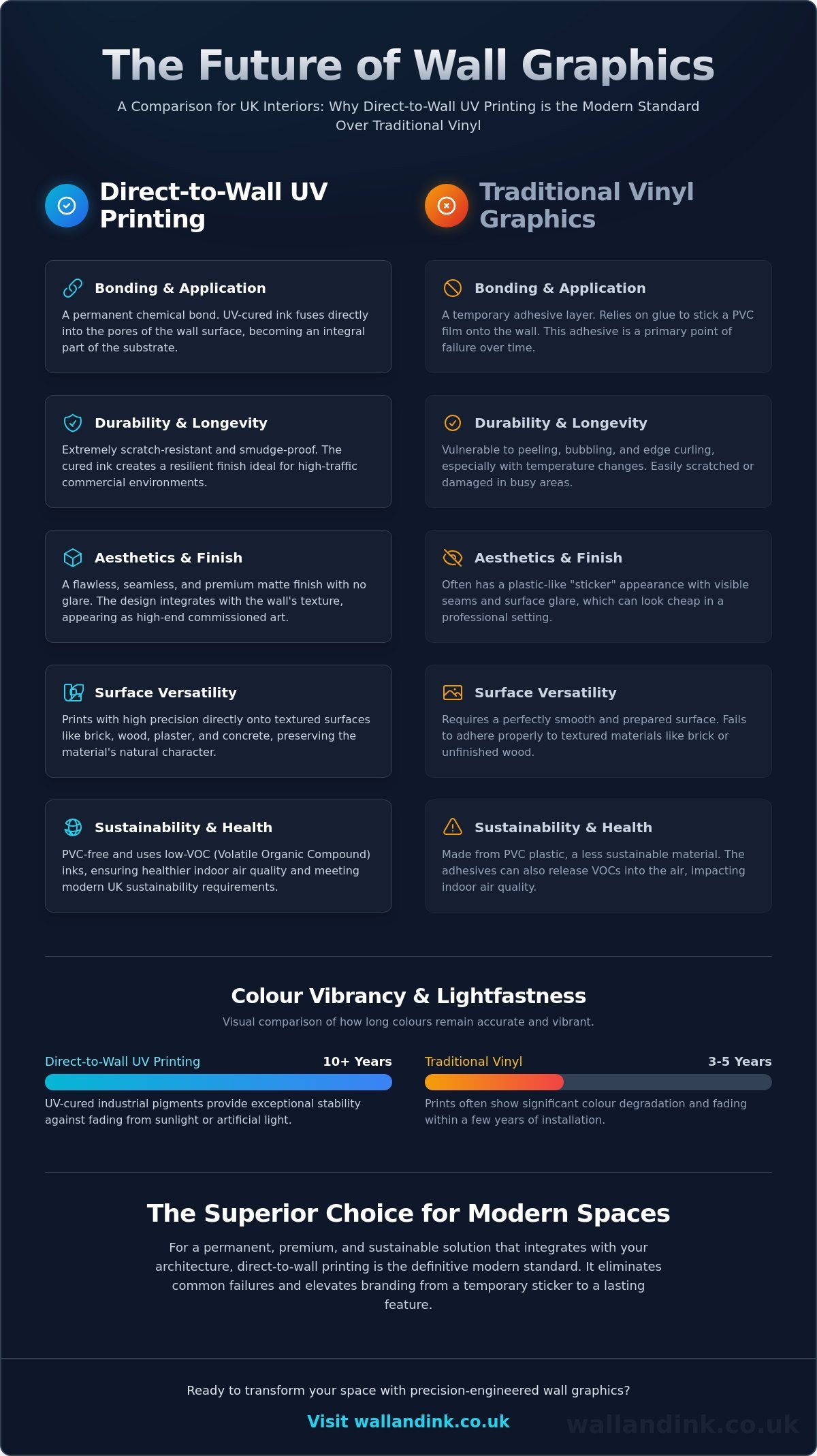
Vinyl graphics are essentially high-grade stickers. They depend on chemical adhesives to stay in place. Over time, these adhesives inevitably fail. You’ve likely seen the common signs of degradation: edge curling, unsightly bubbling, and shrinkage. In UK buildings, temperature fluctuations often accelerate this process. Central heating in the winter and rising summer temperatures cause the vinyl to expand and contract at a different rate than the wall. This leads to tension and eventual peeling. Beyond the mechanical failures, there’s the visual drawback. Vinyl often has a tell-tale glare and visible seams. It sits on the surface, creating a “sticker” look that can feel cheap in a professional setting. Direct printing offers a superior alternative by becoming part of the wall’s DNA.
The Technical Edge: Why UV Ink Outperforms Vinyl Substrates
Precision engineering defines the modern professional workspace. One of the key benefits of printed walls over vinyl is the fundamental shift from temporary physical adhesion to permanent chemical bonding. Vinyl graphics rely on a layer of adhesive that remains sensitive to its environment. This glue-based bond is a point of failure. In contrast, direct-to-wall technology uses a process where UV-curable ink creates a microscopic bond with the wall itself. This results in a finish that is mechanically superior and far more resilient to the daily rigours of a commercial environment.
The science behind this durability is well-documented. Technical research into UV-Curable Inkjet Printing on Surfaces highlights how this technology achieves exceptional adhesion and realistic textures across diverse substrates. Unlike vinyl, which hides the character of a wall behind a plastic film, direct printing allows the underlying texture to remain visible. Whether you are working with the natural grain of wood or the industrial grit of concrete, the graphic integrates with the material. This “substrate-free” advantage ensures the design feels like a bespoke part of the architecture rather than a temporary addition.
Lightfastness is another critical technical advantage. Vinyl prints often lose their colour vibrancy within three to five years when exposed to natural light or high-intensity fluorescent office lighting. UV-cured pigments are engineered for industrial longevity. They remain stable and vibrant in high-exposure areas like sunlit atriums or retail shopfronts. This stability ensures that your brand colours stay accurate and impactful for significantly longer than traditional alternatives.
Superior Adhesion and Scratch Resistance
UV ink doesn’t just sit on the surface. It penetrates the pores of the substrate before the curing light instantly hardens it. This creates a scratch-resistant finish that is incredibly difficult to damage. In busy corridors where trolleys, bags, and equipment frequently brush against walls, vinyl often suffers from “edge lift” or unsightly tears. Direct printing eliminates these risks entirely. It also withstands standard industrial cleaning agents, making it a reliable choice for those managing commercial wall murals in high-traffic zones. There’s no film to peel and no edge to pick at, which effectively discourages accidental damage and vandalism.
Breathability and Building Health
Modern building standards in 2026 prioritise structural health and indoor air quality. Vinyl is a non-porous plastic. When applied over large wall areas, it acts as a vapour barrier. This can trap moisture between the wall and the plastic film, often leading to hidden mould growth or “blown” plasterwork. Direct-to-wall printing is a breathable solution. The ink allows water vapour to pass through the substrate naturally, preventing damp issues and protecting the building’s integrity. It’s a pragmatic, health-conscious choice that aligns with the strictest safety standards for schools, hospitals, and professional offices.
Aesthetics and Sustainability: Solving Vinyls Common Failures
Aesthetic precision shouldn’t come at the cost of environmental responsibility. One of the most immediate visual benefits of printed walls over vinyl is the elimination of surface glare. Traditional vinyl is a plastic film that reflects light unevenly, often obscuring the design under bright office or retail lighting. Direct-to-wall printing uses specialised UV-curable inks that bond with the substrate to provide a matte or satin finish. This results in a “gallery” quality appearance where the art feels integrated into the room’s architecture rather than stuck onto it.
Beyond the visual impact, the lifecycle of the material is a critical factor for modern UK businesses. Vinyl graphics are notoriously difficult to recycle due to the combination of PVC and chemical adhesives. When a brand updates its space, old vinyl typically ends up in a landfill. Direct-to-wall printing eliminates this waste cycle entirely. The application involves a negligible volume of ink and no plastic substrate. When it’s time for a change, you don’t need heat guns or scrapers. You simply paint over the existing design. This “paint-over-ready” characteristic reduces labour costs and environmental impact, making it a pragmatic choice for sustainable School and Educational Murals.
PVC-Free and Eco-Friendly Branding
Corporate Social Responsibility (CSR) goals are now central to procurement decisions. Traditional vinyl manufacturing and disposal carry a heavy carbon footprint. By choosing direct-to-wall printing, organisations opt for a PVC-free solution. Our process uses non-toxic, vegan UV inks that are virtually odourless. This is a vital consideration for sensitive environments like hospitals and schools where air quality is paramount. These inks don’t off-gas harmful chemicals, ensuring that the space remains safe for occupants immediately after the printing process is complete. It’s a clean, efficient way to meet modern building standards whilst maintaining high-resolution branding.
High-Resolution Art Without the Seams
Large-scale graphics often suffer from visible joins and seams when executed in vinyl. These physical breaks in the material distract from the artwork and provide a starting point for peeling. Direct-to-wall printing removes these flaws. The printer’s precision allows for continuous, high-resolution output across vast vertical surfaces. There are no overlaps and no batch variations in colour. You get consistent, vibrant results that maintain the original wall texture. This creates an authentic, high-end feel that is impossible to achieve with a plastic overlay. The result is a bespoke finish that looks like it was always part of the wall’s structure.
Surface Versatility: Printing on Brick, Wood, and Plaster
Vinyl graphics require a near-perfect substrate to achieve a professional result. If a wall is uneven, textured, or made of porous material, the adhesive will struggle to maintain a long-term bond. One of the most practical benefits of printed walls over vinyl is the total elimination of surface preparation requirements. Direct-to-wall printing technology doesn’t require a smooth finish. It’s engineered to work with the wall as it exists, whether that’s rough-cast plaster, exposed brick, or industrial breeze blocks. You don’t need to sand down textures or install expensive backing boards to accommodate a plastic film.
When you apply a vinyl graphic to a brick wall, the plastic film bridges the gaps in the mortar. This creates air pockets that eventually lead to failure and peeling. Direct application allows the UV-curable ink to settle into the recesses of the brickwork. This results in an authentic, industrial aesthetic where the branding looks like it was painted by hand but with the precision of a digital file. This versatility extends to natural materials like timber. Unlike vinyl, which completely obscures the wood grain under a layer of plastic, direct printing allows the natural texture of the wood to show through the pigment. It enhances the material rather than hiding it.
Unconventional Substrates and Textures
Our technology is capable of printing on materials that were previously considered impossible for digital graphics. Concrete, stone, and even glass can be branded with high-resolution imagery without the risk of the graphic lifting. For exterior applications, this is the only viable method for long-term durability. Whilst vinyl will crack and fade under UV exposure on a textured facade, direct printing remains stable. This makes it the ideal choice for Exterior Wall Printing where weather resistance and substrate compatibility are critical for a lasting finish.
Architectural Integration
Traditional vinyl application often struggles with architectural features like light switches, sockets, and complex corners. The film must be cut manually, which often leaves visible gaps or messy edges. Direct-to-wall printers handle these obstacles with industrial precision. The machine can stop and start with millimetre accuracy, printing right up to the edge of an obstacle without the need for manual trimming. This ensures the artwork aligns perfectly with the architectural centre of the room. You avoid the “distorted” look that occurs when vinyl is stretched over curves or irregular features, maintaining the integrity of your design across the entire surface.
The Wall & Ink Approach: Precision Engineering for Your Space
Wall & Ink operates with a focus on industrial precision. We’ve designed our service to eliminate the traditional hassles associated with large-scale wall graphics. By managing the end-to-end process from digital visualisation to UV execution, we ensure that the technical benefits of printed walls over vinyl are fully realised in every project. Our method is a modern solution for pragmatic decision-makers who value efficiency and high-quality results. We don’t rely on guesswork; we rely on calibrated machinery and a methodical workflow.
Speed of installation is a primary advantage of our system. Whilst vinyl requires hours of manual measuring, peeling, and squeegeeing to avoid bubbles, our direct-to-wall printers transform a space in a fraction of the time. Most commercial projects are completed within a single day. This rapid execution minimises disruption to your operations. We lead with radical transparency, offering clear pricing and a national service model that covers professional environments across the UK. Every project benefits from our commitment to colour accuracy and high-resolution output, ensuring your branding is sharp and consistent.
Bespoke Design and Visualisation
The process begins with digital certainty. We use high-fidelity mock-ups to show your Commercial Wall Murals in situ before a single drop of ink touches the wall. This allows you to see how your brand logos or chosen imagery interact with the specific architectural features of your room. Our design team works with your existing assets to ensure they are perfectly adapted for large-scale application. This collaborative phase ensures the final result aligns with your visual narrative, removing the risk of unexpected layout issues during the printing phase.
Professional On-Site Execution
Our technicians arrive at your premises with a clear objective: professional execution with zero mess. The vertical printing system is self-contained and operates with mechanical reliability. We provide a “zero-mess” promise that distinguishes us from traditional decorators. There is no dust from sanding, no toxic fumes from adhesives, and no leftover scraps of plastic backing to dispose of. Once the UV curing process is complete, the wall is instantly dry and ready for use. This clean technology is ideal for high-stakes professional environments where cleanliness is a priority. Enquire about our direct-to-wall printing services today to see how we can upgrade your space with industrial precision.
Future-Proof Your Interior Branding with Direct-to-Wall Precision
Traditional vinyl graphics are no longer the standard for modern professional environments. The technical benefits of printed walls over vinyl are clear: you move from temporary plastic overlays to a permanent, integrated finish that respects the architecture of your building. By utilising UV-cured ink technology, we provide a solution that offers instant durability and long-term colour stability without the risks of peeling or bubbling. This process is entirely PVC-free and environmentally conscious, aligning with the sustainability requirements of 2026.
Choosing direct-to-wall application means investing in a breathable, scratch-resistant surface that handles difficult substrates like brick and wood with industrial precision. Our team provides national UK coverage, ensuring professional on-site installation with a zero-mess promise. It’s time to eliminate the maintenance headaches of legacy methods and adopt a cleaner, more efficient way to brand your space. Get a bespoke quote for your wall printing project and see the difference that precision engineering makes to your interior. We look forward to helping you transform your vertical surfaces into high-resolution assets that last.
Frequently Asked Questions
Is direct-to-wall printing more expensive than vinyl?
Direct-to-wall printing often requires a higher initial investment than basic vinyl stickers, but it delivers a significantly lower total cost of ownership. Vinyl graphics are susceptible to peeling and adhesive failure, which necessitates frequent repairs or full replacements. Direct printing is a permanent, industrial solution that removes the recurring labour costs associated with vinyl removal and surface re-preparation. It is the pragmatic choice for decision-makers who value long-term durability over temporary savings.
Can I remove or change the mural if I want to rebrand?
You can easily update or change a direct-to-wall mural by simply painting over the existing design. Unlike traditional vinyl, which requires heat guns and chemical scrapers that often damage the underlying plaster, our prints are “paint-over-ready”. This makes the rebranding process faster and significantly cleaner. There is no sticky residue to remove and no risk of tearing the wall’s surface, allowing for a seamless transition to a new visual narrative.
How long does a direct-to-wall print actually last?
Direct-to-wall prints are engineered for industrial longevity and typically last for 12 years or more in indoor environments. The UV-cured ink creates a permanent chemical bond with the substrate that is highly resistant to fading and mechanical wear. Whilst vinyl often shows signs of degradation, such as edge curling or bubbling, within three to five years, direct-to-wall technology maintains its colour accuracy and structural integrity for over a decade.
Does the wall need special preparation before you print?
No special preparation is required beyond ensuring the wall is clean, dry, and structurally sound. One of the primary benefits of printed walls over vinyl is the ability to print directly onto textured substrates like brick, wood, and plaster without the need for a perfectly smooth finish. Our technology uses high-precision sensors to map the surface contours automatically. This ensures an accurate application even on irregular architectural features that would reject traditional adhesives.
Is the ink safe for use in children’s bedrooms or hospitals?
Yes, the UV-curable inks used in our process are non-toxic, vegan, and virtually odourless. Because the ink is cured instantly by integrated UV lights, there is no off-gassing of harmful solvents or volatile organic compounds (VOCs). This makes the technology ideal for sterile environments and spaces occupied by children or patients. It meets strict health and safety standards for indoor air quality, providing a safer alternative to plastic-heavy decorative products.
Can you print on exterior walls that are exposed to the elements?
Yes, our specialised exterior wall printing is designed to withstand harsh weather conditions and temperature fluctuations. The UV-cured pigment is highly resistant to rain, frost, and intense sunlight. Because there is no plastic film to crack or adhesive to fail, the graphics remain stable on outdoor textured facades for years. This provides a durable branding solution for retail shopfronts and commercial exteriors that must maintain a professional appearance regardless of the weather.
What is the maximum size of a direct-to-wall mural?
There is virtually no limit to the width of a mural, as our equipment moves along a modular track system to cover vast distances. The height is typically limited by the specific machine configuration, often reaching up to 4 metres in a single pass, but we can extend this for larger architectural projects. We can print across entire warehouse walls or long hospital corridors with millimetre precision, ensuring a seamless finish across the entire vertical surface.
How do I clean a printed wall without damaging the artwork?
You can clean a printed wall using standard non-abrasive cleaning agents and a soft, damp cloth. The hardened UV ink is scratch-resistant and chemically stable, meaning it won’t smudge or fade during routine maintenance. Unlike vinyl, where water can seep under the edges and cause the graphic to lift, a printed wall is an integrated surface. This allows for frequent cleaning in high-traffic corridors without risking the integrity of the design or the wall itself.