
Removable doesn’t always mean paint-safe. Some boardroom wall graphics use adhesive coverings that can be taken down, but the result depends on the material and the condition of the wall beneath it. Removal can affect paint, so the surface matters as much as the graphic.
It’s understandable to want a room that looks considered and on-brand without committing to a finish that may not suit the space long term. The right choice starts with how the room is used, what the walls are made of and whether the paint is sound.
This guide explores practical boardroom graphic ideas, from brand-led visuals to focused wall features. You’ll also learn how removable options compare, which surfaces and paint conditions can affect the result, and how to plan a graphic that works with the room without causing problems when it’s time for a change.
Key Takeaways
- Map doors, corners, sockets and switches before finalising the artwork so important details aren’t obscured.
- Removable coverings can affect paint; the material and the wall’s condition influence what happens during removal.
- Choose a graphic style that supports the room’s purpose, from restrained brand details to a larger focal mural.
- Boardroom illustrations can use self-adhesive vinyl with a subtle textured finish, designed to be used without a separate laminate.
- Compare direct-to-wall printing with applied coverings by considering the wall surface, desired finish and how the room may change over time.
Planning Wall Graphics for Your Business?
Start with a measured wall plan, not the artwork file. In a boardroom, doors, corners, sockets and switches interrupt the printable area. Record their positions, sizes and opening direction before choosing a composition. This helps keep key text, logos and faces clear of fixtures.
Walk the room and mark each obstacle on a scaled elevation. Include door frames, skirting boards, window reveals, light switches, sockets, screens and fixed furniture. Note where a door swings across a wall, since a graphic near its edge may be obscured when the door is open. Photograph each wall straight-on to compare your drawing with the room.
Keep essential content away from cuts and edges. A logo placed across an internal corner can look distorted from the usual meeting-room viewpoint. A headline close to a door frame may lose letters during fitting. Move these elements into a clear viewing area, then use smaller background details around the perimeter.
For example, imagine a presentation wall with a screen, socket and doorway. Map the screen and fixtures, then position the main graphic in the unobstructed area. This creates a legible focal point that doesn’t compete with equipment or disappear behind an open door.
How do wall murals, vinyl lettering and acoustic wall panels compare for boardrooms? A mural creates a large visual feature, whilst lettering suits concise names or messages. Acoustic panels are a separate functional treatment: printed graphics alone don’t absorb sound.
How do you design boardroom graphics to reflect a company brand? Carry recognisable colours, typography and logo use through the room, while keeping text readable from meeting distance. UK Government guidance supports creating a coherent look by combining brand elements across physical spaces and other media.
How can wall graphics improve privacy, acoustics or wayfinding in a meeting room? Graphics can mark an entrance or establish visual zones, but they don’t create physical privacy. Acoustic performance comes from suitable sound-absorbing materials, not an image printed on a wall.
What fire safety and building regulations apply to wall graphics in UK workplaces? Requirements depend on the building, the wall’s location and the material’s fire performance. Check the graphic specification against the building’s fire strategy, and keep alarms, escape signs and route information visible.
How long do office wall graphics last, and how are they maintained? Lifespan depends on the material, wall condition, exposure and installation. Follow the material’s care instructions. Gentle cleaning helps avoid unnecessary wear, while abrasive products can damage the printed surface.
Before approving the design, review the wall plan from the boardroom entrance and seated meeting positions. Confirm that doors open freely, controls remain accessible and important content stays visible. A scaled proof helps stakeholders catch clashes before production. For boardroom wall graphics, planning around fixtures is as important as the visual concept.
Can printed wall coverings be removed later?
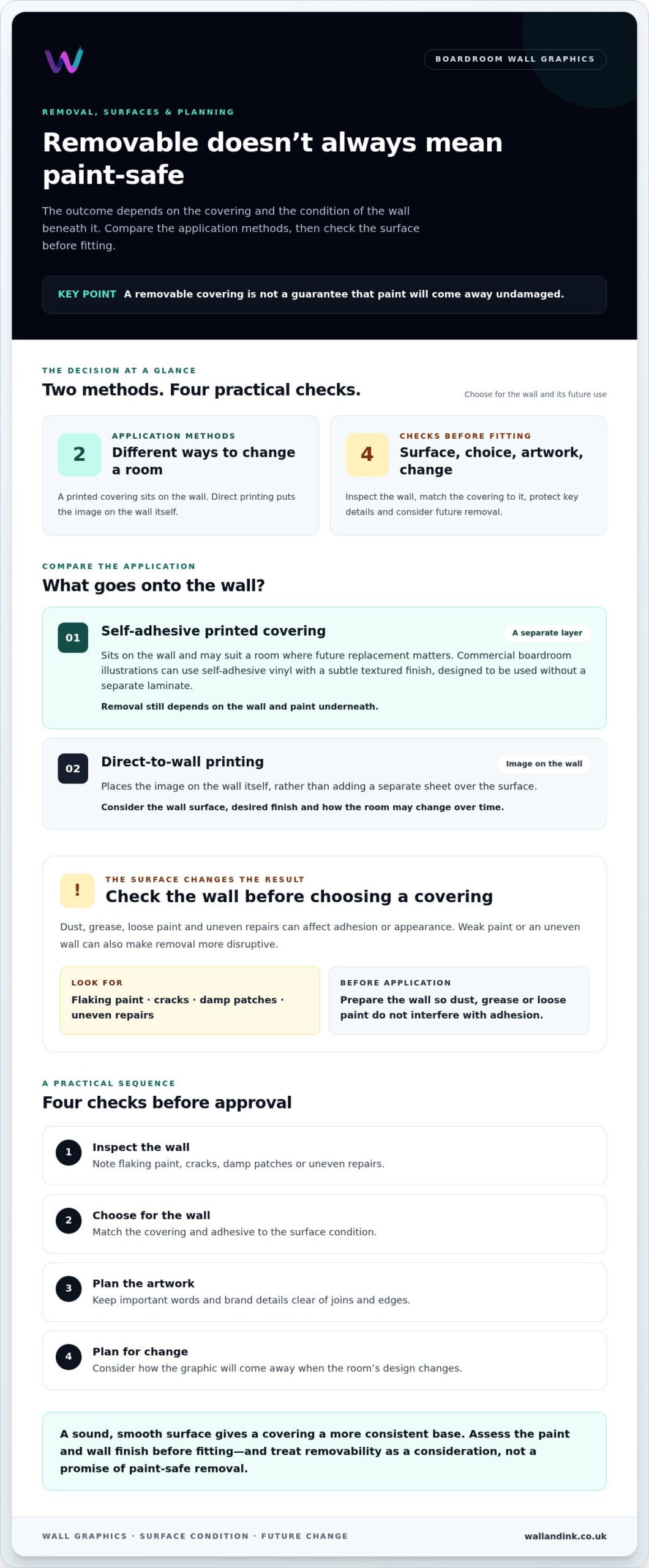
Some printed wall coverings can be removed, but removal isn’t automatically paint-safe. The material and the condition of the surface beneath it affect the outcome. Adhesive coverings can affect paint as they come away, particularly where the coating is weak or the wall is uneven.
Start by identifying the finish you’re considering. A self-adhesive printed covering sits on the wall; direct printing places the image on the wall itself. These methods offer different ways to change a room. A removable covering may suit a space where future replacement matters, whilst direct printing avoids adding a separate sheet over the surface.
For a boardroom refurbishment, imagine a branded wall that may need updating after a rebrand. Choose the application method with that change in mind, then assess the existing paint and wall finish before fitting. This gives you a clearer understanding of how the graphic relates to future redecorating, rather than treating removability as a guarantee of undamaged paint.
Fitting quality also affects the finished appearance. Measure the wall and check the artwork’s scale from the intended viewing position. Before application, prepare the wall so dust, grease or loose paint don’t interfere with adhesion. During fitting, align the image carefully and manage joins so key details don’t break across a seam.
Commercial boardroom illustrations can use self-adhesive vinyl with a subtle textured finish. This type of wall covering can be designed for use without a separate laminate. The construction gives the printed surface its finish without adding another layer, but removal still depends on the wall and paint underneath.
Consider these practical steps before approving a printed covering:
- Inspect the wall: note flaking paint, cracks, damp patches or uneven repairs.
- Choose for the wall: match the covering and adhesive to the surface condition.
- Plan the artwork: keep important words and brand details clear of joins and edges.
- Plan for change: consider how the graphic will come away when the room’s design changes.
For example, a wall with lifting paint needs attention before a new covering is fitted. Applying over an unstable coating risks compromising adhesion and may make later removal more disruptive. A sound, smooth surface gives the covering a more consistent base. If you’re comparing a printed covering with direct wall printing options, consider whether the priority is a removable layer or an image printed onto the wall.
Wall surface and paint condition
A wall graphic relies on the surface beneath it. Dust, grease, loose paint and uneven repairs can affect adhesion or appearance. In a boardroom, inspect the entire area under normal lighting. A smooth, clean, stable wall provides a more consistent base than flaking paint or a rough patch.
Identify the substrate before choosing an application method. Painted plaster, plasterboard and masonry can differ in texture and absorbency. Pronounced texture may show through a thin covering or interrupt contact with the wall. A filled repair can also remain visible if it sits proud of the surrounding paint. Check the surface from the main viewing position, not just up close.
Paint condition matters during fitting and later removal. An adhesive covering bonds to the paint, so weak or poorly adhered paint can lift with it. Freshly painted walls need time to dry and cure, following the paint manufacturer’s instructions. Fitting over tacky paint risks marking the finish or affecting adhesion.
- Look for loose areas: peeling edges, bubbles and powdery paint indicate an unstable coating.
- Check for contamination: hand marks, cleaning residue and grease can interfere with adhesion.
- Assess texture: stippled or uneven paint can affect contact and the graphic’s appearance.
- Review repairs: sanded filler and colour differences may remain visible through the design.
Consider a boardroom with a recently repaired wall. A filled channel beneath the proposed graphic has a slight ridge and a different paint finish. Inspect the repair in angled light, smooth the surface and bring its finish into line before installation. This creates a more even background and keeps the image as the visual focus.
For an older wall with flaking paint, fitting over the damaged area doesn’t solve the underlying problem. Remove unstable material and prepare the surface before applying a covering. If the wall has damp patches, address the source and let the surface dry before decorating. Covering a defect may hide it temporarily while leaving the wall condition unresolved.
Match the method to the surface. Adhesive coverings need reliable contact across the application area; direct printing avoids a separate adhesive layer but still relies on a prepared wall. When planning boardroom wall graphics, record the surface type, paint condition and repairs. These details help guide preparation and prevent the finish from highlighting defects.
What types of wall graphics work best in a boardroom?
The best choice supports the room’s purpose without competing with presentations or discussion. A large brand mural can establish a clear focal point behind the main screen, whilst restrained graphics suit rooms where the display changes frequently. Start by deciding what the wall needs to do: express the company’s identity, provide context or make the space feel finished.
A brand-led graphic can use the company’s colours, typography and visual language in a measured way. For example, a simplified brand pattern can frame a presentation wall without placing a large logo behind video-call participants. Keep high-contrast details away from the screen, where they may distract from slides. Check the composition from the doorway and usual seating positions.
Map-based graphics can connect a boardroom to the organisation’s work. A UK logistics company might show its operating regions, whilst an international business could use a carefully selected global map. Use labels only if they remain legible at the room’s viewing distance. Remove confidential locations, client names or operational details before approving the artwork.
Typography works well for a concise mission statement, company principle or meeting-room identifier. Keep the message brief and leave clear space around the lettering. A dense block of small text may look precise on a computer but become difficult to read across a table. A single phrase, treated as part of the room’s visual design, is easier to absorb.
- Brand pattern: adds identity without filling the wall with text.
- Illustrated mural: creates a focal point around a chosen theme or place.
- Map or diagram: explains geography, process or organisational structure.
- Typography: highlights a short message or room name.
Consider a boardroom used for presentations and client meetings. The blank wall feels impersonal but must work behind a screen. Place a subtle, low-detail brand pattern on the adjacent wall and reserve the screen wall for clear sightlines. This creates a branded room that doesn’t compete with slides or video calls.
For a project-review room, a team may need a visual reference to its work. Use a graphic showing a simplified process or project landscape, with labels limited to essential terms. This creates an at-a-glance prompt that supports discussion without turning the wall into a crowded presentation.
Acoustic performance needs separate consideration. A printed image alone won’t absorb meeting-room sound; its role is visual. If the room has echo, treat sound control as a distinct design requirement rather than expecting a mural to solve it. Choose boardroom wall graphics to suit the room’s use, viewing angles and presentation equipment, then check the artwork at full scale before production.
What materials are used for commercial wall graphics in the UK
Commercial wall graphics can be applied as a separate covering or printed directly onto a wall. The material and method affect the finish, how the graphic meets the surface and the preparation required. For a boardroom, compare the intended appearance with the wall condition and how the room is used.
Self-adhesive vinyl is one option for printed wall coverings. Boardroom illustrations have used vinyl with a subtle textured finish, designed for use without a separate laminate. The texture can influence how light falls across the image, so consider its effect beside windows or overhead lighting. A sample or visual proof can help you assess the finish against the room’s colours.
Vinyl is a covering, not a treatment for a damaged wall. Its adhesive needs a suitable surface, and the wall condition can affect fitting and later removal. If the paint is loose or the plaster is uneven, prepare the area before installation. An image may follow the wall’s contours, leaving surface defects visible beneath the finished graphic.
Direct printing takes a different approach: the image is printed onto the wall rather than supplied as a separate sheet. This avoids adding a covering layer, but the wall still needs preparation for a clean, consistent result. The method can suit a permanent feature, such as a brand image on a presentation wall. It isn’t the same as choosing a removable covering.
Consider a boardroom with bright lighting and a textured wall. A large graphic is planned opposite windows, where surface texture and glare may affect its appearance. Review the wall finish and lighting, then compare the proposed printed material with the intended viewing angle. This helps you choose a finish before producing the artwork.
Use these checks to compare materials and application methods:
- Finish: decide whether a smooth or subtly textured appearance suits the room.
- Wall compatibility: consider paint condition, texture and previous repairs.
- Application: distinguish an adhesive covering from direct wall printing.
- Future changes: weigh the covering’s removal implications against a directly printed image.
For a client-facing boardroom, the situation may call for a polished brand feature that works with existing surfaces. The action is to assess the wall, lighting and design together, rather than choosing material by appearance alone. The result is a graphic planned for its actual setting. Explore wall mural options to consider how a bespoke graphic could work in your space.
Wall & Ink: Direct-to-Wall Printing
Wall & Ink offers Direct-to-Wall Printing for businesses planning a bespoke boardroom feature. UV printing applies the artwork directly to the wall, creating an alternative to a separate adhesive covering. It can suit a permanent branded mural when the wall is prepared and the design is tailored to the space.
Choose this approach when you want artwork scaled to a particular wall rather than a standard-sized image. Wall & Ink can develop a Commercial Wall Mural through bespoke design consultation and digital visualisations, helping you assess the composition before on-site installation. The wall surface and paint condition remain important, especially when comparing direct printing with a covering intended for later removal.
If direct printing suits your boardroom plans, contact Wall & Ink to discuss your project.
Shape a room that supports the way you meet
A boardroom’s walls are part of its working environment. They can set the tone before a presentation, reinforce a sense of purpose and give visitors a clearer impression of the organisation. The strongest design choice feels deliberate in everyday use, not just impressive in a presentation image.
Before moving forward, decide what people should notice or feel when they enter. A calm, focused atmosphere may call for a restrained visual treatment, whilst a client-facing space might benefit from a more distinctive brand feature. Use that intention to guide the artwork, scale and placement of your boardroom wall graphics.
Wall & Ink creates bespoke Commercial Wall Murals and Residential Wall Art, alongside Direct-to-Wall Printing. A clear brief gives the design process a practical starting point and connects the visual idea to the room.
Discuss your ideas with Wall & Ink and take the next step towards a boardroom designed with purpose.
Wall & Ink for Boardroom Wall Graphics
Wall & Ink offers Direct-to-Wall Printing and Commercial Wall Murals for businesses planning boardroom wall graphics.
Turn to Wall & Ink when you’re ready to explore boardroom wall graphics through its commercial wall printing service.
Frequently Asked Questions
What are boardroom wall graphics?
Boardroom wall graphics are designed images or visual elements applied to meeting-room walls. They can include a company mural, a simplified map, a brand pattern or a short statement. A design can create a focal point, support the room’s identity or help visitors recognise the space. Application methods differ: some graphics use a separate covering, whilst direct-to-wall printing places the image on the wall itself.
How are wall graphics installed in a boardroom?
Installation starts with preparing the artwork and wall for the selected method. For direct printing, a specialist positions printing equipment against the wall and applies the image directly to its surface using UV printing technology. A separate covering is fitted differently and must be aligned on the wall. For either approach, clear access to the work area and a final check of the artwork’s position help prevent clashes with furniture or equipment.
Can wall graphics be removed without damaging painted walls?
Removal can affect painted walls, so don’t assume a covering is damage-free simply because it can be taken down. The adhesive, paint strength and wall condition all influence the result. For example, poorly bonded paint may lift with an adhesive layer. Direct-to-wall printing is not a removable covering; changing the design means addressing the printed wall surface rather than peeling off a separate graphic.