
The assumption that porous concrete surfaces are incompatible with high-resolution digital imagery is a legacy misconception. Many architects and facility managers still ask, can you print on a concrete wall without the ink peeling or the texture ruining the final aesthetic? The reality is that concrete is an exceptionally stable, high-performance substrate when approached with industrial precision. You don’t need to settle for vinyl wraps that bubble or traditional paints that fade; modern engineering has provided a more reliable, direct-to-surface alternative.
We understand the concern that exterior elements or high-traffic contact might compromise the integrity of your art. This guide provides a clear technical overview of how advanced UV technology achieves direct-to-wall results that are both durable and visually striking. You’ll gain a thorough understanding of the UV printing process and the specific preparation required to ensure perfect adhesion. We’ll show you how to transform raw surfaces into professional assets whilst maintaining the confidence that your investment is built to last.
Key Takeaways
- Confirm that can you print on a concrete wall with high-resolution results using specialised direct-to-wall UV inkjet technology.
- Identify why smooth, shuttered concrete is the optimal choice for detailed architectural art and how surface porosity affects the final aesthetic.
- Contrast the reliability of direct-to-wall printing with traditional vinyl applications that often fail to adhere to breathing, industrial surfaces.
- Evaluate the durability of UV-cured inks for exterior and high-traffic environments, ensuring long-term resistance to weather and mechanical wear.
- Learn about the bespoke digital visualisation process that allows UK businesses to preview their murals in situ before the printing phase begins.
Can You Print on a Concrete Wall? The Short Answer
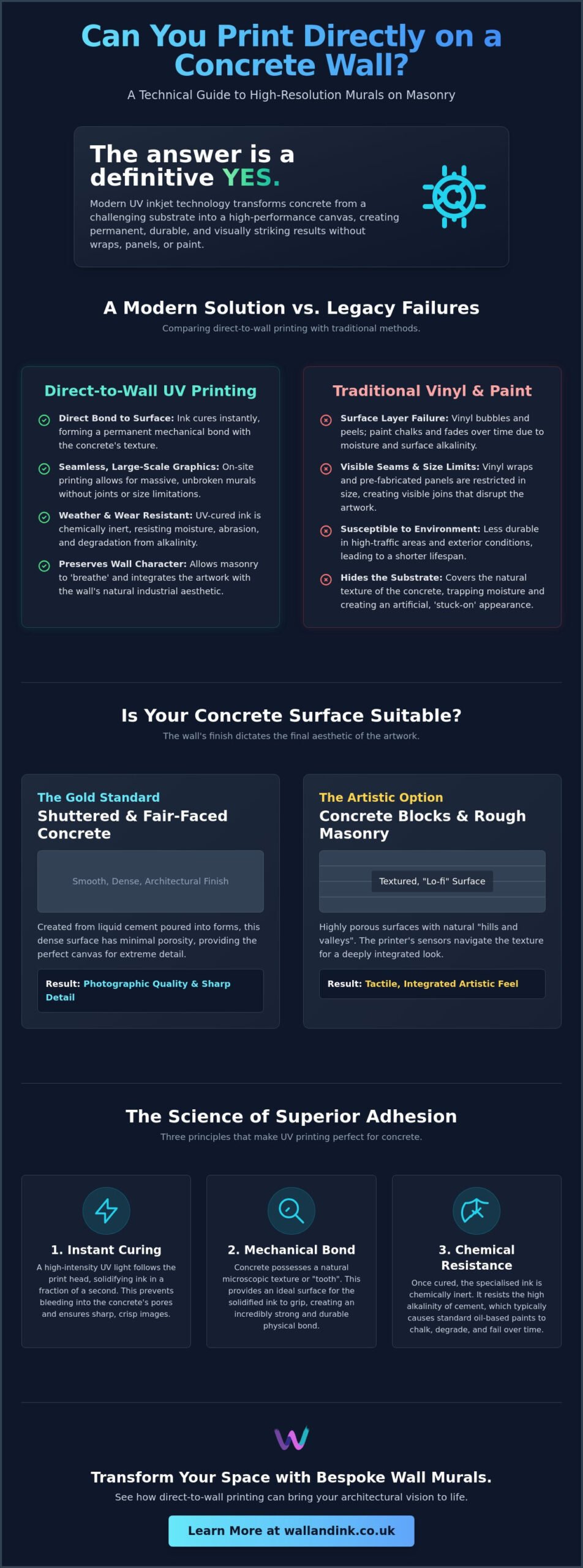
The straightforward answer is yes. You can print directly onto concrete using specialised UV inkjet technology. This isn’t a workaround or a temporary fix like a vinyl decal; it’s a permanent, high-resolution application that treats the wall as a professional substrate. UV wall printing is the application of light-cured inks directly onto vertical surfaces. By using a mobile, computer-controlled carriage that moves along a rail system, the printer applies ink with mechanical precision, following the exact contours of the standing structure.
Unlike traditional wallpaper or vinyl wraps, this method doesn’t hide the concrete. It integrates with it. Traditional materials often struggle with the “breathing” nature of masonry, leading to bubbles, peeling, or moisture traps. Direct-to-wall printing eliminates these legacy failures. The ink bonds with the surface whilst preserving the raw, industrial aesthetic of the concrete. This creates a finish that feels like a part of the architecture rather than an after-thought tacked onto the surface.
The Science of UV Ink Adhesion on Concrete
Concrete is a challenging material for standard paints because of its porosity and chemical makeup. UV printing solves this through instant curing. As the print head passes over the wall, a high-intensity UV light follows immediately behind, solidifying the ink in a fraction of a second. This prevents the pigment from bleeding into the pores or blurring the image. Concrete also possesses a natural “tooth”, a microscopic texture that provides an ideal surface for mechanical bonding. Furthermore, these specialised inks are formulated to be chemically inert once cured. This makes them highly resistant to the naturally alkaline environment of cement, which typically causes standard oil-based paints to chalk or degrade over time.
On-Site Printing vs Pre-Fabricated Panels
Some industrial providers offer printed concrete by processing small slabs in a factory setting before shipping them to a site. This method is often limited to small sections, sometimes as small as 120cm, and creates visible seams that break the visual flow of a mural. Mobile direct-to-wall printing removes these constraints entirely. We bring the technology to the existing architectural structure, allowing for seamless graphics across massive expanses. Printing on-site also ensures the artwork interacts correctly with the room’s natural lighting and shadows. You don’t have to worry about transport damage or complex installation logistics. The printer works on the standing wall, delivering a bespoke result that fits the specific environment perfectly.
Evaluating Your Concrete Surface for Printing
Assessing the substrate is the most critical phase of the project. Concrete is not a uniform material; its density, texture, and age determine how the ink behaves upon application. When considering the question can you print on a concrete wall, you must first evaluate the specific finish of your masonry. The mechanical bond between the UV-cured ink and the wall relies on the surface profile, making some concrete types more suitable for high-resolution detail than others.
The physical properties of the wall dictate the final aesthetic. A smooth, architectural pour allows for sharp lines and subtle gradients, whereas a standard industrial block might produce a more textured, artistic result. Understanding these distinctions ensures the final mural meets your expectations for both clarity and durability.
Shuttered and Fair-Faced Concrete
These surfaces represent the industry gold standard for direct-to-wall digital printing. Shuttered concrete, created by pouring liquid cement into timber or metal forms, results in a smooth, architectural finish. This dense surface allows for exceptional detail, making it possible to achieve photographic quality directly on the wall. Whilst the lines left by timber formwork are often visible, they can be integrated into the design to enhance the industrial aesthetic. For those seeking the highest level of precision, professional site assessments can determine if your fair-faced concrete requires any specific cleaning before the printing carriage is deployed.
Concrete Blocks and Rough Masonry
Standard concrete blocks, or breeze blocks, offer a more textured, “lo-fi” aesthetic. Because these blocks are highly porous and have a rougher surface, the printer uses advanced sensors to maintain a consistent distance, navigating the “hills and valleys” of the masonry. The result is a tactile mural that feels deeply embedded in the structure. This texture often enhances the artistic feel of large-scale graphics, though it may soften ultra-fine text. If you are dealing with older masonry that appears dusty or crumbly, a simple stabilising primer ensures the ink bonds to the solid structure rather than loose surface particles.
Polished and Power-Trowelled Surfaces
Polished concrete presents a unique challenge. These surfaces are non-porous and glass-smooth, which can make adhesion difficult for standard paints. To ensure a permanent grip, we adjust the ink delivery and curing intensity. This prevents the ink from sitting loosely on the surface, ensuring the same scratch-resistant durability found on rougher substrates. Whether your wall is a raw industrial block or a refined architectural feature, the technology adapts to the material’s specific mechanical properties.
UV Printing vs Traditional Methods: Why Concrete Prefers Ink
Concrete presents specific challenges that legacy decorative methods often fail to overcome. When clients ask can you print on a concrete wall, they’re usually looking for a solution that avoids the common pitfalls of vinyl decals or hand-painted murals. Traditional methods treat concrete as a flat, inert surface; however, its porous and thermally active nature requires a more technically advanced approach. UV printing succeeds where other methods fail because it respects the physical reality of the substrate.
The ink sits “in” the surface rather than “on” it. This distinction is vital for maintaining the wall’s tactile character. By bonding mechanically with the microscopic texture of the masonry, the print becomes an integral part of the structure. This eliminates the risk of “ghosting” or peeling that occurs when surface-level graphics are subjected to environmental stress. The result is a finish that feels permanent and intentional, rather than a temporary layer applied to the surface.
The Failure of Vinyl on Concrete
Vinyl is essentially a plastic film held in place by adhesive. On concrete, this is a recipe for failure. Concrete is a breathable material that allows moisture and gases to migrate through its structure. Because vinyl acts as a non-porous barrier, these gases become trapped, causing the graphic to bubble and eventually peel. Temperature fluctuations exacerbate this, as the expansion and contraction rates of plastic and masonry are vastly different. Beyond the mechanical failure, vinyl often carries a “sticker” look that clashes with high-end industrial design. Removing it is equally problematic; adhesives often leave a stubborn residue that discolours the concrete, making future updates difficult and messy.
The Precision Advantage
Direct-to-wall printing offers a level of precision that traditional sign-writing cannot match. We use a CMYK+W ink system to reproduce complex brand logos and photographic gradients with absolute accuracy. This eliminates the human error inherent in hand-painted murals, where consistency can vary across large expanses. The speed of execution is another significant factor for pragmatic decision-makers. Whilst a hand-painted mural of 20 square metres might take a week to complete, our digital process can transform the same area in a single day. This efficiency reduces on-site disruption and ensures that your facility remains operational throughout the project. It’s a modern solution that replaces traditional hassles with industrial reliability.
Durability, Maintenance, and Exterior Concrete Printing
When investing in large-scale graphics, the primary concern for most facility managers is longevity. You aren’t just asking can you print on a concrete wall for a temporary display; you need a solution that withstands years of operational use. UV-cured inks are engineered for industrial endurance. Because the curing process happens instantly under high-intensity light, the ink forms a robust, cross-linked polymer bond. This makes the final print inherently scratch-resistant and ideal for high-traffic corridors, schools, or public spaces where physical contact is inevitable.
The technical specifications of these inks ensure they remain vibrant for up to 12 years when applied to internal walls. For exterior wall printing, the ink maintains its colour integrity for approximately 5 years before any noticeable fading occurs. This durability is far superior to traditional paints, which often chalk or peel within much shorter timeframes when exposed to the elements. The result is a professional finish that retains its impact without the need for constant touch-ups.
Weatherproofing and UV Stability
The British climate is notorious for rapid temperature shifts and heavy rainfall. UV-cured inks are hydrophobic and thermally stable, meaning they don’t swell or contract at a different rate than the concrete substrate. UV inhibitors are integrated directly into the ink formula to absorb harmful radiation and prevent sun bleaching. This chemical stability ensures that the artwork remains sharp even on south-facing facades. For extreme environments, such as coastal areas with high salt spray, industrial zones with heavy pollutants, or the high-humidity pool facilities maintained by JTEVENT, an optional clear coat can be applied to provide an additional sacrificial layer of protection against the environment.
Long-Term Maintenance Tips
Maintenance is remarkably straightforward and requires no specialised equipment. You don’t need aggressive chemicals or abrasive scrubbing to keep the mural clean. A simple damp cloth is usually sufficient to remove dust or surface dirt. It’s vital to avoid using solvent-based cleaners, as these can eventually degrade the ink bond over time. If the underlying concrete develops structural cracks due to building settling, the print will follow the crack. Unlike vinyl, which would tear and peel away from the fissure, the ink remains adhered to the edges of the masonry. If the design needs to be updated or the branding changes, the surface can simply be over-printed. This allows for a complete aesthetic refresh without the need for messy sandblasting or chemical stripping.
The Wall & Ink Process: Bespoke Murals for UK Businesses
We provide a comprehensive end-to-end service designed for businesses that require high-impact visual results without the disruption of traditional renovation. When you ask can you print on a concrete wall, you aren’t just looking for a technical possibility; you’re looking for a managed professional process. Our approach eliminates the coordination headaches of hiring separate designers and decorators. We handle everything from the initial technical site survey to the final digital application, ensuring a seamless transition from concept to masonry.
Cleanliness is a core pillar of our industrial workflow. Unlike traditional painting or sandblasting, our direct-to-wall printing is entirely dust-free. The UV-curing process ensures there are no lingering chemical odours or volatile organic compounds (VOCs) released into your workspace. This makes the technology suitable for active schools, hospitals, and offices where air quality and cleanliness are non-negotiable. We bring the equipment to your standing structure, avoiding the logistical limitations of factory-printed panels.
Bespoke Design and Visualisation
We adapt your existing brand assets, high-resolution photography, or custom illustrations for the specific scale of your concrete substrate. A critical part of our decision-making process is the digital mock-up. We provide a visualisation of the artwork in situ, allowing you to see how the design interacts with the architectural lines of the building before a single drop of ink is applied. This level of transparency ensures that architects and stakeholders can integrate art into the building’s original design with absolute confidence, ensuring the final result complements the industrial environment.
Professional On-Site Installation
Our team provides national coverage across the UK, bringing industrial-grade technology directly to your site. On the day of printing, the setup is methodical and efficient. We follow a precise sequence to ensure the highest quality finish:
- Site calibration and precision rail system assembly.
- Surface sensor adjustment to compensate for concrete texture.
- High-resolution digital application with instant UV curing.
- Immediate pack-down and workspace handover.
Because the ink cures instantly, the room is ready for immediate use. There is no drying time, no cordoned-off areas, and no post-installation cleanup required. This efficiency is designed for pragmatic decision-makers who value quality but cannot afford operational downtime. If you are ready to transform your space, enquire about our UK-wide wall printing services today.
Transform Your Concrete Infrastructure with Industrial Precision
Direct-to-wall printing is the definitive professional answer to the question: can you print on a concrete wall? As we’ve explored, modern UV technology provides a permanent, high-resolution bond that significantly outperforms the failures of traditional vinyl and hand-painted murals. By utilising industrial-grade equipment directly on your standing masonry, we ensure that your architectural features are enhanced without the risk of peeling, bubbling, or atmospheric degradation.
Our process is engineered for the pragmatic decision-maker. We include bespoke digital mock-ups to guarantee visual accuracy before any ink is applied. On-site execution is entirely dust-free and odourless, ensuring your facility remains fully operational throughout the installation. With a proven 12-year indoor durability rating, your artwork remains a high-quality asset that withstands the rigours of high-traffic environments. We eliminate the traditional hassles of renovation, delivering a clean, efficient, and technically superior result for your UK facility.
Ready to upgrade your industrial or commercial environment? Get a bespoke quote for your concrete wall project and discover the impact of direct-to-surface digital art.
Frequently Asked Questions
Is concrete printing permanent or can it be removed?
Concrete printing is a permanent solution designed to last for over a decade in indoor environments. Because the UV-cured ink bonds mechanically with the substrate, it cannot be simply peeled off like a vinyl decal. If you need to update the wall, the surface can be painted over with a high-opacity primer or removed using professional mechanical abrasion. This ensures the wall can be repurposed without leaving the stubborn adhesive residue associated with traditional graphics.
Does the concrete need to be sealed before you print on it?
Most architectural concrete does not require a pre-print sealant. Our UV-cured ink is engineered to bond directly with the raw, porous surface of the masonry. However, if the wall is particularly old, dusty, or crumbly, a stabilising primer is applied to ensure the ink adheres to the solid structure rather than loose particles. We assess the porosity and texture of the wall during our technical survey to determine if any specific preparation is required.
Can you print white ink onto dark or grey concrete?
Yes, our technology utilises a dedicated white ink channel to ensure vibrant results on dark or grey substrates. When clients ask can you print on a concrete wall that has a deep grey industrial tone, we apply a white base layer first. This prevents the concrete’s natural colour from dulling the final image. This process ensures that brand colours and high-contrast graphics remain sharp and accurate, regardless of the substrate’s base shade.
How long does it take to print a mural on a concrete wall?
The printing process is exceptionally efficient, typically allowing us to complete a 20-square-metre mural in a single day. Setup and calibration take approximately one to two hours, followed by the automated printing phase. Because the UV ink cures instantly under the carriage light, there is no drying time required. This speed minimises on-site disruption, allowing businesses and schools to return to normal operations immediately after the equipment is packed down.
Is the ink eco-friendly and safe for indoor environments like schools?
Our UV-cured inks are entirely safe for sensitive indoor environments, including schools and healthcare facilities. The process is virtually odourless and produces no harmful volatile organic compounds (VOCs) during or after the application. Unlike solvent-based paints or traditional wallpapers that use heavy adhesives, our method is dust-free and non-toxic. This makes it an ideal choice for educational murals where air quality and immediate room re-occupancy are primary concerns for facility managers.
What is the maximum size of a mural you can print on concrete?
There is virtually no upper limit to the horizontal size of a mural we can produce. Our modular rail system allows the printer to move across any distance, meaning we can cover entire building facades or long industrial corridors. For height, the system is adjustable to reach several metres in a single pass, and for taller structures, we utilise professional access equipment. Each section is printed with mechanical precision to ensure seamless transitions across the entire expanse.
Can you print on exterior concrete walls in the winter?
Exterior printing can be carried out during the winter months, provided the surface is dry and the ambient temperature is above 5 degrees Celsius. Whilst the UV-cured ink is weather-resistant once applied, moisture on the substrate can interfere with the initial mechanical bonding process. We monitor local weather conditions closely and use protective enclosures if necessary to ensure the site remains dry. This flexibility allows for project completion throughout the year across the UK.
Do you provide the artwork, or do I need to supply my own?
We offer a flexible approach to artwork. You can supply your own high-resolution files, which we will then optimise for the specific texture of your concrete wall. Alternatively, we can provide a bespoke design service to create unique imagery tailored to your brand or environment. Every project includes a digital mock-up phase, ensuring you can review how the art integrates with your architecture before the final on-site printing begins.