
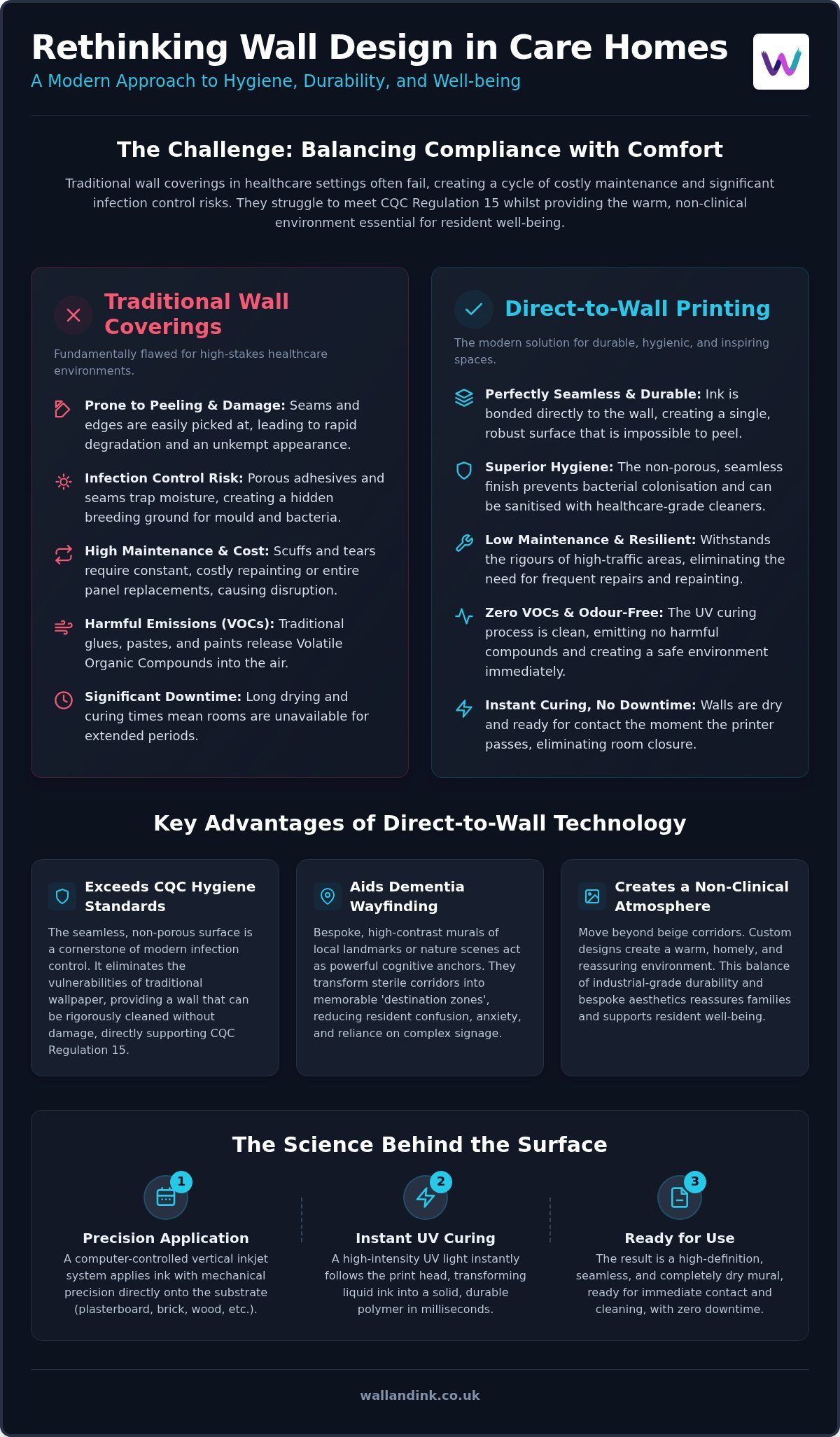
Traditional wallpaper and vinyl graphics are no longer fit for purpose in high-traffic healthcare environments. You’ve likely seen the cycle: wallpaper peeling at the seams or vinyl graphics being picked at by residents, creating both an eyesore and a documented infection control risk. It’s a frustrating reality for those trying to balance CQC Regulation 15 compliance with the need for a warm, homely atmosphere. Effective care home interior wall design shouldn’t be a constant compromise between clinical safety and aesthetic comfort.
We recognise that maintaining a stimulating yet hygienic environment is a primary concern for pragmatic decision-makers. This guide explores how direct-to-wall printing technology is disrupting legacy methods by providing durable, seamless murals that are impossible to peel and simple to sanitise. You’ll discover how to utilise bespoke UV-cured designs to improve dementia wayfinding and create non-clinical spaces that genuinely reassure families. We’ll examine the technical advantages of direct-to-substrate application and how these precision-engineered surfaces meet the rigorous demands of modern healthcare standards.
Key Takeaways
- Understand how UV direct-to-wall printing technology eliminates the volatile organic compounds (VOCs) and drying times associated with traditional adhesives.
- Discover how to exceed CQC hygiene standards by replacing porous, seamed wallpaper with seamless surfaces that prevent bacterial growth and are easy to sanitise.
- Learn to optimise care home interior wall design by utilising high-contrast landmark murals and specific Light Reflectance Values to improve resident wayfinding.
- Identify the technical requirements for various wall substrates to ensure a durable, high-definition finish that withstands the rigours of a high-traffic care environment.
- Master the balance between a warm, non-clinical aesthetic and industrial-grade durability to create spaces that attract families and support resident well-being.
The Challenge of Modern Care Home Interior Wall Design
Pragmatic care home operators face a constant tension. CQC Regulation 15 demands clean, well-maintained environments, yet residents require a space that feels like home, not a hospital. Walls are often the most underutilised asset in this equation. They’re typically treated as passive boundaries rather than active tools for cognitive support. By applying Evidence-Based Design principles, we can see that the physical environment directly impacts resident outcomes and operational efficiency. Plain, clinical paint fails both the resident and the maintenance budget. High-resolution, bespoke imagery solves the clinical feel objection whilst providing the durability that healthcare environments require. Unlike generic stock patterns, bespoke designs can replicate local heritage or natural vistas, grounding residents in a familiar reality. This technical precision ensures that the visual outcome is as reliable as the substrate it’s printed on.
Moving Beyond the Clinical Aesthetic
Beige corridors represent a failure of design. These monochromatic environments often lead to sensory deprivation, which can increase agitation and confusion amongst residents with dementia. Effective care home interior wall design uses environmental psychology to reduce anxiety by providing clear visual cues. Creating destination zones with large-scale murals encourages purposeful movement. A mural of a local landmark or a garden scene provides a cognitive anchor. It transforms a sterile transition space into a focal point that sparks memory and conversation. This approach reduces the reliance on complex signage, which can often be confusing for those in advanced stages of cognitive decline.
The Failure of Traditional Wall Coverings
Legacy solutions like wallpaper and vinyl graphics are fundamentally flawed in high-stakes healthcare settings. Wallpaper seams are a primary target for resident damage. They’re easily picked at, leading to rapid degradation and an unkempt appearance. Below the surface, the risks are even more significant. Traditional vinyl glue and wallpaper paste are organic materials that trap moisture against the substrate. This creates a hidden breeding ground for mould and bacteria, directly contradicting infection control protocols. Maintenance cycles for traditional paint are equally inefficient. Scuffed corridor walls require constant repainting, which involves sanding, dust, and drying time. This cycle creates ongoing labour costs and limits room availability. Traditional methods also fail the snagging test. A single tear in a vinyl wrap necessitates the replacement of the entire panel to maintain a professional appearance. This is a maintenance headache that modern facilities can no longer afford.
The Science of Direct-to-Wall Printing in Healthcare
Direct-to-wall printing represents a technical departure from legacy decorating methods. The process utilises a computer-controlled vertical inkjet system that moves across the wall surface with mechanical precision. As the ink is applied, a high-intensity UV light source follows the print head. This light triggers an instant chemical reaction known as curing. The liquid ink transforms into a durable, solid polymer in milliseconds. This process eliminates the need for drying time and ensures the mural is ready for contact immediately after the print head passes. It’s a clean, industrial process that removes the variables associated with traditional painting or paper hanging. The result is a high-definition image that bonds at a molecular level to the substrate, whether that’s plasterboard, exposed brick, or wood panelling. This level of precision is essential for effective care home interior wall design, where durability and hygiene are non-negotiable requirements.
Infection Control and Seamless Surfaces
Traditional wall coverings create inherent risks for infection control. Seams in wallpaper or the edges of vinyl decals provide ideal environments for moisture to accumulate and bacteria to thrive. Direct-to-wall printing removes these vulnerabilities entirely. By applying ink directly to the substrate, we create a completely seamless finish. There are no gaps for residents to pick at and no hidden pockets for pathogens to colonise. The resulting UV-cured ink surface is entirely non-porous and resistant to penetration by liquids. This allows staff to sanitise walls using standard healthcare-grade detergents and chemical cleaners without risking the integrity of the design. It’s a pragmatic solution for facilities that must maintain a clinical level of cleanliness whilst avoiding a clinical appearance. For managers looking to modernise their facility, our direct-to-wall printing services provide a robust alternative to high-maintenance traditional coverings.
Safety and VOC Compliance
Respiratory health is a critical consideration in care settings. Traditional adhesives and solvent-based paints often release Volatile Organic Compounds (VOCs) for days or weeks after application. Our UV-curable inks are low-VOC and virtually odourless. This allows for rapid installation in occupied buildings without compromising air quality. A communal lounge can be transformed whilst residents are in the dining room; there are no fumes to clear and no mess to manage. Beyond air quality, the cured ink meets stringent fire safety standards. It doesn’t contribute to flame spread, making it compliant with UK fire regulations for commercial wall-applied graphics. These technical advantages ensure that the environment remains safe for residents and staff alike. Incorporating these durable finishes helps managers align their facilities with established dementia-friendly design guidelines, which emphasise the need for clear, high-contrast, and non-glare surfaces to support resident independence and cognitive health.
Dementia-Friendly Design: Murals vs Traditional Coverings
Care home interior wall design plays a critical role in the daily lives of the estimated 982,000 people living with dementia in the UK. While some facilities rely on simple colour-coded corridors, generic blocks of colour often lack the specificity required for effective orientation. High-resolution murals provide distinct “Landmark” cues that are more easily processed by the ageing brain. To ensure these landmarks remain functional, we adhere to the University of Stirling’s Dementia Services Development Centre (DSDC) guidelines. These standards recommend a difference of at least 30 degrees of Light Reflectance Value (LRV) between critical surfaces like walls and floors. Direct-to-wall printing allows us to manage these values with mathematical precision. We create high-contrast environments that support visibility without the confusing glare or reflections often found in laminated vinyl alternatives.
Wayfinding and Cognitive Anchors
Recognition is the foundation of resident independence. Bespoke “front door” murals for individual rooms act as personal cognitive anchors. These life-sized, realistic images allow residents to identify their own living space through visual memory recall rather than relying on abstract room numbers. This technology also serves a vital safety function. We can print murals that disguise “staff only” doors or service areas by blending them into a continuous, non-stimulating landscape. This subtle intervention significantly reduces exit-seeking behaviour and resident agitation. Unlike generic stock photography, bespoke local imagery is far more effective. A resident is more likely to engage with a familiar scene of a local park or high street than a generic mountain range from a different continent. These familiar scenes stimulate long-term memory and provide a sense of security.
Biophilia and Resident Wellbeing
Biophilic design is the strategic integration of natural elements into the built environment to satisfy the human need for connection with nature. In a care home context, this involves transforming windowless corridors or internal lounges into “indoor gardens” using floor-to-ceiling nature scenes. Research indicates that nature-based wall art can reduce heart rates and lower blood pressure amongst residents. High-resolution prints of local woodland or coastal paths create a perceived sense of openness in confined spaces. This is particularly effective in high-traffic corridors where residents may feel enclosed. Because the UV-cured ink is applied directly to the wall, these scenes remain crisp and vibrant for years. They don’t fade or peel like traditional nature-themed wallpaper, ensuring the therapeutic benefit remains consistent without the need for frequent maintenance. Effective care home interior wall design shouldn’t just be decorative; it must be a functional tool for wellbeing.
Actionable Guidance: Planning Your Interior Wall Strategy
Successful care home interior wall design begins with a technical audit of the building’s physical substrates. Our UV-cured inks are engineered to bond with various surfaces including plaster, concrete, and existing emulsion. The primary requirement is a stable, debris-free surface. When planning the scale of an installation, consider the functional goal. A single feature wall serves as a high-impact cognitive anchor, whilst a full-room wrap provides the immersive biophilic environment required for sensory rooms or communal lounges. This decision should be driven by the specific needs of the resident population in that zone.
Integrating these designs with your existing infrastructure is essential. Unlike reflective vinyl, our direct-to-wall prints have a matte finish that diffuses light. This eliminates the glare that often triggers confusion in residents with visual impairments. From an acoustic perspective, the micro-thin layer of ink does not interfere with the performance of sound-absorbing panels or textured wall finishes. When budgeting, look beyond the initial installation. Traditional paint in high-traffic corridors typically requires a full refresh every 24 months due to scuffs and damage. Our murals are designed for a 10-year lifecycle. This significantly reduces long-term labour costs and the operational downtime associated with frequent repainting cycles.
Colour Psychology for Different Zones
Visual environments directly influence resident behaviour. Calming blues and greens are appropriate for bedrooms and quiet lounges to promote rest and lower anxiety. Conversely, warm tones like soft oranges or yellows in dining areas can help stimulate appetite and encourage social engagement. We strictly avoid high-contrast, repetitive patterns or busy geometries. These can be misinterpreted as moving objects or physical hazards by residents with dementia, potentially leading to falls or significant distress. Every colour choice is made with industrial precision to ensure the Light Reflectance Values support orientation without causing overstimulation.
The Design Visualisation Process
Precision is the hallmark of our process. We provide digital mock-ups that overlay the proposed design onto photographs of your actual walls. This allows stakeholders and management to approve the visual impact before any ink hits the substrate. Our designers scale every image to account for handrails, electrical sockets, and medical call points. This ensures that critical safety equipment is never obscured and the artwork remains coherent across the entire surface. We often collaborate with families to choose meaningful local themes that resonate with the residents’ specific heritage. For a bespoke solution tailored to your facility, explore our range of commercial wall murals to see how we transform healthcare environments.
The Wall & Ink Approach: Bespoke Solutions for UK Care Homes
Wall & Ink operates as a specialist disruptor in the healthcare sector. We provide an end-to-end service that covers every stage from the initial creative design consultation to on-site execution. Our process is engineered for pragmatic decision-makers who require high-quality results without the logistical burden of traditional decorating. We’ve eliminated the mess, the fumes, and the drying times. Our “No-Hassle” promise means there’s no need for stripping old wallpaper, sanding down plaster, or dealing with sticky adhesive residues. We print directly onto your existing stable surfaces, ensuring a clean and efficient transition from plain walls to high-impact care home interior wall design.
We maintain national UK coverage, allowing us to deliver consistent design quality across multiple facility locations for larger care groups. This ensures that whether you operate a single boutique home or a nationwide network, the technical precision and aesthetic standard remain identical. Case studies from across the country demonstrate how our direct-to-wall art has transformed sterile corridors into vibrant, memory-stimulating environments whilst maintaining the highest hygiene standards. This industrial-grade reliability is why we’re trusted by professional providers to modernise their estates with minimal disruption.
Bespoke Design for Unique Facilities
Our design team specialises in turning low-resolution concepts or local heritage photographs into high-definition, wall-ready art. We don’t just print images; we organise visual elements with scientific precision to avoid sensory overwhelm. This is critical in dementia-friendly environments where overstimulation can lead to resident distress. The resulting finish is permanent and scratch-resistant. It’s built to withstand the daily rigours of a high-traffic healthcare zone, including frequent contact from wheelchairs, trolleys, and walking frames. Unlike traditional vinyl, there are no edges to peel or surfaces to scratch, ensuring the investment lasts for years.
Getting Started with Your Transformation
The process begins with a detailed consultation phase. We identify your facility’s specific pain points, whether that’s poor wayfinding, resident agitation, or unsustainable maintenance costs. Once the strategy is defined, our execution is rapid. We respect the operational demands of a working care home, which is why our process is preferred by busy managers who cannot afford long-term room closures or the dust associated with traditional renovations. To begin your facility’s modernisation and improve the resident experience, enquire about our bespoke care home wall printing services today.
Future-Proofing Your Care Environment with Direct-to-Wall Printing
Modernising your facility requires a shift from legacy decorating methods to industrial-grade solutions. We’ve established that effective care home interior wall design must serve a dual purpose: supporting resident cognitive function whilst meeting rigorous infection control standards. By choosing direct-to-wall printing, you eliminate the inherent risks of peeling wallpaper and bacterial growth behind vinyl seams. Our seamless, hygienic finish provides a robust surface that is easy to sanitise and impossible for residents to pick or damage, ensuring compliance with the most demanding healthcare protocols.
Every project we undertake includes a bespoke design visualisation; this ensures the final output aligns perfectly with your facility’s layout and resident needs before any ink hits the substrate. Our durable UV-cured inks provide a permanent, scratch-resistant finish that maintains its vibrancy in high-traffic corridors for years. This technical precision removes the constant cycle of repainting and maintenance, allowing you to focus on resident care. If you’re ready to transform your clinical spaces into stimulating, homely environments, book a design consultation for your care home project today. We’re here to help you create a safer, more engaging space for your residents and their families.
Frequently Asked Questions
Is direct-to-wall printing safe for residents with respiratory issues?
Direct-to-wall printing is entirely safe for residents with respiratory conditions because we use low-VOC UV inks. Unlike traditional solvent-based paints or wallpaper adhesives that release fumes for days, our inks cure instantly under high-intensity UV light. This process ensures there are no lingering odours or airborne particulates. It’s a clean, industrial method that allows for immediate room occupancy without compromising the air quality of the healthcare environment.
How long does a typical care home wall mural take to print?
The technical execution speed depends on the total square footage and the complexity of the surface. However, a standard feature wall for care home interior wall design typically takes only a few hours to complete. Because the ink cures in milliseconds, there is no drying time or secondary finishing required. This allows facilities to return to full operational capacity much faster than traditional decorating methods that involve multi-day drying cycles.
Can the wall art be cleaned with hospital-grade disinfectants?
Our murals are fully compatible with standard healthcare-grade detergents and hospital disinfectants. The UV-curing process creates a non-porous, chemically resistant polymer bond that prevents liquids from penetrating the surface. Staff can maintain rigorous infection control protocols by wiping down the printed walls without risking any degradation to the image quality or the substrate. This makes it a superior choice for high-traffic clinical zones where hygiene is a priority.
What happens if a wall printed by Wall & Ink gets damaged?
Wall & Ink murals are exceptionally durable and resistant to the scratches or picking that often ruins vinyl graphics. If the underlying wall substrate suffers significant structural damage, we can recalibrate our equipment to print directly over the repaired area. This precision-targeted repair is far more efficient than traditional methods, which usually require the removal and replacement of entire wallpaper drops or vinyl panels to maintain a consistent appearance.
Do we need to move residents out of the area during the printing process?
You don’t need to relocate residents during the installation process. Our vertical inkjet technology is quiet and doesn’t produce dust, mess, or volatile fumes. This lack of disruption is a primary reason why busy care managers prefer our method. We can transform a communal lounge or corridor whilst residents are occupied in a nearby dining area, ensuring that the facility’s daily routine remains uninterrupted from start to finish.
Can you print on textured walls or only on smooth plaster?
Our advanced UV printers are designed to apply high-resolution imagery to a wide variety of substrates beyond smooth plaster. We can print directly onto exposed brick, concrete, wood panelling, and even certain types of plastic or metal surfaces. The technology compensates for minor surface irregularities, ensuring the ink bonds securely to the physical reality of the wall. This flexibility allows us to create bespoke care home interior wall design across an entire estate regardless of the building’s age.
How does direct printing compare to the cost of high-quality wallpaper?
Whilst the initial outlay for direct-to-wall printing may be higher than low-end wallpaper, it’s highly competitive with premium, fire-rated digital wall coverings. The real value lies in the 10-year maintenance cycle. You eliminate the recurring costs of stripping, sanding, and repainting that traditional wallpaper requires every few years. When factoring in the reduction in operational downtime and the elimination of damage repairs, direct printing is the most cost-effective long-term strategy.
Can we use our own photos or local historical images for the design?
We specialise in adapting local historical images or family photos into high-definition, wall-ready formats. Our bespoke design service includes a digital visualisation phase where we show exactly how your chosen imagery will look within your specific architectural space. Using local landmarks is a proven strategy for dementia-friendly design; it sparks long-term memories and provides residents with a sense of familiarity and security that generic stock patterns cannot replicate.