
What if your wall graphic didn’t need to be fitted as wallpaper or applied as vinyl? Commercial wall printing puts bespoke artwork directly onto a wall, connecting a business objective with a graphic designed for that specific space. To decide whether it suits your project, consider the surface, the design and how people will see it.
Those are practical questions when the wall is part of a busy office, school, shop or hospitality setting. The right approach depends on the space, the audience and what the graphic needs to do, whether that’s reinforce your brand, communicate information or shape the environment. A digital visualisation can help you review the artwork at scale and in context before printing.
This article explains how direct-to-wall printing differs from conventional wall graphics, where it can add value and what to consider about your site. You’ll also see how Wall & Ink manages a commercial project, from design consultation and artwork adaptation through to digital visualisation and on-site printing with UV printers. The aim is a clear route from business purpose to a wall graphic planned for your space.
Key Takeaways
- See how commercial wall printing can connect a business goal with a graphic planned for a real space.
- Understand how a project moves from a design brief and artwork preparation to visualisation and on-site printing.
- Compare graphic ideas for offices, education, retail and hospitality settings.
- Learn which wall and site details to consider before planning a mural, including dimensions and surface material.
- Discover how Wall & Ink manages commercial projects from design consultation to UV printing across the UK.
What commercial wall printing can do for a business space
Commercial wall printing is the process of printing bespoke artwork directly onto a wall to support a business’s identity, communication or environment. Instead of treating the wall as a blank backdrop, it makes the surface part of how people experience a space. A graphic might welcome visitors, help them find their way or give a room a more recognisable character.
Let the purpose guide the design. A company mark or brand colours can establish identity in a reception area. In a shared workplace, a graphic could make a meeting zone easier to recognise. A school might use a wall to support orientation or learning, while a hotel or restaurant could use imagery to shape the feel of a particular area. A mural can take many forms, as the general overview of Mural shows, but a commercial design needs to make sense for its audience and setting.
Where commercial wall printing fits in a business
Start by deciding what people should understand or feel in the space. Consider the purpose before choosing a graphic concept, as the same visual approach won’t suit every site.
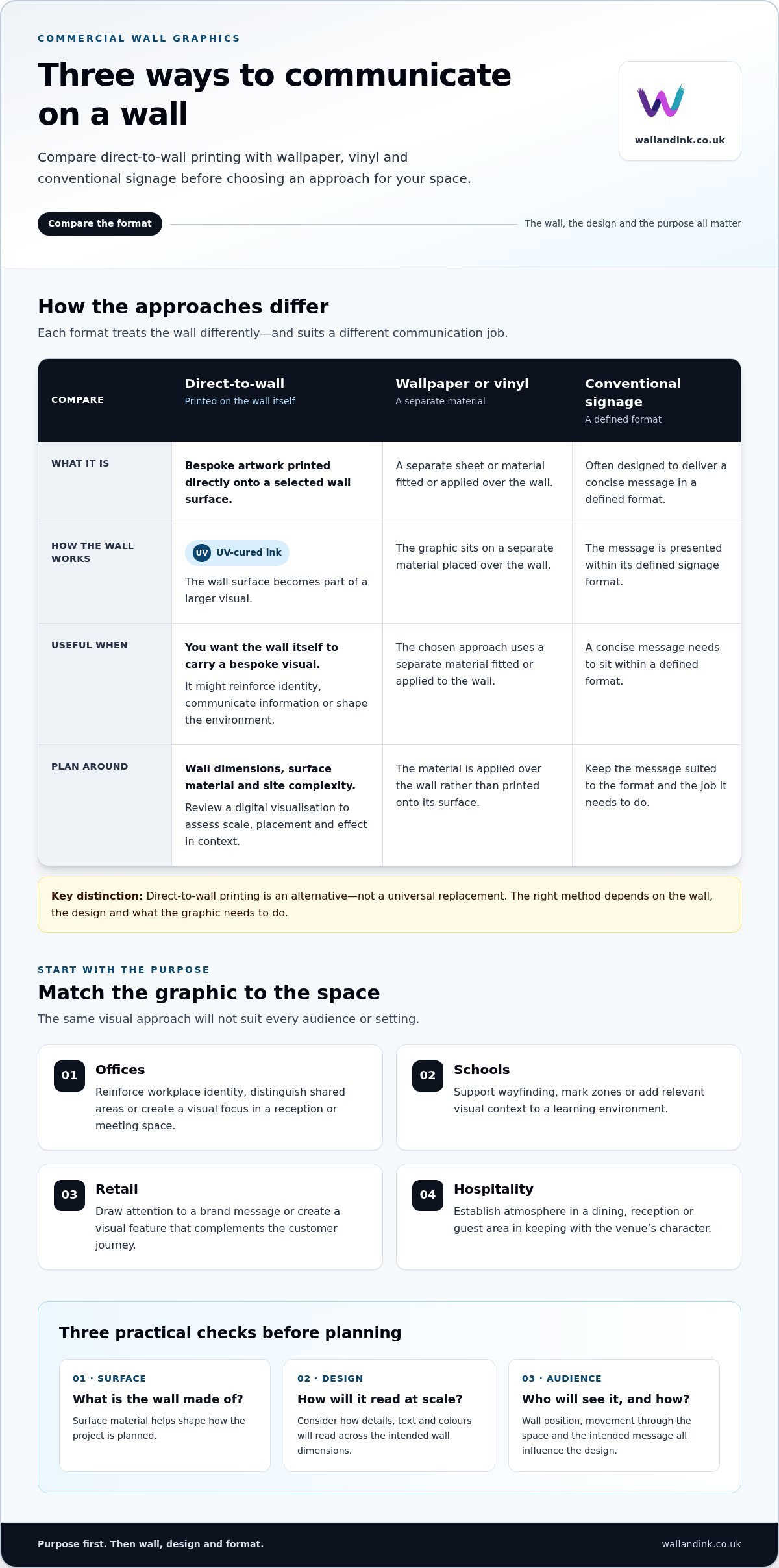
- Offices: Reinforce workplace identity, distinguish shared areas or create a clear visual focus in a reception or meeting space.
- Schools: Support wayfinding, mark zones or add relevant visual context to a learning environment.
- Retail: Draw attention to a brand message or create a visual feature that complements the customer journey.
- Hospitality: Establish atmosphere in a dining, reception or guest area in keeping with the venue’s character.
These are starting points, not fixed templates. A design that works behind a reception desk may be distracting in a teaching area. Consider the wall’s position, how people move through the space and what message you want them to take away.
What makes direct-to-wall printing different
With direct-to-wall printing, prepared artwork is printed onto the physical wall surface using a specialist UV printer. UV refers to ultraviolet light, which is used to cure the ink as it is applied. The image is printed on the wall itself, rather than on a separate sheet of wallpaper or vinyl fitted over it.
That difference affects how the project is planned. Conventional signage is often designed to deliver a concise message in a defined format; a printed wall can make the surface part of a larger visual. Wallpaper and vinyl are separate materials fitted or applied to a wall, while direct printing places the image on the surface. It’s an alternative, not a universal replacement. The right method depends on the wall, the design and the job the graphic needs to do.
For a business, the useful question is not simply what image might look good. Consider what the wall needs to communicate, who will see it and how the design can serve that specific space.
How direct-to-wall printing turns a design into a wall mural
A successful mural starts before the printer reaches the site. The business purpose, artwork and physical wall all need to work together. A logo designed for a screen, for example, may need adapting to read clearly at a much larger scale. Doors, corners and the direction people approach from can also affect how the finished image is seen.
Direct-to-wall printing takes prepared artwork from an agreed brief and prints it onto a selected wall surface using a UV printer. The process connects design decisions to the wall’s dimensions and setting, so the proposed graphic can be reviewed in context before on-site printing begins.
From business brief to print-ready artwork
A design consultation establishes what the mural needs to achieve and who will see it. Wall & Ink can adapt supplied material, such as a logo or photograph, into artwork suited to the wall. A digital visualisation shows the proposed design in its intended setting, helping you assess scale, placement and overall effect before the artwork is prepared for printing.
The project typically moves through these stages:
- Set the purpose. Define whether the wall should communicate brand identity, share information or contribute to the character of the space.
- Review the site. Identify the intended wall and note its dimensions, surface and surroundings. These details help the design fit the physical setting.
- Develop the artwork. Adapt supplied assets or develop bespoke visuals, considering how details, text and colours will read at the intended scale.
- Review a visualisation. See the proposed design in context and refine its placement or proportions before it moves towards printing.
This review helps address a common concern: a design can look different when enlarged from a computer screen to a full wall. Seeing it in the space gives you a clearer basis for decisions about composition and emphasis.
What happens during on-site printing
Once the artwork and wall have been planned, printing takes place at the client’s site on the selected surface. The Wall & Ink team brings the UV printer to the wall and carries out the print there. Ultraviolet light cures the ink as it is applied. The image is printed directly onto the wall, rather than supplied as a separate sheet to fit or apply.
The physical setting remains part of the job. Wall dimensions influence the artwork’s scale, while surface material and site complexity can shape how the project is planned. Clear artwork and placement decisions give the on-site team a defined design to print. The visualisation helps connect the agreed composition to the real space.
For businesses considering commercial wall printing, the process is a practical sequence: establish the purpose, prepare artwork for the wall, review it in context, then print it on site. Wall & Ink’s bespoke direct-to-wall printing service brings those stages together, from design consultation through to the finished mural.
Match commercial wall printing to your space and business objective
A strong mural concept starts with a clear purpose. Decide whether the wall should express your identity, help people find their way or give an area a defined atmosphere. Then consider who will see it, where they’ll stand and how they’ll move through the space. These factors help shape a graphic that belongs in its setting rather than simply filling a blank wall.
Use the examples below as starting points. A suitable design depends on the site and the message, not just the type of business.
| Business setting | Communication goal | Possible graphic concept |
|---|---|---|
| Office | Reinforce identity or distinguish shared and visitor-facing areas | Brand-led imagery or a graphic that gives a reception, meeting space or team area a clear visual focus |
| Education | Support orientation, learning themes or clear messaging | Age-appropriate subject imagery, visual prompts or graphics that help identify different areas |
| Retail | Express the brand and create a point of visual interest | Bespoke imagery that relates to a product, campaign or part of the customer journey |
| Hospitality | Establish character or make a guest area easier to recognise | A site-specific visual that complements the venue’s identity and the purpose of the space |
Commercial murals for workplaces and educational settings
In an office, consider how the graphic will appear to visitors as well as staff. A reception wall may call for a clear expression of the organisation’s identity, while a shared area could use artwork to distinguish its function. In a school, subject-related imagery or clear visual messages can give a corridor, entrance or learning area a relevant focus. Keep wording legible and visuals appropriate for the people who use the space.
Retail and hospitality wall graphics
Customer-facing graphics need to work with the surrounding environment. Consider sightlines from entrances, counters and seating, as well as how customers move through the area. A design partly hidden behind fixtures may lose its purpose; a dominant graphic beside important information could compete for attention. Bespoke artwork can reflect the business’s visual identity without relying on a generic format. Its scale, content and placement should suit the venue.
Design suitability and surface suitability are separate questions. A concept may fit the audience and business objective, but the actual wall still needs consideration. Its dimensions, material, condition and position in the space can affect how the project is planned. Assess the selected surface rather than assuming that every wall in an office, school, shop or venue is equally suitable. This keeps the graphic’s purpose in view while grounding decisions in the site itself.
For commercial wall printing, match the message to the people and place first. Then assess the wall, sightlines and surrounding features so the final concept is appropriate both visually and practically.
Plan a commercial wall-printing project with fewer surprises
Good planning connects the business objective to the wall that will carry the design. Before artwork is finalised, establish what the graphic needs to do, identify the intended surface and consider how people use the space. This lets the design and site plan develop together, rather than treating the wall as an afterthought.
Work through the decisions in sequence:
- Define the goal. Decide whether the graphic should express your organisation’s identity, communicate information or give an area a particular visual character. A clear purpose guides choices about imagery, text and placement.
- Identify the wall. Record its location and dimensions, then note doors, windows, switches, furniture and other visible features. Consider what can be seen from the entrance and how people move past it.
- Describe the site. Note the wall’s material and visible condition, along with access to the area and nearby fixtures that could affect planning. Site complexity varies by project, so accurate details are more useful than assumptions about a typical wall.
- Develop and review the artwork. Prepare the design for the selected wall and review a digital visualisation in context before printing. This gives you an opportunity to assess scale, colour and placement as part of the real space.
Prepare the wall and site information
Measure the intended area and share its location within the premises. Describe the surface, including its material and any features that may affect where the image sits. A wall with a doorway, corner or fixed equipment presents a different layout challenge from an uninterrupted surface. Record access considerations too, so the physical setting informs the plan. Base preparation on the actual project rather than generic instructions.
Think about the wall’s role in the room. Is it visible as soon as someone enters, viewed mainly from a seating area or passed at close range? This context can influence how much detail the artwork needs and where key elements should appear. Nearby signs or displays matter too: a mural should work with these features, not compete with essential information.
Review the design before printing
A digital visualisation helps you judge the proposed graphic against the room and wall, rather than viewing the artwork in isolation. Check whether the main image has the right scale, whether colours sit comfortably in the space and whether the composition avoids doors or fixtures. Look closely at logos, wording and fine image details. Elements that appear clear on a screen may need consideration at full wall scale.
Use the review to focus on practical design choices. Confirm that the intended message is easy to understand from the positions where people will see it, and that the placement supports the wall’s purpose. This is especially useful when the graphic must sit alongside existing features or serve a visitor-facing function.
Planning a commercial wall printing project begins with useful site information and a clear design objective. To discuss your requirements and how they relate to the wall and setting, Discuss your commercial wall-printing project.
From bespoke design to on-site printing with Wall & Ink
Wall & Ink manages commercial wall murals as a connected project, from understanding the business objective to printing the agreed artwork directly onto the wall. The service brings design consultation, artwork adaptation, digital visualisation and professional on-site printing together, so the design can be reviewed in its setting before it is produced. Wall & Ink works with commercial clients across the UK.
A managed service for commercial spaces
The process is tailored to the artwork and the site. During a design consultation, the project’s purpose and visual direction are explored. Existing client logos or photographs can be adapted into wall-ready artwork, or a design can be developed around the space and its intended use. A digital visualisation shows how the proposed mural may look in context, helping you assess scale and placement before on-site printing.
This approach suits workplace receptions and shared areas, schools, retail spaces and hospitality venues. The objective differs by setting, so the design is developed for the particular audience and wall rather than selected from a fixed template. The visualisation connects the creative idea to the physical site, while direct-to-wall printing brings the prepared artwork onto the selected surface.
Move from concept to a project conversation
You don’t need a finished design to begin planning. A few practical details help make the initial discussion specific and useful. Consider preparing:
- The wall’s location and approximate dimensions
- The purpose of the mural and the people who will see it
- Any logos, photographs or design ideas you’d like to include
- A description of the wall surface and nearby features that may affect placement
These details help frame the project, which is tailored to its artwork, surface and site. Wall dimensions affect the composition, while surface material and site complexity inform planning for the on-site print. Sharing what you know gives the design conversation a practical starting point. Consultation and visualisation then help connect the business objective to the proposed graphic. Project scope is shaped around the requirements of the individual wall and setting.
For a commercial wall printing project, start with what you want the wall to achieve and where the mural will sit. Share the wall, approximate dimensions, purpose and any design ideas you have. Plan a bespoke commercial wall mural with Wall & Ink.
Turn your wall into a purposeful part of your space
Start by identifying one wall and deciding what you want it to do. It could welcome visitors, express your organisation’s character or make an area easier to understand. That clear objective gives the design conversation a practical starting point and keeps choices focused on the people who use the space.
With commercial wall printing, the design should feel at home on the wall and make sense in its surroundings. Wall & Ink’s design consultations and digital visualisations help shape bespoke artwork around the project, while professional on-site printing is available across the United Kingdom. You can begin with an idea rather than a finished brief.
Share the wall, its approximate dimensions and the purpose you have in mind. Wall & Ink can help develop the concept into a considered mural for your business space. Discuss a bespoke commercial wall-printing project with Wall & Ink and take the first step towards a graphic designed for your setting.
Frequently Asked Questions
How much does commercial wall printing cost?
The cost depends on the project’s print area and complexity, including the wall surface and any bespoke artwork development required. A straightforward logo mural and a detailed image across a more complex surface involve different planning and production needs. Wall & Ink tailors the project scope to the wall and design, so share the approximate dimensions, surface material and intended artwork when discussing your requirements.
How long does a commercial wall-printing project take?
Project timing depends on the design work, the wall and the scope of the print. A project that needs artwork developed or adapted may involve different planning from one with supplied, print-ready imagery. Site access and surface complexity can also affect arrangements for on-site printing. Sharing your intended wall and any key scheduling considerations early helps shape a realistic plan around the project.
Can commercial wall printing be used on exterior walls?
Yes, Wall & Ink offers exterior wall printing. The suitability of an individual exterior wall depends on its material, condition and exposure, so the actual site matters more than a general assumption about outdoor surfaces. Include the wall’s position on the building and a description of its substrate when outlining the project. This helps the team consider the surface and artwork together during planning.
What artwork file do I need for a commercial wall print?
You don’t need finished, print-ready artwork to start. Wall & Ink can adapt client logos or photographs into artwork for a wall, and a design consultation can establish the visual direction. If you already have files, share the versions available along with their intended use. The team can then consider how the image, text and detail should translate to the selected wall and viewing distance.
Can a company logo be printed directly onto a wall?
Yes, a company logo can be adapted for direct-to-wall printing. Before production, consider the logo’s proportions, colours and any small lettering, as details that work on a business card may need a different treatment at mural scale. Wall & Ink can use a supplied logo as part of bespoke wall-ready artwork, with a digital visualisation helping you judge its placement in the space.
Does direct-to-wall printing use wallpaper paste or vinyl?
No. Direct-to-wall printing applies the prepared image to the physical wall using a UV printer; it doesn’t involve wallpaper paste or a vinyl graphic. This is a distinct approach to creating a wall mural, with the artwork printed onto the chosen surface rather than fitted as a separate covering. Surface material and condition remain relevant when planning the project and assessing the intended design.