
Did you know that a well-designed office environment can increase employee productivity by up to 8%? Most managers view aesthetics as a secondary concern, yet the hidden “grey office tax” of uninspiring workspaces is costing UK businesses billions in lost output and high staff turnover. You’re likely tired of staring at beige walls and watching talented colleagues leave for modern, vibrant competitors. When it comes to convincing my boss to invest in office decor, the argument shouldn’t be about “prettiness.” It’s about high-performance infrastructure that supports your bottom line.
This guide will help you transform office aesthetics from a vanity project into a strategic investment that drives retention. You’ll learn how to present a professional business case backed by ROI evidence, including how durable direct-to-wall printing eliminates the maintenance hassles and downtime associated with traditional alternatives. We’ll provide a proposal template and explore how bespoke wall murals can solve recruitment pains whilst creating a workspace that actually works. We’ll show you how to move from a drab environment to an industrial-grade solution that is scratch-resistant and lasts for up to ten years.
Key Takeaways
- Learn how to mitigate the productivity drain caused by uninspiring environments by understanding the psychological impact of enriched workspaces.
- Discover how to use staff retention and recruitment metrics to transform office aesthetics from a vanity project into a strategic business asset.
- Compare the long-term durability of different decor solutions and learn why direct-to-wall printing eliminates the common failures of peeling and fading.
- Follow a practical, step-by-step guide for convincing my boss to invest in office decor by auditing high-impact zones and gathering internal social proof.
- Understand the technical benefits of UV printing technology, which provides a professional, maintenance-free finish with zero operational downtime.
Understanding the “Grey Office Tax” on Productivity
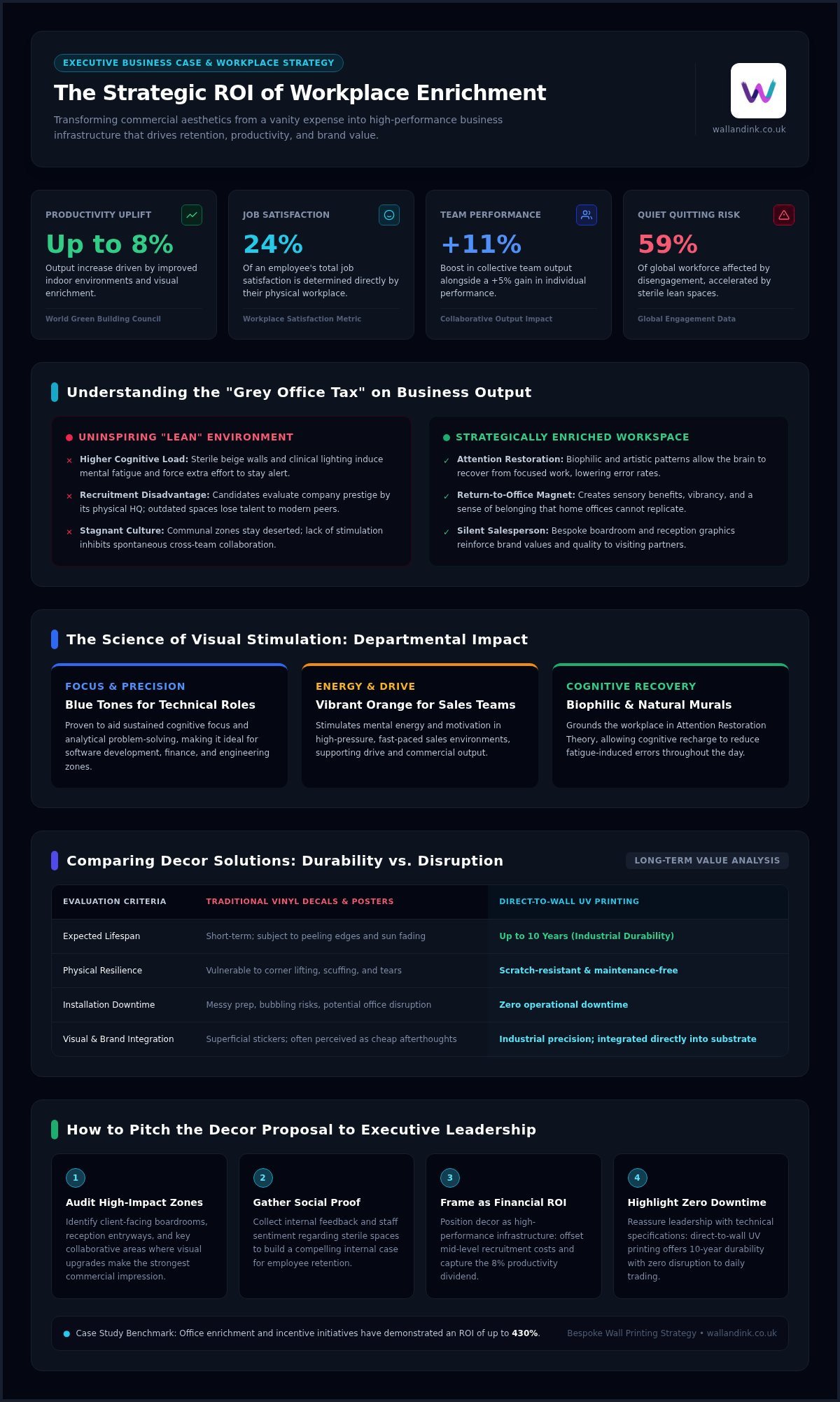
The “Grey Office Tax” isn’t a visible line item on your balance sheet, but it impacts your profit margins every single day. It represents the measurable decline in output caused by uninspiring, “lean” workspaces that lack character and stimulation. Research by the World Green Building Council indicates that improved indoor environments can boost productivity by up to 8%. When you’re convincing my boss to invest in office decor, it’s vital to frame the conversation around this hidden cost. A workspace with bare walls and clinical lighting creates mental fatigue, whilst an enriched environment stimulates cognitive function and keeps staff alert.
Environmental enrichment in a corporate context is the strategic integration of sensory elements into the physical workspace to improve employee performance and psychological health. By moving away from a lean design, companies mitigate the risk of “quiet quitting,” which currently affects 59% of global employees according to recent engagement data. Visual stimuli reduce the cognitive load required to stay focused, effectively lowering the mental energy expenditure of your team.
The Science of Visual Stimulation in the Workplace
Visual stimuli aren’t just decorative; they’re functional tools for brain regulation. Specific colours drive distinct department behaviours. Blue tones are proven to aid focus in technical roles, whereas vibrant oranges can stimulate energy in high-pressure sales environments. Integrating effective space planning ensures these visual elements align with the physical flow of the office. Large-scale murals and biophilic designs also play a role in Attention Restoration Theory. This theory suggests that viewing natural or artistic patterns allows the brain to recover from the fatigue of intense, focused work, leading to fewer errors and better problem-solving.
Identifying the Signs of a Stagnant Environment
A stagnant office manifests through clear, observable signs. If communal areas remain empty or staff members rarely collaborate outside of scheduled meetings, the environment likely lacks the necessary stimulation to foster interaction. First impressions also suffer. Visiting partners and potential recruits judge a company’s success by its physical headquarters. If your current space feels outdated compared to modern industry competitors, you’re facing a recruitment disadvantage. Identifying these pain points is the first step in convincing my boss to invest in office decor as a necessary business upgrade rather than a luxury.
Building the Business Case: ROI Beyond Aesthetics
An employee’s workplace is responsible for 24% of their job satisfaction. This satisfaction doesn’t just improve morale; it impacts individual performance by 5% and team performance by 11%. When you’re convincing my boss to invest in office decor, these figures shift the conversation from “style” to “stability.” High employee turnover is a significant financial drain for UK businesses. Replacing a mid-level professional often costs thousands in recruitment fees and lost productivity, making the environment a critical factor in staff retention.
The “Return to Office” challenge is another powerful leverage point. Employees who’ve spent years working in comfortable home environments are often reluctant to return to clinical, sterile cubicles. Investing in commercial wall murals transforms the office into a destination rather than a requirement. It’s about creating a space that offers sensory benefits and a sense of belonging that a home office simply cannot match. By positioning the office as a “selling tool” for talent, you ensure the company remains competitive in a tight labour market.
Strengthening Brand Identity for Client-Facing Areas
Generic posters and framed prints often feel like afterthoughts that dilute your professional image. Bespoke wall murals serve as a silent salesperson, reinforcing corporate values the moment a client enters the boardroom or reception. High-resolution graphics printed directly onto the substrate ensure a professional, integrated look that traditional vinyl decals cannot achieve. This level of industrial precision signals to partners that your organisation values quality and durability. It moves the brand beyond superficial decoration into a fully integrated, branded environment.
Calculating the Cost of Inaction
Consider the financial burden of a stagnant culture. A case study on an office manufacturer showed a 430% ROI from an incentive programme that included creating a more engaging sales environment. Whilst a basic office fit-out across the UK can start from £45 per square foot, the cost of losing top-tier talent due to low morale is far higher. By convincing my boss to invest in office decor now, you’re opting for a one-off capital expenditure that reduces long-term operational costs.
- Recruitment agency fees, which typically range from 15% to 20% of an annual salary.
- Onboarding costs and training time for new hires.
- The measurable loss of institutional knowledge during turnover.
Digital visualisations allow you to prove this value and see the final result before the first drop of ink is applied to the wall. This ensures the project aligns perfectly with your strategic goals and eliminates the risk of aesthetic dissatisfaction.
Comparing Decor Solutions: Durability vs. Disruption
Pragmatic decision-makers prioritise the lifecycle of any office asset. If a mural begins to peel or fade within months, the strategic value is lost. When you’re convincing my boss to invest in office decor, you must differentiate between temporary fixes and industrial-grade solutions. Traditional mediums like wallpaper and vinyl decals often fail to withstand the rigours of a professional environment, leading to additional costs and maintenance headaches. Choosing a solution that offers long-term reliability is essential for protecting the company’s capital expenditure.
Why Traditional Wallpaper Often Fails Commercial Spaces
Wallpaper is fundamentally ill-suited for high-traffic corridors and climate-controlled rooms. In modern offices, HVAC systems create constant airflow that dries out traditional adhesives, causing seams to lift and curl over time. Scaling bespoke digital art across large expanses is also problematic; visible joins disrupt the design and create physical weak points. A single impact from a cleaning trolley or furniture move can tear delicate paper, necessitating a full-room strip-and-replace rather than a simple repair. This lack of durability makes wallpaper a high-risk choice for active workspaces.
Vinyl decals present similar failures. Temperature fluctuations in UK offices cause the material to expand and contract, which inevitably leads to unsightly bubbling and edge-peeling. UV exposure from large windows quickly degrades the ink, resulting in significant fading that makes the brand look stagnant. These failures don’t just look poor; they require staff time to manage and additional budget to replace, undermining the initial business case.
Direct-to-Wall UV Printing: The Modern Advantage
Direct-to-wall printing serves as the disruptor to these legacy methods. By using UV ink technology that bonds directly to substrates like plaster, brick, or glass, the process eliminates the need for adhesives or physical layers. There are no seams to fail. The mechanical precision of the printing machine ensures a professional finish that manual application simply cannot achieve. This method is the strongest technical justification for convincing my boss to invest in office decor.
The UV-cured inks are scratch-resistant and light-fast, offering a durability rating of up to 10 years for interior prints. Unlike wallpaper, these surfaces are wipe-clean and easy to maintain using standard detergents. This eliminates the need for frequent, disruptive replacements. Choosing this industrial-grade alternative ensures that the investment remains a high-quality asset for the long term, rather than a recurring maintenance liability.
How to Pitch Your Proposal: A Step-by-Step Guide
Successful proposals rely on logic and data rather than subjective taste. When you’re convincing my boss to invest in office decor, start with a comprehensive audit of the current physical space. Identify “high-impact” zones where visual intervention will yield the highest return. Focus on the reception area, main boardrooms, and communal breakout spaces. These are the primary touchpoints for both clients and employees. By targeting these areas, you ensure the investment addresses the “first impression” problem and daily staff morale simultaneously.
Anticipate the “disruption” objection before it’s raised. Traditional refurbishments often involve dust, chemical smells, and significant downtime. You should highlight that modern UV printing technology allows for a clean, no-mess installation that occurs whilst the office remains fully operational. There’s no need to clear the room or stop work. This technical advantage removes the most common barrier to approval, presenting the project as a low-risk, high-reward upgrade.
Gathering Internal Feedback and Data
Internal social proof is a powerful tool for shifting executive opinion. Create a short staff survey to identify “dead zones” in the office that hinder collaboration or focus. Ask direct questions: “Does the current environment reflect our brand values?” or “Would you feel proud hosting a key partner in this space?” Presenting anecdotal evidence from the team alongside productivity metrics makes the case undeniable. It moves the project from a personal request to a collective business requirement. If the company is currently planning a rebrand, align the decor proposal with these objectives to show strategic cohesion.
Presenting the Visualisation and Cost Analysis
Decision-makers need to see the final result to understand the value. Utilise digital mock-ups to show the “after” state before a single drop of ink is applied. This visualisation bridges the gap between a conceptual idea and a tangible business asset. Frame the quote as a capital investment in infrastructure that will last for a decade, rather than a recurring operational expense. Emphasise the durability of UV-cured inks on various substrates, ensuring the boss understands this is a one-off cost for a long-term solution. To begin building your specific business case, you can request a bespoke design consultation to obtain accurate visualisations and technical specifications.
Wall & Ink: Professional Wall Printing for UK Workplaces
Wall & Ink operates as the national specialist for direct-to-wall printing, providing a modern alternative to the traditional decor methods that often fail in high-stakes professional environments. When you’re convincing my boss to invest in office decor, the technical assurance of our application process is a vital selling point. Our UV ink technology bonds directly to almost any substrate, including plaster, wood, brick, and glass. This eliminates the need for adhesives, which are the primary cause of failure in traditional wallpaper and vinyl decals.
The “No-Hassle” promise is central to our service. Because the ink is applied directly to the surface, there are no seams to lift and no material to peel or bubble. The process is clean, odourless, and produces zero mess, ensuring the office remains a productive environment throughout the installation. This industrial precision guarantees a result that looks integrated into the architecture rather than stuck onto it. By removing the disruption factor, you eliminate the most significant barrier to executive approval.
Bespoke Design Services for Corporate Rebrands
Our end-to-end design-to-print service ensures that your corporate identity is translated with total accuracy. The design team works closely with your existing brand guidelines to produce wall-ready art that maintains high-resolution clarity even at massive scales. Colour accuracy is managed through rigorous technical calibration, ensuring your corporate palette remains consistent across all physical touchpoints. We don’t just print images; we adapt digital visualisations to your specific architectural layout, accounting for light switches, windows, and structural features to ensure a seamless aesthetic.
National Reach with Industrial Precision
We provide national UK service coverage, bringing industrial-grade equipment to your site regardless of location. The reliability of UV printing is unmatched for long-lasting commercial decor, offering a scratch-resistant finish that stays vibrant for up to 10 years. This long-term durability is the final piece of the puzzle when convincing my boss to invest in office decor, as it transforms the project from a recurring maintenance task into a permanent asset. You’re choosing a solution designed for pragmatic decision-makers who value efficiency and high-quality results.
To see how this technology can transform your specific workspace, you can request a digital visualisation for your office space and receive a technical breakdown of the process.
Securing Long-Term Asset Value through Modern Workplace Design
Transforming a clinical workspace into an enriched environment is a strategic move that mitigates the hidden costs of low engagement. By focusing on industrial precision and long-term durability, you ensure that every pound spent contributes directly to company culture and staff retention. When it comes to convincing my boss to invest in office decor, the most persuasive case highlights the elimination of traditional maintenance cycles and the professional integration of brand identity.
Choosing direct-to-wall UV technology provides maximum durability whilst removing the common failure points of peeling seams and fading graphics. Our national UK service includes bespoke design and visualisation to ensure the final result aligns perfectly with your architectural layout. Because the process is clean and requires zero office disruption, it’s a pragmatic solution for active business environments. You don’t have to settle for uninspiring walls that drain productivity; instead, you can opt for a high-performance infrastructure upgrade that stands the test of time.
Transform your workspace with a professional Wall & Ink consultation to begin your transition from a stagnant office to a modern, branded destination. It’s time to let technical excellence drive your professional success.
Frequently Asked Questions
How long does it take to install a wall mural in an active office?
Most commercial wall murals are completed within a single working day, depending on the total square footage. The direct-to-wall printing machine operates with mechanical precision, applying UV-cured ink that dries instantly. This means there’s no downtime for your team and no waiting for adhesives to set. You won’t need to vacate the room, allowing your office to remain fully operational whilst the installation occurs.
Is direct-to-wall printing more expensive than traditional wallpaper?
Direct-to-wall printing is a strategic investment that offers superior long-term value compared to traditional wallpaper. Whilst the upfront square-metre cost reflects the advanced technology used, you avoid the recurring expenses associated with seam repair and adhesive failure. When convincing my boss to invest in office decor, highlight that this is a one-off capital expenditure for an asset with a ten-year durability rating, rather than a temporary fix.
Can you print on textured surfaces like brick or wood in a modern office?
Yes, our UV ink technology is designed to bond directly to a wide variety of substrates, including brick, wood, plaster, and glass. The printing head maintains industrial precision even on uneven surfaces, which is something traditional vinyl decals cannot achieve. This flexibility allows you to integrate branding into the existing architectural features of your building without the need for extensive surface preparation or additional cladding.
What happens if we need to change the decor or move offices in the future?
If you need to update your branding or vacate a leased space, the prints can be simply painted over using standard emulsion. Because the ink bonds directly to the wall without a physical layer of paper or plastic, there’s no need for the laborious stripping or scraping associated with wallpaper. This makes the reversal process clean and cost-effective, ensuring you can return the walls to their original state easily.
Does the UV ink smell or create mess during the installation process?
The UV printing process is entirely odourless and produces no dust, waste, or chemical fumes. The inks cure instantly under a specialised light source, meaning there’s no “wet paint” phase or drying time required. This technical advantage makes it a perfect solution for active professional environments, including healthcare and educational settings, where maintaining air quality and a clean workspace is a non-negotiable requirement for management.
How do I calculate the ROI of an office redesign for my proposal?
Focus your ROI analysis on measurable gains in productivity and recruitment savings. Research indicates that enriched environments can boost output by up to 8% and significantly reduce the “grey office tax” caused by high staff turnover. When convincing my boss to invest in office decor, contrast the one-off installation cost against the financial burden of replacing a mid-level professional, which often involves thousands in recruitment agency fees.
Can we use our own corporate branding and logos in the design?
Bespoke design consultations are a standard part of our process to ensure your corporate identity is accurately represented. Our team translates your specific brand guidelines, logos, and colour palettes into high-resolution, wall-ready art. We use technical colour calibration to ensure the final print matches your digital assets perfectly. Digital visualisations are provided beforehand so you can verify the layout and branding within your actual architectural space.
Is direct-to-wall printing durable enough for high-traffic corridors?
UV-cured prints are exceptionally durable and scratch-resistant, making them ideal for high-traffic areas like corridors and reception zones. The finish is light-fast and won’t fade even when exposed to direct sunlight from large office windows. Unlike wallpaper or vinyl, there are no seams to catch or peel, and the surface can be cleaned using standard detergents. This industrial-grade resilience ensures the mural remains a high-quality professional asset for up to ten years.