
The most impressive corporate reception can be instantly undermined by a single peeling edge on a vinyl decal or a dust-gathering frame that has seen better days. You’ve likely invested heavily in your brand identity, yet traditional methods of displaying it often feel like a temporary afterthought rather than a permanent architectural feature. It’s a common challenge for pragmatic decision-makers seeking premium corporate wall art for client areas who need to maintain a pristine environment in high-traffic zones without the constant headache of maintenance or cluttered walls.
In this definitive guide, you’ll discover how to transform your environment using direct-to-wall printing to create high-resolution, durable art with a seamless finish. We’ll show you how this specialised process achieves a professional result that integrates directly with your building’s surfaces. We’ll also examine the technical precision behind accurate brand colour reproduction and explain why this modern application method eliminates the mess and disruption of legacy alternatives. From industrial durability to architectural-grade results, we’ll outline everything you need to know about this innovative approach to professional decor.
Key Takeaways
- Understand why corporate wall art for client areas is a critical strategic tool for brand storytelling and establishing professional authority.
- Compare the mechanical superiority and durability of UV-cured ink against the known failure points of traditional vinyl decals and wallpaper.
- Learn how to select high-impact designs that align with the specific functions of reception areas, boardrooms, and corridors.
- Discover the technical capabilities of direct-to-wall printing across various substrates including brick, wood, metal, and glass.
- Identify how to achieve a seamless, architectural-grade finish with minimal disruption to your daily business operations.
Beyond First Impressions: Why Corporate Wall Art Matters in Client Areas
Corporate wall art for client areas serves as a silent but powerful communicator of brand values. It is no longer sufficient to hang mass-produced prints that lack connection to your company’s specific mission. Instead, modern businesses are utilising their physical infrastructure as a canvas for storytelling. This shift is rooted in the long history of murals, which have evolved from traditional hand-painted works into high-precision digital applications that integrate directly with a building’s surfaces.
Pragmatic leaders recognise that every square metre of a client-facing area is an opportunity to reinforce reliability. When a visitor enters a space, they subconsciously assess the organisation’s attention to detail. Generic stock imagery suggests a lack of permanence or vision; bespoke architectural art suggests investment, stability, and a forward-thinking culture. It’s a strategic move away from temporary fixes toward a permanent, high-resolution finish that matches the calibre of your service.
The Impact on Client Trust and Professionalism
The psychological impact of a well-designed reception area is measurable in client behaviour. Professional aesthetics can reduce perceived wait times by providing engaging, large-scale visual interest that anchors the room. In boardrooms, custom murals establish an atmosphere of authority and focus, setting the tone for high-stakes negotiations. Architectural art is a permanent integration into the building’s substrate rather than a superficial, removable addition. It signals that your business is established and your brand is literally built into the walls.
This sense of permanence and quality is equally important in the luxury property market. For an example of how high-end design is applied to modern living spaces, you can check out Unipad and their selection of luxury student accommodation in Lancaster.
Reflecting Brand Identity Through Visuals
Modern UK offices are moving away from hanging pictures and toward creating immersive environments. This transition involves more than just displaying a logo. It involves the following elements:
- Colour Consistency: Integrating exact corporate colour palettes directly into the wall surface for a seamless, professional look.
- Visual Storytelling: Using high-resolution graphics to depict company milestones, global reach, or specific mission statements.
- Surface Integration: Transforming transit zones like corridors into brand journeys that utilise the existing architecture.
Direct-to-wall printing allows for this level of detail without the clutter of frames or the fragility of traditional media. By printing directly onto plaster, brick, or glass, you ensure that your brand identity becomes a durable part of the architecture itself. This approach eliminates the dated look of old-fashioned office decor, replacing it with a clean, modern aesthetic that reflects a company in control of its image.
Direct-to-Wall Printing vs Traditional Art: A Comparison for Businesses
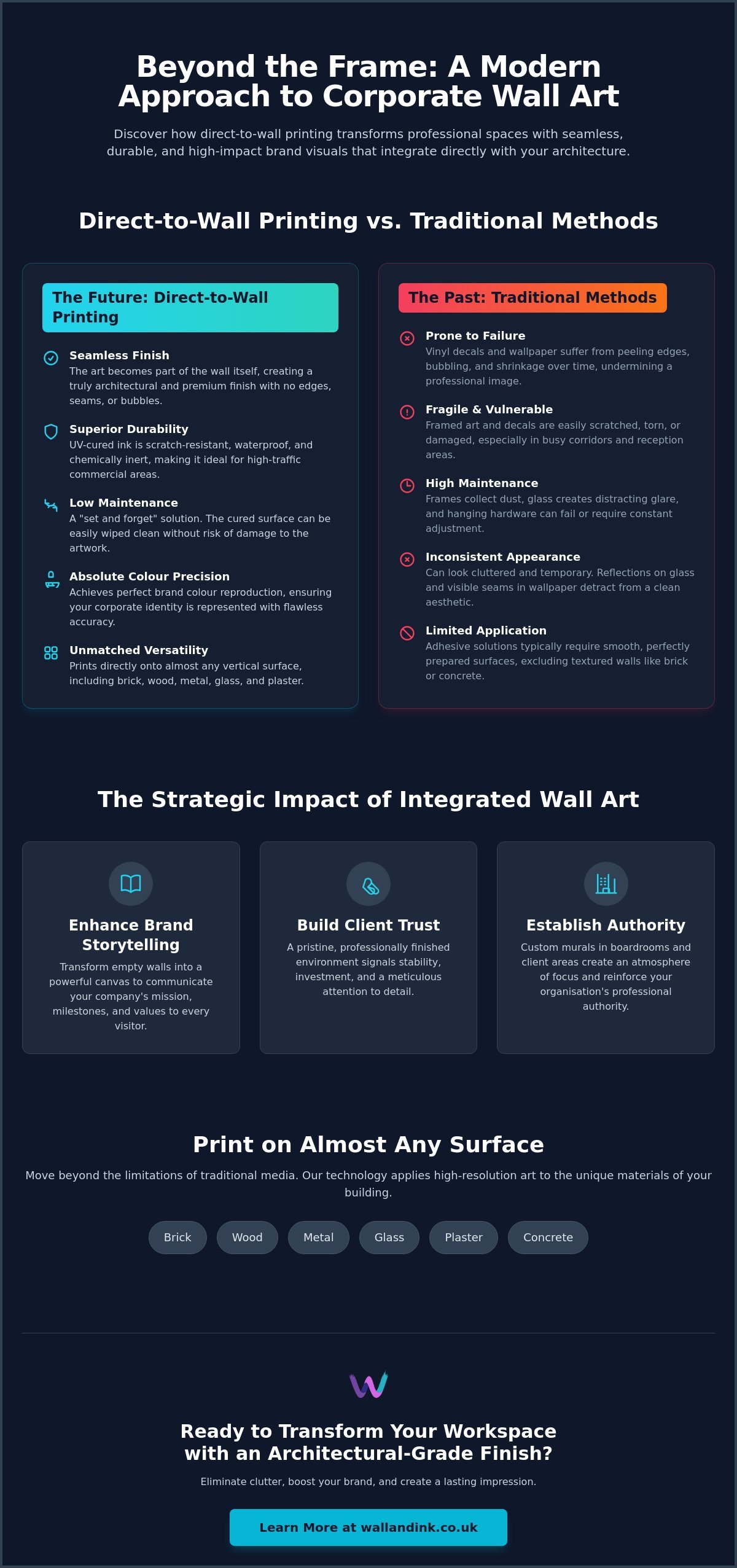
Traditional framed art carries a significant hidden cost in maintenance and spatial requirements. Frames collect dust, glass creates distracting reflections, and hardware can eventually fail or require re-levelling. For high-traffic zones, these physical barriers often become a liability. The importance of workplace design is well-documented in its ability to drive innovation, yet cluttered walls can often detract from a clean, professional aesthetic. Direct-to-wall printing offers a “set and forget” alternative that integrates corporate wall art for client areas into the very structure of the building.
This method provides a seamless finish that is impossible to achieve with traditional media. There are no visible seams, no bubbles, and no physical edges to catch on passing equipment or clothing. In narrow corridors or busy commercial centres, this space-saving advantage is vital. By removing the physical footprint of frames and canvases, you maintain the architectural integrity of the space whilst delivering high-impact brand visuals.
Why Traditional Vinyl and Wallpaper Often Fail
Adhesive-based solutions like vinyl decals and wallpaper are prone to specific failure points in professional environments. Edge-peeling is the most common issue, often caused by cleaning equipment or high footfall. Temperature fluctuations within an office can cause vinyl to bubble or shrink, leading to a dated and neglected appearance. Hygiene is another critical factor; printed walls are entirely smooth and easy to sanitise, unlike textured wallpapers that can trap dust and bacteria in their fibres. For those seeking a more permanent solution, exploring commercial wall murals provides a clear path to a maintenance-free environment.
The Longevity of UV Wall Printing
The technical superiority of direct-to-wall printing lies in the UV-curing process. As the printer applies the ink, high-intensity ultraviolet light instantly cures it, turning the liquid into a solid that bonds directly to the substrate. This creates a hard, scratch-resistant surface that is highly resistant to fading, even in sun-drenched atriums or glass-walled reception areas. Whilst standard vinyl typically has a lifespan of around three years before showing signs of wear, UV-cured ink maintains its integrity for ten years or more. This mechanical bond ensures that the art remains as vivid and precise as the day it was installed, providing a long-term return on investment for any corporate facility.
Designing High-Impact Client Areas: Receptions, Boardrooms, and Beyond
Effective corporate wall art for client areas must align with the specific utility of each zone. A reception area requires a different psychological approach than a high-stakes meeting room or a transit corridor. Recent scientific research on workplace design indicates that the visual environment directly influences aesthetic and cognitive experiences. By using direct-to-wall printing, you can control these variables with millimetre precision. This ensures that the art enhances rather than distracts from the architectural purpose of the space.
High-resolution photography and abstract digital graphics offer distinct advantages depending on the room’s function. Photography can ground a space in reality, showcasing global projects or natural landscapes to create trust. Abstract graphics, conversely, provide a modern, energetic feel that can stimulate creativity in collaborative zones. Lighting plays a crucial role here; directional LEDs can highlight specific textures in the print, adding a three-dimensional quality to a flat wall surface without the need for physical frames.
Creating a Welcoming Reception with Custom Graphics
The reception serves as the primary touchpoint for every visitor. Soft, professional colour palettes can create a calm waiting environment, reducing the anxiety often associated with corporate visits. Hero murals act as a central focal point, immediately communicating brand identity through bespoke digital art. This approach avoids the clinical feel of bare walls whilst maintaining a level of sophistication that traditional office decor often lacks. It is about balancing corporate branding with genuine artistic expression to create a memorable entrance.
Beyond permanent decor, businesses often enhance corporate hospitality with interactive features; you can learn more about Foto Me Now for professional photobooth solutions that engage clients during brand activations and events.
Professional Boardrooms: Art that Commands Respect
In boardrooms, the objective is to project authority and focus. Minimalist abstract graphics provide visual depth without becoming a distraction during intense discussions. These large-scale murals can also assist in softening the room’s acoustics by breaking up large, flat surfaces. It is essential to select colours that remain professional and balanced during video conferences. This ensures the background does not interfere with the clarity of digital presentations or distract from the speaker during virtual meetings.
Wayfinding and Corridor Murals
Transit zones are frequently overlooked, yet they are vital for guiding client flow through a building. Corridors can be transformed into brand journeys that use subtle wayfinding cues integrated directly into the print. This is particularly effective in high-traffic transition spaces where traditional frames or protruding art would present a safety hazard or be prone to damage. Direct-to-wall printing allows for continuous, immersive graphics that lead visitors through the building naturally, turning a functional walk into a branded experience.
The Technical Precision of UV Wall Printing for Commercial Spaces
The mechanical superiority of direct-to-wall printing lies in its ability to translate digital precision into physical environments without the margin for error found in manual applications. Unlike traditional methods that rely on adhesives or physical fixings, this technology uses a specialised vertical printing rail and an advanced inkjet head to apply graphics directly to the substrate. This process is clean, fast, and quiet; it’s the ideal solution for installing corporate wall art for client areas during standard business hours without disrupting staff or visitors.
Surface compatibility is a core advantage of this industrial method. The hardware adjusts to the texture and density of various materials, ensuring a consistent finish across different architectural elements. We can print on a wide range of substrates including:
- Bare or painted plaster: Achieving a smooth, integrated look that appears part of the wall.
- Exposed brick and concrete: Maintaining the industrial texture whilst adding vibrant brand visuals.
- Natural wood: Allowing the grain to interact with the ink for a sophisticated, tactile effect.
- Glass and metal: Utilising specialised adhesion promoters for non-porous surfaces.
Health and safety considerations are paramount in indoor corporate environments. UV-cured inks are formulated to be low in volatile organic compounds (VOCs). Because the ink is instantly solidified by ultraviolet light, there is no off-gassing or lingering chemical odour. This allows for the immediate use of the room following installation, which is a critical benefit for busy reception centres and boardrooms that cannot afford downtime.
Digital Visualisation: Seeing the Mural Before Printing
Precision begins long before the printer arrives on site. We utilise digital mock-ups to ensure every graphic is scaled and positioned correctly relative to architectural features like light switches, door frames, or skirting boards. This stage is vital for adapting corporate logos and high-resolution photography for large-scale application. Technical colour matching ensures that your brand identity is reproduced with absolute accuracy, maintaining consistency across your entire property portfolio and reinforcing your professional image.
The Science of UV Ink and Surface Prep
The technical foundation of this service is the interaction between the UV ink and the wall surface. Whether printing on smooth plaster or textured brick, the substrate must be clean and stable to ensure a permanent bond. The printing head operates with extreme precision, delivering resolutions ranging from 720 to 2880 dpi. This level of detail ensures that fine text and complex gradients remain crisp even when viewed from a close distance. Because the ink bonds mechanically to the surface, the result is a durable, scratch-resistant finish that outlasts traditional alternatives. To see these technical standards in action, you can explore our range of direct-to-wall printing services.
Transforming Your UK Workspace with Wall & Ink
Wall & Ink provides a comprehensive, end-to-end service designed for organisations that require more than just a product delivery. We handle every stage of the process, from the initial consultation to the final UV execution on-site. This integrated approach ensures that the high-resolution files provided by your design team are translated with technical accuracy onto the physical substrate. By maintaining direct communication between our technical team and your decision-makers, we eliminate the communication gaps common when using third-party agencies or traditional decor suppliers.
Our pricing model is built on radical transparency. We utilise a price-per-square-metre metric that allows for precise budgeting across large-scale projects. This straightforward approach is designed for pragmatic facility managers and financial directors who value honesty and efficiency. It removes the guesswork often associated with bespoke interior installations, providing a clear cost structure for corporate wall art for client areas across multiple sites. You receive a professional, architectural finish without the hidden costs or hardware failure risks associated with legacy alternatives.
Our Bespoke Design and Consultation Process
We work alongside your internal design team, architects, or brand consultants to ensure the final output meets your exact specifications. This collaboration includes adapting existing brand assets for architectural-scale printing, ensuring that logos and graphics maintain their integrity at any size. We understand the operational requirements of a busy office. Our scheduling is flexible; we organise installations to minimise disruption, ensuring your business remains fully functional whilst we upgrade your environment.
Why National Businesses Choose Wall & Ink
National corporations select Wall & Ink for our technical reliability and the consistency of our results across the UK. Whether you are managing a single headquarters or a nationwide rebrand, our specialist equipment and expert technicians deliver a uniform finish that traditional methods cannot replicate. We have successfully transformed various corporate environments, replacing peeling vinyl and dated frames with durable, high-impact murals that stand the test of time.
Enquire about our bespoke wall printing services for your client areas to begin your transformation with industrial precision and expert reliability.
Elevating Your Professional Environment with Technical Precision
Adopting direct-to-wall printing allows you to move beyond the limitations of traditional frames and peeling vinyl. By integrating high-resolution graphics directly into your building’s architecture, you create a permanent and professional atmosphere that commands respect. Choosing the right corporate wall art for client areas is a strategic investment in your brand’s long-term authority and reliability. This method ensures your workspace reflects the same calibre of excellence as the services you provide to your clients.
Wall & Ink offers national UK coverage for commercial projects, delivering industrial-grade results with minimal disruption. Our UV ink technology provides odour-free, instant-dry results; whilst our bespoke digital visualisation ensures your vision is accurately mapped before the first drop of ink is applied. We eliminate the maintenance burden of legacy decor, replacing it with a clean, modern, and durable finish that integrates seamlessly with your existing infrastructure.
Transform your client areas with a bespoke wall mural consultation and discover a more efficient way to define your corporate space. We look forward to helping you modernise your environment with expert precision.
Frequently Asked Questions
How long does direct-to-wall printing take for a corporate office?
Most projects are completed within a single working day. The printing hardware typically covers between 1.2 and 2 square metres per hour, depending on the complexity and resolution of the design. This efficiency ensures that corporate wall art for client areas can be installed with minimal downtime for your facility.
Is UV wall printing durable enough for high-traffic client reception areas?
Yes, the durability of UV-cured ink is one of its primary advantages in commercial settings. The ink bonds mechanically to the substrate and is hardened instantly by ultraviolet light, creating a scratch-resistant surface. It doesn’t peel at the edges or succumb to the wear and tear common in busy reception centres and corridors.
Can you print corporate logos and specific brand colours accurately?
Digital precision ensures that we can reproduce corporate logos and brand colours with absolute fidelity. By using high-resolution source files, the printer achieves crisp lines and accurate colour matching. This maintains brand consistency across your entire office network and ensures a professional, architectural-grade result.
What wall surfaces are suitable for direct-to-wall printing in an office?
We can print on almost any stable surface found in a professional environment. This includes standard plaster, brick, concrete, wood, glass, and metal. The printer’s sensors automatically adjust for surface irregularities, allowing for high-resolution graphics even on textured substrates like exposed brickwork or timber panelling.
How does wall printing compare to traditional wallpaper or vinyl decals?
Direct-to-wall printing is an architectural integration rather than a superficial layer. It eliminates the common failure points of traditional media, such as peeling seams, bubbling adhesive, or shrinking vinyl. The result is a seamless finish that looks like a permanent part of the building’s infrastructure rather than a temporary addition.
Is the printing process disruptive to a busy office environment?
The installation process is designed to be quiet and clean. Our equipment doesn’t produce dust or mess, and the UV-cured inks are entirely odour-free. Because the ink dries instantly, there’s no need to cordone off areas for long periods; the room is ready for immediate use as soon as the print is finished.
Can the wall mural be removed if the office undergoes a rebrand?
Updating your space is straightforward and doesn’t require the labour-intensive scraping associated with wallpaper or vinyl. If you decide to rebrand, you simply paint over the mural with a standard primer and topcoat. This returns the wall to a blank canvas without leaving any adhesive residue or damaging the underlying surface.
Is direct-to-wall printing environmentally friendly for corporate ESG goals?
This method is a more sustainable choice for modern offices because it produces significantly less waste. There are no backing papers, plastic liners, or chemical adhesives to dispose of. Additionally, the use of low-VOC, UV-cured inks ensures a healthier indoor air quality, supporting your organisation’s environmental and social governance targets.