
The most affordable quote for an office feature wall often becomes your most expensive liability when you factor in the inevitable peeling of vinyl or the labour-intensive removal of traditional wallpaper. You need a high-impact, professional finish that reflects your brand’s quality without the hidden maintenance costs or the risk of inconsistent hand-painted results. This guide provides a transparent breakdown of the office wall printing cost and explains why UV direct-to-wall technology is the most reliable investment for UK businesses in 2026.
We understand that addressing the “flight to quality” in modern UK office design requires precision and long-term value. You’ll learn how the investment in direct-to-wall printing compares to legacy alternatives, focusing on durability and technical superiority. We’ll detail the specific factors that influence per-square-metre pricing and provide a clear roadmap of our process from digital design to the final UV-cured finish on your workspace walls. This technical overview ensures you can plan your project with confidence and total cost transparency.
Key Takeaways
- Learn how the square metre serves as the primary metric for calculating investment and how digital file complexity dictates technical prep-work requirements.
- Compare the office wall printing cost against traditional hand-painted murals and bespoke wallpaper to determine the most efficient allocation of your budget.
- Understand how various substrates, including brick, plaster, and glass, impact the technical approach and the necessary surface preparation for a permanent finish.
- Identify the long-term ROI of UV printing technology, which provides a durable solution that avoids the common failures of vinyl peeling or wallpaper lifting.
- Gain a clear understanding of the design and digital visualisation phase to ensure your project is perfectly aligned with your branding before execution.
The True Cost of a Custom Wall Mural UK: Beyond the Initial Quote
Calculating the investment for a professional workspace involves looking past the bottom line of a single invoice. In the past, the history of wall murals was defined by subjective labour costs and the unpredictable schedule of manual artistry. Modern UV printing has disrupted this model. It replaces variable human factors with industrial precision. When you evaluate your office wall printing cost, you’re investing in a technical process that prioritises durability, speed, and mechanical accuracy over the inconsistencies of traditional methods.
The pricing for a custom wall mural in the UK rests on three core pillars: scale, surface, and design. Scale is measured in precise square metres, allowing for predictable budgeting. The surface substrate, whether it’s raw brick, smooth plaster, or industrial glass, determines the technical calibration required. Finally, the design complexity dictates the digital preparation needed before the machine ever touches the wall. This objective framework ensures that pragmatic decision-makers receive a quote based on technical reality rather than artistic guesswork.
Why Traditional Pricing Models are Changing
The shift from labour-intensive hand-painting to high-resolution digital execution has stabilised project timelines. Hand-painted murals often require weeks of on-site presence, driving up costs through extended day rates and secondary protective coatings. Our UV ink technology cures instantly during the printing process. It creates a scratch-resistant finish that doesn’t need expensive varnishes. Because the process is digital, it’s a zero-waste method. You only pay for the ink that’s actually on the wall, not the excess material or off-cuts associated with traditional decor.
Hidden Costs of Legacy Wall Decor
Budgeting for cheap alternatives like vinyl or wallpaper often leads to a cycle of expensive replacements. Vinyl decals frequently peel in high-traffic office corridors, especially when subjected to cleaning chemicals or temperature fluctuations. Wallpaper requires intensive labour for both installation and eventual removal, often damaging the underlying plaster and necessitating costly repairs. Legacy murals also suffer from fading, frequently requiring touch-ups within 24 months to maintain a professional appearance.
Business downtime is another critical factor. Manual installations can cordons off vital workspace for days or even weeks. Digital wall printing is a clean, efficient process that minimises disruption. There’s no mess, no lingering chemical odours, and no need to vacate the premises. By choosing a direct-to-wall approach, you’re eliminating the hidden maintenance and repair costs that eventually make “cheap” alternatives the most expensive choice for your business.
Calculating Your Investment: Factors Affecting Wall Printing Fees
Transparency is the foundation of a professional quote. Unlike traditional decorating services that rely on rolls of paper or unpredictable artist day rates, the industry standard for digital wall printing is the square metre (sq m). This metric provides a precise and scalable way to calculate your office wall printing cost. It ensures you only pay for the specific area of the wall that receives ink; eliminating the 15 to 20 percent material wastage typically associated with wallpaper installations.
Our technical process allows for a fixed-price approach based on the physical dimensions of the project. However, several variables influence the final fee. These range from the physical accessibility of the site to the digital preparation required before the machine is deployed. Understanding these factors helps pragmatic decision-makers allocate their budgets effectively whilst ensuring a high-quality, durable outcome.
Scale and Square Footage
Larger projects often benefit from improved economies of scale. Whilst a small feature print in a reception area carries a baseline call-out fee to cover equipment transport and setup, expansive corridor murals or multi-floor branding projects typically see a reduction in the per-metre rate. When calculating your budget, we measure the total printable area; carefully subtracting windows, doors, and permanent fixtures like sockets or radiators. This precision ensures your quote reflects the actual work performed on the substrate.
Technical Complexity and Resolution
The quality of the final print depends entirely on the resolution of the digital source file. High-resolution files are essential for large-scale murals to prevent pixelation. If your branding requires professional image sourcing or the conversion of simple sketches into scalable vector graphics, these design hours will be reflected in the initial quote. We use digital visualisations to overlay the artwork onto a photo of your actual wall. This step is critical; it prevents costly alignment errors and ensures the final result matches your expectations perfectly. If you are ready to see how your branding translates to a large scale, you can view our technical specifications to prepare your files.
Two factors that often surprise clients are height and colour density. Standard wall heights are manageable with our primary equipment. If your project involves high-atrium walls or exterior surfaces requiring scaffolding or specialised lifts, these access costs are factored into the logistical fee. Conversely, the number of colours or the density of the ink does not typically increase the office wall printing cost. Because our UV printers use a digital CMYK process, a vibrant, multi-coloured photographic mural costs the same to print as a simple two-colour logo of the same size. This allows for total creative freedom without the financial penalties associated with traditional screen printing or manual painting.
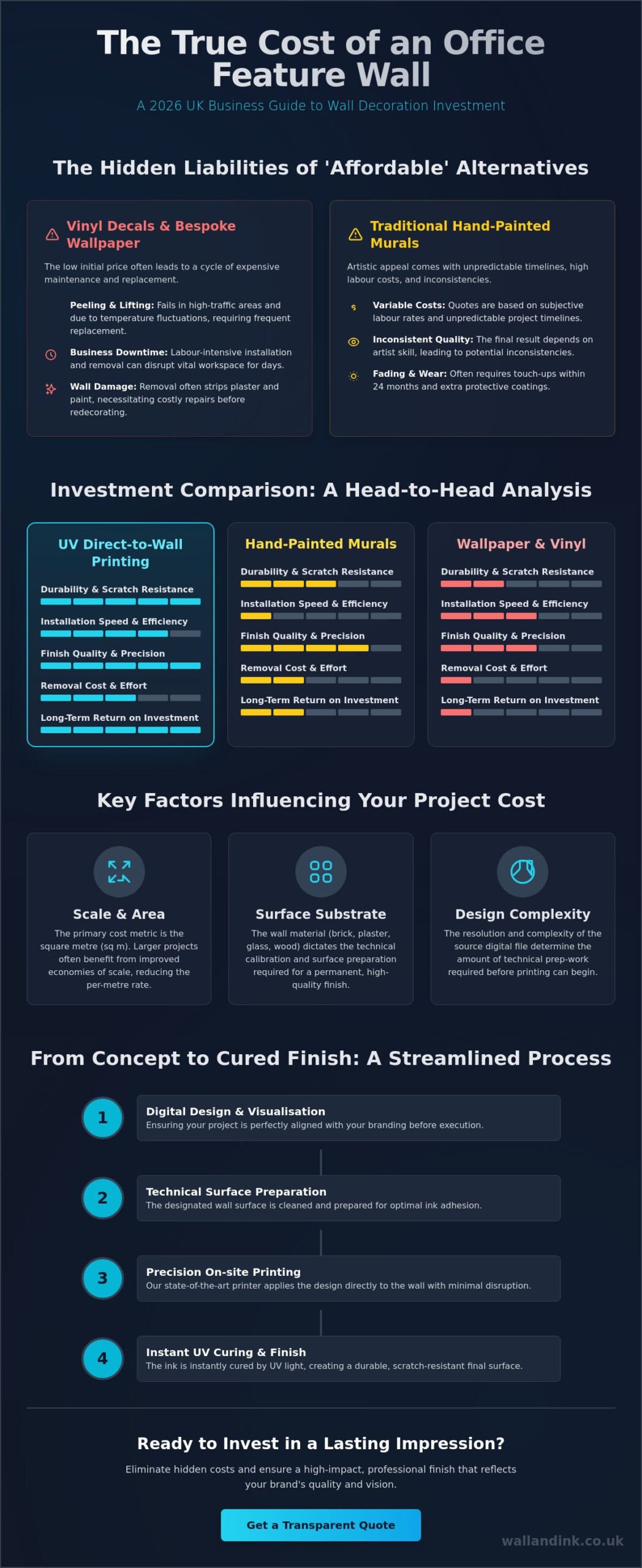
Price Comparison: Direct-to-Wall Printing vs Traditional Alternatives
Direct-to-wall printing offers a unique financial profile compared to legacy decor. When evaluating the office wall printing cost, you must weigh the upfront investment against the total labour-to-material ratio of other methods. Traditional options often appear cheaper on paper because they separate material costs from professional installation fees. Our approach integrates these into a single, high-precision service that eliminates the logistical headache of coordinating multiple contractors.
The lifespan cost of your decor is where the ROI of UV printing becomes most apparent. Vinyl graphics and wallpaper typically require replacement every three to five years due to edge lifting or surface scuffing. In contrast, UV-cured ink is engineered for durability. It bonds permanently to the substrate, providing a professional finish that resists the wear and tear of a busy commercial environment. This “once and done” application prevents the cycle of re-decorating costs that many businesses face with cheaper, less durable materials.
UV Printing vs Bespoke Wallpaper
Bespoke wallpaper requires more than just the cost of the rolls. You must budget for high-grade adhesives, specialist hangers, and the inevitable 15 percent material overage to account for pattern matching and off-cuts. Over time, wallpaper in high-traffic commercial centres suffers from lifting seams and edge peeling. UV printing eliminates these failures. The ink bonds directly to the wall, whether it’s smooth plaster or textured brick. There are no seams to catch, no backing paper to bubble, and no adhesives to fail in humid conditions.
UV Printing vs Hand-Painted Murals
Hand-painted art is a labour-intensive process defined by the artist’s day rate and subjective interpretation. Commercial projects across the UK often start from £2,500 for a single wall; frequently taking several days or weeks to complete. This creates significant downtime for your staff. Digital wall printing delivers a guaranteed result in a fraction of the time. What takes an artist days, our machinery completes in hours. For multi-site corporate branding, digital execution ensures total consistency across every office location. You won’t face the risk of artistic variation that can compromise brand identity.
The environmental cost is equally important for modern ESG reporting. Traditional vinyl production relies on chemical-heavy processes and generates significant non-recyclable waste. In contrast, UV printing is a zero-waste method. It uses low-VOC inks that align with the UK’s Volatile Organic Compounds in Paints, Varnishes and Vehicle Refinishing Products Regulations 2012. This makes it a sustainable choice for businesses prioritising indoor air quality and a lower carbon footprint whilst achieving a premium aesthetic.
Budgeting for Success: Design Fees and Surface Preparation
Achieving a flawless result depends on meticulous preparation before the machine ever reaches your site. While the physical office wall printing cost covers the ink and execution, the pre-print phase is where project quality is secured. Digital visualisation is a technical necessity rather than an optional extra. It allows us to map your branding onto the specific architecture of your room, ensuring that light switches, radiators, or door frames don’t interrupt critical design elements. By identifying these obstacles digitally, we eliminate the risk of expensive on-site errors.
The Creative Development Phase
Digital files are the blueprints of our process. Design fees are typically structured as a separate budget item to reflect the time required for technical file preparation. If you provide high-resolution, print-ready assets, your costs remain minimal. However, adapting a standard corporate logo for a 10-metre corridor mural requires professional vectorisation to prevent pixelation. Most professional quotes include two or three rounds of revisions. This structured approach ensures the final digital proof is perfect before any ink is applied to your substrate.
Substrate Impact on Pricing
The physical substrate is as important as the ink. Bare plaster is the most cost-effective surface for direct-to-wall printing. It’s smooth, neutral, and allows the UV-cured ink to bond consistently with minimal calibration. Industrial surfaces like exterior brickwork or metal cladding require a more complex technical approach. These textures demand higher ink density and slower print speeds to ensure full coverage across uneven depths.
Non-porous surfaces such as glass, tile, or polished wood require a specialised UV primer. This chemical agent creates a permanent bond between the ink and the substrate, preventing the scratching or lifting that often occurs with vinyl decals. To keep your costs down, ensure your walls are a “clean slate.” Removing old wallpaper, filling cracks, and applying a fresh coat of high-quality matt emulsion prevents the need for expensive on-site remedial work by our team. You can request a technical site assessment to identify the specific preparation needs for your building surfaces.
Logistics and site access round out the final investment. For national UK projects, we factor in travel and equipment transport. Centralising multiple installations across different regional offices can often reduce the total logistical fee per site. This level of transparency in budgeting prevents the hidden extras common in the traditional decorating trade. It allows pragmatic decision-makers to plan their workspace transformation with total financial clarity.
Maximising ROI with Wall & Ink’s UV Printing Technology
The initial office wall printing cost is an investment in permanent quality. Traditional decor methods often require a secondary budget for maintenance or replacement within a few years. Our direct-to-wall process eliminates these recurring expenses. It provides a “once and done” solution that maintains its integrity in high-traffic commercial environments. This mechanical superiority ensures that your branding remains as sharp on day 1,000 as it did on day one. By choosing a permanent digital application, you remove the financial burden of the “replace and repair” cycle associated with legacy materials.
Wall & Ink operates as a reliable partner for organisations requiring UK-wide consistency. Whether you are managing a single headquarters in London or a national rollout of retail units, our technical process guarantees identical results across every site. We remove the variables of local contractors and subjective artistic interpretation. This industrial precision is why pragmatic facility managers choose our service to secure long-term value. We invite you to request a technical visualisation to see exactly how your specific architecture can be transformed without the traditional hassles of renovation.
Long-Term Durability and Maintenance
Our UV-cured inks are engineered for resilience. They are scratch-resistant and fade-proof; qualities that are essential for protecting your visual assets. In schools and hospitals, the ability to clean walls with standard detergents without damaging the artwork provides a significant cost-saving for facilities management. Traditional murals often degrade under rigorous cleaning protocols. Our prints do not. They offer a level of durability that maintains a professional atmosphere in the most demanding settings.
The technical stability of our ink is particularly valuable for high-sunlight UK shopfronts. Standard digital prints often suffer from UV degradation, leading to muted colours and a dated appearance. Our specialised application method ensures that exterior wall printing remains vibrant even under constant exposure. It is a durable solution designed for the physical reality of modern architecture. This resilience justifies the office wall printing cost by extending the life of the graphic far beyond that of vinyl or wallpaper.
Getting a Precise Quote
Accuracy in pricing starts with accurate data. Before contacting our team, we recommend taking several steps to ensure your estimate is as precise as possible. Measure the total width and height of the intended wall area. Subtract any permanent fixtures such as large windows, built-in cabinetry, or structural pillars. This ensures you are only quoted for the actual ink coverage required.
Taking clear, straight-on photos of the substrate helps our technicians identify any potential preparation needs. This transparency allows us to provide a comprehensive quote that includes logistics, design visualisation, and execution. Enquire about your custom wall mural project today to receive a technical visualisation and see your workspace transformed with industrial precision.
Secure Your Workspace Investment with Technical Precision
Investing in a professional finish for your commercial environment requires a shift from subjective decorating to industrial execution. You now understand that the office wall printing cost is defined by technical parameters like square metre metrics and substrate complexity rather than the unpredictable labour of manual artistry. Our direct-to-wall method provides a permanent bond that eliminates the common failures of vinyl and wallpaper. It’s a pragmatic solution for businesses that value long-term durability and brand consistency across multiple UK sites.
We combine industrial UV precision with scratch-resistant finishes to ensure your mural remains a high-impact asset for years. Our national UK service coverage allows us to transform any professional setting, from high-atrium offices to retail shopfronts, with minimal disruption to your daily operations. If you’re ready to move beyond temporary decor and invest in a modern, durable solution, our team is prepared to execute your vision with mechanical accuracy.
Request a Bespoke Quote for Your Wall Printing Project and take the first step toward a high-resolution, professional workspace transformation today.
Frequently Asked Questions
How much does a custom wall mural cost per square metre in the UK?
Custom wall mural pricing is calculated per square metre to ensure total transparency and scalability for your project. While industry averages for various application methods exist, our technical approach depends on the specific substrate and the logistical requirements of your site. This per-unit metric allows pragmatic decision-makers to budget accurately. It eliminates the unpredictable day rates associated with traditional manual artistry.
Is direct-to-wall printing more expensive than high-quality wallpaper?
The initial office wall printing cost may be higher than standard wallpaper, but it offers superior long-term value. You avoid the expenses of adhesives, specialist hangers, and the 15 percent material wastage common with patterned rolls. Because our UV-cured ink doesn’t peel or lift at the seams, you won’t face the recurring replacement costs that often plague high-traffic commercial environments.
Are there extra charges for printing on surfaces like brick or concrete?
Textured substrates like brick, concrete, or industrial stone require specialised technical calibration. These porous or uneven surfaces demand higher ink density and slower machine speeds to ensure complete coverage across varying depths. While this influences the final quote, the result is a permanent bond that traditional vinyl or wallpaper simply cannot achieve on such challenging industrial materials.
How long does a UV printed wall mural last before it needs replacing?
A UV printed mural is designed for permanent durability in professional settings. The ink is cured instantly using ultraviolet light, creating a scratch-resistant finish that won’t fade or scuff in busy corridors or reception areas. In indoor environments, these graphics remain vibrant for years without the need for touch-ups. This resilience makes it a highly cost-effective choice for hospitals, schools, and offices.
Do I need to pay a separate fee for the mural design and visualisation?
Design and digital visualisation are typically billed as a separate technical phase to ensure project accuracy. This fee covers the expert preparation of your digital files to ensure they meet high-resolution requirements for large-scale execution. It also includes the creation of a digital mock-up. This step is vital for aligning the artwork with your building’s specific architectural features before any ink is applied.
What is the minimum project size for a professional wall printing service?
There is no technical limit on how small a print can be, but most projects carry a baseline call-out fee. This covers the logistics of transporting industrial equipment and the on-site setup process. To maximise your investment, we recommend grouping multiple branding elements into a single session. This approach reduces the effective cost per unit and ensures a more efficient project timeline.
Can a wall mural be printed on newly plastered walls?
Direct-to-wall printing is highly effective on new plaster once the surface has fully cured. The wall must be dry and finished with a high-quality matt emulsion to provide a stable base for the UV ink. Printing on a clean, well-prepared substrate is the most efficient way to keep your office wall printing cost low. It ensures a smooth finish without the need for expensive remedial work.