
Why are you still relying on paper and glue to define your brand’s physical identity in 2026? Your high-traffic corridors deserve better than the inevitable peeling, bubbling, and picking that plagues traditional vinyl graphics. You understand that a first impression is vital; however, maintaining a pristine custom mural for business premises using legacy materials often feels like a losing battle against daily wear and tear.
We promise a technical evolution that makes wallpaper and vinyl obsolete for professional commercial environments. In this guide, you’ll discover how direct-to-wall UV printing provides a permanent, maintenance-free solution that achieves vibrant 1440 dpi imagery on almost any surface, including challenging textured substrates like brick or wood. We will examine the industrial precision of this specialised process, the importance of Class A fire ratings for building code compliance, and why this method is the most reliable way to impress clients whilst avoiding the usual downtime of traditional installations.
Key Takeaways
- Eliminate the “peel factor” by switching from outdated adhesives to direct-to-wall UV technology that bonds ink directly to the substrate.
- Secure a maintenance-free branding solution with a smudge-proof, scrubbable finish that withstands the rigours of high-traffic commercial corridors.
- Learn how to specify a custom mural for business premises that achieves industrial-grade precision on challenging surfaces like textured brick or wood.
- Utilise digital visualisation tools to preview high-resolution mock-ups in your actual space, ensuring perfect alignment with your brand’s aesthetic.
- Discover why the instant curing process of UV inkjet technology provides superior fade resistance and durability compared to traditional paper alternatives.
Why Traditional Wall Murals Often Fail in Business Premises
Traditional wall coverings are struggling to meet the demands of modern commercial environments. Whilst wallpaper and vinyl decals were once the standard, they’re now showing their age in the face of industrial-grade requirements. The primary failure point is the “peel factor.” In high-traffic corridors or heated offices, chemical adhesives eventually lose their bond. This leads to lifting edges and unsightly curling that immediately undermines a company’s professional image. It’s a common sight in busy centres: a once-vibrant graphic now looks neglected and worn.
Maintenance presents another significant hurdle. Traditional wallpaper is notoriously difficult to clean without compromising the print quality. Attempting to scrub away scuffs usually results in torn fibres or faded colours. For a custom mural for business premises, this lack of durability is a liability. Modern Digital Printing Technology has evolved to solve these issues, yet many businesses remain stuck in a cycle of applying PVC-based vinyls that are both environmentally taxing and visually flawed. Seams and joins in wallpaper tiles frequently disrupt complex corporate logos, creating a fragmented aesthetic rather than a seamless brand statement.
The High Cost of Frequent Replacements
Pragmatic decision-makers look at the long-term ROI. Replacing vinyl graphics every 24 months because of scuffs and tears isn’t just a maintenance task; it’s a recurring capital drain. A damaged wall art installation ruins the first impression you’ve worked hard to build. Beyond the material costs, the disruption to daily operations during traditional re-decoration is substantial. You don’t just pay for the paper; you pay for the downtime and the labour required to strip, prep, and re-apply fragile materials. It’s an inefficient process that modern technology has made unnecessary.
Substrate Limitations of Legacy Methods
Legacy methods are restricted by the physical reality of the wall. Wallpaper cannot be applied to raw brick, concrete, or reclaimed wood without extensive and expensive smoothing. If you attempt to force a large-format sticker onto a textured surface, you’ll inevitably face “ghosting” or air bubbles. These imperfections aren’t just aesthetic flaws. They are structural weaknesses where the adhesive will fail first. Modern direct-to-wall printing removes these barriers, allowing for high-resolution imagery on substrates that were previously considered unreachable for a custom mural for business premises.
The Science of Direct-to-Wall UV Printing Technology
Direct-to-wall printing represents a technical departure from traditional decorating methods. This process uses automated UV inkjet technology to apply artwork directly to vertical surfaces. Unlike legacy systems that rely on paper or vinyl carriers, this method eliminates the intermediate substrate entirely. It’s a precise mechanical application. A computer-controlled print head moves along a vertical track, ensuring millimetre-perfect alignment across the entire span of the wall. This level of industrial precision makes it the ideal choice for a custom mural for business premises where brand accuracy is non-negotiable.
The core of this technology is the UV curing process. High-intensity ultraviolet lamps follow the print head, instantly solidifying the ink as it hits the surface. This instant curing creates a smudge-proof, durable finish that is ready for use immediately. There’s no drying time. There are no chemical fumes. We utilise low-VOC, UV-cured inks that meet the stringent safety requirements of hospitals and schools. This makes the process as clean as it is efficient, allowing businesses to resume operations without the lingering smells associated with traditional paints or adhesives.
If you’re looking for a permanent branding solution that bypasses the flaws of wallpaper, you can explore our direct-to-wall printing services to see how this technology transforms commercial spaces.
Printing on Any Surface: From Brick to Glass
One of the most significant advantages of this technology is its versatility across varied substrates. The print head features advanced sensors that allow it to follow the natural texture of a wall whilst maintaining perfect image clarity. This means a custom mural for business premises can be applied to raw brick, industrial concrete, or even reclaimed wood without loss of resolution. The ink bonds directly to the material, whether it’s porous stone or non-porous glass and metal. This capability allows designers to utilise existing architectural features rather than hiding them behind expensive smoothing layers or plasterboard.
High-Resolution Detail and Colour Accuracy
Precision engineering allows for photorealistic results that traditional methods cannot replicate. The system achieves resolutions ranging from 720 to 2880 DPI, producing sharp lines and smooth gradients. We maintain brand consistency through precise CMYK+W colour matching, ensuring your corporate identity is rendered exactly as intended. Maintaining this level of consistency across all physical touchpoints is vital; for example, Micro Printing highlights the importance of industrial-grade attention to detail in commercial printing and direct mail, ensuring a seamless identity from office walls to customer letterboxes. White ink under-printing allows for vibrant colours on dark walls, providing a bright, opaque base that prevents the substrate colour from bleeding through the artwork. This technical feature ensures that even the most complex logos remain vivid and legible on any background colour.
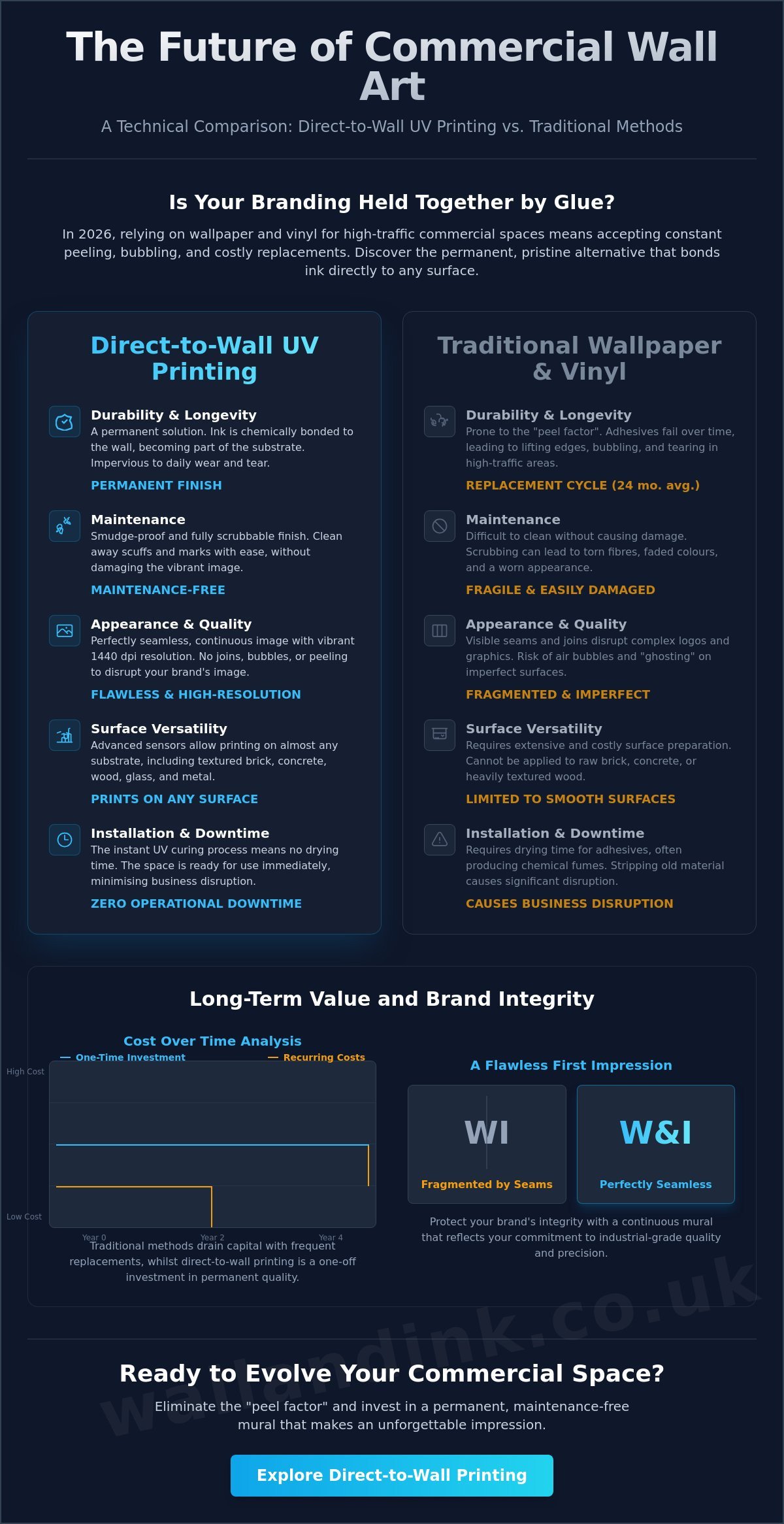
Direct-to-Wall vs Wallpaper: A Technical Comparison for 2026
Choosing the right medium for a custom mural for business premises requires a pragmatic assessment of durability and maintenance. Traditional wallpaper relies on paper fibres and surface-level dyes that inevitably fade when exposed to consistent UV light or harsh office lighting. Direct-to-wall printing utilises industrial UV inks that are cured into the substrate. This creates a bond that resists fading and mechanical wear far better than any paper-based alternative. The result is a finish that remains vibrant for years without the need for protective laminates or frequent touch-ups.
Cleanability is a primary differentiator in professional environments. Wallpaper is fragile; moisture or cleaning agents often cause the edges to lift or the ink to bleed. Direct-to-wall prints are scrubbable. You can remove scuffs and dirt using standard cleaning supplies without damaging the imagery. This technical resilience is essential for high-traffic corridors and reception areas. Furthermore, the installation speed offers a significant operational advantage. Traditional decorating involves days of preparation, pasting, and drying. Direct-to-wall printing is a rapid, automated process that transforms a space in hours, not days.
The aesthetic outcome also differs fundamentally. Wallpaper always looks “stuck-on,” often revealing its presence through slight thickness at the edges. Direct-to-wall printing provides a “painted-on” tactile finish that integrates with the architecture. It feels like part of the building rather than an after-thought applied to it.
The “No-Seam” Advantage for Brand Integrity
Brand integrity depends on precision. Traditional wall coverings are applied in strips, meaning complex corporate logos are often split across multiple joins. These seams are visual weak points that disrupt the flow of the design. Direct-to-wall technology allows for a continuous, uninterrupted print across 20+ metres of wall space. You won’t see any vertical lines or mismatched patterns. This method also eliminates the risk of “shrinkage gaps.” Whilst vinyl graphics often contract over time due to temperature changes, direct-to-wall ink remains stable, ensuring the mural looks as perfect in year five as it did on day one.
Health, Safety, and Environmental Standards
Modern commercial standards demand higher safety profiles. Traditional adhesives and solvent-based inks often emit strong odours that can linger for weeks. Our UV-cured inks are virtually odourless, making them suitable for immediate occupancy. Fire safety is another critical factor. Whilst traditional wallpaper can contribute to flame spread, direct-to-wall ink is applied thinly to non-flammable substrates, often helping premises maintain Class A fire ratings. The process is also significantly more sustainable. There is no backing paper to discard, no adhesive tubs to recycle, and zero off-cut waste. It’s a precise application that uses only the exact amount of ink required for the design.
Strategic Applications: Transforming Offices, Retail, and Schools
A custom mural for business premises serves as more than just an aesthetic upgrade. It’s a strategic tool for communication and spatial management. In corporate environments, these installations translate abstract core values into permanent visual landmarks. This isn’t about temporary posters or fragile vinyl. It’s about integrating brand identity directly into the architectural fabric of the building. This permanent approach ensures that your messaging remains as professional as your operations.
Retailers and hospitality venues use this technology to create “Instagrammable” feature walls that drive footfall and social media engagement. Unlike traditional redecoration, our process is clean and rapid. Restaurants and bars can update their atmosphere without the mess of paste or the smell of solvents, ensuring the venue remains operational throughout the process. It’s a pragmatic solution for businesses that can’t afford the downtime of traditional decorating cycles.
Branding and Wayfinding for Professional Services
High-resolution graphics help guide clients through complex floorplans. Reception areas can feature detailed company history timelines that establish authority from the moment a visitor enters. These installations provide a sense of permanence and scale that smaller, framed art cannot match. Beyond the visual impact, custom murals can improve office acoustics by breaking up large, flat surfaces that would otherwise reflect sound waves. This reduces the “echo” effect often found in open-plan spaces, contributing to a more focused working environment.
High-Traffic Durability for Public Spaces
In educational and healthcare settings, durability is the primary requirement. Schools specifically prefer UV printing because it prevents students from peeling or picking at the graphics, which is the most common failure point for vinyl decals. The ink is cured directly into the surface, making it virtually tamper-proof in busy corridors. In healthcare settings, the resistance of UV ink to aggressive cleaning chemicals is a critical advantage. You can maintain hygiene standards without degrading the artwork.
The application isn’t limited to interiors. Exterior wall printing allows for branding facades and outdoor seating areas, using weather-resistant inks that bond to brick and render. To see how these applications can be tailored to your specific sector, view our range of commercial wall murals.
Planning Your Custom Mural: From Digital Visualisation to Installation
The successful execution of a custom mural for business premises begins with a methodical technical assessment. We identify the specific substrate properties and environmental conditions of your wall before any printing commences. This consultation phase ensures that the chosen surface is structurally sound and ready for high-precision UV application. We evaluate factors like moisture levels and surface temperature to guarantee the longevity of the ink bond. This industrial approach removes the guesswork often associated with traditional decorating.
Precision printing requires high-fidelity data. We manage the transition from digital file to physical wall by optimising vector logos and high-resolution raster images for large-scale output. This technical preparation ensures that gradients are smooth and lines remain crisp, even when viewed from a distance of just a few centimetres. We handle the complex CMYK+W colour separation required to make your brand assets stand out on any background, ensuring total brand consistency.
The Importance of Digital Mock-ups
Scale is often the most misunderstood element of commercial design. Digital visualisation allows you to see the artwork in situ, providing a realistic representation of how the mural interacts with furniture, lighting, and architectural features. This step prevents “scale shock” and allows for the adjustment of colour profiles to match the specific Kelvin temperature of your office lighting. It’s a pragmatic way to secure stakeholder approval before the final installation. Our process includes transparent bespoke design and digital visualisation fees to ensure you understand every technical step of the journey.
The Installation Day: Zero Mess, Maximum Impact
Traditional redecoration is messy and time-consuming. Our direct-to-wall printing system uses a compact vertical track that requires minimal floor clearance. This small footprint means we can work in narrow corridors or busy reception areas without blocking access or creating a safety hazard. There are no adhesive tubs, no backing papers to discard, and zero off-cut waste to manage. You won’t find any of the typical hassles associated with wallpaper or vinyl.
The “print and walk away” benefit is a significant advantage for operational managers. The UV ink cures instantly under the print head, removing the need for drying time or cordoned-off areas. Once the machine finishes its pass, the custom mural for business premises is fully durable and ready for the daily rigours of a professional environment. Final quality checks ensure the ink density and alignment meet our industrial standards for precision. Ready to transform your workspace? Contact Wall & Ink for a bespoke consultation.
Future-Proof Your Commercial Space with Industrial Precision
The evolution of commercial branding demands a shift from fragile paper to industrial-grade precision. By choosing a custom mural for business premises applied via direct-to-wall UV technology, you eliminate the recurring costs and maintenance hassles of traditional vinyl and wallpaper. You gain a permanent solution that remains vibrant for over 10 years thanks to our UV-stable inks. Every project includes full digital visualisation. This ensures your brand assets are positioned with millimetre-perfect accuracy before the first drop of ink touches the wall.
This technology handles the physical reality of your building. Whether you need to print on raw brick, industrial glass, or reclaimed wood, the process remains clean, rapid, and precise. It’s time to move beyond the limitations of legacy methods and embrace a branding solution designed for the rigours of 2026. Request a bespoke quote for your business mural and transform your environment today. We look forward to helping you define your space with clarity and confidence.
Frequently Asked Questions
Can you print a custom mural on any type of wall surface?
Yes, our technology prints directly onto almost any vertical substrate. This includes porous surfaces like brick, stone, and industrial concrete, as well as non-porous materials like glass, metal, and wood. Advanced sensors in the print head maintain a consistent distance from the wall, allowing the ink to follow natural textures whilst maintaining high-resolution image clarity. It’s a versatile solution for spaces where traditional adhesives would fail.
How long does a direct-to-wall mural last in a busy office?
Indoors, these murals are engineered to maintain their vibrance for over 10 years. The UV-cured ink is highly resistant to fading from both artificial office lighting and natural sunlight. Because the finish is scrubbable, you can clean away scuffs in high-traffic corridors using standard supplies without damaging the print. This durability makes a custom mural for business premises a superior long-term investment compared to fragile paper alternatives.
Is the ink used in wall printing safe for indoor environments?
The inks we utilise are entirely safe for all indoor environments. We use low-VOC, UV-cured inks that are virtually odourless upon application. Because the curing process is instantaneous under ultraviolet light, there are no lingering chemical fumes or drying times. This technical safety profile allows for immediate occupancy in sensitive environments like healthcare facilities, schools, and professional office suites without any air quality concerns.
How much does a custom mural for business premises cost?
Project costs are determined by the total square metreage and the specific substrate involved. We operate with a transparent pricing structure based on price-per-unit metrics, ensuring you only pay for the exact area printed. Factors such as surface texture and the requirement for white ink under-printing on dark walls will influence the final quote. We recommend a professional consultation to assess your specific site requirements and provide an accurate estimate.
How do I prepare my wall before the printing team arrives?
Preparation is minimal compared to legacy decorating methods. You must ensure the wall is clean, dry, and structurally sound. You don’t need to smooth out textures like brick or wood; however, any flaking paint or loose debris should be removed to ensure a permanent bond. We handle the technical file preparation and digital alignment, so your primary task is providing a clear workspace for our vertical track system.
Can the mural be removed or painted over if we rebrand?
You can easily paint over the mural if your branding evolves. The ink layer is extremely thin and integrates with the surface, so it doesn’t leave a raised profile or visible edges. Unlike vinyl or wallpaper, there’s no need for steaming, scraping, or adhesive removal. Simply apply two coats of a high-quality emulsion to return the wall to its original state or prepare it for a new design.
What is the maximum size for a direct-to-wall printed mural?
There is virtually no limit to the horizontal width of a print. Our modular track system allows for continuous printing across spans exceeding 20 metres without any visible seams or joins. Vertical height is managed through the adjustable mast of the printing unit, which can be configured for most standard commercial ceiling heights. This flexibility makes it possible to scale your custom mural for business premises to fit any architectural space.
How does wall printing compare to traditional hand-painted murals?
Digital printing provides a level of industrial precision and speed that hand-painting cannot replicate. We reproduce photorealistic imagery and complex gradients with up to 2880 dpi resolution, ensuring total brand consistency. Whilst a muralist might take days or weeks to complete a project, our automated system finishes the work in a fraction of the time. This reduces on-site labour costs and minimises the disruption to your daily business operations.