
Traditional wall coverings are a fundamental compromise that eventually fails the sheer scale of modern architectural spaces. If you’ve managed large-scale installations, you’re likely familiar with the frustration of visible seams or edges that peel in high-traffic corridors. These legacy methods weren’t designed for the demands of expansive surfaces. When sourcing custom murals for large walls UK specialists now look toward industrial-grade solutions that eliminate these technical failures entirely.
You need a result that combines aesthetic impact with mechanical durability. This article explains how the direct-to-wall revolution allows you to bypass wallpaper limitations through high-resolution UV printing applied directly to your substrate. We’ll examine the precision of this modern method and how it provides a seamless, bespoke finish for any dimension without the logistical burden of traditional installation processes. Discover how this technical shift ensures your art remains as permanent and resilient as the wall itself.
Key Takeaways
- Learn how UV ink technology bonds directly to various substrates to provide industrial-grade durability and high-resolution finishes that standard wall coverings cannot match.
- Compare the efficiency of direct-to-wall printing against traditional methods, focusing on reduced installation times and superior performance in high-traffic commercial zones.
- Identify the specific resolution and DPI requirements needed to produce custom murals for large walls UK without pixelation or loss of detail on expansive surfaces.
- Discover how to utilise digital mock-ups and high-resolution source imagery to ensure your bespoke art fits the exact architectural dimensions of your space.
- Gain insight into a professional, nationwide service that delivers precise, mess-free mural application for schools, retail centres, and private residences across the UK.
Defining Custom Murals for Large Walls: Beyond Traditional Wallpaper
Wall art has transitioned through several distinct technological eras. Historically, Mural techniques relied on hand-painted frescoes or labour-intensive oils applied directly to wet plaster. Today, the industry has moved towards industrial-grade digital UV printing. This evolution isn’t just about aesthetics; it’s about solving the unique mechanical challenges posed by expansive architectural surfaces. When specifying custom murals for large walls UK projects often encounter the “large wall problem.” This is where standard image files and consumer-grade materials fail to maintain clarity or structural integrity over five or ten metres of surface area.
Large-scale projects demand a technical approach that accounts for both viewing distance and substrate stability. A low-resolution file stretched across a warehouse wall results in visible pixelation. Conversely, heavy vinyl can sag under its own weight over time. Direct-to-wall printing solves this by applying ink directly onto the substrate. This creates a permanent bond that doesn’t rely on external carriers like paper or plastic. It’s a precise, mechanical application that treats the wall as the canvas rather than a backing for a sticker.
The Limitations of Traditional Wallpaper Murals
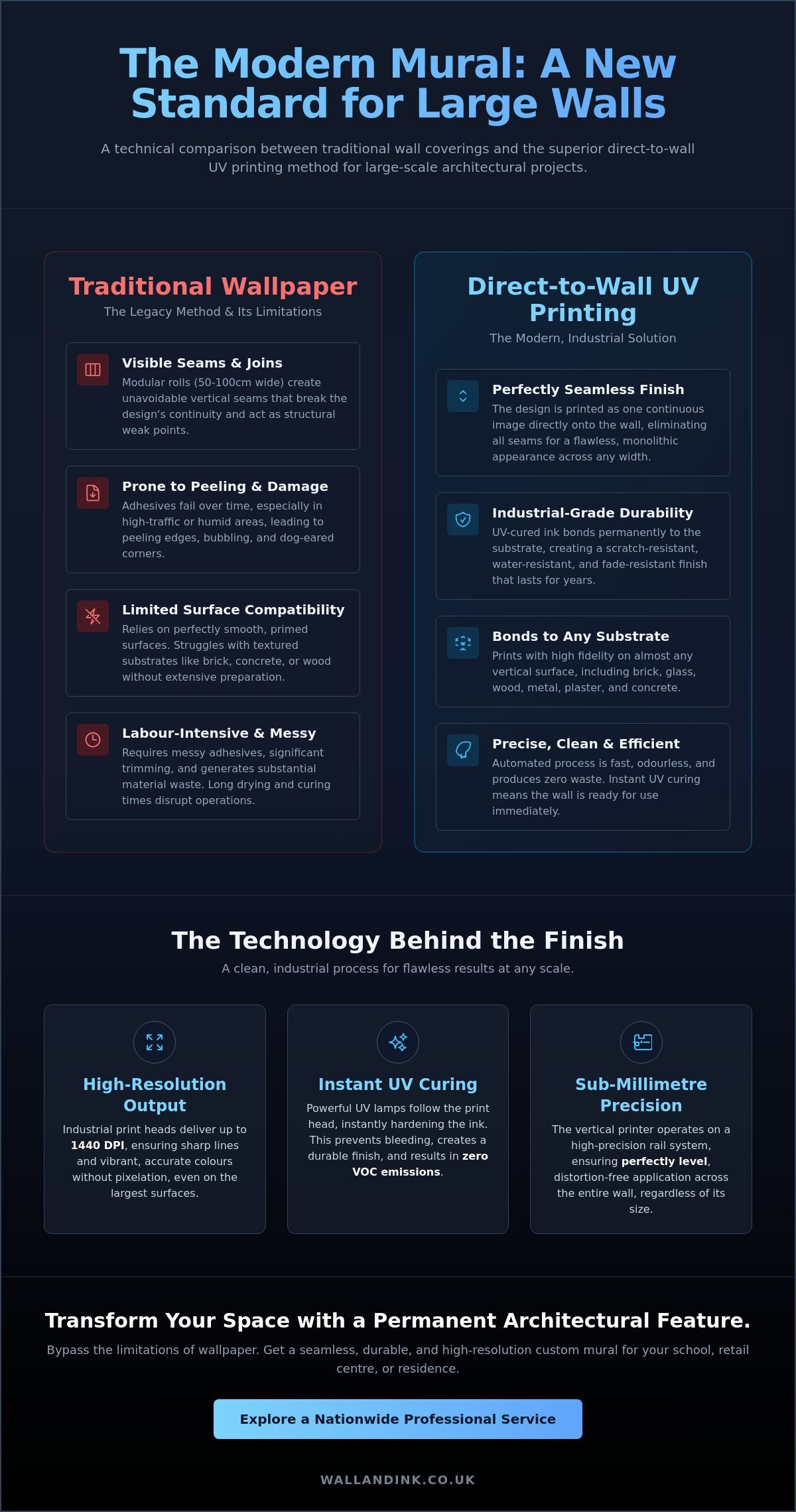
Wallpaper is inherently modular. It arrives in rolls, usually between 50cm and 100cm wide. This means every large installation contains vertical seams that break the visual continuity of the design. In high-traffic commercial environments, these seams are structural weak points. Adhesives can dry out or fail in humid conditions, which leads to peeling edges and dog-eared corners. There’s also the issue of material waste. Traditional wallpaper requires significant overlapping and trimming, creating offcuts that are rarely recyclable and contribute to environmental overhead.
Why Direct-to-Wall Printing is the Modern Alternative
Direct-to-wall application removes the middleman. By using a specialised vertical printer, the design is applied as a continuous, seamless layer of ink across any width. The process uses UV-cured inks that dry instantly under ultraviolet lamps. This method ensures zero VOC emissions and immediate durability. There’s no drying time and no lingering chemical smell. This technology is versatile enough to bond with almost any surface, including brick, glass, wood, and polished plaster. It’s a clean, industrial solution for decision-makers who value long-term reliability over temporary fixes. It turns custom murals for large walls UK into a permanent architectural feature rather than a temporary decoration.
The Technology Behind High-Resolution Direct-to-Wall Printing
The transition from manual application to automated systems relies on advanced digital fabrication technologies that treat the wall as a live substrate rather than a static background. This industrial process involves a specialised vertical printer mounted on a high-precision rail system. By utilising these mechanical tracks, the print head maintains sub-millimetre accuracy across the entire vertical plane. This level of precision is critical when producing custom murals for large walls UK installations where even a minor misalignment would be magnified over an expansive area. The result is a perfectly level, distortion-free reproduction of the original design.
Resolution requirements change when art spans five metres or more. Standard consumer prints often fail at this scale, but industrial wall printers deliver high-resolution output up to 1440 dpi. This ensures that fine lines, complex gradients, and brand-specific colours remain sharp even when viewed from a close distance. Colour accuracy is managed through sophisticated software that translates digital palettes into physical ink drops with total consistency. It’s a reliable method for professional environments where corporate identity and visual impact are non-negotiable.
UV Curing: The Secret to Instant Durability
Direct-to-wall printing employs a specific chemical process known as UV curing. As the print head moves across the surface, powerful ultraviolet lamps follow immediately behind, “freezing” the ink the moment it touches the substrate. This instant curing prevents the ink from bleeding or running, which is particularly important on non-porous surfaces like glass or polished wood. Because the ink is hardened instantly, the finished mural is scratch-resistant and wipe-clean from day one. This durability ensures that indoor installations can last 10 years or more without fading or losing their mechanical bond to the wall.
Adapting to Architectural Features
Modern wall printers are equipped with integrated laser sensors that constantly scan the wall’s topography. These sensors detect obstacles such as light switches, sockets, and window frames in real-time, allowing the machine to pause or adjust its path with total safety. This technology also manages surface irregularities. Whether the substrate is smooth plaster or textured brick, the sensors maintain a consistent distance between the print head and the wall to ensure image integrity. If you’re planning a complex project, you can view our technical specifications to see how this precision equipment handles your specific site requirements. This ability to print directly into “dead zones” near skirting boards or corners makes it a far more versatile option than traditional framed art or vinyl alternatives.
Comparing Mural Methods: Why Direct-to-Wall Wins on Large Surfaces
Traditional mural installation is typically a multi-day logistical challenge involving scaffolding, manual labour, and significant site preparation. However, Digital fabrication has redefined these timelines, shifting the focus from manual application to mechanical precision. For project managers commissioning custom murals for large walls UK wide, the choice of method determines not just the initial visual impact, but the long-term maintenance overhead of the facility. Direct-to-wall systems provide a level of industrial reliability that legacy alternatives cannot match.
The efficiency of this modern method is most evident when comparing installation windows. Whilst a hand-painted or wallpapered mural might take several days to complete and dry, a direct-to-wall print is often finished in a matter of hours. This speed does not come at the cost of quality; it’s the result of a streamlined, automated process that eliminates the variables of human error and material drying times.
Wallpaper vs. Vinyl vs. Direct Printing
Wallpaper is often the default choice for large-scale graphics, yet it remains the most fragile. It’s prone to seam-splitting and adhesive failure, especially in areas with fluctuating temperatures or humidity. Vinyl offers a faster application but frequently results in “bubbling” and a synthetic, plastic-like finish that lacks architectural integration. Direct-to-wall printing removes these material carriers entirely. By bonding UV-cured ink directly to the substrate, the art becomes an integral part of the wall itself, providing a premium, permanent finish that withstands the rigours of high-traffic commercial environments.
The ‘Cleanliness’ Factor in UK Commercial Spaces
Hygiene is a primary concern in sectors like healthcare, hospitality, and education. Traditional murals with physical edges or seams provide micro-crevices where bacteria and dust can accumulate. Direct printing is perfectly flat. It has no seams, no overlaps, and no raised edges, making it fully compatible with heavy-duty commercial cleaning protocols and chemical wipe-downs.
The installation process is equally clean. Unlike wallpapering, there’s no paste, no water, and no sticky residue left on-site. The printer operates quietly and produces zero VOC emissions, allowing businesses to remain operational whilst the mural is being applied. If you need to rebrand or update the space in the future, the mural can simply be painted over with standard emulsion. There’s no need for scraping or chemical stripping, which makes the long-term cost-benefit profile significantly more attractive for pragmatic decision-makers who value efficiency and cleanliness.
Designing for Scale: How to Visualise and Prepare Your Mural Project
Success in large-scale wall art is determined long before the printer arrives on site. Designing custom murals for large walls UK projects requires a methodical approach to spatial planning and technical file preparation. Because the art often spans ten metres or more, any oversight in the design phase is magnified once applied to the substrate. Professional preparation ensures that the final result aligns perfectly with your brand identity and architectural environment.
Surface integrity is the first technical requirement. The wall must be structurally sound, dry, and free from flaking paint or contaminants. Whilst our UV inks bond to almost any substrate, a smooth, neutral-coloured surface provides the most accurate colour reproduction and finest detail. If the wall has significant texture, such as bare brick, the design composition should account for how shadows and highlights will interact with the physical topography of the surface.
The Role of Digital Visualisation
We move beyond basic “upload and preview” tools by using site-specific photography to create an accurate digital mock-up of your space. This process allows you to see the art in situ, accounting for furniture placement, lighting conditions, and architectural breaks like doorways or pillars. It’s an iterative process. We refine the composition to ensure that key visual elements aren’t obscured by office equipment or structural features. This transparency ensures that pragmatic decision-makers can approve the project with total confidence in the aesthetic outcome.
Technical File Requirements for Large Walls
The choice between vector and raster formats is critical for massive scales. Vector files are the industrial standard for branding, logos, and geometric designs because they scale infinitely without any loss of resolution. For photographic murals, high-resolution raster files are essential. We evaluate every file to ensure it meets the necessary pixel density for the intended viewing distance. For a mural intended to be viewed from a distance of 2 metres, the source file should ideally maintain a resolution of 150 DPI at the final print size to ensure total clarity.
Colour matching is equally precise. We use specialised software to ensure that corporate colours are reproduced with exact consistency across the entire wall. To ensure your design meets these technical standards, you can start your project consultation with our design team. This professional oversight eliminates the risk of pixelation or colour shifts, providing a result that is as sharp as a digital screen but integrated into your physical architecture.
Bespoke Wall Printing Services: Professional Installation Across the UK
High-value architectural projects require more than just a delivered product; they require a managed technical execution. Unlike postal services that ship rolls of paper and leave the complex application to the client, our approach is built on a full-service model. Delivering custom murals for large walls UK wide requires a mobile infrastructure capable of handling diverse site conditions and substrates. We provide an end-to-end service that bridges the gap between digital design and physical installation, ensuring the final output matches the industrial precision of our UV printing technology.
This professional execution is applied across multiple high-stakes environments. In corporate headquarters, we provide branding that is permanently integrated into the workspace. In educational centres, we deliver murals that serve as durable learning tools. For the retail and hospitality sectors, our graphics provide a high-resolution finish that withstands heavy footfall and frequent cleaning. We operate as a reliable partner for pragmatic decision-makers who value efficiency and the elimination of traditional decorating hassles.
Our National UK Service Standards
Our technicians are specialised operators who handle the entire technical setup on-site. This involves more than just starting a machine; it includes the precise calibration of the vertical rail system and the constant monitoring of the UV curing process. We maintain strict quality control throughout the print, checking every square centimetre for colour consistency and mechanical perfection. Once the installation is complete, our team provides specific guidance on maintaining the mural to ensure it remains a permanent feature of your architecture. This level of oversight is why professional execution is essential for large-scale projects where the cost of failure is high.
Transforming Your Space Today
The journey from a blank surface to a finished mural is designed to be logical and transparent. We don’t hide behind complex consultation requirements. Instead, we lead with a straightforward process that respects your time and project deadlines. To begin, we require basic site measurements, a few photographs of the wall, and your initial design concepts. Our team then handles the digital preparation and spatial visualisation to ensure the art fits your exact dimensions.
Our timescales are built for the modern business world. Because direct-to-wall printing eliminates the need for drying times and multiple site visits, we can often move from a finalised concept to a completed custom murals for large walls UK project in record time. This efficiency ensures minimal disruption to your daily operations whilst providing a result that is far superior to legacy wallpaper or vinyl. If you are ready to bypass the limitations of traditional methods, you can start your large-scale mural project with Wall & Ink today. We bring advanced UV technology directly to your substrate, anywhere in the UK.
Scaling Your Vision with Industrial Precision
Transitioning from traditional methods to digital application is a strategic choice for high-traffic environments. You’ve seen how direct-to-wall technology solves the chronic failures of wallpaper and vinyl by eliminating seams and adhesive issues entirely. By bonding ink directly to the substrate, you achieve a seamless, high-resolution finish that remains resilient for years. This industrial-grade approach ensures that your branding or bespoke art is perfectly integrated into the architecture of your space without the logistical burden of traditional decorating.
When commissioning custom murals for large walls UK wide, professional execution is the only way to guarantee a result that matches your exact technical specifications. Our advanced UV-cured ink technology and full national installation service provide a reliable, mess-free alternative to legacy processes. You can now request a bespoke quote for your large-scale mural project to begin your transformation. Modernising your expansive surfaces into high-impact, durable assets is a logical step for any professional environment.
Frequently Asked Questions
Can you print custom murals on textured walls like brick or concrete?
Yes, direct-to-wall printing is fully compatible with textured substrates including brick, concrete, and breeze blocks. The printer utilises integrated laser sensors to scan the wall’s topography in real-time, adjusting the print head to maintain a consistent distance from the surface. This ensures the design remains sharp and distortion-free, even on irregular architectural features.
How long does a large-scale direct-to-wall mural last?
Indoors, these murals typically last ten years or more without fading or losing their mechanical bond to the wall. The UV-cured inks are hardened instantly during the application process, creating a scratch-resistant finish that is far more durable than traditional paper. This longevity makes them a reliable choice for custom murals for large walls UK projects in high-traffic environments.
Is direct-to-wall printing more expensive than high-end wallpaper?
The total value is often superior to high-end wallpaper when you consider the reduction in installation time and long-term maintenance. You bypass the costs associated with multi-day labour, specialised adhesives, and the eventual repair of peeling seams. Direct printing provides an industrial-grade finish that doesn’t require the frequent replacements common with paper-based products.
What happens if I want to change the design or remove the mural later?
You can update your space by simply painting over the existing mural with two coats of standard emulsion. Unlike wallpaper or vinyl, there’s no need for steaming, scraping, or chemical stripping that could damage the plaster. This makes rebranding a clean and straightforward process that fits the needs of evolving commercial spaces.
Do I need to prepare the wall in a special way before you arrive?
The wall must be clean, dry, and structurally sound with no flaking paint or loose material. A neutral or white base coat is recommended to ensure the most accurate colour reproduction from the UV inks. Filling any significant holes or cracks beforehand provides a uniform canvas that allows the print head to operate with maximum precision.
Is the ink used in wall printing safe for schools and hospitals?
Our UV-cured inks are entirely safe for use in sensitive environments such as classrooms and healthcare wards. They produce zero VOC emissions and are cured instantly by ultraviolet lamps, meaning there’s no drying time and no chemical odour. The finished surface is perfectly flat and can be cleaned with standard hospital-grade disinfectants without damaging the art.
What is the maximum size of wall you can print on?
We can print to an unlimited width by extending the precision rail system across the entire length of the wall. Whilst vertical height is governed by the reach of the machine’s mast, we can manage expansive surfaces through modular setups. This flexibility allows us to deliver custom murals for large walls UK that fit the exact architectural dimensions of warehouses, halls, and offices.
Can you print photos as well as graphic designs on large walls?
Both high-resolution photography and vector graphics can be reproduced with total clarity at any scale. The printer achieves an industrial resolution of up to 1440 dpi, ensuring that fine photographic details and gradients remain sharp even when viewed from a close distance. This technology allows for the seamless integration of complex fine art and brand-specific imagery onto any substrate.